

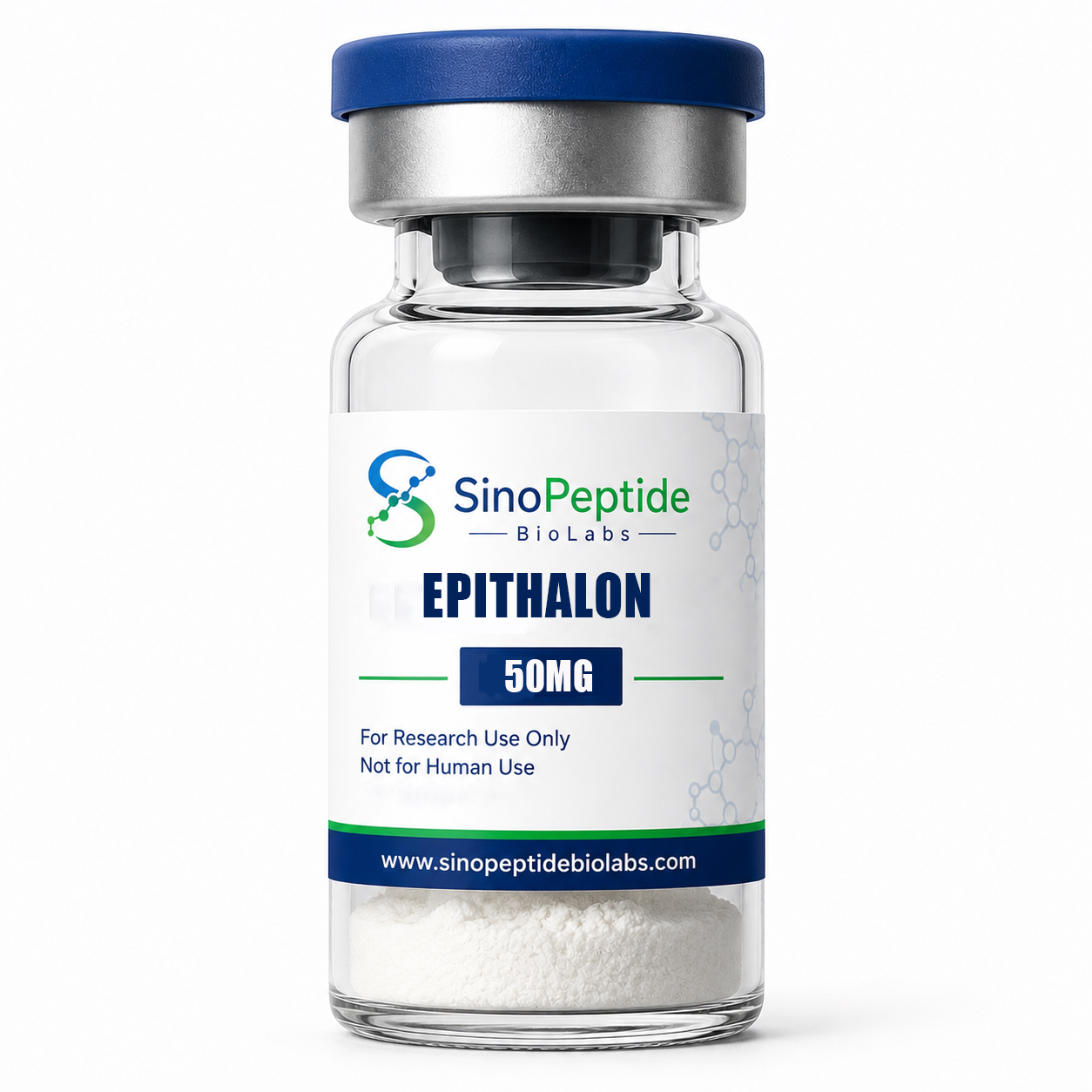
Epithalon 50mg
$130.00
10 Vials/ Kits
Epithalon 50mg: Benefits, Mechanism, Anti-Aging Research, Safety & Uses
Introduction to Epithalon 50mg
Epithalon 50mg is a peptide product containing Epithalon, also commonly spelled Epitalon. Epithalon is a synthetic tetrapeptide composed of four amino acids and has attracted scientific interest because of research involving cellular aging, telomerase activity, telomere biology, circadian regulation, and age-related physiological processes.
The peptide is particularly well known in the longevity-research community because laboratory studies have investigated whether Epithalon can influence cellular mechanisms associated with replicative aging. One human-cell study reported that Epithalon induced telomerase activity and telomere elongation in cultured human fibroblasts.
More recent research has continued investigating these mechanisms. A 2025 paper examined Epithalon’s effects on telomere length, hTERT expression, telomerase activity, and alternative lengthening of telomeres in several human cell lines. The paper was subsequently accompanied by a correction, which is important context when interpreting the findings.
Historical human research has also investigated related pineal peptide preparations such as Epithalamin, including studies involving elderly populations and circadian melatonin production. However, Epithalamin is not necessarily identical to purified synthetic Epithalon, so findings from those studies should not automatically be attributed to an Epithalon 50mg product.
Current regulatory information is particularly important. FDA’s 2026 materials state that it identified no clinical data supporting the safety of epitalon and no safety-related information sufficient to establish whether the substance could cause harm when administered to humans by the proposed subcutaneous route. FDA also identified potential immunogenicity concerns associated with aggregation and peptide-related impurities.
This article provides an evidence-based overview of Epithalon 50mg, including its scientific background, proposed mechanisms, telomere research, longevity research, potential applications, safety considerations, regulatory status, product-quality considerations, and frequently asked questions.
What Is Epithalon?
Epithalon, also written as Epitalon, is a synthetic tetrapeptide consisting of four amino acids:
Ala-Glu-Asp-Gly
Its molecular structure has made it an interesting subject for research into cellular aging and biological regulation.
FDA’s Substance Registration System identifies Epitalon as an ingredient substance and lists Epithalon as a synonym. However, FDA explicitly notes that the presence of a substance in the database does not mean that it has undergone regulatory review or approval.
Epithalon is frequently discussed in connection with the pineal gland and the peptide preparation Epithalamin. These terms should not automatically be treated as interchangeable.
This distinction is important for accurate SEO content because many online pages combine research involving:
- Epithalon
- Epitalon
- Epithalamin
- Pineal gland extracts
- Synthetic peptide preparations
without clearly identifying the substance that was actually studied.
For a product specifically labeled Epithalon 50mg, the product description should identify the exact compound rather than relying on broad references to pineal peptide research.
What Does the 50mg Label Mean?
The term 50mg in Epithalon 50mg refers to the labeled quantity of peptide in the product.
It should not automatically be interpreted as a recommended clinical dose.
This distinction is especially important for research peptides because experimental studies may use different concentrations, administration methods, formulations, and research protocols.
Therefore, Epithalon 50mg means a product labeled with a total quantity of 50 milligrams. It does not establish:
- A standard therapeutic dose
- A medically recommended dose
- A proven longevity protocol
- A validated anti-aging treatment
- A universally appropriate amount for human administration
A responsible product page should distinguish the amount contained in the product from any dosing protocol.
Epithalon and Anti-Aging Research
Epithalon is most commonly associated with aging research.
The interest comes from several interconnected areas of biology, including:
- Telomere biology
- Telomerase activity
- Cellular senescence
- Replicative lifespan
- Circadian regulation
- Pineal function
- Melatonin-related physiology
- Age-associated cellular changes
Researchers have investigated whether Epithalon can influence some of these pathways.
However, it is essential to distinguish between cellular or experimental findings and demonstrated benefits in humans.
For example, laboratory studies have reported changes in telomerase activity and telomere length in cultured human cells. Such findings are scientifically interesting but do not demonstrate that administering Epithalon to a person will extend lifespan or prevent age-related disease.
This distinction is critical when creating medically responsible SEO content.
Epithalon and Telomerase
One of the most frequently discussed mechanisms associated with Epithalon is its potential relationship with telomerase.
Telomerase is an enzyme involved in maintaining telomere length.
Telomeres are protective structures located at the ends of chromosomes. Their biology is closely associated with cellular replication and aging.
A landmark laboratory study investigated Epithalon in telomerase-negative human fetal fibroblasts. Researchers reported that Epithalon induced expression of the catalytic component of telomerase, increased telomerase activity, and was associated with telomere elongation.
This finding helped generate substantial interest in Epithalon as a research compound.
However, a cellular experiment is not equivalent to a clinical trial.
The study demonstrated a biological effect in cultured cells. It did not establish that Epithalon:
- Extends human lifespan
- Prevents cancer
- Reverses biological aging
- Prevents age-related disease
- Improves human healthspan
Those claims require substantially stronger clinical evidence.
Epithalon and Telomere Research
Telomeres are among the most frequently discussed subjects in Epithalon research.
A 2004 study investigated the effects of Epithalon on human somatic cells and reported telomere elongation alongside increased telomerase activity. The investigators also reported that treated cells underwent additional divisions compared with controls.
More recently, research published in Biogerontology examined Epithalon’s effects in several human cell lines, including changes in telomere length, hTERT messenger RNA expression, telomerase activity, and alternative lengthening of telomeres.
The research is relevant to cellular-aging science, but it should be interpreted carefully.
Telomere length is not a simple measure of overall human aging
Human aging involves numerous biological systems, including:
- DNA damage
- Epigenetic changes
- Mitochondrial function
- Cellular senescence
- Immune aging
- Protein homeostasis
- Metabolic regulation
- Stem-cell function
- Chronic inflammation
Consequently, changing telomere length in a laboratory cell model does not establish that the intervention reverses biological aging in humans.
Epithalon and Cellular Aging
Cellular aging is a complex biological process.
As cells undergo repeated replication, various changes can occur, including alterations in telomere length and the development of cellular senescence.
Epithalon has been investigated as a potential modulator of cellular processes associated with replicative aging.
In laboratory experiments, researchers observed that Epithalon-treated human fibroblasts could undergo additional cell divisions and exhibit changes in telomere characteristics.
These observations provide a basis for continued research.
They do not, however, establish that Epithalon is an anti-aging therapy for humans.
A useful SEO article should therefore use terminology such as:
“investigated for its potential role in cellular aging”
rather than:
“proven to reverse aging.”
That distinction improves both scientific accuracy and the credibility of the page.
Epithalon and Longevity Research
The terms Epithalon longevity and Epitalon lifespan extension are popular search phrases.
Historical research involving pineal peptide preparations has reported potentially favorable findings in elderly populations.
For example, a 2007 publication described a 12-year randomized clinical study of Epithalamin, a pineal gland peptide preparation, in elderly patients with coronary disease and accelerated cardiovascular aging. The authors reported lower mortality and improvements in several measures among treated participants.
Another publication described a long-term observational follow-up involving peptide preparations from the pineal gland and thymus in elderly people and reported lower mortality among treatment groups.
These studies are historically interesting, but they should not be presented as definitive proof that synthetic Epithalon 50mg extends human lifespan.
There are several reasons:
- Epithalamin and Epithalon are not automatically identical.
- The studies were conducted using particular peptide preparations and protocols.
- Modern clinical standards and trial methodologies may differ.
- Independent replication is limited.
- Current FDA materials state that clinical safety data for epitalon are insufficient.
Therefore, claims of proven human lifespan extension would go beyond the available evidence.
Epithalon and Circadian Rhythm Research
Another area of interest involves circadian biology.
The pineal gland plays an important role in the body’s circadian system, particularly through melatonin production.
Historical research involving Epithalamin examined melatonin rhythms in elderly individuals.
One study reported that treatment with Epithalamin altered the circadian pattern of plasma melatonin in elderly subjects, particularly among people whose pineal melatonin activity was initially reduced.
These findings provide a possible connection between pineal peptide research and circadian regulation.
However, once again, findings involving Epithalamin should not automatically be described as clinical evidence for Epithalon 50mg.
Epithalon and Melatonin
Melatonin is a hormone primarily associated with regulation of the sleep-wake cycle.
Because historical pineal peptide research has examined melatonin rhythms, Epithalon is sometimes marketed online as a compound that improves melatonin production or sleep.
The scientific picture is more complicated.
Research involving Epithalamin reported modulation of melatonin-producing function in elderly individuals.
However, this does not establish that Epithalon 50mg is a clinically proven treatment for:
- Insomnia
- Circadian rhythm disorders
- Jet lag
- Sleep deprivation
- Delayed sleep phase
Current FDA materials specifically note that approved therapies for insomnia exist and that there is no clinical safety data supporting epitalon.
Therefore, sleep-related claims should be presented as research questions rather than established therapeutic outcomes.
Potential Epithalon Benefits: What Does Research Actually Show?
Searches for Epithalon benefits often return claims involving longevity, telomeres, sleep, immunity, energy, and anti-aging.
The evidence should be separated into different levels.
1. Cellular Aging Research
Epithalon has demonstrated biological effects in cultured human cells, including changes in telomerase activity and telomere length.
This is one of the strongest reasons for continued laboratory investigation.
2. Telomere Research
Studies have investigated whether Epithalon can influence telomere maintenance and elongation.
The results are relevant to molecular aging research but do not establish clinical longevity benefits.
3. Circadian Research
Related pineal peptide research has investigated melatonin rhythms and circadian regulation.
4. Aging Research
Historical studies involving Epithalamin and other peptide preparations have reported physiological changes in elderly populations.
However, these studies should not be treated as definitive evidence for Epithalon 50mg.
5. Longevity Research
Epithalon remains an experimental subject in longevity research.
There is currently insufficient evidence to conclude that Epithalon extends human lifespan.
Epithalon 50mg Safety Considerations
Safety is one of the most important considerations when evaluating Epithalon.
FDA’s current information is particularly relevant.
In its 2026 review, FDA stated that there was no clinical data to support the safety of epitalon. The agency also stated that it had not identified safety information regarding epitalon-related bulk drug substances administered to humans, particularly through the proposed subcutaneous route.
FDA additionally identified potential immunogenicity concerns related to peptide aggregation and peptide-related impurities.
This means that a responsible Epithalon 50mg product page should avoid statements such as:
- “Completely safe”
- “No side effects”
- “Clinically proven safe”
- “Safe for everyone”
- “FDA approved”
Such claims are not supported by current regulatory information.
Epithalon and Immunogenicity
Immunogenicity refers to the ability of a substance to trigger an immune response.
Peptides may potentially produce immune responses, particularly when manufacturing, aggregation, degradation, formulation, or impurity issues are present.
FDA specifically identified potential immunogenicity concerns for compounded epitalon for certain routes because of possible aggregation and peptide-related impurities.
This makes product quality especially important.
For research applications, documentation may include:
- Peptide identity
- Purity
- Batch information
- Analytical testing
- Manufacturing information
- Storage requirements
- Relevant quality-control testing
A product label alone does not establish that a peptide has been adequately characterized.
Epithalon 50mg and Product Quality
When evaluating a research peptide, the product itself should be considered separately from claims about the underlying molecule.
Certificate of Analysis
A Certificate of Analysis (COA) can provide batch-specific information about analytical testing.
A useful COA may identify:
- Product name
- Batch number
- Testing date
- Purity
- Identity
- Analytical method
- Testing laboratory
A COA is useful for assessing analytical documentation, but it does not prove clinical safety.
Peptide Identity
Identity testing helps confirm that the material corresponds to the intended peptide.
This is particularly important for products marketed under names such as:
- Epithalon
- Epitalon
- Epithalon acetate
- Epithalamin
These terms should not be used interchangeably without confirming the actual material.
Purity
Purity testing can provide information about detectable impurities in a sample.
However, purity alone does not establish:
- Sterility
- Endotoxin status
- Clinical safety
- Biological activity
- Long-term stability
Is Epithalon 50mg FDA Approved?
Epithalon 50mg should not be marketed as an FDA-approved drug.
FDA’s 2026 Pharmacy Compounding Advisory Committee materials specifically evaluated Epithalon free base and Epithalon acetate in the context of possible inclusion on the 503A Bulks List, with insomnia listed as the evaluated use.
The FDA’s supporting safety assessment states that no clinical data were identified to support the safety of epitalon and that available information was insufficient to determine whether the substance could cause harm when administered to humans through the proposed route.
FDA also maintains an orphan-drug database entry showing that Epitalon previously received an orphan designation for retinitis pigmentosa in 2010, but the designation was withdrawn or revoked and the product was not FDA approved for that orphan indication.
Therefore, a website should not describe Epithalon as:
- FDA-approved anti-aging therapy
- FDA-approved longevity treatment
- FDA-approved sleep treatment
- FDA-approved telomere therapy
Epithalon Research and Retinitis Pigmentosa
Epithalon has also appeared in the FDA orphan-designation database.
FDA records show that Epitalon received an orphan designation in 2010 for the treatment of retinitis pigmentosa. The record indicates that the designation was subsequently withdrawn or revoked and that Epitalon was not FDA approved for the orphan indication.
This is an important distinction.
An orphan designation is not the same as FDA approval.
Therefore, an SEO article should not use the historical designation to imply that Epithalon is an approved treatment for retinal disease.
Epithalon 50mg for Research
Epithalon may be of interest in several research fields.
Cellular Aging
Researchers can investigate how peptides influence cellular replication, senescence, and telomere biology.
Telomere Biology
Epithalon has been investigated for its effects on telomerase activity and telomere length in cultured cells.
Circadian Biology
Related pineal peptide research has examined melatonin production and circadian rhythms.
Longevity Research
Epithalon remains a subject of experimental gerontology research.
Molecular Biology
Researchers can examine effects on:
- hTERT expression
- Telomerase activity
- Telomere maintenance
- Cellular proliferation
- Aging-related pathways
Epithalon vs. Epithalamin
These names are often confused.
Epithalon/Epitalon is a synthetic tetrapeptide.
Epithalamin refers to a pineal gland peptide preparation studied in several historical clinical investigations.
Although the compounds are related conceptually through pineal peptide research, they should not automatically be treated as identical.
This distinction is particularly important when reviewing historical studies.
For example, studies reporting long-term outcomes with Epithalamin cannot automatically be presented as clinical trials of a modern Epithalon 50mg product.
Epithalon vs. Other Anti-Aging Peptides
Epithalon is one of many experimental peptides associated with longevity research.
Depending on the research question, other peptides may be investigated for:
- Cellular signaling
- Immune regulation
- Tissue repair
- Metabolic pathways
- Growth hormone pathways
- Neuroendocrine function
However, different peptides have different mechanisms and evidence bases.
A product page should therefore avoid describing Epithalon as universally superior to other research compounds.
Instead, explain the specific research question for which Epithalon has been investigated: particularly telomere biology, telomerase activity, cellular aging, and pineal/circadian research.
Epithalon 50mg and Longevity Claims
Longevity is one of the most commercially attractive subjects associated with Epithalon.
However, longevity claims require especially careful wording.
What laboratory research suggests
Cell studies have demonstrated changes in telomerase activity and telomere length following Epithalon exposure.
What historical human research suggests
Some studies involving related pineal peptide preparations have reported favorable outcomes in elderly populations.
What has not been established
There is insufficient modern clinical evidence to conclude that Epithalon:
- Extends human lifespan
- Reverses biological aging
- Prevents age-related disease
- Prevents cancer
- Produces measurable increases in human healthspan
Consequently, these should remain research hypotheses rather than product promises.
How to Evaluate an Epithalon 50mg Product
For legitimate research purposes, several factors can be considered.
1. Confirm the Compound
Verify whether the product contains Epithalon/Epitalon and identify whether it is a free-base or salt formulation.
2. Review Analytical Documentation
Look for batch-specific identity and purity information.
3. Check the COA
The certificate should correspond to the actual lot or batch being evaluated.
4. Review Manufacturer Information
Transparent information about manufacturing and quality control can make a research product easier to evaluate.
5. Avoid Unsupported Medical Claims
Claims about guaranteed longevity, disease prevention, or reversal of aging should not be treated as established scientific conclusions.
SEO Best Practices for an Epithalon 50mg Product Page
A page targeting Epithalon 50mg can capture multiple search intents by combining product information with educational research content.
Primary search intent
- Epithalon 50mg
- Epitalon 50mg
- Epithalon peptide
Scientific search intent
- What is Epithalon?
- How does Epithalon work?
- Epithalon telomerase
- Epithalon telomeres
- Epithalon longevity research
Safety search intent
- Is Epithalon safe?
- Epithalon side effects
- Is Epithalon FDA approved?
- Epithalon safety research
Research-product intent
- Epithalon research peptide
- Epithalon 50mg COA
- Epitalon research peptide
- Epithalon peptide purity
Using these topics naturally can create stronger topical relevance than repeating the exact keyword throughout every paragraph.
Secondary SEO Keywords for Epithalon 50mg
Use the following related keywords naturally throughout supporting content:
- Epithalon 50mg
- Epitalon 50mg
- Epithalon peptide
- Epitalon peptide
- Epithalon research
- Epithalon benefits
- Epithalon mechanism
- Epithalon telomeres
- Epithalon telomerase
- Epithalon anti-aging
- Epithalon longevity
- Epithalon sleep research
- Epithalon circadian rhythm
- Epithalon safety
- Epithalon side effects
- Epithalon FDA approval
- Epithalon FDA status
- Epitalon research peptide
- longevity peptide research
- telomere research peptide
- anti-aging peptide research
- Epithalon COA
- Epithalon purity
Frequently Asked Questions About Epithalon 50mg
What is Epithalon 50mg?
Epithalon 50mg is a product labeled as containing 50 milligrams of Epithalon, also known as Epitalon. It is an experimental peptide investigated primarily in cellular aging, telomere, telomerase, circadian, and longevity-related research.
What is Epithalon made of?
Epithalon is a tetrapeptide composed of four amino acids: alanine, glutamic acid, aspartic acid, and glycine.
Is Epithalon the same as Epitalon?
Yes. Epitalon is a commonly used spelling of the same peptide. FDA’s Substance Registration System lists Epitalon and Epithalon among the relevant names for the substance.
What does Epithalon do?
Research has investigated Epithalon’s potential effects on telomerase activity, telomere length, cellular replication, circadian biology, and aging-related pathways. Much of the mechanistic evidence comes from laboratory research rather than definitive human clinical trials.
Does Epithalon lengthen telomeres?
Laboratory studies have reported telomere elongation and increased telomerase activity in cultured human cells following Epithalon exposure. However, this does not establish that Epithalon lengthens telomeres in humans after administration.
Does Epithalon reverse aging?
There is currently insufficient clinical evidence to conclude that Epithalon reverses human aging. Cellular research is promising as a research direction but cannot be directly translated into proven anti-aging effects in people.
Is Epithalon FDA approved?
No. Current FDA materials do not establish Epithalon as an FDA-approved drug. FDA has specifically stated that there is no clinical data supporting the safety of epitalon in the context reviewed.
Is 50mg a recommended dose?
No. The 50mg designation identifies the quantity of material in the product. It should not automatically be interpreted as a recommended clinical dose.
Has Epithalon been studied in humans?
Related human research has examined pineal peptide preparations such as Epithalamin, while direct modern clinical safety evidence for Epithalon itself remains insufficient. FDA’s current review found no clinical studies assessing the safety of epitalon-related bulk drug substances administered to humans.
What is the relationship between Epithalon and telomerase?
Laboratory research has reported that Epithalon can increase telomerase activity and induce expression of the telomerase catalytic subunit in cultured human cells.
Is Epithalon a sleep peptide?
Epithalon has been investigated in connection with pineal function and circadian biology, and FDA’s 2026 review evaluated epitalon in the context of insomnia. However, this does not establish Epithalon as an approved or clinically proven insomnia treatment.
What should I look for in an Epithalon 50mg COA?
A batch-specific COA may provide information about peptide identity, purity, analytical methodology, testing date, and lot number. A COA should not be interpreted as proof of clinical safety or FDA approval.
Suggested Internal Links for Epithalon 50mg
To build a strong topical cluster around peptide research and longevity, consider linking this page to relevant educational content such as:
- DSIP 5mg
- Pinealon 20mg
- Thymalin 10mg
- Thymosin Alpha-1 10mg
- CJC-1295 No DAC 5mg
- CJC-1295 With DAC 5mg
- Peptide Research Guide
- Peptide Safety and Quality Guide
- Certificate of Analysis (COA) Guide
- Telomere and Cellular Aging Research
- Understanding Experimental Peptides
Use descriptive, contextually relevant anchor text rather than forcing exact-match keywords into every internal link.
Final Thoughts on Epithalon 50mg
Epithalon 50mg is an experimental peptide that has attracted attention because of research into cellular aging, telomerase activity, telomere biology, circadian regulation, and longevity.
Laboratory studies have reported notable effects on telomerase activity and telomere length in cultured human cells. More recent research has continued exploring the molecular mechanisms associated with Epithalon and telomere biology.
Historical human research involving related pineal peptide preparations such as Epithalamin has also reported changes in circadian melatonin production and various aging-related outcomes. However, these findings should not automatically be interpreted as clinical evidence for a modern Epithalon 50mg product.
The distinction between Epithalon and Epithalamin is particularly important. They are related within the history of pineal peptide research, but they should not be treated as interchangeable compounds without confirming what was actually administered in a particular study.
Current FDA information provides an additional reason for caution. FDA’s 2026 review states that there is no clinical data supporting the safety of epitalon and identifies potential immunogenicity concerns associated with peptide aggregation and peptide-related impurities for certain administration routes.
For SEO purposes, the most credible approach is therefore to describe Epithalon as a research peptide and accurately explain what laboratory and historical research has found, rather than presenting it as a proven anti-aging, longevity, telomere-extension, or sleep treatment.
A well-optimized Epithalon 50mg page should combine the primary product keyword with relevant semantic terms, explain the science in accessible language, distinguish laboratory findings from human clinical evidence, provide transparent regulatory information, and avoid unsupported medical promises.
This evidence-focused approach can make the content more useful to readers while also strengthening topical relevance, credibility, and long-term SEO value.
Medical and research disclaimer: This article is for educational and research-information purposes only. It does not constitute medical advice, diagnosis, or a recommendation to use Epithalon. Epithalon should not be represented as an FDA-approved anti-aging, longevity, sleep, or disease-treatment product. Anyone considering an experimental peptide for personal medical use should consult an appropriately qualified healthcare professional and comply with applicable laws and regulations.
Epithalon 50mg Epithalon 50mg Epithalon 50mg Epithalon 50mg Epithalon 50mg Epithalon 50mg Epithalon 50mg Epithalon 50mg Epithalon 50mg Epithalon 50mg Epithalon 50mg Epithalon 50mg Epithalon 50mg Epithalon 50mg Epithalon 50mg Epithalon 50mg Epithalon 50mg Epithalon 50mg Epithalon 50mg Epithalon 50mg Epithalon 50mg Epithalon 50mg Epithalon 50mg Epithalon 50mg
Be the first to review “Epithalon 50mg”
Related products
Pure Peptides
Pure Peptides
Pure Peptides
Pure Peptides
Pure Peptides
Pure Peptides
Pure Peptides
Pure Peptides
Reviews
There are no reviews yet.