
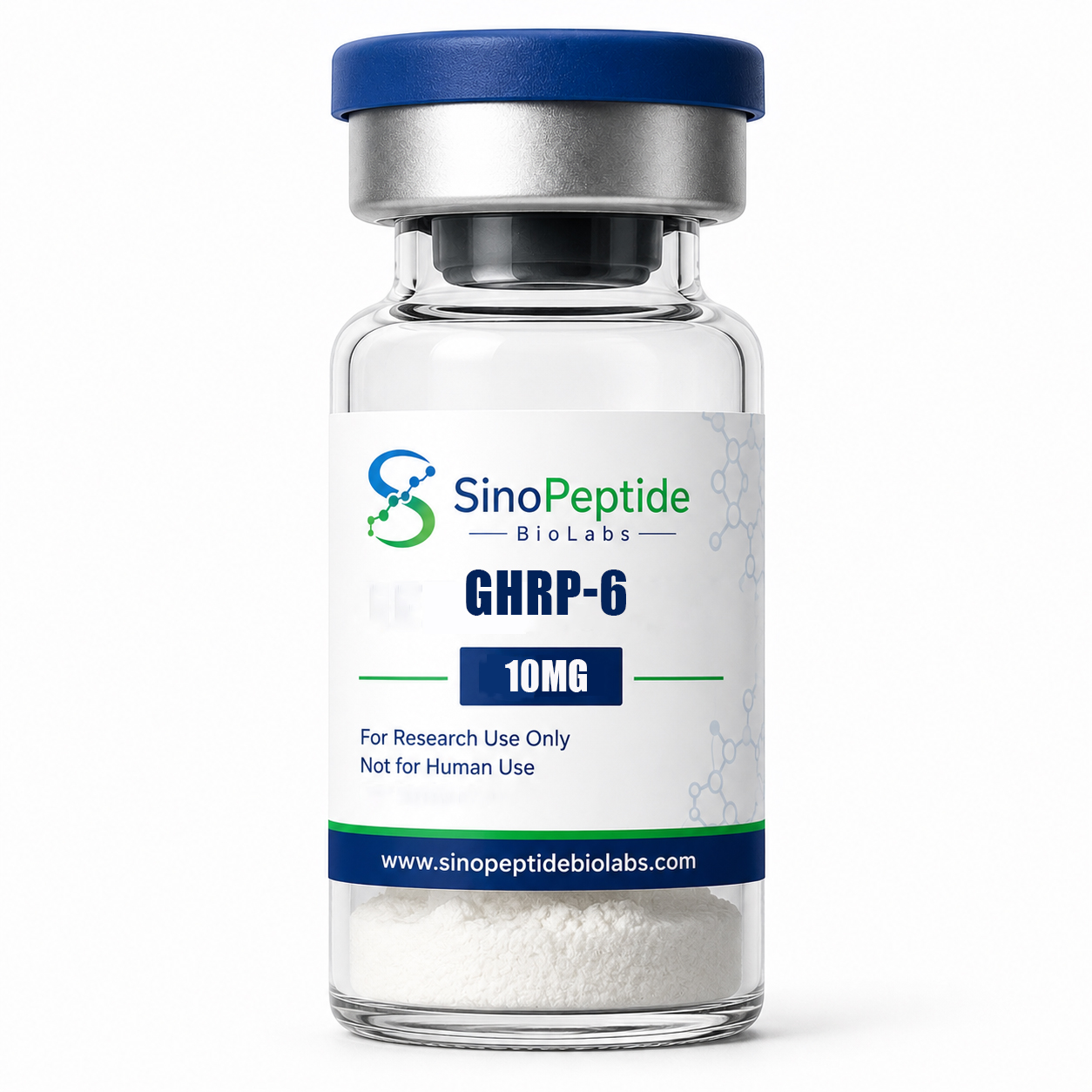
GHRP-6 Acetate 10mg
$48.00
10 Vials/ Kits
GHRP-6 Acetate 10mg: Complete Research Peptide Guide
GHRP-6 Acetate 10mg is a research peptide associated with studies involving growth hormone (GH) secretion, ghrelin-receptor signaling, appetite-related pathways, and metabolic research. As interest in peptide science continues to grow, GHRP-6 has become a commonly discussed compound in laboratory research focused on the mechanisms that regulate growth hormone and related physiological signaling.
This guide explains what GHRP-6 Acetate 10mg is, how it is studied, its proposed mechanism of action, research applications, quality considerations, storage, safety considerations, and frequently asked questions. The goal is to provide scientifically responsible information without confusing experimental research with approved medical treatment.
Research-use notice: GHRP-6 is an experimental research compound. Information about laboratory mechanisms or research findings should not be interpreted as instructions for human use, treatment, dosing, or administration. Products marketed for research should be handled only according to applicable laboratory and regulatory requirements.
What Is GHRP-6 Acetate 10mg?
GHRP-6 stands for Growth Hormone-Releasing Peptide-6. It is a synthetic peptide that has been investigated for its ability to influence growth hormone secretion through pathways associated with the growth hormone secretagogue receptor (GHS-R).
The term 10mg generally refers to the quantity of peptide contained in the product. The term acetate describes the salt form associated with the peptide formulation. Therefore, GHRP-6 Acetate 10mg should be understood as a product containing a specified quantity of GHRP-6 in acetate form.
GHRP-6 has attracted scientific interest because it provides researchers with a model for studying interactions between peptide signaling, ghrelin-related pathways, pituitary growth hormone secretion, appetite signaling, and metabolism.
Importantly, a research peptide should not automatically be considered equivalent to an approved pharmaceutical product. Product quality, formulation, sterility, intended use, and regulatory status can differ substantially between research materials and regulated medicines.
Understanding GHRP-6
GHRP-6 belongs to a class of synthetic growth hormone secretagogues. These compounds have historically been investigated because they can stimulate GH release through mechanisms that differ from administering growth hormone itself.
Research involving GHRP-6 has helped scientists investigate several interconnected biological systems, including:
- Growth hormone secretion
- Ghrelin-related signaling
- Growth hormone secretagogue receptor activity
- Pituitary signaling
- Hypothalamic regulation
- Appetite-related pathways
- Metabolic signaling
- Endocrine physiology
- Peptide-receptor interactions
Because these systems are interconnected, research on GHRP-6 is not limited to a single biological pathway.
How Does GHRP-6 Work?
One of the primary reasons GHRP-6 is studied is its interaction with the growth hormone secretagogue receptor, commonly referred to as GHS-R.
GHS-R is closely associated with ghrelin signaling. Ghrelin is a naturally occurring peptide hormone involved in several physiological processes, including regulation of appetite and growth hormone secretion.
GHRP-6 acts as a growth hormone secretagogue, meaning that it has been studied for its capacity to promote the release of endogenous growth hormone.
The simplified research pathway can be described as:
GHRP-6 → GHS-R-related signaling → pituitary signaling → increased GH secretion
The biological response is considerably more complex than this simplified model. Researchers also investigate how GHRP-6 interacts with other regulatory systems that influence GH secretion.
Growth Hormone Research
Growth hormone is produced by the anterior pituitary gland. Its secretion is regulated by a complex interaction involving the hypothalamus, pituitary gland, peripheral hormones, and metabolic signals.
GHRP-6 provides researchers with a tool for investigating this regulatory network.
Laboratory studies have historically examined how growth hormone secretagogues affect GH release under different experimental conditions.
Ghrelin-Related Research
GHRP-6 is particularly interesting because of its relationship with ghrelin receptor signaling.
Ghrelin is a naturally occurring hormone that participates in appetite regulation and endocrine signaling. The connection between ghrelin-related pathways and growth hormone secretion makes GHRP-6 useful for studying the relationship between appetite signaling and endocrine physiology.
This does not mean that GHRP-6 should be interpreted simply as a synthetic version of ghrelin. The pharmacology of synthetic secretagogues can differ from that of naturally occurring hormones.
GHRP-6 Acetate 10mg Research Applications
GHRP-6 Acetate 10mg may be encountered in laboratory and scientific research involving peptide signaling and endocrine biology.
1. Growth Hormone Secretion Research
A major research application involves examining mechanisms responsible for stimulating endogenous GH secretion.
Researchers can use growth hormone secretagogues as experimental tools to investigate:
- Pituitary GH release
- Secretagogue receptor activity
- Endocrine feedback mechanisms
- Interactions between hypothalamic and pituitary signaling
- Differences between endogenous and stimulated hormone release
2. Ghrelin Receptor Research
Because GHRP-6 is associated with GHS-R signaling, it can be relevant to laboratory studies examining ghrelin-related receptor pathways.
Such research can contribute to a better understanding of how peptide hormones and synthetic ligands interact with endocrine receptors.
3. Appetite and Feeding Research
Ghrelin signaling has an important relationship with appetite and feeding behavior. GHRP-6 has therefore appeared in experimental research examining appetite-related pathways.
Researchers may investigate relationships among:
- Peptide signaling
- Feeding behavior
- Hormonal regulation
- Energy balance
- Growth hormone secretion
These findings should remain within their experimental context and should not be interpreted as evidence that GHRP-6 is an approved appetite or weight-management treatment.
4. Metabolic Research
Growth hormone and ghrelin-related signaling are connected to broader metabolic processes. Consequently, GHRP-6 can be relevant to experimental studies investigating endocrine-metabolic relationships.
Potential research areas include:
- Glucose metabolism
- Lipid metabolism
- Energy balance
- Hormonal signaling
- Growth-related pathways
5. Endocrine Research
GHRP-6 can also be used as an experimental model for understanding endocrine regulation.
The endocrine system consists of interconnected organs and signaling molecules. Manipulating one pathway can influence several downstream processes, which makes secretagogue research useful for understanding hormonal regulation.
GHRP-6 vs. Growth Hormone
GHRP-6 and growth hormone are not the same substance.
Growth hormone is a peptide hormone naturally produced by the pituitary gland. Pharmaceutical growth hormone products may contain recombinant human growth hormone and are regulated as medicines in jurisdictions where they are approved.
GHRP-6, by contrast, is a synthetic growth hormone secretagogue studied for its ability to stimulate endogenous GH release.
This distinction is important.
GHRP-6 does not simply replace growth hormone. Instead, research focuses on its ability to influence biological signaling involved in GH secretion.
GHRP-6 vs. GHRP-2
GHRP-6 and GHRP-2 are related research compounds, but they are not identical.
Both belong to the broader group of growth hormone-releasing peptides and have been investigated for effects involving growth hormone secretion and secretagogue receptor signaling.
However, differences in molecular structure and pharmacological properties can lead to differences in experimental responses.
For laboratory research, these compounds should therefore be treated as distinct research materials rather than interchangeable products.
Why Does the Product Say “Acetate”?
The word acetate generally identifies the salt form associated with the peptide.
Peptides can be supplied in different chemical forms depending on manufacturing and formulation processes. The counterion can influence characteristics such as stability and handling.
For buyers and laboratories, the important consideration is not simply the word “acetate” but whether the supplier provides reliable documentation identifying:
- Peptide identity
- Quantity
- Purity
- Batch information
- Testing methodology
- Manufacturing information
- Storage recommendations
Understanding the 10mg Quantity
The 10mg designation describes the amount of peptide in the product.
It does not automatically describe:
- A medical dose
- A treatment schedule
- A concentration after preparation
- A recommended administration amount
For research products, the quantity should be considered a product specification rather than a recommendation for human use.
Laboratories should rely on validated experimental protocols and institutional requirements when determining how research material is handled.
GHRP-6 Acetate 10mg Quality Considerations
Quality is one of the most important factors when purchasing research peptides.
Two products carrying the same name can differ substantially in purity, identity confirmation, manufacturing controls, and documentation.
Certificate of Analysis
A Certificate of Analysis (COA) is an important quality document.
A useful COA should identify the relevant batch and provide analytical information such as:
- Peptide identity
- Purity
- Batch or lot number
- Testing date
- Analytical method
- Testing laboratory or facility
- Relevant specifications
For peptide products, high-performance liquid chromatography (HPLC) is commonly associated with purity assessment, while mass spectrometry can be used to support molecular identity.
A COA should be associated with the actual batch rather than being a generic document copied across multiple products.
Peptide Purity
Purity is an important consideration because impurities can interfere with experimental results.
Potential sources of impurities can include:
- Incomplete synthesis products
- Truncated peptide sequences
- Residual solvents
- Related substances
- Degradation products
- Manufacturing contaminants
High-quality research workflows therefore place considerable emphasis on analytical characterization.
Choosing a GHRP-6 Acetate 10mg Research Product
Researchers evaluating GHRP-6 Acetate 10mg should look beyond product naming and packaging.
Important considerations include:
1. Identity Verification
The supplier should provide information supporting the identity of the material.
2. Batch-Specific Documentation
Batch-specific testing is more useful than generic claims about purity.
3. Analytical Testing
Look for transparent information about the analytical methods used to evaluate the peptide.
4. Manufacturing Transparency
Information about manufacturing standards and quality-control procedures can help laboratories evaluate product reliability.
5. Proper Labeling
A research product should clearly state its intended purpose and relevant restrictions.
6. Storage Information
The supplier should provide appropriate storage guidance based on the product’s formulation and stability data.
Storage and Handling Considerations
Peptides can be sensitive to environmental conditions, and improper storage can contribute to degradation.
Important factors may include:
- Temperature
- Moisture
- Light exposure
- Repeated handling
- Container integrity
- Freeze-thaw conditions
The exact storage requirements depend on the formulation and manufacturer’s stability information.
Laboratories should follow the supplier’s validated storage instructions rather than assuming that all GHRP-6 products have identical stability profiles.
Research material should also be stored in appropriately labeled containers and handled according to laboratory safety procedures.
Stability of GHRP-6
Peptide stability can be affected by multiple environmental variables.
Potential degradation mechanisms include:
- Hydrolysis
- Oxidation
- Temperature-related degradation
- Physical aggregation
- Repeated freeze-thaw exposure
The presence of a peptide in a vial does not guarantee that it remains chemically unchanged over time.
For quantitative laboratory experiments, researchers should consider appropriate analytical verification where stability is important to the study.
Safety Considerations
GHRP-6 is an experimental compound and should not be presented as a universally established therapeutic product.
Potential biological effects and risks can depend on the experimental model, formulation, purity, exposure conditions, and individual biological factors.
Growth hormone-related signaling can influence multiple physiological pathways. Consequently, manipulating this system may have effects beyond the immediate experimental endpoint.
For this reason, researchers should evaluate:
- Material identity
- Purity
- Contaminant risk
- Experimental exposure
- Laboratory safety
- Regulatory requirements
- Appropriate waste disposal
Human use of experimental research peptides should not be inferred from laboratory studies.
Regulatory Status
The regulatory status of GHRP-6 can vary according to jurisdiction and intended use.
A product sold as a research chemical or research peptide is not automatically an approved medicine.
This distinction is particularly important for websites selling peptide products online. Marketing language should accurately describe the product’s intended purpose and should avoid unsupported claims that a research compound can diagnose, treat, cure, or prevent disease.
Before purchasing or using research materials, laboratories and organizations should review applicable local laws, import requirements, institutional policies, and regulatory standards.
Common Misconceptions About GHRP-6
Misconception 1: GHRP-6 Is Growth Hormone
It is not.
GHRP-6 is a synthetic growth hormone secretagogue, whereas growth hormone is a naturally produced hormone or a pharmaceutical recombinant hormone when supplied as a medicine.
Misconception 2: 10mg Means a Human Dose
It does not.
10mg describes the amount of material in the product.
Misconception 3: Research Results Prove Medical Benefits
They do not.
Experimental findings may provide useful biological information, but research evidence must be evaluated according to study design, species, model, endpoints, and clinical evidence.
Misconception 4: All GHRP-6 Products Are Identical
They are not necessarily identical.
Purity, formulation, manufacturing quality, analytical testing, storage history, and documentation can vary.
Misconception 5: A COA Alone Guarantees Product Quality
A COA is useful, but it is only one part of quality assessment.
Researchers should also consider supplier transparency, testing methodology, batch traceability, manufacturing practices, and product handling.
GHRP-6 Acetate 10mg: Frequently Asked Questions
What is GHRP-6 Acetate 10mg?
GHRP-6 Acetate 10mg is a research peptide product containing a specified quantity of GHRP-6 in acetate form. It has been studied primarily in relation to growth hormone secretagogue and ghrelin-related signaling.
What does GHRP-6 stand for?
GHRP-6 stands for Growth Hormone-Releasing Peptide-6.
What is GHRP-6 studied for?
Research has examined GHRP-6 in areas including growth hormone secretion, secretagogue receptor signaling, ghrelin-related biology, appetite pathways, endocrine regulation, and metabolism.
Is GHRP-6 the same as HGH?
No. GHRP-6 is a secretagogue studied for its ability to influence endogenous GH release, whereas HGH refers to human growth hormone.
What does 10mg mean?
It refers to the quantity of peptide contained in the product. It should not be interpreted as a recommended human dose.
What is a GHRP-6 COA?
A Certificate of Analysis provides analytical information about a particular product batch, potentially including identity, purity, lot number, and testing methodology.
How should GHRP-6 research material be stored?
Storage requirements depend on the specific formulation and manufacturer. Researchers should follow the supplier’s documented storage conditions and laboratory procedures.
Is GHRP-6 approved as a medicine?
Approval and regulatory status depend on jurisdiction and product classification. A research-grade GHRP-6 product should not automatically be considered an approved pharmaceutical.
Can GHRP-6 research findings be used as medical advice?
No. Laboratory and preclinical findings do not automatically establish safety or effectiveness for human treatment.
Building an E-E-A-T-Friendly GHRP-6 Product Page
For websites publishing peptide research information, SEO performance should not come from keyword repetition alone.
A high-quality GHRP-6 Acetate 10mg page should demonstrate clear, trustworthy information.
Consider including:
- An accurate product description
- Research-use classification
- Batch-specific COA information
- Manufacturer information
- Clear product specifications
- Storage information
- Regulatory disclaimers
- Scientific references
- Author credentials where applicable
- Editorial review information
- A visible “last updated” date
Content should avoid exaggerated claims such as “guaranteed results,” “instant growth hormone boost,” or unsupported claims about treating medical conditions.
Search engines and readers both benefit from content that answers questions directly and distinguishes established facts from experimental hypotheses.
Recommended On-Page SEO Structure
A strong GHRP-6 Acetate 10mg page can use the following structure:
H1: GHRP-6 Acetate 10mg: Complete Research Peptide Guide
H2: What Is GHRP-6 Acetate 10mg?
H2: Understanding GHRP-6
H2: How Does GHRP-6 Work?
H2: GHRP-6 Acetate 10mg Research Applications
H2: GHRP-6 vs. Growth Hormone
H2: GHRP-6 vs. GHRP-2
H2: GHRP-6 Acetate 10mg Quality Considerations
H2: Storage and Handling
H2: Safety and Regulatory Considerations
H2: Frequently Asked Questions
This structure allows the page to cover informational, commercial, and research-related search intent without excessive keyword repetition.
Final Thoughts
GHRP-6 Acetate 10mg is an experimental peptide that has been investigated extensively in the context of growth hormone secretagogue activity, GHS-R-related signaling, ghrelin biology, endocrine regulation, and related metabolic research.
For laboratories and research organizations, understanding the distinction between a research peptide and an approved pharmaceutical is essential. Product identity, analytical purity, batch traceability, storage conditions, and supplier documentation are all important factors when evaluating research material.
The strongest GHRP-6 Acetate 10mg content should therefore focus on scientific accuracy rather than unsupported health claims. Explaining what GHRP-6 is, how researchers study its signaling pathways, what the 10mg designation means, how product quality can be assessed, and why regulatory classification matters creates useful content for both researchers and readers.
GHRP-6 should be discussed within its appropriate experimental context. Research findings can contribute to understanding peptide and endocrine biology, but they should not be presented as proof of a particular medical outcome or as instructions for human treatment.
Research-use disclaimer: This article is for educational and informational purposes. GHRP-6 is discussed as an experimental research compound. Nothing in this article constitutes medical advice, a diagnosis, treatment recommendation, or instructions for human administration. Researchers should follow applicable laws, institutional requirements, laboratory safety procedures, and manufacturer documentation when handling research materials.
GHRP-6 Acetate 10mg GHRP-6 Acetate 10mg GHRP-6 Acetate 10mg GHRP-6 Acetate 10mg GHRP-6 Acetate 10mg GHRP-6 Acetate 10mg GHRP-6 Acetate 10mg GHRP-6 Acetate 10mg GHRP-6 Acetate 10mg GHRP-6 Acetate 10mg GHRP-6 Acetate 10mg GHRP-6 Acetate 10mg GHRP-6 Acetate 10mg GHRP-6 Acetate 10mg GHRP-6 Acetate 10mg
Be the first to review “GHRP-6 Acetate 10mg”
Related products
Pure Peptides
Pure Peptides
Pure Peptides
Pure Peptides
Pure Peptides
Pure Peptides
Pure Peptides
Pure Peptides
Reviews
There are no reviews yet.