

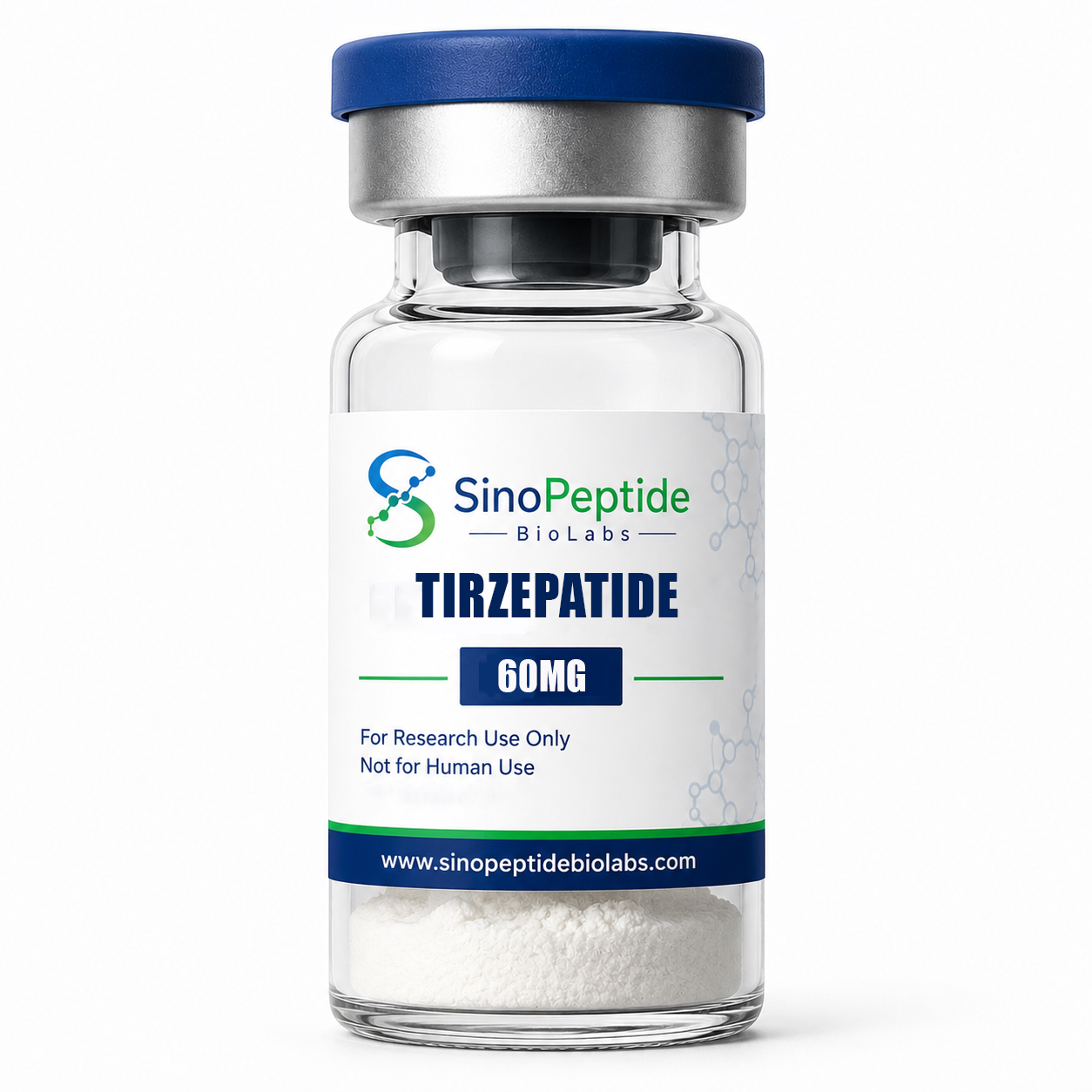
Tirzepatide 60mg
$240.00
10 Vials/ Kits
Tirzepatide 60mg: Complete Guide to Strength, Quantity, Research, Safety and FDA Status
Tirzepatide 60mg is a product specification that can cause considerable confusion because the number “60mg” may describe the total amount of tirzepatide contained in a multidose presentation, rather than an individual weekly dose.
Tirzepatide is a dual GIP and GLP-1 receptor agonist that has been extensively researched for metabolic conditions, including type 2 diabetes and obesity. Major clinical studies have evaluated therapeutic doses such as 5mg, 10mg, and 15mg once weekly.
The current U.S. FDA labeling for Zepbound lists a 60mg/2.4mL multidose presentation containing four 15mg/0.6mL doses. This means that the 60mg figure represents the total amount of tirzepatide in the multidose presentation rather than a recommendation to administer 60mg at one time.
The distinction between total quantity, concentration, presentation, and individual dose is particularly important when creating accurate health-related SEO content.
This guide explains what Tirzepatide 60mg means, how tirzepatide works, how the 60mg presentation relates to 15mg doses, what clinical research has shown, important safety considerations, quality and documentation considerations, FDA status, and frequently asked questions.
Important: This article is for general educational purposes. It is not individualized medical advice, a prescription, or instructions for self-administration of tirzepatide.
What Is Tirzepatide?
Tirzepatide is a synthetic peptide-based medicine that activates two incretin-related receptors:
- Glucose-dependent insulinotropic polypeptide (GIP) receptors
- Glucagon-like peptide-1 (GLP-1) receptors
Because it activates both pathways, tirzepatide is commonly described as a dual GIP/GLP-1 receptor agonist.
GIP and GLP-1 are naturally occurring hormones involved in metabolic signaling. Their receptors participate in processes related to glucose regulation, insulin secretion, appetite, food intake, and gastrointestinal function.
Tirzepatide has been investigated extensively in people with type 2 diabetes, obesity, and overweight accompanied by weight-related health conditions.
The clinical development program has included large randomized controlled trials evaluating different doses and treatment populations.
For obesity, the SURMOUNT-1 trial evaluated once-weekly tirzepatide at 5mg, 10mg, and 15mg over 72 weeks. The study included 2,539 adults with obesity or overweight and a weight-related complication, excluding people with diabetes.
These studies provide the evidence base for understanding tirzepatide’s clinical effects.
However, they should not be interpreted as evidence for a 60mg weekly dose.
What Does Tirzepatide 60mg Mean?
The phrase Tirzepatide 60mg can refer to the total amount of active ingredient contained in a product presentation.
This is different from saying that 60mg is administered as one dose.
Under current FDA labeling, Zepbound has a multidose presentation described as:
60mg/2.4mL
The presentation contains:
Four doses of 15mg/0.6mL
Therefore:
15mg × 4 = 60mg total
This is an important distinction for anyone searching for Tirzepatide 60mg online.
Tirzepatide 60mg at a glance
| Product characteristic | Information |
|---|---|
| Active ingredient | Tirzepatide |
| Total quantity | 60mg |
| Total volume in FDA-labeled multidose presentation | 2.4mL |
| Concentration | 25mg/mL |
| Doses per presentation | 4 |
| Amount per labeled dose | 15mg/0.6mL |
| 60mg weekly dose | Not the labeled weekly dosage |
| Maximum recommended Zepbound dosage | 15mg once weekly |
The most important point is:
Tirzepatide 60mg total quantity is not the same as a 60mg weekly dose.
What Is Tirzepatide 60mg/2.4mL?
Tirzepatide 60mg/2.4mL describes a multidose presentation containing a total of 60mg of tirzepatide in 2.4mL.
The current FDA labeling identifies this presentation as:
4 doses of 15mg/0.6mL
The concentration is listed as:
25mg/mL
This is calculated from:
60mg ÷ 2.4mL = 25mg/mL
The individual labeled dose is 15mg in 0.6mL.
This distinction is useful because online product listings sometimes display the total quantity prominently without explaining how that quantity relates to individual doses.
A high-quality SEO page should explain both figures.
Tirzepatide 60mg: Total Quantity vs Individual Dose
The words quantity and dose should not be treated as interchangeable.
Total Quantity
Total quantity describes the amount of active ingredient contained in the complete product presentation.
For example:
60mg total tirzepatide
Concentration
Concentration describes how much active ingredient is present per unit volume.
For the FDA-labeled 60mg/2.4mL presentation:
25mg/mL
Individual Dose
An individual dose describes the amount administered at one time.
The FDA-labeled multidose presentation contains:
15mg/0.6mL per dose
Total Presentation
Four individual 15mg doses equal:
60mg total
This relationship is essential when interpreting the keyword “Tirzepatide 60mg.”
Is Tirzepatide 60mg a Weekly Dose?
No.
The phrase “Tirzepatide 60mg” should not be interpreted as a recommendation to administer 60mg once weekly.
The current FDA Zepbound labeling identifies 15mg once weekly as the maximum recommended dosage.
The 60mg figure can instead describe the total amount contained in a four-dose multidose presentation.
This distinction should be prominently displayed on a website selling or describing tirzepatide-related products.
It also prevents readers from confusing a product’s total quantity with the clinically established dosage.
Tirzepatide 60mg and 15mg
The relationship between Tirzepatide 60mg and Tirzepatide 15mg is particularly straightforward.
A current FDA-labeled 60mg/2.4mL multidose presentation contains four 15mg doses.
In simple terms:
15mg × 4 = 60mg
Therefore, a product labeled 60mg does not represent a new 60mg clinical strength.
Instead, it can represent four individual 15mg doses contained in the same multidose presentation.
This is one of the most useful explanations for people searching:
- Tirzepatide 60mg
- Tirzepatide 60 mg
- Tirzepatide 60mg/2.4mL
- Tirzepatide 60mg vial
- Tirzepatide 60mg dosage
- Tirzepatide 60mg strength
Tirzepatide 60mg vs 15mg
Although the numbers look very different, they can describe two different aspects of the same presentation.
| Term | Meaning |
|---|---|
| Tirzepatide 15mg | Individual labeled dose/strength |
| Tirzepatide 60mg | Total amount in the multidose presentation |
| 60mg/2.4mL | Total quantity and volume |
| 15mg/0.6mL | Individual labeled dose |
| 60mg weekly | Not the labeled maximum weekly dosage |
This is why product pages should avoid statements suggesting that 60mg is a “higher weekly dose” than 15mg.
In the context of the FDA-labeled multidose presentation, 60mg represents the total quantity across four 15mg doses.
How Does Tirzepatide Work?
Tirzepatide’s pharmacological activity involves two incretin pathways.
GIP Receptor Activation
GIP, or glucose-dependent insulinotropic polypeptide, is an endogenous hormone involved in nutrient and metabolic signaling.
Tirzepatide activates the GIP receptor and contributes to the medicine’s overall metabolic effects.
Researchers continue to investigate the specific contribution of GIP signaling to tirzepatide’s pharmacological profile.
GLP-1 Receptor Activation
GLP-1, or glucagon-like peptide-1, is another incretin hormone.
GLP-1 receptor activation can influence:
- Glucose-dependent insulin secretion
- Glucagon regulation
- Gastric emptying
- Appetite
- Food intake
- Metabolic regulation
Dual GIP and GLP-1 Activity
Tirzepatide’s simultaneous activity at GIP and GLP-1 receptors is a defining feature of the medicine.
This distinguishes tirzepatide from medicines that primarily target the GLP-1 receptor.
Clinical studies have demonstrated substantial effects on body weight and metabolic measures at studied therapeutic doses.
However, these findings should be associated with the doses actually evaluated in clinical trials.
They should not be extrapolated to claim that a 60mg weekly dose has established safety or effectiveness.
Tirzepatide 60mg and Clinical Research
One of the most important studies of tirzepatide for obesity is the SURMOUNT-1 phase 3 trial.
The study enrolled 2,539 adults with obesity or overweight and at least one weight-related complication. Participants did not have diabetes.
Participants received once-weekly tirzepatide at:
- 5mg
- 10mg
- 15mg
or placebo for 72 weeks.
The trial included a dose-escalation period before participants reached their assigned maintenance doses.
SURMOUNT-1 Weight Results
Using the treatment-regimen estimand, mean weight change at week 72 was:
| Treatment | Mean weight change |
|---|---|
| Tirzepatide 5mg | −15.0% |
| Tirzepatide 10mg | −19.5% |
| Tirzepatide 15mg | −20.9% |
| Placebo | −3.1% |
The trial reported substantial weight reduction with all three studied tirzepatide doses.
The important point for a Tirzepatide 60mg article is that 60mg weekly was not one of the doses evaluated in SURMOUNT-1.
Therefore, these results should not be presented as evidence for a 60mg weekly regimen.
Long-Term Tirzepatide Research
Tirzepatide has also been studied over longer periods.
A later analysis of SURMOUNT-1 examined participants with obesity and prediabetes over 176 weeks, followed by an off-treatment period.
The trial continued to evaluate 5mg, 10mg, and 15mg once-weekly tirzepatide.
Researchers reported substantial and sustained weight reduction and a lower risk of progression to type 2 diabetes compared with placebo. No new safety signals were identified in the three-year analysis.
Again, these findings concern the studied doses.
They do not establish the clinical safety or effectiveness of administering 60mg weekly.
What Are the Tirzepatide Product Strengths?
Current FDA labeling includes several tirzepatide strengths and multidose presentations.
Single-dose strengths
The Zepbound label lists:
- 2.5mg/0.5mL
- 5mg/0.5mL
- 7.5mg/0.5mL
- 10mg/0.5mL
- 12.5mg/0.5mL
- 15mg/0.5mL
Multidose presentations
The current label lists:
| Total quantity | Total volume | Number of doses | Dose per presentation |
|---|---|---|---|
| 10mg | 2.4mL | 4 | 2.5mg/0.6mL |
| 20mg | 2.4mL | 4 | 5mg/0.6mL |
| 30mg | 2.4mL | 4 | 7.5mg/0.6mL |
| 40mg | 2.4mL | 4 | 10mg/0.6mL |
| 50mg | 2.4mL | 4 | 12.5mg/0.6mL |
| 60mg | 2.4mL | 4 | 15mg/0.6mL |
The FDA label also identifies a 60mg/2.4mL presentation at 25mg/mL.
This table illustrates why the total number of milligrams printed on a product should not automatically be interpreted as an individual dose.
Is Tirzepatide 60mg FDA Approved?
A precise answer requires distinguishing among the active ingredient, product presentation, and dosage.
Tirzepatide is an FDA-approved active ingredient in specific prescription products.
The current Zepbound labeling includes a 60mg/2.4mL multidose presentation containing four 15mg/0.6mL doses.
However, 60mg is not the maximum recommended weekly Zepbound dosage.
The maximum recommended dosage is 15mg once weekly.
Therefore, the accurate SEO wording is:
Tirzepatide 60mg can refer to the total amount of tirzepatide in a four-dose multidose presentation, rather than a 60mg weekly clinical dose.
This distinction is substantially more accurate than describing Tirzepatide 60mg as an independent 60mg therapeutic strength.
Is 60mg Tirzepatide a Clinical Dose?
The answer depends on whether “60mg” refers to the total quantity or an individual administration.
A 60mg total-quantity presentation can contain four 15mg doses.
A 60mg single administration is a different concept and should not be inferred from the product’s total quantity.
The major SURMOUNT-1 obesity trial evaluated 5mg, 10mg, and 15mg once weekly.
The FDA-labeled maximum recommended Zepbound dosage is 15mg once weekly.
Consequently, a website should not market 60mg as a standard weekly clinical dosage.
Tirzepatide 60mg and Weight Management Research
Tirzepatide has been extensively studied for weight management.
The SURMOUNT clinical program has evaluated tirzepatide in adults with obesity or overweight and related metabolic conditions.
In SURMOUNT-1, the 15mg group achieved a mean 20.9% weight change at week 72 under the treatment-regimen estimand.
The study also reported improvements in prespecified cardiometabolic measures.
However, clinical trial outcomes depend on:
- The specific dose
- The treatment duration
- Participant characteristics
- Trial design
- Lifestyle intervention
- Adherence
- Statistical analysis
- Safety monitoring
Consequently, it is not scientifically appropriate to assume that a total product quantity of 60mg produces an outcome associated with a 60mg weekly dose.
Tirzepatide 60mg vs Semaglutide
Tirzepatide and semaglutide are often compared because both are widely studied medicines used in metabolic medicine.
Their mechanisms are different.
Tirzepatide activates both:
- GIP receptors
- GLP-1 receptors
Semaglutide primarily activates:
- GLP-1 receptors
The SURMOUNT-5 trial directly compared tirzepatide and semaglutide in adults with obesity without type 2 diabetes.
Participants received maximum tolerated tirzepatide doses of 10mg or 15mg or maximum tolerated semaglutide doses of 1.7mg or 2.4mg for 72 weeks.
The trial reported greater mean weight reduction with tirzepatide in that study population.
Importantly, the study did not evaluate a 60mg weekly tirzepatide dose.
Therefore, SURMOUNT-5 should not be used to make claims about a 60mg weekly regimen.
Tirzepatide 60mg Safety Information
Tirzepatide is a prescription medicine with important safety considerations.
The FDA labeling contains a boxed warning concerning thyroid C-cell tumors observed in rats. The relevance of this finding to humans has not been established.
The labeling contraindicates Zepbound in people with a personal or family history of medullary thyroid carcinoma or in people with Multiple Endocrine Neoplasia syndrome type 2.
Other warnings and precautions include:
- Severe gastrointestinal adverse reactions
- Acute kidney injury associated with volume depletion
- Acute gallbladder disease
- Acute pancreatitis
- Serious hypersensitivity reactions
- Hypoglycemia when used with certain glucose-lowering medicines
- Diabetic retinopathy complications in applicable patients
- Pulmonary aspiration during general anesthesia or deep sedation
The specific prescribing information for the relevant product should always be consulted for complete safety details.
A website should avoid claims such as “completely safe,” “risk-free,” or “guaranteed.”
Common Adverse Effects of Tirzepatide
Gastrointestinal reactions are among the most commonly reported adverse events associated with tirzepatide.
These can include:
- Nausea
- Diarrhea
- Vomiting
- Constipation
- Abdominal discomfort
- Dyspepsia
- Decreased appetite
Other adverse reactions may also occur.
In SURMOUNT-1, gastrointestinal adverse events were the most common and were generally mild to moderate, occurring primarily during dose escalation.
Individual responses can vary.
People using prescription tirzepatide should follow the labeling for their specific product and seek appropriate medical advice regarding adverse effects.
Tirzepatide 60mg Storage Considerations
Storage requirements depend on the exact product and presentation.
For FDA-approved Zepbound, the current label states that the product should be protected from heat and light and should not be frozen.
The label provides specific storage conditions for different presentations.
For the multidose vial, the current prescribing information should be consulted for the applicable storage requirements.
A website should not provide generic storage instructions that could conflict with the labeling of a particular product.
When evaluating a Tirzepatide 60mg product, verify:
- Product identity
- Manufacturer
- Presentation
- Concentration
- Storage temperature
- Expiration date
- Lot or batch number
- Packaging integrity
- Regulatory classification
- Product-specific handling instructions
Tirzepatide 60mg Quality and Product Verification
The numerical quantity printed on a package is only one component of product evaluation.
A transparent product description should identify:
Active Ingredient
The active ingredient should be clearly identified as tirzepatide.
Total Quantity
Determine whether 60mg refers to the total amount contained in the presentation.
Volume
Confirm the total volume.
For the FDA-labeled multidose presentation, the total volume is 2.4mL.
Concentration
The current labeled 60mg/2.4mL presentation has a concentration of 25mg/mL.
Individual Dose
The multidose presentation contains four 15mg/0.6mL doses.
Batch Information
A lot or batch number allows quality documentation to be associated with a particular production batch.
Expiration
Expiration information should be clearly provided.
Regulatory Status
The product should be accurately identified as an approved prescription medicine, compounded product, research material, or other formulation where applicable.
What Is a Certificate of Analysis for Tirzepatide?
A Certificate of Analysis (COA) is laboratory documentation associated with a particular batch of material.
Depending on the material and laboratory, a COA may include:
- Product name
- Batch number
- Test date
- Identity testing
- Purity analysis
- Analytical method
- Appearance
- Other applicable specifications
For research materials, a batch-specific COA can provide useful analytical information.
However, a COA does not automatically mean that a product is FDA-approved.
It also does not by itself establish that a product is sterile, clinically safe, or suitable for human use.
This distinction is important for responsible peptide SEO content.
Tirzepatide 60mg and HPLC Testing
High-performance liquid chromatography (HPLC) is a commonly used analytical technique for characterizing peptide materials.
HPLC can provide information about chromatographic purity and related substances.
However, HPLC purity is only one component of quality assessment.
A reported HPLC purity percentage does not automatically prove:
- Sterility
- Clinical safety
- Correct labeling
- Stability
- Regulatory approval
- Proper manufacturing
- Appropriate storage
- Suitability for human administration
Therefore, website owners should avoid turning an HPLC result into an unsupported safety claim.
Tirzepatide 60mg for Research
Tirzepatide is also relevant to scientific research involving incretin biology, metabolic pathways, and peptide pharmacology.
Research topics may include:
- GIP receptor signaling
- GLP-1 receptor signaling
- Dual incretin receptor pharmacology
- Glucose metabolism
- Appetite regulation
- Energy balance
- Body-weight regulation
- Pharmacokinetics
- Peptide characterization
- Analytical testing
- Metabolic disease research
Research applications should be clearly distinguished from approved clinical treatment.
A research product should not be described as an approved medicine unless its regulatory status supports that representation.
Why 60mg Product Quantity Should Not Be Confused With Dosage
The central concept behind the Tirzepatide 60mg keyword is straightforward:
60mg total quantity
is not necessarily the same as:
60mg individual dose
The current FDA-labeled presentation provides a clear example.
The product contains:
60mg total
within:
2.4mL total volume
and is divided into:
four 15mg/0.6mL doses
Therefore:
15mg × 4 = 60mg
This makes the meaning of the 60mg product quantity much clearer.
It also explains why a product page should not describe 60mg as the next clinical dose after 15mg.
Tirzepatide 60mg Product Information Table
For SEO and user experience, a concise product-information table can help readers understand the terminology quickly.
| Specification | Tirzepatide 60mg presentation |
|---|---|
| Active ingredient | Tirzepatide |
| Total amount | 60mg |
| Total volume | 2.4mL |
| Concentration | 25mg/mL |
| Number of labeled doses | 4 |
| Individual labeled dose | 15mg/0.6mL |
| 60mg weekly dosage | Not the labeled dosage |
| Maximum recommended Zepbound dosage | 15mg once weekly |
| Primary mechanism | GIP and GLP-1 receptor agonism |
| Clinical research doses | 5mg, 10mg, 15mg in SURMOUNT-1 |
| Quality documentation | Product/batch dependent |
| Storage | Follow specific product labeling |
Common Misconceptions About Tirzepatide 60mg
Misconception 1: 60mg Means 60mg Weekly
This is incorrect.
The current FDA-labeled 60mg/2.4mL presentation contains four 15mg doses.
Misconception 2: 60mg Is a New Clinical Strength Above 15mg
The total quantity should not be confused with a new individual clinical dosage.
The FDA-labeled maximum recommended Zepbound dosage is 15mg once weekly.
Misconception 3: More Total Milligrams Means Better Results
A larger total quantity does not automatically produce better clinical outcomes.
Clinical outcomes depend on the studied dose, treatment duration, patient characteristics, tolerability, adherence, and other factors.
Misconception 4: 60mg Tirzepatide Was Studied in SURMOUNT-1
It was not.
SURMOUNT-1 evaluated 5mg, 10mg, and 15mg once weekly.
Misconception 5: A COA Proves FDA Approval
A Certificate of Analysis is laboratory documentation.
It is not a regulatory approval document.
Misconception 6: Every Tirzepatide 60mg Product Is Identical
Not necessarily.
Product presentation, manufacturer, formulation, labeling, regulatory status, and quality controls can differ.
How to Evaluate a Tirzepatide 60mg Product Online
A high-quality website should provide transparent information rather than relying solely on the product name.
1. Check the Active Ingredient
The product should clearly identify tirzepatide.
2. Check the Total Quantity
Determine whether 60mg represents total product content.
3. Check the Volume
Look for the total volume associated with the product.
4. Check the Concentration
Confirm how much tirzepatide is present per milliliter.
5. Check the Presentation
Determine whether the product is a single-dose or multidose presentation.
6. Check the Regulatory Status
Do not assume that every online tirzepatide product has the same regulatory status as an FDA-approved medicine.
7. Check Batch Information
Lot or batch information can help establish traceability.
8. Check Quality Documentation
Where applicable, review batch-specific analytical documentation.
9. Check Storage Information
Storage instructions should correspond to the actual product.
10. Avoid Unsupported Claims
Avoid statements promising guaranteed weight loss, guaranteed results, or universal safety.
Why Accurate Tirzepatide 60mg SEO Content Matters
A strong health-related SEO page should answer search intent rather than simply repeat a keyword.
People searching for Tirzepatide 60mg may want to understand:
- What does Tirzepatide 60mg mean?
- Is 60mg a weekly dose?
- What is Tirzepatide 60mg/2.4mL?
- How many doses are in a 60mg presentation?
- How does 60mg relate to 15mg?
- What does clinical research say about tirzepatide?
- What is the maximum recommended dose?
- What is tirzepatide’s mechanism?
- What safety information applies?
- What is a tirzepatide COA?
- What does HPLC purity mean?
Answering these questions creates useful topical depth.
It is also more appropriate for health SEO than repeating “Tirzepatide 60mg” unnaturally throughout every paragraph.
Frequently Asked Questions About Tirzepatide 60mg
What is Tirzepatide 60mg?
Tirzepatide 60mg can refer to a total quantity of 60mg of tirzepatide in a multidose presentation. The current FDA-labeled Zepbound presentation contains four 15mg/0.6mL doses.
Is Tirzepatide 60mg a weekly dose?
No. The 60mg figure can represent the total quantity in a four-dose presentation. The maximum recommended Zepbound dosage is 15mg once weekly.
What is Tirzepatide 60mg/2.4mL?
It is a multidose presentation containing 60mg of total tirzepatide in 2.4mL. The FDA labeling identifies four 15mg/0.6mL doses.
How many doses are in Tirzepatide 60mg/2.4mL?
The FDA-labeled multidose presentation contains four 15mg/0.6mL doses.
What is the concentration of Tirzepatide 60mg/2.4mL?
The labeled concentration is 25mg/mL.
Is Tirzepatide 60mg FDA approved?
Tirzepatide is an FDA-approved active ingredient in specific prescription products, and the current Zepbound labeling includes a 60mg/2.4mL multidose presentation. However, 60mg should not be interpreted as a 60mg weekly clinical dose.
What is the maximum recommended Zepbound dosage?
The current FDA labeling identifies 15mg once weekly as the maximum recommended dosage.
Has 60mg weekly tirzepatide been studied in SURMOUNT-1?
No. SURMOUNT-1 studied 5mg, 10mg, and 15mg once weekly.
What is the difference between Tirzepatide 60mg and 15mg?
In the current multidose presentation, 60mg represents the total quantity while 15mg represents the amount in each of four individual doses.
Is tirzepatide a GLP-1 medication?
Tirzepatide activates both GIP and GLP-1 receptors, so it is commonly described as a dual GIP/GLP-1 receptor agonist.
What does a tirzepatide COA show?
A Certificate of Analysis may provide batch-specific analytical information such as identity and purity testing. It does not by itself establish regulatory approval or clinical suitability.
What is HPLC testing for tirzepatide?
HPLC is an analytical technique that can be used to characterize peptide purity and related components. It is only one part of a broader quality assessment.
Final Thoughts on Tirzepatide 60mg
Tirzepatide 60mg is best understood by distinguishing total product quantity from individual clinical dosage.
The current FDA Zepbound labeling includes a 60mg/2.4mL multidose presentation containing four 15mg/0.6mL doses, with a listed concentration of 25mg/mL.
Therefore:
60mg total ≠ 60mg weekly dose.
The clinical evidence also needs to be described accurately. SURMOUNT-1 evaluated 5mg, 10mg, and 15mg once weekly and reported substantial weight reduction at those studied doses.
Longer-term SURMOUNT-1 research likewise evaluated 5mg, 10mg, and 15mg, with sustained weight reduction and a lower incidence of progression to type 2 diabetes among participants with obesity and prediabetes.
Consequently, an accurate SEO page should not describe 60mg as an independently established weekly clinical dose.
Instead, the strongest informational approach is to explain the relationship between:
- Tirzepatide 60mg total quantity
- Tirzepatide 60mg/2.4mL
- Four 15mg doses
- 15mg individual strength
- Clinical research
- FDA labeling
- Safety
- Product quality
- COA documentation
- HPLC testing
This approach provides useful information while avoiding the common mistake of equating total product quantity with dosage.
For website owners, accurate terminology is particularly important when publishing health-related content. Product quantity, concentration, individual dose, clinical dosage, and regulatory status should be presented as separate concepts.
A transparent and evidence-based Tirzepatide 60mg page can therefore address the user’s search intent without making unsupported claims about efficacy, safety, or dosing.
Medical and research disclaimer: This article is provided for general educational purposes and does not constitute medical advice or a prescription. Tirzepatide is a prescription medicine, and labeling, approved indications, presentations, and regulatory requirements may vary by product and jurisdiction. Readers should consult an appropriately qualified healthcare professional regarding individual treatment decisions. Research-use products should not be represented as approved medicines unless their regulatory status supports that representation.
Be the first to review “Tirzepatide 60mg”
Related products
Pure Peptides
Pure Peptides
Pure Peptides
Pure Peptides
Pure Peptides
Pure Peptides
Pure Peptides
Pure Peptides
Reviews
There are no reviews yet.