

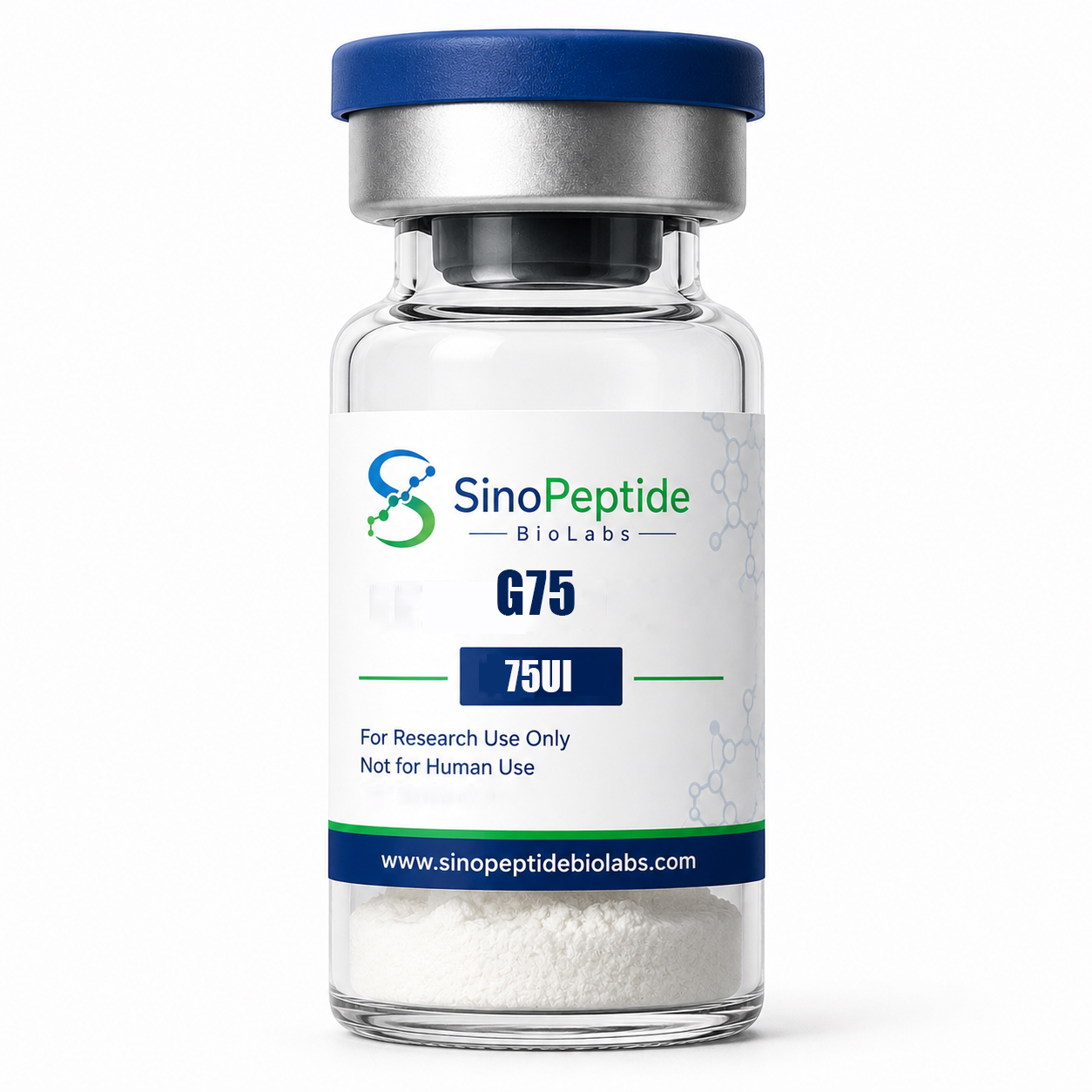
HMG 75ui
$55.00
10 Vials/ Kits
HMG 75 IU: Complete Guide to Human Menopausal Gonadotropin
HMG 75 IU is a formulation of human menopausal gonadotropin (HMG), also known as menotropins or menotrophin. It contains gonadotropic activity associated with two naturally occurring reproductive hormones: follicle-stimulating hormone (FSH) and luteinizing hormone (LH).
In a commonly used 75-IU menotropin formulation, each vial provides 75 International Units of FSH activity and 75 International Units of LH activity. FDA documentation describes menotropins as human menopausal gonadotropins containing FSH and LH activity.
HMG is primarily associated with medically supervised fertility treatment. Depending on the specific product and jurisdiction, menotropins may be used in controlled ovarian stimulation, ovulation induction protocols, and assisted reproductive technologies such as in-vitro fertilization (IVF). Some historical menotropin products also carried indications related to stimulation of spermatogenesis in selected male patients.
Because HMG directly affects the reproductive endocrine system, it is not a product that should be self-administered or used according to generic online dosing schedules. Treatment requires an individualized medical assessment and, in fertility treatment, appropriate monitoring.
This guide explains what HMG 75 IU is, how FSH and LH contribute to its activity, its medical applications, quality considerations, safety information, and frequently asked questions.
What Is HMG 75 IU?
HMG stands for human menopausal gonadotropin.
The term historically refers to gonadotropins obtained from the urine of postmenopausal women and purified for pharmaceutical use. Modern regulatory terminology commonly uses menotropins.
The “75 IU” designation refers to the biological activity of the product rather than simply its physical weight.
A typical 75-IU menotropin vial contains:
| Component | Labeled activity |
|---|---|
| Follicle-stimulating hormone (FSH) | 75 IU |
| Luteinizing hormone (LH) | 75 IU |
| Total gonadotropic activity | 150 IU combined activity |
It is important not to interpret “HMG 75 IU” as meaning that the entire vial contains only 75 IU of total hormonal activity. In products such as MENOPUR, the labeled strength is 75 IU FSH plus 75 IU LH activity.
The precise formulation, excipients, presentation, administration route, and approved indications can differ between brands and countries.
What Does HMG Stand For?
HMG means human menopausal gonadotropin.
It may also appear under related terminology including:
- Human menopausal gonadotrophin
- Menotropins
- Menotropin
- Menotrophin
- hMG
- HMG injection
The terminology can vary between manufacturers, regulatory authorities, and medical literature.
FDA’s substance database lists menotropins under several of these names, including human menopausal gonadotrophin, menotropin, menotrophin, Menopur, and Repronex.
HMG 75 IU Composition
The most important feature of HMG 75 IU is its combined FSH and LH activity.
FSH Activity
Follicle-stimulating hormone plays a major role in reproductive physiology.
In women, FSH stimulates the growth and development of ovarian follicles. During a medically supervised fertility treatment cycle, controlled stimulation can encourage the development of multiple follicles.
In men, FSH participates in the function of the seminiferous tubules and contributes to spermatogenesis.
LH Activity
Luteinizing hormone has complementary reproductive functions.
In women, LH contributes to ovarian steroid production and the normal sequence of follicular development and ovulation.
In men, LH stimulates Leydig cells in the testes to produce testosterone.
The combination of FSH and LH activity is therefore an important characteristic of menotropin products.
How Does HMG 75 IU Work?
HMG works by supplying exogenous gonadotropic activity that acts on the reproductive system.
Its two principal hormonal activities have different but complementary roles.
FSH and the ovaries
FSH interacts with receptors on ovarian granulosa cells and promotes follicular development.
As follicles mature, hormonal changes can be monitored using:
- Ultrasound
- Serum estradiol measurements
- Other reproductive hormone assessments
This monitoring helps fertility specialists determine how the ovaries are responding.
LH and ovarian function
LH contributes to steroidogenesis and ovarian function.
In controlled fertility treatment, LH activity may complement FSH stimulation by supporting hormonal processes associated with follicular development.
FSH and male reproductive function
FSH acts on the seminiferous system and is involved in spermatogenesis.
However, male fertility treatment is more complex than simply administering FSH or HMG. The underlying cause of infertility, endogenous hormone levels, testicular function, and other factors must be evaluated by a specialist.
HMG 75 IU for Fertility Treatment
One of the primary medical contexts for HMG is fertility treatment.
Menotropins may be used as part of carefully monitored treatment protocols designed to stimulate ovarian follicular development.
Depending on the clinical situation, fertility specialists may use gonadotropins in:
- Ovulation induction
- Controlled ovarian stimulation
- IVF treatment
- Other assisted reproductive technology protocols
FDA documentation for menotropins describes their use in stimulating multiple follicular development for patients participating in IVF programs and in certain ovulation-induction settings.
The treatment is not simply based on the product strength. A fertility specialist determines the treatment protocol according to ovarian reserve, age, hormone levels, previous treatment response, ultrasound findings, and the specific assisted-reproduction protocol.
HMG 75 IU and IVF
In-vitro fertilization is one of the best-known clinical applications associated with menotropins.
During IVF, controlled ovarian stimulation is used to encourage development of multiple follicles rather than the single dominant follicle typically seen during a natural menstrual cycle.
Menotropin products containing FSH and LH activity may be incorporated into such protocols.
FDA documentation for MENOPUR identifies the product as menotropins containing 75 IU FSH and 75 IU LH activity per vial and describes its use in controlled ovarian stimulation for assisted reproductive technologies.
Treatment generally involves clinical monitoring rather than relying on the vial strength alone.
Monitoring can include:
- Transvaginal ultrasound
- Estradiol testing
- Follicular measurements
- Clinical assessment
- Evaluation of ovarian response
This monitoring is essential because excessive ovarian stimulation can produce significant complications.
HMG 75 IU and Ovulation Induction
HMG may also be used in selected patients who require medically supervised ovulation induction.
The objective is to stimulate follicular development in patients who have difficulty producing an appropriate ovulatory response.
However, not every cause of infertility is suitable for gonadotropin treatment.
For example, official menotropin labeling includes contraindications involving primary ovarian failure and certain uncontrolled endocrine disorders.
Consequently, fertility treatment should begin with appropriate diagnostic evaluation.
HMG 75 IU for Male Fertility
HMG also has a history of use in male reproductive medicine.
Its FSH and LH activity can influence reproductive physiology through different pathways.
FSH supports the seminiferous system and spermatogenesis, while LH stimulates testosterone production through the Leydig cells.
Historical FDA documentation describes menotropin products in relation to spermatogenesis treatment, although the approved indications and formulations have differed between products and regulatory submissions.
Male infertility can have many causes, including:
- Hypogonadotropic hypogonadism
- Primary testicular disorders
- Varicocele
- Genetic conditions
- Medication effects
- Hormonal disorders
- Obstructive causes
Therefore, HMG should not be regarded as a universal male fertility treatment.
A physician may evaluate:
- Testosterone
- FSH
- LH
- Prolactin
- Semen analysis
- Testicular function
- Other relevant reproductive parameters
before determining whether gonadotropin treatment is appropriate.
HMG 75 IU vs. hCG
HMG and human chorionic gonadotropin (hCG) are both gonadotropin-based medicines, but they are not identical.
HMG provides FSH and LH activity, while hCG primarily acts through the LH receptor.
This distinction is clinically important.
HMG
- Contains FSH activity
- Contains LH activity
- Supports follicular development
- Has applications in controlled ovarian stimulation
- Can have a role in selected male reproductive treatment
hCG
- Mimics LH activity at the receptor level
- Can be used in specific fertility protocols
- May be administered after appropriate follicular development in certain ovulation-induction protocols
Historical FDA documentation describes sequential use of menotropins and hCG in certain fertility protocols.
They should not be considered interchangeable medications.
HMG 75 IU vs. FSH-Only Products
Another important distinction is between HMG and recombinant or urinary FSH-only preparations.
HMG:
Provides both FSH and LH activity.
FSH-only products:
Primarily provide FSH activity without the same LH component.
This difference can influence how a fertility specialist designs a treatment protocol.
The appropriate medication depends on the individual’s reproductive physiology and treatment objective.
HMG 75 IU and Ovarian Stimulation
Ovarian stimulation is one of the most important applications of menotropin therapy.
The objective is to encourage development of ovarian follicles under controlled medical supervision.
During treatment, clinicians monitor ovarian response because excessive stimulation may increase the risk of ovarian hyperstimulation syndrome (OHSS).
The current MENOPUR label specifically warns that gonadotropin treatment can cause OHSS and recommends appropriate monitoring facilities and experienced physicians.
This is why online dosing schedules should not replace individualized fertility treatment.
HMG 75 IU Safety
HMG is a prescription gonadotropin and should be used under medical supervision.
Its effects are not limited to a single organ. Gonadotropins influence the reproductive endocrine system and can produce clinically important effects.
Potential safety concerns include:
- Ovarian hyperstimulation syndrome
- Multiple pregnancy
- Ovarian enlargement
- Ovarian cysts
- Injection-site reactions
- Hypersensitivity
- Headache
- Abdominal discomfort
- Pelvic pain
- Fluid accumulation in severe OHSS
The exact adverse-effect profile depends on the product, patient, treatment protocol, and underlying condition.
Ovarian Hyperstimulation Syndrome
Ovarian hyperstimulation syndrome (OHSS) is one of the most important complications associated with ovarian gonadotropin therapy.
It can occur when the ovaries respond excessively to stimulation.
Potential manifestations can include:
- Enlarged ovaries
- Abdominal pain
- Abdominal distension
- Fluid accumulation
- Nausea
- Vomiting
- Changes in blood volume
- Breathing difficulties in severe cases
- Thromboembolic complications in severe cases
The current MENOPUR prescribing information specifically identifies OHSS as an important warning associated with gonadotropin therapy.
Because OHSS can become medically serious, patients receiving gonadotropins require appropriate monitoring.
Multiple Pregnancy and HMG
Controlled ovarian stimulation can result in the development of multiple follicles.
If more than one egg is fertilized, there is an increased possibility of a multiple pregnancy.
Multiple pregnancy carries additional maternal and fetal risks compared with singleton pregnancy.
For this reason, fertility treatment protocols are designed around careful monitoring and individualized decision-making.
The official MENOPUR labeling specifically identifies multiple births as a potential risk of gonadotropin treatment.
HMG 75 IU Contraindications
The contraindications depend on the specific product label.
For example, the current MENOPUR labeling lists contraindications including:
- Prior hypersensitivity to menotropins or excipients
- Pregnancy
- High FSH indicating primary ovarian failure
- Certain uncontrolled non-gonadal endocrine disorders
- Sex-hormone-dependent tumors of reproductive organs
- Tumors of the pituitary or hypothalamus
- Abnormal uterine bleeding of undetermined cause
- Certain ovarian cysts or enlargement not attributable to PCOS
This illustrates why HMG should be prescribed only after appropriate clinical evaluation.
HMG 75 IU Administration
HMG products are supplied as pharmaceutical preparations for injection, but the precise route depends on the specific product.
For example, the current U.S. MENOPUR product is labeled for subcutaneous administration, while historical menotropin products such as Repronex were approved for subcutaneous and/or intramuscular administration depending on the product and label.
Therefore, the route should never be inferred from the term “HMG 75 IU.”
Always follow the prescribing information for the exact product.
HMG 75 IU Dosage: Why Individualization Matters
A common online search is “HMG 75 IU dosage.”
However, there is no universally appropriate HMG dose for every patient.
Fertility protocols are individualized according to factors such as:
- Age
- Ovarian reserve
- Baseline hormone levels
- Previous response to stimulation
- Treatment objective
- IVF protocol
- Ultrasound findings
- Estradiol levels
- Risk of OHSS
- Other medications
Official prescribing information for MENOPUR provides dosing frameworks for specific clinical indications but emphasizes individualized monitoring and adjustment.
For this reason, an internet article should not be used to establish a personal injection schedule.
Why HMG Requires Medical Monitoring
HMG directly changes gonadotropin activity and ovarian or testicular physiology.
In women undergoing controlled ovarian stimulation, monitoring can help clinicians determine:
- Whether follicles are developing
- How many follicles are developing
- Whether the response is excessive
- Whether treatment should continue
- Whether treatment should be adjusted
- Whether the risk of OHSS is increasing
The current MENOPUR label states that gonadotropin therapy requires appropriate monitoring facilities and physicians experienced in infertility treatment.
HMG 75 IU Storage
Storage requirements vary by product.
HMG products may be supplied as lyophilized powder or pellets, sometimes together with a diluent or vial-adapter system.
The current MENOPUR prescribing information describes 75-IU FSH plus 75-IU LH activity supplied as a lyophilized powder or pellet in sterile vials with associated diluent materials.
Because storage conditions can differ between brands and presentations, users should follow the manufacturer’s official instructions.
Important considerations may include:
- Temperature
- Light exposure
- Packaging integrity
- Expiration date
- Reconstitution instructions
- Post-reconstitution storage
- Time limits after preparation
Do not assume that storage instructions for one HMG brand apply to another.
HMG 75 IU Quality Considerations
When evaluating an HMG product, product quality and regulatory authenticity are important.
Consumers and healthcare professionals should look for:
1. Manufacturer identification
The product should clearly identify the manufacturer or licensed pharmaceutical company.
2. Lot or batch number
A traceable lot number allows the product to be connected to manufacturing and quality records.
3. Expiration date
Do not use pharmaceutical products beyond their labeled expiration date.
4. Packaging integrity
The vial and packaging should be intact and appropriately sealed.
5. Official labeling
The product should include clear information about:
- Active ingredients
- Strength
- Route
- Storage
- Indications
- Contraindications
- Warnings
- Manufacturer
6. Regulatory status
A legitimate pharmaceutical product should have an identifiable regulatory pathway in the market where it is sold.
The FDA Purple Book, for example, identifies menotropin products such as MENOPUR as licensed biological products and lists a 75-IU presentation.
HMG 75 IU Is Not a Research Peptide
HMG is sometimes grouped with “hormones” or “peptides” in online marketplaces, but it should not automatically be categorized alongside experimental research peptides.
Menotropins are gonadotropin medicines used in reproductive medicine.
Products such as MENOPUR have formal pharmaceutical labeling and regulatory histories. The FDA’s Purple Book identifies MENOPUR as a licensed biological product with a 75-IU presentation.
This distinction is important for website SEO because users searching for HMG 75 IU are often looking for information about a fertility medication, not a general research peptide.
HMG 75 IU and Pharmaceutical Authenticity
Because HMG is a prescription fertility medicine, authenticity matters.
Purchasing from an unauthorized source can create risks involving:
- Incorrect strength
- Counterfeit labeling
- Improper storage
- Loss of potency
- Contamination
- Expired product
- Unknown manufacturing standards
A product that visually resembles a genuine pharmaceutical vial should not automatically be assumed to be authentic.
For prescription fertility medicines, obtaining the product through an appropriately licensed healthcare and pharmacy system provides important safeguards.
HMG 75 IU: Important Difference Between IU and mg
Another common misunderstanding involves converting HMG’s IU measurement into milligrams.
IU means International Units.
International Units describe biological activity rather than simply the physical mass of the substance.
Therefore, “75 IU” should not automatically be converted into “75 mg.”
For HMG, the labeled biological activity is used to describe the potency of the gonadotropin components.
A 75-IU HMG product can therefore contain a particular mass of protein while its pharmaceutical strength is expressed in International Units.
HMG 75 IU Frequently Asked Questions
What is HMG 75 IU?
HMG 75 IU is a menotropin formulation used in reproductive medicine. A commonly used formulation contains 75 IU of FSH activity and 75 IU of LH activity.
What does HMG stand for?
HMG stands for human menopausal gonadotropin. The active pharmaceutical ingredient is commonly referred to as menotropins or menotrophin.
What is HMG 75 IU used for?
Depending on the product and jurisdiction, HMG may be used for controlled ovarian stimulation, ovulation induction, and assisted reproductive technologies such as IVF. Certain menotropin products have also had applications in selected male fertility treatment.
Does HMG contain FSH and LH?
Yes. A standard 75-IU menotropin formulation such as MENOPUR contains 75 IU FSH activity and 75 IU LH activity per vial.
Is HMG the same as hCG?
No. HMG provides FSH and LH activity, whereas hCG primarily produces LH-like activity. They have different pharmacological roles and are not interchangeable.
Is HMG the same as FSH?
No. HMG contains both FSH and LH activity, while an FSH-only medicine primarily provides FSH activity.
Can HMG be used for male fertility?
Some menotropin products have been used in selected male fertility settings, particularly where gonadotropin deficiency contributes to impaired spermatogenesis. Treatment depends on the underlying diagnosis and requires specialist supervision.
Is HMG 75 IU a prescription medicine?
Menotropin products are prescription medicines in regulated markets. The exact regulatory status varies by country and product.
Does HMG 75 IU cause multiple pregnancy?
Gonadotropin treatment can increase the possibility of multiple pregnancy because multiple follicles may develop. Official MENOPUR labeling identifies multiple births as a potential risk.
What is the biggest safety concern with ovarian stimulation?
One major concern is ovarian hyperstimulation syndrome, or OHSS. It can become serious and requires medical monitoring.
Can I choose my own HMG dose?
No. HMG treatment should be individualized by a qualified fertility specialist. The appropriate regimen depends on the patient’s medical history, reproductive status, treatment objective, and response to stimulation.
How should HMG 75 IU be stored?
Storage depends on the exact product. Follow the manufacturer’s official prescribing and storage instructions rather than applying generic HMG storage advice.
Final Thoughts on HMG 75 IU
HMG 75 IU is a medically important gonadotropin formulation containing FSH and LH activity. In commonly used menotropin products, a 75-IU vial contains 75 IU FSH activity plus 75 IU LH activity.
Its primary clinical relevance is reproductive medicine, particularly controlled ovarian stimulation and assisted reproductive technologies. Menotropins have also had applications in selected male reproductive disorders.
Because HMG directly affects reproductive hormone pathways, treatment requires appropriate diagnosis, individualized prescribing, and clinical monitoring. It should not be treated like an ordinary supplement or experimental peptide.
The most important considerations when evaluating an HMG 75 IU product are authenticity, exact formulation, regulatory status, storage conditions, manufacturer information, and adherence to official prescribing information.
For patients undergoing fertility treatment, the appropriate HMG regimen should always be determined by the treating fertility specialist.
Medical disclaimer: This article is provided for educational and SEO purposes only. It does not replace a physician’s diagnosis, prescription, or treatment plan and does not provide an individualized HMG dosing or injection schedule. HMG/menotropins are prescription medicines and should be used only under appropriate medical supervision.
Be the first to review “HMG 75ui”
Related products
Pure Peptides
Pure Peptides
Pure Peptides
Pure Peptides
Pure Peptides
Pure Peptides
Pure Peptides
Pure Peptides
Reviews
There are no reviews yet.