

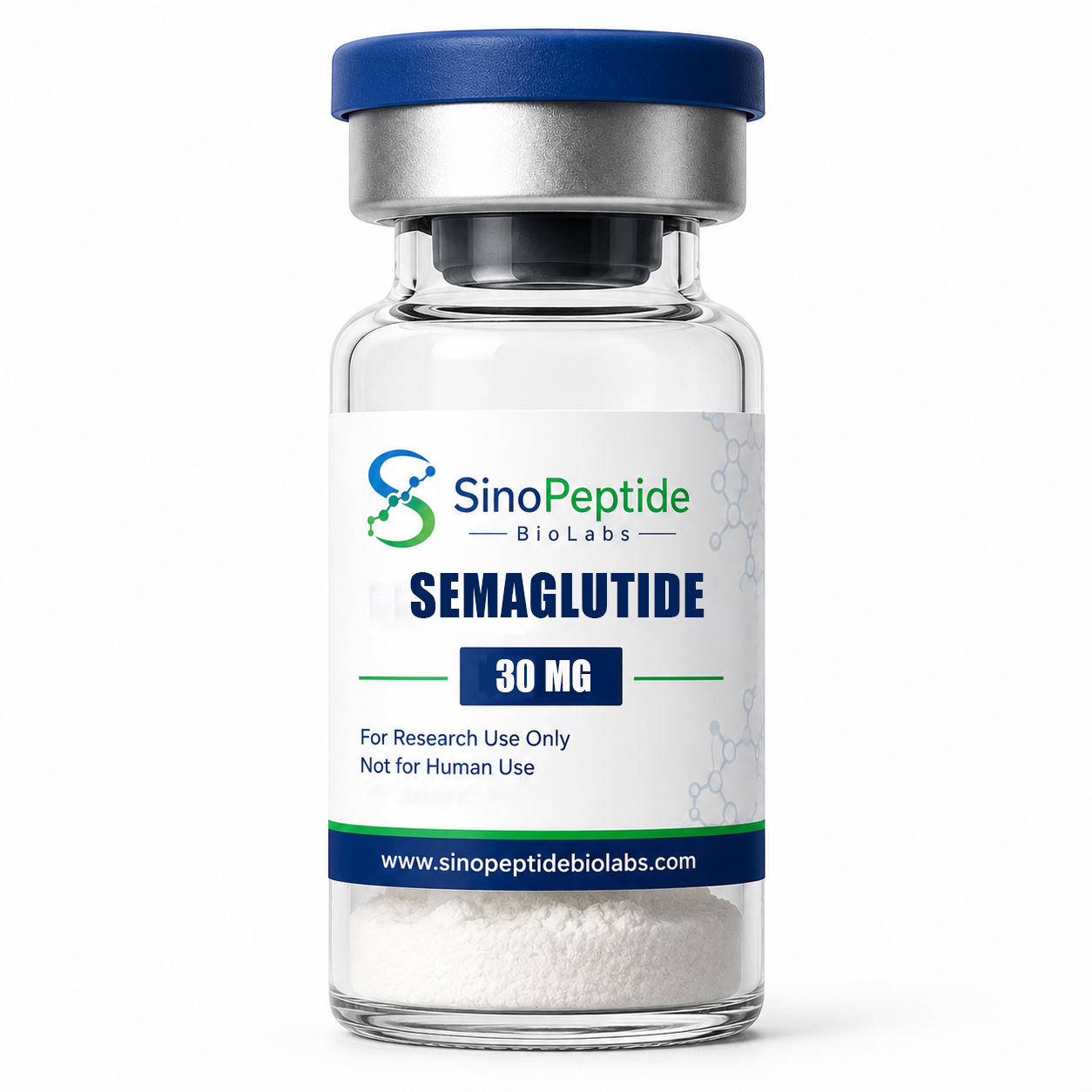
Semaglutide 30mg
$125.00
10Vials/ kits
Semaglutide 30mg: Complete Guide to Uses, Mechanism, Research, Safety & Quality
Semaglutide is one of the most widely studied glucagon-like peptide-1 (GLP-1) receptor agonists in modern metabolic medicine. It has been extensively investigated for blood-glucose management, body-weight reduction, cardiovascular risk reduction, and, more recently, metabolic-associated steatohepatitis (MASH).
The term Semaglutide 30mg can be confusing, however. A 30mg label may describe the total amount of semaglutide contained in a particular vial, research material, formulation, or other product presentation. It should not automatically be interpreted as a recommended patient dose. Approved semaglutide products use specific formulations, strengths, routes of administration, and dosing schedules established through regulatory review.
This distinction is especially important when evaluating products marketed online as “Semaglutide 30mg.” The name alone does not establish that a product is FDA-approved, pharmaceutically equivalent to Ozempic or Wegovy, or suitable for human use.
This guide explains what Semaglutide 30mg means, how semaglutide works, what clinical research has demonstrated, how approved products differ from independently marketed products, and what quality and safety factors should be considered.
What Is Semaglutide?
Semaglutide is a synthetic analogue of the naturally occurring hormone GLP-1. It belongs to a class of medicines known as GLP-1 receptor agonists.
GLP-1 is involved in several physiological processes, including glucose-dependent insulin secretion, glucagon regulation, gastric emptying, and appetite signaling. By activating GLP-1 receptors, semaglutide can influence blood-glucose regulation and food intake.
Semaglutide is the active ingredient in several well-known prescription products, including:
- Ozempic
- Wegovy
- Rybelsus
These products are not interchangeable simply because they contain semaglutide. Their approved indications, formulations, strengths, routes of administration, and labeling can differ.
For example, Ozempic is used for adults with type 2 diabetes, while Wegovy has approvals involving chronic weight management and cardiovascular risk reduction in specified populations. Rybelsus is an oral semaglutide product used for type 2 diabetes.
What Does Semaglutide 30mg Mean?
The phrase Semaglutide 30mg generally indicates a quantity or labeled amount of semaglutide associated with a particular product presentation.
That does not mean that 30mg is an approved single dose.
This distinction is one of the most important points for anyone creating or purchasing content around Semaglutide 30mg.
A product could potentially be described by its total contents rather than by the amount intended for administration at one time. Consequently, the term “30mg” should always be interpreted together with the product’s complete labeling.
Semaglutide 30mg vs. Semaglutide Dose
These terms should not be treated as synonyms.
Product quantity refers to the amount of active ingredient contained in a particular product or package.
Clinical dose refers to the amount administered according to an approved prescribing regimen.
An SEO page should therefore avoid stating that “30mg semaglutide is the recommended dose” unless a specific regulatory label establishes that claim.
For an online product simply labeled “Semaglutide 30mg,” the safest and most accurate description is that 30mg identifies the stated product quantity or strength, while the clinical significance depends on the formulation, concentration, route, and regulatory status.
How Does Semaglutide Work?
Semaglutide works primarily through activation of GLP-1 receptors.
GLP-1 receptor signaling affects multiple systems involved in metabolic regulation.
1. Glucose-dependent insulin secretion
When blood glucose is elevated, GLP-1 receptor activation can increase insulin secretion. Because this process is glucose-dependent, the mechanism differs from simply stimulating insulin release regardless of blood-glucose concentration.
2. Glucagon regulation
Semaglutide can reduce inappropriate glucagon secretion when glucose levels are elevated. Glucagon normally helps raise blood glucose, particularly during fasting.
The combined effects on insulin and glucagon contribute to improved glycemic regulation.
3. Appetite and food intake
GLP-1 signaling also affects areas of the brain involved in appetite and food intake.
Clinical studies of semaglutide have demonstrated substantial reductions in body weight in appropriately selected populations. The weight-management effects are considered to involve reduced energy intake alongside broader metabolic effects.
4. Gastric emptying
GLP-1 receptor activation can affect gastric emptying, particularly during earlier stages of treatment. This can contribute to feelings of fullness and may influence food intake.
These mechanisms help explain why semaglutide has been studied across both diabetes and obesity medicine.
Semaglutide 30mg and Weight-Loss Research
Semaglutide has generated substantial clinical evidence in obesity research.
The STEP clinical development program evaluated semaglutide in people with overweight or obesity, with several trials examining a 2.4mg once-weekly formulation alongside lifestyle intervention.
In STEP 1, adults without diabetes received semaglutide 2.4mg or placebo for 68 weeks. The semaglutide group experienced substantially greater average weight reduction than the placebo group.
An extension of STEP 1 subsequently evaluated what happened after treatment discontinuation. Participants regained a substantial portion of the weight they had lost during treatment, demonstrating an important principle in obesity research: continued treatment may be important for maintaining the effects achieved with pharmacotherapy.
This evidence is relevant when discussing Semaglutide 30mg because it shows why the quantity written on a product label should not be confused with the dose used in major clinical trials.
Semaglutide Clinical Research
Semaglutide has been investigated across multiple clinical areas.
Type 2 diabetes
Semaglutide has been extensively studied for improving glycemic control in adults with type 2 diabetes.
The mechanism involves GLP-1 receptor activation, resulting in effects on insulin secretion, glucagon regulation, appetite, and other metabolic processes.
Chronic weight management
Semaglutide 2.4mg has been studied extensively in people with overweight or obesity.
The STEP program demonstrated clinically meaningful reductions in body weight compared with placebo in several populations.
Cardiovascular outcomes
Semaglutide has also been evaluated in cardiovascular outcomes research.
The SELECT study investigated semaglutide 2.4mg in adults with established cardiovascular disease and overweight or obesity who did not have diabetes. FDA subsequently approved an indication for Wegovy to reduce the risk of cardiovascular death, heart attack, and stroke in specified adults with cardiovascular disease and overweight or obesity.
Metabolic-associated steatohepatitis
More recently, Wegovy received FDA approval for treatment of MASH in adults with moderate-to-advanced fibrosis.
This represents another area in which semaglutide research has expanded beyond traditional glucose management and weight reduction.
Semaglutide 30mg and GLP-1 Research
From a research perspective, Semaglutide 30mg may appear in discussions involving peptide quantity, analytical testing, formulation, or research materials.
However, the presence of “30mg” on a product label does not establish that the material corresponds to an FDA-approved pharmaceutical formulation.
Researchers and laboratories evaluating semaglutide-related materials should distinguish among:
- Active ingredient identity
- Molecular identity
- Purity
- Potency
- Concentration
- Formulation
- Sterility
- Endotoxin status
- Packaging
- Storage conditions
- Intended use
- Regulatory status
These factors are more informative than the product name alone.
Semaglutide 30mg vs. Ozempic
Ozempic is an FDA-approved prescription product containing semaglutide.
It is indicated for specific adults with type 2 diabetes and also has an indication to reduce the risk of major adverse cardiovascular events in certain adults with type 2 diabetes and established cardiovascular disease.
An independently marketed product called “Semaglutide 30mg” should not automatically be described as Ozempic or as equivalent to Ozempic.
FDA has specifically taken action against companies making misleading claims about unapproved semaglutide products, including claims that such products are the same as FDA-approved medicines.
Therefore, an SEO page should avoid phrases such as:
“Semaglutide 30mg is generic Ozempic.”
unless a specific approved regulatory product supports that statement.
Semaglutide 30mg vs. Wegovy
Wegovy is another prescription product containing semaglutide.
Unlike Ozempic, Wegovy is specifically associated with chronic weight-management indications in appropriately selected patients. FDA has also approved Wegovy for reducing certain cardiovascular risks in adults with cardiovascular disease and overweight or obesity, and for MASH in specified adults.
Clinical weight-management studies have generally focused on specific approved or investigational doses rather than an unspecified “30mg dose.”
Consequently, Semaglutide 30mg should not be marketed as synonymous with Wegovy simply because both involve semaglutide.
Semaglutide 30mg vs. Rybelsus
Rybelsus is an oral semaglutide product.
This highlights another important issue with the phrase “Semaglutide 30mg”: semaglutide is available in different pharmaceutical formulations.
An oral semaglutide formulation is not automatically interchangeable with an injectable semaglutide formulation on a milligram-for-milligram basis.
FDA labeling specifically establishes different administration and dosing requirements for approved formulations.
Therefore, comparing semaglutide products solely by milligram quantity can create a misleading impression.
Is Semaglutide 30mg FDA Approved?
The answer depends on what is meant by “Semaglutide 30mg.”
Semaglutide itself is an FDA-approved active ingredient in specific prescription products.
However, that does not mean that every product labeled “Semaglutide 30mg” is FDA-approved.
FDA approval applies to specific drug products and applications, including their formulation, manufacturing, labeling, indications, and other characteristics.
An independently marketed vial or research product carrying the name “Semaglutide 30mg” should therefore not be presented as FDA-approved unless its specific product has an applicable FDA approval.
This distinction is particularly important for websites selling or describing peptide products.
Compounded Semaglutide vs. FDA-Approved Semaglutide
Compounded drugs are different from FDA-approved drug products.
FDA states that compounded drugs are not FDA-approved and are not reviewed by the agency for safety, effectiveness, and quality before marketing in the same manner as approved drugs.
The agency has also issued warnings regarding misleading advertising of compounded semaglutide.
For example, FDA has objected to claims suggesting compounded semaglutide is the same as an FDA-approved product. FDA has also highlighted concerns involving fraudulent labeling, dosing errors, and semaglutide salt forms.
Therefore, a website should clearly distinguish:
FDA-approved semaglutide products
from
compounded semaglutide
and from
research or other independently marketed semaglutide materials.
Quality Considerations for Semaglutide 30mg
If Semaglutide 30mg is being discussed as a research material, quality documentation becomes particularly important.
A professional product page should avoid vague statements such as “premium quality” or “100% pharmaceutical grade” unless those claims can be supported.
Certificate of Analysis
A Certificate of Analysis, or COA, can provide information about a specific batch.
Depending on the product and laboratory, documentation may include:
- Batch or lot number
- Test date
- Identity
- Purity
- Potency or assay
- Appearance
- Testing methodology
- Laboratory information
- Acceptance criteria
A COA should correspond to the actual batch being described.
HPLC testing
High-performance liquid chromatography, commonly abbreviated HPLC, can be used to evaluate peptide purity.
HPLC results may provide a chromatographic profile and an estimated purity percentage.
However, a single HPLC result does not automatically establish sterility, endotoxin status, identity, stability, or suitability for human administration.
Mass spectrometry
Mass spectrometry can help confirm molecular identity and molecular mass.
For peptide research, identity testing can be an important complement to purity testing.
Sterility and endotoxin testing
If a material is intended for laboratory research rather than human administration, the relevant quality requirements may differ.
A purity percentage alone does not prove that a product is sterile or appropriate for injection.
Websites should therefore avoid equating “high purity” with “safe for human use.”
Storage and Stability
Semaglutide is a peptide-based pharmaceutical compound, and its stability can depend on formulation and storage conditions.
Storage instructions should always follow the documentation supplied for the specific approved product or research material.
Important factors can include:
- Temperature
- Light exposure
- Moisture
- Container integrity
- Freeze-thaw exposure
- Reconstitution status
- Formulation
- Storage duration
It is not appropriate to assume that every Semaglutide 30mg product has identical storage requirements.
Semaglutide Safety
Semaglutide has a well-characterized safety profile from extensive clinical development, but it is not free of risks.
Common adverse reactions associated with approved semaglutide products include gastrointestinal symptoms such as:
- Nausea
- Vomiting
- Diarrhea
- Constipation
- Abdominal pain
- Dyspepsia
Other warnings and precautions depend on the particular semaglutide product and indication.
FDA-approved Wegovy labeling includes a boxed warning concerning thyroid C-cell tumors based on findings in rodents. The labeling also contains warnings involving conditions such as pancreatitis, gallbladder disease, hypoglycemia in relevant settings, kidney injury, hypersensitivity reactions, diabetic retinopathy complications, and other potential adverse effects.
Current FDA information should always be consulted rather than relying on an outdated product description.
Semaglutide and the Thyroid C-Cell Warning
One of the most recognizable safety considerations associated with semaglutide is the boxed warning regarding thyroid C-cell tumors.
This warning originates from animal studies in rodents. The human relevance has not been established.
Approved labeling contraindicates relevant semaglutide products in people with a personal or family history of medullary thyroid carcinoma or Multiple Endocrine Neoplasia syndrome type 2.
This is one reason semaglutide should be treated as a prescription medicine when used clinically rather than as an ordinary dietary supplement.
Semaglutide and Gastrointestinal Effects
Gastrointestinal adverse effects are among the most frequently reported effects in clinical trials.
Nausea, vomiting, diarrhea, constipation, and abdominal discomfort can occur.
These effects are one reason approved treatment regimens use structured dose escalation rather than treating a product quantity as a single administration amount.
For this reason, a webpage about Semaglutide 30mg should avoid publishing a simplistic statement such as “take 30mg” or presenting the entire vial quantity as a recommended dose.
Why “30mg” Should Not Be Used as a Dosing Instruction
A product containing 30mg of semaglutide could theoretically represent a total quantity rather than a single administration.
Confusing these concepts can create serious medication errors.
FDA has reported adverse events associated with dosing errors involving compounded injectable semaglutide products. These errors have included incorrect measurements and administration of amounts beyond approved labeling.
Therefore, SEO content should make the distinction explicit:
30mg may describe the amount contained in a product; it does not automatically describe an approved clinical dose.
Semaglutide 30mg for Research
Research use is another context in which the phrase Semaglutide 30mg may appear.
Laboratories may investigate semaglutide in areas such as:
- GLP-1 receptor signaling
- Metabolic regulation
- Appetite pathways
- Glucose homeostasis
- Obesity biology
- Pharmacology
- Peptide characterization
- Analytical chemistry
- Drug-development research
Research material should be clearly identified as such.
A research-use product should not be promoted as a treatment for obesity, diabetes, cardiovascular disease, MASH, or another medical condition unless the product has the appropriate regulatory authorization.
What Makes a High-Quality Semaglutide 30mg Product Page?
For SEO and user trust, a high-quality product page should provide transparent information rather than relying on exaggerated claims.
Consider including:
1. Exact product name
Use “Semaglutide 30mg” consistently while explaining what the 30mg designation represents.
2. Product type
Clearly state whether the material is:
- An FDA-approved prescription drug
- A compounded preparation
- A research material
- Another formulation
3. Purity information
Provide verified analytical information where available.
4. Batch documentation
A batch-specific COA can increase transparency.
5. Storage information
Provide storage instructions applicable to the exact product.
6. Regulatory disclaimer
If the product is research-only, clearly state that it is not intended for human consumption or clinical treatment.
7. Avoid unsupported claims
Avoid phrases such as:
- Guaranteed weight loss
- Instant fat burning
- Zero side effects
- Miracle peptide
- Completely safe
- FDA-approved research peptide
These claims can undermine both credibility and regulatory compliance.
Semaglutide 30mg SEO Content Strategy
To rank for Semaglutide 30mg, content should address the searcher’s likely questions instead of repeating the keyword excessively.
Important topical clusters include:
- What is Semaglutide 30mg?
- Semaglutide mechanism
- GLP-1 receptor agonist
- Semaglutide clinical research
- Semaglutide weight-loss research
- Semaglutide and type 2 diabetes
- Semaglutide safety
- Semaglutide purity
- Semaglutide COA
- Semaglutide HPLC
- Semaglutide FDA approval
- Semaglutide vs Ozempic
- Semaglutide vs Wegovy
- Semaglutide vs Rybelsus
- Compounded semaglutide
- Research semaglutide
This creates semantic relevance without excessive repetition of the primary keyword.
Common Misconceptions About Semaglutide 30mg
Misconception 1: 30mg means one dose
Not necessarily. It may describe total product quantity.
Misconception 2: Every semaglutide product is Ozempic
No. Ozempic is a specific FDA-approved product.
Misconception 3: Every semaglutide product is FDA approved
No. FDA approval applies to specific products and applications.
Misconception 4: High purity proves pharmaceutical quality
No. Purity testing is only one component of quality evaluation.
Misconception 5: Compounded semaglutide is automatically identical to branded semaglutide
FDA specifically cautions against claims that compounded semaglutide is the same as an FDA-approved drug.
Misconception 6: A larger milligram number means a better product
Not necessarily. Product quantity and clinical effectiveness are separate concepts.
Frequently Asked Questions
What is Semaglutide 30mg?
Semaglutide 30mg generally refers to a product or material labeled as containing 30mg of semaglutide. The designation should not automatically be interpreted as a recommended clinical dose.
Is Semaglutide 30mg FDA approved?
Specific semaglutide medicines are FDA approved, but an independently marketed product labeled “Semaglutide 30mg” is not automatically FDA approved. Approval applies to specific products and applications.
Is Semaglutide 30mg the same as Ozempic?
Not automatically. Ozempic is a specific FDA-approved semaglutide product. A separate product labeled Semaglutide 30mg should not be described as Ozempic without appropriate regulatory evidence.
Is Semaglutide 30mg the same as Wegovy?
Not necessarily. Wegovy is a specific prescription semaglutide product with its own approved formulation, labeling, and indications.
What is semaglutide used for?
Approved semaglutide products have different indications, including type 2 diabetes, chronic weight management, cardiovascular risk reduction in specified populations, and MASH for an approved Wegovy indication.
How does semaglutide work?
Semaglutide activates GLP-1 receptors. This affects glucose-dependent insulin secretion, glucagon regulation, appetite, food intake, and other metabolic processes.
What are common semaglutide side effects?
Common adverse effects include gastrointestinal symptoms such as nausea, diarrhea, vomiting, constipation, and abdominal discomfort.
What is a semaglutide COA?
A Certificate of Analysis is batch-specific documentation that can provide information about identity, purity, potency, or other tested characteristics.
What is HPLC testing for semaglutide?
HPLC is an analytical technique commonly used to assess peptide purity and characterize the composition of a sample.
Is Semaglutide 30mg a research peptide?
The answer depends on the specific product. Semaglutide itself is an approved pharmaceutical ingredient, but products independently marketed as “Semaglutide 30mg” may be research materials, compounded preparations, or other products. The product’s regulatory status should be verified independently.
Final Thoughts on Semaglutide 30mg
Semaglutide is a well-studied GLP-1 receptor agonist with extensive evidence across metabolic medicine. Its clinical development has included type 2 diabetes, obesity, cardiovascular outcomes, and MASH research.
However, Semaglutide 30mg should be described carefully. The 30mg designation can refer to the amount of active ingredient in a product rather than an approved patient dose. Approved semaglutide medicines have specific formulations, strengths, indications, and labeling.
For website owners, the strongest SEO strategy is therefore not to make exaggerated claims about Semaglutide 30mg. Instead, provide accurate information about the molecule, mechanism, research evidence, quality testing, regulatory status, and differences between approved medicines and independently marketed products.
A transparent product page that distinguishes product quantity from clinical dosage, research material from prescription medicine, and purity from overall pharmaceutical quality can provide greater value to readers while also supporting long-term search visibility.
Research-use disclaimer: Information about research-grade or independently marketed semaglutide products is provided for educational and scientific information only. Such material should not be represented as an FDA-approved medicine or as a substitute for professional medical care. Always verify the regulatory status and official labeling of the specific product being discussed.
Be the first to review “Semaglutide 30mg”
Related products
Pure Peptides
Pure Peptides
Pure Peptides
Pure Peptides
Pure Peptides
Pure Peptides
Pure Peptides
Pure Peptides
Reviews
There are no reviews yet.