
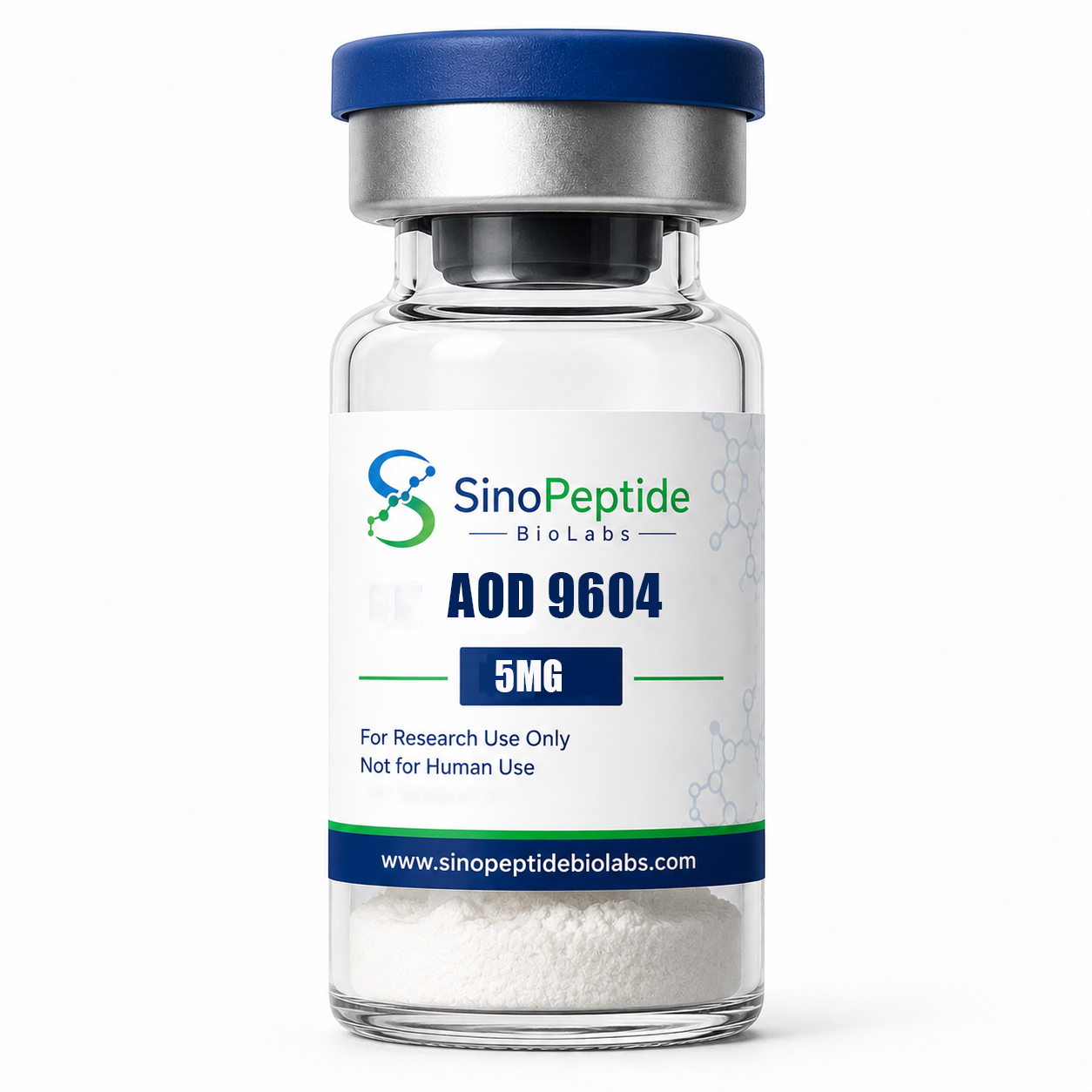
AOD 9604 5mg
$128.00
10 Vials/ Kits
AOD 9604 5mg: Research, Benefits, Safety, Uses & Regulatory Guide
AOD 9604 5mg: A Complete Guide to Research, Benefits, Safety and Regulatory Status
AOD 9604 has attracted considerable interest in peptide and metabolic research because it was developed as a fragment of human growth hormone with the goal of investigating fat metabolism without reproducing the complete range of biological effects associated with full-length growth hormone.
Today, AOD 9604 5mg is frequently searched for in connection with weight management, fat metabolism, peptide research, and experimental body-composition applications. However, online descriptions can sometimes overstate what is actually known about the compound.
A careful review of the scientific and regulatory record presents a more nuanced picture.
AOD-9604 is a synthetic peptide derived from the C-terminal region of human growth hormone. FDA documentation describes it as a 16-amino-acid peptide, corresponding to residues 177–191 of human growth hormone with an additional N-terminal tyrosine.
The compound was investigated as a potential treatment for obesity. Preclinical research generated interest because animal studies suggested effects on lipid metabolism and body fat. Human clinical development subsequently progressed into Phase II studies, but the larger obesity program did not demonstrate a statistically significant weight-loss advantage over placebo, and development for obesity was discontinued.
There are also important regulatory considerations. FDA’s current evaluation states that AOD-9604 is not a component of an FDA-approved drug, and the agency has identified concerns involving immunogenicity, peptide-related impurities and characterization of the active pharmaceutical ingredient.
This article explains what AOD 9604 5mg is, what researchers have studied, what the human evidence shows, how it differs from growth hormone, and why product quality and regulatory status matter.
What Is AOD 9604?
AOD-9604 is a synthetic peptide derived from a portion of human growth hormone.
Its structure is based on the C-terminal region of growth hormone, specifically residues 177–191, with an additional tyrosine residue at the N-terminus. FDA’s Pharmacy Compounding Advisory Committee documentation describes both AOD-9604 free base and AOD-9604 acetate as 16-amino-acid substances.
The compound was developed with a specific research objective: investigate whether some of the fat-metabolism effects associated with growth hormone could be reproduced without producing the broader growth-promoting effects of the intact hormone.
That distinction is central to understanding AOD-9604.
It is not the same thing as recombinant human growth hormone.
Instead, it is a smaller peptide fragment designed to investigate selected biological pathways.
What Does AOD 9604 5mg Mean?
The term AOD 9604 5mg describes a product containing a stated amount of the peptide.
The number 5mg means five milligrams of material.
It should not automatically be interpreted as:
- A clinically validated dose
- A recommended treatment amount
- A standard human dosage
- A proven effective amount
- A specific injection volume
This distinction is particularly important because AOD-9604 has been studied using different formulations, routes, and amounts in different research settings.
For example, historical human obesity studies investigated oral formulations at different amounts, while FDA’s 2024 evaluation considered proposed compounded formulations including subcutaneous, oral, and topical preparations.
Therefore, a website listing AOD 9604 5mg should clearly identify the quantity as a product characteristic rather than presenting it as an established medical dosing recommendation.
AOD-9604 and Human Growth Hormone
AOD-9604 is derived from human growth hormone, but it should not be treated as equivalent to full-length HGH.
Human growth hormone is a much larger protein hormone with a broad range of physiological effects.
It participates in pathways involving:
- Growth
- Protein metabolism
- Lipid metabolism
- Glucose metabolism
- Tissue growth
- IGF-1 signaling
AOD-9604 was designed to investigate a much narrower portion of this biology.
The underlying research question was essentially whether the region of growth hormone associated with fat metabolism could produce metabolic effects without the complete hormone’s growth-promoting activity.
This led to the development of AOD-9604 as an experimental anti-obesity candidate.
How Does AOD-9604 Work?
The proposed mechanism of AOD-9604 has primarily been associated with lipid metabolism.
Preclinical research suggested that the peptide could influence pathways involved in:
- Lipolysis
- Fatty-acid metabolism
- Fat accumulation
- Energy metabolism
Animal research was an important reason the compound attracted attention during its early development.
However, a crucial scientific principle should be emphasized:
A biological mechanism observed in laboratory or animal research does not automatically establish a clinically meaningful effect in humans.
This distinction is especially important for AOD-9604 because the later human obesity-development program did not demonstrate the expected weight-loss benefit in its larger confirmatory study.
AOD-9604 and Fat Metabolism
One of the primary reasons AOD-9604 became popular in peptide research is its proposed relationship with fat metabolism.
The peptide was developed from a region of growth hormone that researchers believed could influence adipose-tissue biology.
Preclinical research investigated whether AOD-9604 could:
- Increase breakdown of stored fat
- Influence fatty-acid oxidation
- Reduce accumulation of body fat
- Affect adipose-tissue metabolism
These findings provided the rationale for human research.
However, the transition from animal models to human outcomes was not straightforward.
FDA’s 2024 review of the evidence concluded that most identified studies failed to show a weight-reduction benefit compared with placebo, and specifically noted that a study involving 536 participants with obesity did not demonstrate significant weight loss compared with placebo. FDA stated that development of AOD-9604 for obesity was subsequently terminated.
Therefore, phrases such as “clinically proven fat burner” or “guaranteed fat-loss peptide” are not supported by the current evidence.
AOD 9604 and Weight Loss Research
Weight loss is the most common reason AOD-9604 is discussed online.
The compound was originally developed specifically as a potential obesity treatment.
Early research generated interest, but the clinical evidence ultimately failed to establish the level of efficacy needed to continue development as an obesity medicine.
FDA’s Pharmacy Compounding Advisory Committee materials summarize the clinical effectiveness evidence and state that most identified studies failed to show a benefit over placebo. The agency also noted the failure of a larger study involving 536 participants and the subsequent termination of the obesity development program.
This is one of the most important facts to include in an accurate AOD-9604 article.
Why the distinction matters
A peptide can have:
- An interesting mechanism
- Positive animal data
- Early human findings
- A plausible metabolic hypothesis
and still fail to demonstrate clinically meaningful efficacy in a larger controlled trial.
AOD-9604 illustrates this distinction particularly well.
AOD-9604 Human Clinical Research
AOD-9604 progressed beyond purely laboratory research and was evaluated in human obesity studies.
FDA’s 2024 briefing materials describe clinical development involving multiple studies and identify a major Phase IIb study in obese adults.
The larger study enrolled approximately 536 participants according to FDA’s summary and investigated AOD-9604 for weight reduction. The agency reported that the study did not find significant weight loss compared with placebo and that the obesity program was discontinued.
Historical sponsor documentation also describes a randomized, double-blind, placebo-controlled trial involving adults with obesity and oral AOD-9604 doses of 0.25mg, 0.5mg, or 1mg daily. The study was designed to evaluate weight loss and safety over an extended treatment period.
This history is important because many modern online claims about AOD-9604 focus heavily on its preclinical research while giving insufficient attention to its larger human obesity trial.
What Did the Human Obesity Trials Show?
The overall clinical record is mixed.
Earlier studies generated signals that contributed to continued development.
However, the larger confirmatory study failed to establish a statistically significant weight-loss advantage over placebo.
FDA summarizes the evidence by stating:
- Most identified studies did not show weight-reduction benefit compared with placebo.
- A study enrolling 536 patients with obesity did not demonstrate significant weight loss compared with placebo.
- Development of AOD-9604 for obesity was terminated.
- FDA found insufficient evidence supporting effectiveness for treatment of obesity.
This means that a scientifically accurate article should not describe AOD-9604 as an established weight-loss treatment.
Instead, it can accurately be described as an experimental peptide that was investigated as an anti-obesity drug but whose obesity development program was discontinued after unsuccessful clinical results.
AOD-9604 Benefits: What Can Actually Be Claimed?
Search engines frequently return pages listing extensive “AOD-9604 benefits.”
These claims need to be separated into three categories.
Established Biological Research
AOD-9604 has been investigated for its relationship with lipid metabolism and fat biology.
Preclinical Findings
Animal and laboratory research generated evidence suggesting potential effects on fat metabolism.
Proven Human Clinical Benefits
This is where the evidence is considerably weaker.
The major human obesity-development program did not demonstrate a statistically significant weight-loss advantage over placebo.
Therefore, responsible website copy should avoid promising:
- Guaranteed fat loss
- Rapid weight loss
- Permanent weight reduction
- Guaranteed body recomposition
- Clinically proven fat burning
Instead, use evidence-based language such as:
“AOD-9604 has been investigated for its potential effects on fat metabolism and obesity, but clinical evidence has not established it as an effective weight-loss treatment.”
AOD-9604 and Body Composition
Body composition refers to the relative amounts of:
- Fat mass
- Lean mass
- Bone
- Water
Because AOD-9604 was developed around fat-metabolism research, body composition became an important research interest.
Preclinical experiments suggested possible effects on adipose tissue.
Some early clinical investigations also examined changes in body composition.
However, body-composition claims should not be generalized beyond the specific study population and methodology.
Importantly, a reduction in scale weight does not automatically demonstrate selective fat loss.
High-quality research needs to distinguish:
Body weight → fat mass → lean mass → metabolic outcomes
These are different measurements.
AOD-9604 vs HGH
AOD-9604 and HGH are related conceptually but are not interchangeable.
| Feature | AOD-9604 | Human Growth Hormone |
|---|---|---|
| Structure | Peptide fragment | Full-length hormone |
| Origin | Synthetic fragment based on HGH sequence | Recombinant human hormone in pharmaceutical products |
| Primary research interest | Fat metabolism/obesity | Growth hormone deficiency and other approved indications |
| Growth-promoting activity | Designed to avoid broad HGH effects | Full biological hormone activity |
| FDA-approved drug component | No | Specific HGH products are FDA approved for defined indications |
| Clinical development | Obesity program discontinued | Established pharmaceutical applications |
AOD-9604 was specifically designed to investigate selected metabolic effects without reproducing the complete activity of HGH.
That does not mean it provides the same clinical benefits as growth hormone.
Is AOD-9604 a Growth Hormone Secretagogue?
No.
AOD-9604 should not be classified as a conventional growth hormone secretagogue.
Growth hormone secretagogues are compounds that stimulate the body to release growth hormone.
AOD-9604 is instead a peptide fragment derived from the growth hormone sequence.
Its development focused primarily on investigating metabolic effects associated with the C-terminal portion of growth hormone.
This distinction can be useful for SEO because users often search for AOD-9604 alongside compounds such as CJC-1295, ipamorelin, GHRP-2 and other peptides.
Those compounds have different mechanisms and should not be presented as interchangeable.
AOD-9604 Safety
Safety is particularly important because AOD-9604 is not an FDA-approved drug for obesity or another human indication.
FDA’s current evaluation states that the agency has identified limited safety-related information for AOD-9604 and has concerns regarding:
- Potential immunogenicity
- Peptide-related impurities
- API characterization
- Peptide aggregation
- Route-specific safety considerations
FDA states that it does not have sufficient information to determine whether compounded AOD-9604 would cause harm when administered to humans and notes that serious adverse events have been identified in the available information, although causality was not established.
This is a major consideration when evaluating AOD 9604 5mg products.
Immunogenicity and AOD-9604
Immunogenicity refers to the potential of a substance to trigger an immune response.
Peptide-based medicines can sometimes generate immune responses because the immune system may recognize the peptide or impurities associated with its manufacture.
FDA specifically identified immunogenicity as a concern for AOD-9604 and noted that the risk may be influenced by factors including:
- Peptide structure
- Aggregation
- Impurities
- Route of administration
The FDA advisory committee materials specifically discuss potential immunogenicity concerns for AOD-9604 free base and AOD-9604 acetate.
This does not mean that every exposure will produce an immune reaction.
It means that the available safety information is insufficient to characterize the risk with the certainty expected for an approved medicine.
AOD-9604 and Product Quality
Product quality is especially important for peptide products.
Two products carrying the same name may not necessarily have identical:
- Purity
- Concentration
- Formulation
- Manufacturing standards
- Storage requirements
- Sterility assurance
- Analytical documentation
FDA has specifically highlighted challenges related to peptide-related impurities and characterization of AOD-9604 active pharmaceutical ingredients.
For this reason, consumers and researchers should evaluate documentation rather than relying solely on marketing descriptions.
AOD-9604 5mg: What to Check on the Label
A product labeled AOD 9604 5mg should ideally provide clear information about:
Active Ingredient
The label should identify AOD-9604 and, where relevant, whether the material is free base or a salt form such as acetate.
Quantity
The product should clearly state that the package contains 5mg of the stated material.
Lot Number
A lot or batch number helps establish traceability.
Expiration Date
The expiration or retest date should be clearly identifiable.
Manufacturer or Supplier
A responsible manufacturer or supplier should be identifiable.
Analytical Documentation
Depending on the product category, appropriate documentation may include:
- Certificate of analysis
- Identity testing
- Purity testing
- Peptide characterization
- Batch information
A generic laboratory document should not automatically be treated as proof that a particular vial contains the stated amount or purity.
AOD-9604 Sterility Considerations
For products intended for injection, sterility is a critical quality attribute.
AOD-9604 has been sold in various online contexts as an injectable research peptide, but the existence of an injectable product does not establish that it has appropriate pharmaceutical sterility assurance.
FDA has previously posted a recall involving compounded injectable AOD-9604 products because of a lack of assurance of sterility. The 2021 recall involved 3mg injectable AOD-9604 products from Innoveix Pharmaceuticals and stated that administration of a sterile-intended product that is not sterile can result in serious, potentially life-threatening infections.
This was a specific historical recall and should not be interpreted as evidence that every AOD-9604 product is contaminated.
It does, however, demonstrate why sterile manufacturing and quality controls matter for injectable peptide products.
Is AOD-9604 FDA Approved?
No FDA-approved drug containing AOD-9604 is currently identified in the FDA materials reviewed for this article.
FDA’s Pharmacy Compounding Advisory Committee documentation states that neither AOD-9604 free base nor AOD-9604 acetate is a component of an FDA-approved drug.
FDA’s current bulk-substance evaluation also identifies significant safety concerns associated with compounded AOD-9604.
The FDA Substance Registration System contains an entry for AOD-9604, but FDA explicitly explains that the existence of a UNII does not imply regulatory review or approval.
Therefore:
AOD-9604 should not be marketed as an FDA-approved weight-loss medication.
AOD-9604 and Compounding
Compounding is another important regulatory issue.
FDA’s 2024 advisory materials reviewed AOD-9604 free base and AOD-9604 acetate in the context of potential inclusion on the 503A bulk drug substances list.
The agency’s evaluation raised concerns about the safety and characterization of these substances.
FDA’s current page on certain bulk drug substances states that compounded drugs containing AOD-9604 may present significant safety risks and notes limited safety information, potential immunogenicity concerns and complexities involving peptide-related impurities and API characterization.
This regulatory information is especially relevant to websites selling or discussing compounded AOD-9604 products.
AOD 9604 5mg: Research Product vs Pharmaceutical Medicine
One of the most important distinctions for online product content is whether a product is:
- An approved pharmaceutical
- A compounded drug
- A research-use product
- A laboratory reagent
- A supplement
- An unregulated online product
These categories have very different regulatory and quality requirements.
AOD-9604 does not currently have FDA approval as a pharmaceutical medicine.
Therefore, websites should avoid language suggesting that an AOD 9604 5mg product is equivalent to an FDA-approved obesity medication.
AOD-9604 and Weight Management
The popularity of AOD-9604 is largely connected to weight-management claims.
However, the human clinical evidence needs to be placed at the center of the discussion.
The compound was specifically developed for obesity research, but the larger clinical program did not demonstrate the required efficacy compared with placebo.
FDA’s review concluded that there was a lack of evidence supporting effectiveness for treating obesity.
This is particularly important in 2026 because the obesity-treatment landscape has changed considerably since AOD-9604 was originally investigated.
Multiple FDA-approved medications now exist for chronic weight management, depending on patient characteristics and indication.
AOD-9604 should therefore not be represented as an established substitute for approved obesity treatments.
AOD-9604 Mechanism vs Marketing Claims
AOD-9604 is often marketed using phrases such as:
- “fat-burning peptide”
- “HGH fragment for fat loss”
- “next-generation weight-loss peptide”
- “non-growth-promoting HGH fragment”
- “advanced fat-loss peptide”
Some of these descriptions refer to the original rationale for developing the molecule.
However, marketing language should not be confused with clinical evidence.
The more precise description is:
AOD-9604 is a synthetic peptide fragment derived from human growth hormone that was investigated for potential effects on fat metabolism and obesity. Its larger obesity-development program failed to demonstrate significant weight-loss efficacy versus placebo, and the program was discontinued.
This wording is both more scientifically defensible and more useful for readers.
AOD-9604 Research in Animals
Before human trials, AOD-9604 attracted attention because of experimental research involving animal models.
Preclinical studies investigated whether the peptide could influence:
- Fat accumulation
- Lipid metabolism
- Fatty-acid oxidation
- Body weight
- Adipose tissue
These findings helped establish the hypothesis that AOD-9604 might provide metabolic effects without the broader growth-related activity of full-length growth hormone.
But animal studies cannot establish human efficacy.
Differences in:
- Metabolism
- Peptide exposure
- Pharmacokinetics
- Receptor biology
- Dosing
- Disease state
can all affect whether a result translates successfully to humans.
AOD-9604 is a useful example of why promising preclinical results need to be validated through controlled clinical trials.
Why AOD-9604 Did Not Become an Approved Obesity Drug
Drug development requires more than demonstrating a plausible biological mechanism.
A candidate must ultimately demonstrate an acceptable balance between:
Efficacy + Safety + Quality + Reproducibility
AOD-9604 generated enough preclinical interest to enter human clinical development.
However, the larger obesity program did not demonstrate sufficient weight-loss efficacy compared with placebo.
FDA’s 2024 evaluation specifically states that development for obesity was terminated following the unsuccessful study.
This explains why AOD-9604 remains a research topic rather than an established FDA-approved obesity medication.
AOD 9604 5mg: Important Product Considerations
If a website is creating a product page for AOD 9604 5mg, the content should clearly separate product specifications from medical claims.
A useful product page can describe:
- Product name
- Amount: 5mg
- Peptide identity
- Research background
- Molecular description
- Quality documentation
- Packaging
- Storage information supplied by the manufacturer
- Regulatory status
- Research-use limitations
It should avoid unsupported claims such as:
- Guaranteed weight loss
- Guaranteed fat burning
- Guaranteed appetite suppression
- Guaranteed muscle preservation
- Clinically proven obesity treatment
- FDA-approved weight-loss therapy
This approach creates more trustworthy content and reduces the risk of misleading health claims.
Frequently Asked Questions About AOD 9604 5mg
What is AOD 9604 5mg?
AOD 9604 5mg refers to a product containing a stated 5mg quantity of AOD-9604. The 5mg designation describes the amount of peptide and should not automatically be interpreted as a recommended clinical dose.
What is AOD-9604?
AOD-9604 is a synthetic 16-amino-acid peptide derived from the C-terminal region of human growth hormone. It was developed primarily for research into fat metabolism and obesity.
Is AOD-9604 a form of HGH?
AOD-9604 is derived from a portion of the human growth hormone sequence, but it is not full-length human growth hormone.
Does AOD-9604 cause weight loss?
Clinical research has not established AOD-9604 as an effective weight-loss treatment. FDA’s review reported that a large obesity study failed to demonstrate significant weight loss compared with placebo and that development for obesity was discontinued.
Is AOD-9604 FDA approved?
AOD-9604 is not a component of an FDA-approved drug. FDA has also raised safety concerns regarding its use in compounded drug products.
What does 5mg mean?
Five milligrams refers to the amount of material in the product. It is not automatically a validated human dose.
Is AOD-9604 a growth hormone secretagogue?
No. AOD-9604 is a peptide fragment derived from human growth hormone rather than a conventional growth hormone secretagogue.
What are the proposed benefits of AOD-9604?
Research has investigated AOD-9604 for effects involving fat metabolism and obesity. However, the larger human obesity program did not establish significant weight-loss efficacy compared with placebo.
Is AOD-9604 safe?
The available safety information is limited. FDA has identified concerns involving potential immunogenicity, peptide-related impurities and difficulties in characterizing the active ingredient.
Has AOD-9604 been studied in humans?
Yes. AOD-9604 progressed into human clinical research for obesity. FDA’s review identifies a large study involving approximately 536 participants and reports that it did not demonstrate significant weight loss compared with placebo.
Is AOD-9604 the same as semaglutide?
No. AOD-9604 and semaglutide are structurally and pharmacologically different compounds. Semaglutide is an approved prescription medicine for specific indications, while AOD-9604 is not an FDA-approved drug.
Is AOD-9604 a peptide for fat loss?
It was developed and researched as a potential anti-obesity peptide, but available clinical evidence does not establish it as an effective weight-loss treatment.
Final Thoughts on AOD 9604 5mg
AOD-9604 remains an interesting compound in peptide and metabolic research because it was specifically designed to investigate selected fat-metabolism effects associated with a fragment of human growth hormone.
Its scientific history includes encouraging preclinical research and early clinical development, but the larger human obesity program produced an important negative result.
FDA’s review states that the major obesity study involving approximately 536 participants did not demonstrate significant weight loss compared with placebo and that development for obesity was subsequently terminated. The agency concluded that there is insufficient evidence supporting AOD-9604’s effectiveness for treating obesity.
The safety picture also deserves careful attention. FDA has identified limited safety information and concerns involving immunogenicity, peptide-related impurities, aggregation and API characterization.
For a product listed as AOD 9604 5mg, the “5mg” designation should be understood as a quantity rather than a validated human dosage.
For SEO purposes, the strongest approach is not to rely on exaggerated weight-loss claims. Instead, the page should provide useful information about the compound’s identity, scientific background, human clinical evidence, limitations, regulatory status and product-quality considerations.
That approach creates content that is both search-friendly and more credible for readers researching AOD-9604.
AOD 9604 5mg AOD 9604 5mg AOD 9604 5mg AOD 9604 5mg AOD 9604 5mg AOD 9604 5mg AOD 9604 5mg AOD 9604 5mg AOD 9604 5mg AOD 9604 5mgAOD 9604 5mg AOD 9604 5mg AOD 9604 5mg AOD 9604 5mg AOD 9604 5mg AOD 9604 5mg AOD 9604 5mg AOD 9604 5mg AOD 9604 5mg AOD 9604 5mg AOD 9604 5mg
Be the first to review “AOD 9604 5mg”
Related products
Pure Peptides
Pure Peptides
Pure Peptides
Pure Peptides
Pure Peptides
Pure Peptides
Pure Peptides
Pure Peptides
Reviews
There are no reviews yet.