
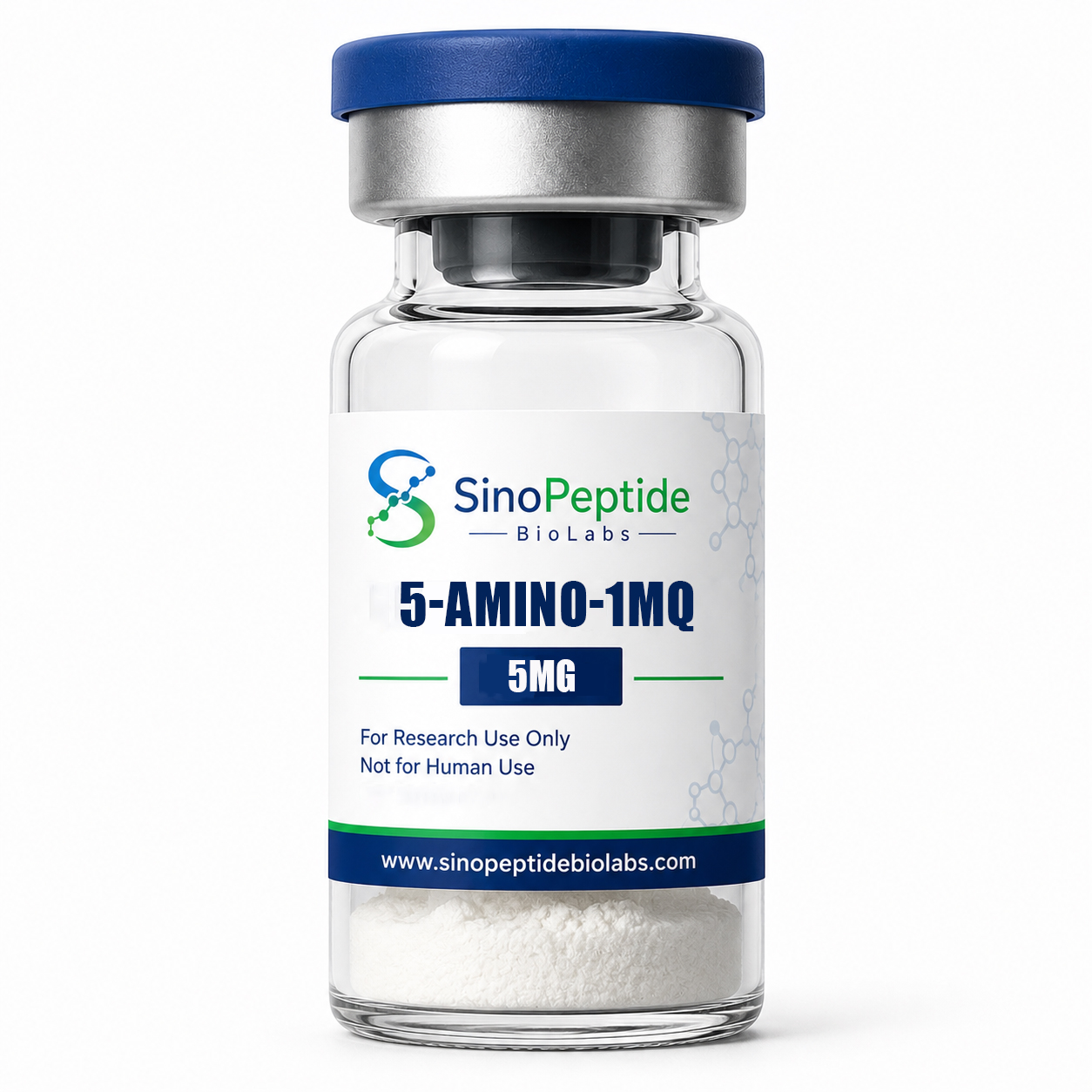
5-amino 1mq 5mg
$75.00
10 Vials/Kits
5-Amino 1MQ 5mg: Research, Mechanism, Benefits, Safety & Evidence
What Is 5-Amino 1MQ 5mg?
5-Amino 1MQ 5mg refers to a 5-milligram quantity of 5-amino-1-methylquinolinium, a synthetic small molecule investigated primarily as an inhibitor of nicotinamide N-methyltransferase (NNMT).
One important point for accurate product information is that 5-Amino-1MQ is not a peptide. It is a small-molecule quinolinium compound. It is sometimes grouped with research peptides because commercial research suppliers may list it alongside peptides and other metabolic research compounds, but its chemical structure and pharmacology are different.
Research interest in 5-Amino-1MQ comes largely from the biological role of NNMT. This enzyme participates in the metabolism of nicotinamide and uses S-adenosylmethionine (SAM) as a methyl donor. Researchers have investigated whether inhibiting NNMT can alter cellular methylation chemistry, nicotinamide metabolism, NAD+ availability and metabolic pathways.
Early experimental studies produced interesting findings in cultured cells and mice, particularly in models of diet-induced obesity. However, these findings should not be presented as proof that 5-Amino-1MQ produces the same effects in humans.
The distinction between preclinical research and human clinical evidence is particularly important when discussing 5-Amino 1MQ 5mg.
5-Amino 1MQ 5mg at a Glance
| Feature | Research information |
|---|---|
| Compound | 5-Amino-1-methylquinolinium |
| Common name | 5-Amino-1MQ |
| Compound class | Synthetic small molecule |
| Peptide? | No |
| Primary research target | NNMT |
| Full enzyme name | Nicotinamide N-methyltransferase |
| Main research area | Metabolism and cellular biology |
| Evidence level | Primarily preclinical |
| Human clinical evidence | No established clinical efficacy or safety evidence identified |
| 5mg designation | Quantity of material, not a validated human dose |
| Common research models | Cell cultures and rodents |
| Human therapeutic approval | No established approved medical indication |
The 5mg amount should therefore be understood as a product quantity or research-material quantity, rather than as evidence of an appropriate human dose.
What Is 5-Amino-1MQ?
5-Amino-1MQ is a synthetic compound developed during research into inhibitors of nicotinamide N-methyltransferase (NNMT).
NNMT is an enzyme involved in methylation metabolism. It catalyzes the methylation of nicotinamide, producing 1-methylnicotinamide (1-MNA). Because nicotinamide is also connected to NAD+ salvage pathways, researchers have investigated whether altering NNMT activity can influence cellular metabolic processes.
The compound attracted attention after researchers identified membrane-permeable NNMT inhibitors capable of modifying NNMT activity inside cells.
In laboratory studies, 5-Amino-1MQ demonstrated inhibitory activity against NNMT and reduced intracellular production of 1-MNA in cultured adipocytes. Researchers also observed changes in NAD+ and SAM-related measurements under experimental conditions.
These observations provide a scientific rationale for continuing research into NNMT inhibition. They do not, however, establish that taking 5-Amino-1MQ produces a particular clinical outcome in people.
How Does 5-Amino-1MQ Work?
The central research mechanism involves inhibition of NNMT.
To understand why this matters, it helps to look at the pathway.
NNMT uses nicotinamide as a substrate and SAM as a methyl donor. The reaction produces 1-MNA. Researchers have proposed that elevated NNMT activity can influence the balance between methyl-donor metabolism and NAD+ salvage.
5-Amino-1MQ was designed to interfere with NNMT activity.
In experimental adipocyte systems, researchers reported that 5-Amino-1MQ reduced intracellular 1-MNA concentrations. The same research program found changes in cellular NAD+ levels at some tested concentrations.
This led to a research hypothesis:
NNMT inhibition → reduced nicotinamide methylation → altered cellular NAD+/methylation metabolism → potential changes in metabolic function.
However, biological pathways are more complicated than a single linear sequence. Changes observed in cultured cells do not necessarily translate into predictable effects in humans.
For that reason, it is more accurate to describe 5-Amino-1MQ as an experimental NNMT inhibitor rather than a proven metabolic treatment.
5-Amino-1MQ and NNMT
NNMT has become an area of interest in metabolic research because researchers have identified associations between NNMT expression and metabolic conditions.
A review of NNMT research describes the enzyme as being involved in nicotinamide metabolism and discusses its potential relationship with obesity and type 2 diabetes research. The review also summarizes experimental findings involving 5-Amino-1MQ.
Researchers are particularly interested in adipose tissue because NNMT activity may influence the metabolic environment within adipocytes.
In experimental models, NNMT inhibition has been associated with:
- Lower 1-MNA production
- Changes in NAD+ levels
- Changes in SAM-related metabolism
- Altered adipocyte metabolism
- Reduced adipose tissue mass in certain mouse experiments
- Changes in body weight in diet-induced obese mice
These findings explain why 5-Amino-1MQ has become an interesting compound in metabolic research.
They should not be interpreted as evidence that the compound is a clinically proven weight-management treatment.
5-Amino 1MQ 5mg and Weight Loss Research
Weight management is one of the most common reasons people search for 5-Amino 1MQ 5mg online.
However, an evidence-based article needs to distinguish between weight-loss research in animals and demonstrated weight-loss effects in humans.
In a 2018 study, researchers investigated selective, membrane-permeable NNMT inhibitors in diet-induced obese mice. The study included 5-Amino-1MQ and reported reductions in body weight and adipose tissue measurements under the experimental conditions.
The researchers conducted experiments in cultured adipocytes as well as obese mice. In the mouse experiment, 5-Amino-1MQ treatment was associated with progressive body-weight reduction over the study period.
These results are scientifically relevant because they support further investigation of NNMT as a metabolic target.
But the study was conducted in mice, not people.
Therefore, statements such as “5-Amino 1MQ 5mg causes weight loss” or “5-Amino 1MQ is a proven fat burner” would go beyond the available evidence.
A more accurate description is:
5-Amino-1MQ has demonstrated metabolic and body-weight effects in certain preclinical models, but human efficacy has not been established.
That distinction is important for medically responsible SEO content.
Does 5-Amino-1MQ Increase NAD+?
NAD+ is an important cellular cofactor involved in energy metabolism and numerous biochemical reactions.
Because NNMT consumes nicotinamide, researchers have investigated whether inhibiting NNMT could influence the availability of nicotinamide for NAD+ salvage.
In cultured adipocytes, the foundational 5-Amino-1MQ research reported concentration-dependent increases in NAD+ measurements across some experimental concentrations, with a statistically significant increase reported at one tested concentration.
This finding is interesting but should not be converted into a claim that 5-Amino 1MQ 5mg reliably increases NAD+ in humans.
There are several steps between:
cell culture observation → animal pharmacology → human pharmacology → clinical benefit.
The first two stages do not automatically establish the latter two.
Therefore, claims such as “5-Amino 1MQ boosts NAD+ in humans” should be avoided unless supported by appropriate human clinical research.
5-Amino 1MQ 5mg Research Applications
Because 5-Amino-1MQ directly targets NNMT, researchers may use the compound as a pharmacological tool for investigating cellular metabolism.
Potential research areas include:
1. NNMT biology
5-Amino-1MQ can be used in experimental systems designed to investigate the biological consequences of NNMT inhibition.
2. Adipocyte research
Cultured adipocytes have been used to investigate the effects of NNMT inhibition on 1-MNA, NAD+ and related metabolic pathways.
3. Obesity models
Diet-induced obese mice have been used to investigate whether NNMT inhibition influences body weight, adipose tissue and metabolic parameters.
4. Cellular metabolism
The relationship between NNMT, nicotinamide metabolism, SAM and NAD+ makes the compound useful for mechanistic laboratory investigations.
5. Drug-discovery research
5-Amino-1MQ also contributes to the broader research program investigating NNMT as a potential therapeutic target.
The important qualification is that research use does not mean established therapeutic use.
5-Amino-1MQ 5mg: What Does “5mg” Mean?
The term 5mg simply refers to the nominal amount of compound.
It should not automatically be interpreted as:
- A recommended human dose
- A clinically tested dose
- A therapeutic dose
- A daily dose
- A validated weight-loss dose
This distinction is especially important because the available efficacy literature involves experimental concentrations and animal doses rather than an established human dosing regimen.
For example, the 2018 mouse study used experimental dosing conditions that cannot simply be converted into a human recommendation.
Animal pharmacology is useful for drug discovery, but animal doses cannot be treated as instructions for human use.
Is There a Human Dose for 5-Amino 1MQ 5mg?
There is currently no established, clinically validated human dose that can be recommended on the basis of published clinical evidence.
The published research has focused on laboratory experiments and animal models. Current evidence reviews also describe the human evidence gap and report no established human clinical efficacy or safety profile for 5-Amino-1MQ.
Consequently, websites should avoid publishing a specific “5-Amino-1MQ 5mg dosage protocol” as though it were medically established.
The phrase 5mg describes the quantity of material in a research product; it does not establish that 5mg is an appropriate amount for human administration.
Is 5-Amino-1MQ FDA Approved?
5-Amino-1MQ should not be marketed as an FDA-approved weight-loss medication, metabolic treatment or longevity drug.
The available evidence describes it as an experimental research compound, and current literature does not establish an approved therapeutic indication.
Regulatory status can differ by jurisdiction and can change over time, so websites selling or discussing research compounds should avoid broad statements such as “legal everywhere” or “approved for human use.”
For a research product page, the safer and more accurate wording is:
“5-Amino-1MQ is an experimental research compound and is not presented as an approved human medicine.”
Is 5-Amino-1MQ a Peptide?
No.
This is one of the most important corrections for SEO and scientific accuracy.
5-Amino-1MQ is a small molecule, not a peptide.
A peptide consists of amino-acid residues connected through peptide bonds. 5-Amino-1MQ instead belongs to the quinolinium small-molecule chemical class.
It is sometimes categorized alongside research peptides because of the types of suppliers and online communities that discuss it, but this commercial grouping does not change its chemistry.
Therefore, SEO content should use phrases such as:
- 5-Amino-1MQ research compound
- 5-Amino-1MQ NNMT inhibitor
- 5-Amino-1MQ small molecule
- 5-Amino-1-methylquinolinium
rather than repeatedly calling it a peptide.
5-Amino-1MQ vs Peptides
The distinction between 5-Amino-1MQ and peptide compounds can be summarized simply.
| Characteristic | 5-Amino-1MQ | Peptide |
|---|---|---|
| Chemical type | Small molecule | Amino-acid chain |
| Peptide bonds | No | Yes |
| Primary research target | NNMT | Depends on peptide |
| Molecular structure | Quinolinium-based | Amino-acid sequence |
| Typical research | Enzyme inhibition/metabolism | Receptor, signaling or other biological pathways |
| Evidence depends on compound | Yes | Yes |
This distinction helps prevent misleading product descriptions and improves topical relevance for search engines.
Potential Research Benefits of 5-Amino-1MQ
The word “benefits” needs to be used carefully.
For an experimental compound, it is more accurate to discuss research findings rather than guaranteed benefits.
Research involving 5-Amino-1MQ has investigated:
- NNMT inhibition
- Cellular 1-MNA reduction
- NAD+ metabolism
- Adipocyte biology
- Lipogenesis-related pathways
- Body weight in obese mouse models
- Adipose tissue measurements
- Broader metabolic mechanisms
The foundational mouse research reported reduced body weight and adipose tissue measurements following NNMT inhibitor treatment.
These findings are reasons for continued scientific interest, not proof of clinical effectiveness.
5-Amino-1MQ and Metabolic Research
Metabolic research involving NNMT is broader than the study of weight alone.
Researchers are interested in how NNMT connects:
nicotinamide metabolism + methylation chemistry + NAD+ salvage + cellular metabolism.
This makes NNMT a potentially useful biological target for experimental research.
Importantly, evidence about NNMT as a target should not automatically be described as evidence for 5-Amino-1MQ as a treatment.
Different NNMT inhibitors can have different:
- Potency
- Selectivity
- Pharmacokinetics
- Tissue distribution
- Bioavailability
- Toxicology
- Off-target effects
Therefore, results obtained with another NNMT inhibitor should not automatically be attributed to 5-Amino-1MQ.
What Does the Research Actually Show?
The evidence can be divided into several levels.
Laboratory evidence
Cellular and biochemical experiments support the ability of 5-Amino-1MQ to inhibit NNMT and alter related metabolic measurements.
Animal evidence
Mouse studies have reported changes in body weight and adipose tissue in diet-induced obesity models.
Human evidence
There is no established clinical evidence demonstrating that 5-Amino-1MQ produces weight loss, improves metabolic disease, increases NAD+ in humans, or has a defined long-term safety profile.
This evidence hierarchy should remain visible throughout any high-quality article about 5-Amino 1MQ 5mg.
5-Amino-1MQ Safety Considerations
Safety is one of the largest unanswered questions surrounding experimental 5-Amino-1MQ.
Short-term observations in laboratory animals cannot establish a comprehensive human safety profile.
A study may report no obvious adverse effects during a particular experimental period, but that does not establish:
- Long-term human safety
- Reproductive safety
- Drug-interaction safety
- Safety during pregnancy
- Safety in people with liver disease
- Safety in people with kidney disease
- Safety in people taking metabolic medications
- Safe chronic exposure levels
Because human clinical data are not established, there is also no reliable human adverse-event frequency that can be used to reassure consumers.
For this reason, 5-Amino-1MQ should be described in research-oriented language rather than presented as a proven consumer health product.
Why Human Research Matters
Animal studies are an important part of drug development, but they cannot answer every question.
Human research is required to determine:
- Whether the compound is adequately absorbed.
- How it distributes throughout the body.
- How quickly it is metabolized.
- How it is eliminated.
- Whether its biological target is affected at clinically relevant exposure.
- Whether the observed animal effects occur in humans.
- What adverse effects occur in humans.
- Whether long-term exposure is safe.
Current 5-Amino-1MQ evidence does not provide those answers.
This is why responsible SEO content should not transform mouse results into human health promises.
How to Evaluate a 5-Amino 1MQ 5mg Research Product
If a website is publishing a product page for research purposes, product-quality information is more useful than unsupported health claims.
Consider documenting:
Compound identity
The product should clearly identify the compound as 5-Amino-1MQ or 5-amino-1-methylquinolinium.
Quantity
A “5mg” label should clearly indicate the stated quantity of material.
Batch information
A batch or lot number allows researchers to associate the product with its documentation.
Certificate of Analysis
Where available, a current COA should provide relevant analytical information rather than simply displaying a generic certificate.
Analytical characterization
Depending on the material and supplier, appropriate analytical methods may include chromatographic or spectrometric characterization.
Storage information
Storage recommendations should come from the actual manufacturer’s validated product documentation rather than from generic assumptions about research chemicals.
Intended use
A research product page should clearly distinguish laboratory research from medical treatment.
5-Amino-1MQ 5mg and Research Quality
Product quality matters because experimental results depend on the identity and integrity of the material being studied.
A research laboratory evaluating a 5mg material may want to verify:
- Identity
- Purity
- Lot number
- Assay information
- Analytical method
- Manufacturing documentation
- Storage conditions
- Expiration or retest information
- Certificate of Analysis
A high-quality product page should avoid presenting “99% purity” or similar numbers without supporting batch-specific analytical documentation.
The exact formulation, salt form and analytical specification should be confirmed using the manufacturer’s documentation.
Is 5-Amino-1MQ the Same as 1-MNA?
No.
These compounds are related within the NNMT pathway but are not the same chemical.
5-Amino-1MQ is an NNMT inhibitor.
1-MNA, or 1-methylnicotinamide, is a product generated by NNMT-mediated methylation of nicotinamide.
This distinction matters because NNMT inhibition with 5-Amino-1MQ can reduce production of 1-MNA in experimental systems.
Using these names interchangeably would therefore be scientifically incorrect.
Is 5-Amino-1MQ the Same as NMN?
No.
5-Amino-1MQ and NMN are chemically and biologically different.
NMN is a nicotinamide mononucleotide involved in the NAD+ biosynthetic pathway.
5-Amino-1MQ is an experimental inhibitor of NNMT.
They should not be described as interchangeable NAD+-related compounds.
Is 5-Amino-1MQ the Same as GLP-1?
No.
5-Amino-1MQ and GLP-1 receptor agonists belong to entirely different pharmacological categories.
5-Amino-1MQ is an experimental small-molecule NNMT inhibitor.
GLP-1 receptor agonists are established pharmaceutical agents that act through the GLP-1 receptor and have clinical evidence for specific indications.
Therefore, 5-Amino-1MQ should not be marketed as a “GLP-1 alternative” or as an equivalent weight-management treatment.
Frequently Asked Questions About 5-Amino 1MQ 5mg
What is 5-Amino 1MQ 5mg?
5-Amino 1MQ 5mg refers to a 5-milligram quantity of 5-Amino-1MQ, a synthetic small molecule investigated as an inhibitor of nicotinamide N-methyltransferase (NNMT).
Is 5-Amino-1MQ a peptide?
No. It is a small-molecule quinolinium compound, not a peptide.
What does 5-Amino-1MQ target?
Its primary research target is the enzyme nicotinamide N-methyltransferase, or NNMT.
Why is 5-Amino-1MQ studied?
Researchers study it because NNMT participates in nicotinamide and methylation metabolism. Experimental studies have investigated how inhibiting NNMT affects cellular metabolism and adipose tissue biology.
Has 5-Amino-1MQ been studied for weight loss?
Yes, but the important evidence comes from preclinical research. Mouse studies have reported reductions in body weight and adipose tissue under experimental conditions.
Does 5-Amino-1MQ cause weight loss in humans?
Human efficacy has not been established. Animal findings should not be presented as proof of human weight-loss effects.
Does 5-Amino-1MQ increase NAD+?
Cell studies have reported changes in NAD+ measurements following NNMT inhibition, including increases under certain experimental conditions. This does not establish a clinically meaningful NAD+ increase in humans.
Is 5-Amino-1MQ FDA approved?
It should not be presented as an FDA-approved treatment. Current evidence does not establish an approved medical indication.
Is 5mg a recommended human dose?
No. The 5mg designation describes an amount of material and should not be represented as a clinically validated human dose.
Are there human safety studies of 5-Amino-1MQ?
A comprehensive human safety profile has not been established through clinical trials.
Can 5-Amino-1MQ replace approved weight-loss medications?
It should not be presented as a replacement for clinically established treatments. Its evidence base is fundamentally different and remains preclinical.
What is the difference between 5-Amino-1MQ and 1-MNA?
5-Amino-1MQ is an NNMT inhibitor, while 1-MNA is a product of the NNMT-mediated methylation of nicotinamide.
What should researchers check when evaluating a 5mg product?
Researchers should verify compound identity, quantity, batch information, analytical documentation, COA information and appropriate storage requirements.
Final Thoughts on 5-Amino 1MQ 5mg
5-Amino 1MQ 5mg is an interesting experimental research compound with a clearly defined biological target: nicotinamide N-methyltransferase (NNMT).
The compound is particularly notable because researchers have reported NNMT inhibition, reduced 1-MNA production and metabolic changes in cellular models. In diet-induced obese mice, experimental treatment with 5-Amino-1MQ has also been associated with reductions in body weight and adipose tissue.
However, the evidence has an important boundary.
These findings are preclinical. They do not establish that 5-Amino-1MQ produces the same effects in humans, nor do they establish a validated human dose or long-term safety profile.
For this reason, the most scientifically accurate way to describe 5-Amino 1MQ 5mg is as an experimental NNMT inhibitor used in metabolic and cellular research.
For SEO purposes, accurate terminology is also important. The compound should not repeatedly be called a peptide, a proven fat burner, a clinically proven weight-loss compound, or an approved medicine. Instead, content should naturally incorporate relevant terms such as 5-Amino-1MQ research, 5-Amino-1MQ NNMT inhibitor, 5-Amino 1MQ 5mg, 5-amino-1-methylquinolinium, and NNMT inhibition research.
That approach creates useful topical coverage while keeping the article aligned with the scientific evidence currently available.
5-amino 1MQ 5mg 5-amino 1MQ 5mg 5-amino 1MQ 5mg 5-amino 1MQ 5mg 5-amino 1MQ 5mg 5-amino 1MQ 5mg 5-amino 1MQ 5mg 5-amino 1MQ 5mg 5-amino 1MQ 5mg 5-amino 1MQ 5mg 5-amino 1MQ 5mg 5-amino 1MQ 5mg 5-amino 1MQ 5mg 5-amino 1MQ 5mg 5-amino 1MQ 5mg 5-amino 1MQ 5mg 5-amino 1MQ 5mg 5-amino 1MQ 5mg 5-amino 1MQ 5mg 5-amino 1MQ 5mg 5-amino 1MQ 5mg 5-amino 1MQ 5mg 5-amino 1MQ 5mg 5-amino 1MQ 5mg 5-amino 1MQ 5mg 5-amino 1MQ 5mg 5-amino 1MQ 5mg 5-amino 1MQ 5mg 5-amino 1MQ 5mg 5-amino 1MQ 5mg 5-amino 1MQ 5mg 5-amino 1MQ 5mg 5-amino 1MQ 5mg
Be the first to review “5-amino 1mq 5mg”
Related products
Pure Peptides
Pure Peptides
Pure Peptides
Pure Peptides
Pure Peptides
Pure Peptides
Pure Peptides
Pure Peptides
Reviews
There are no reviews yet.