
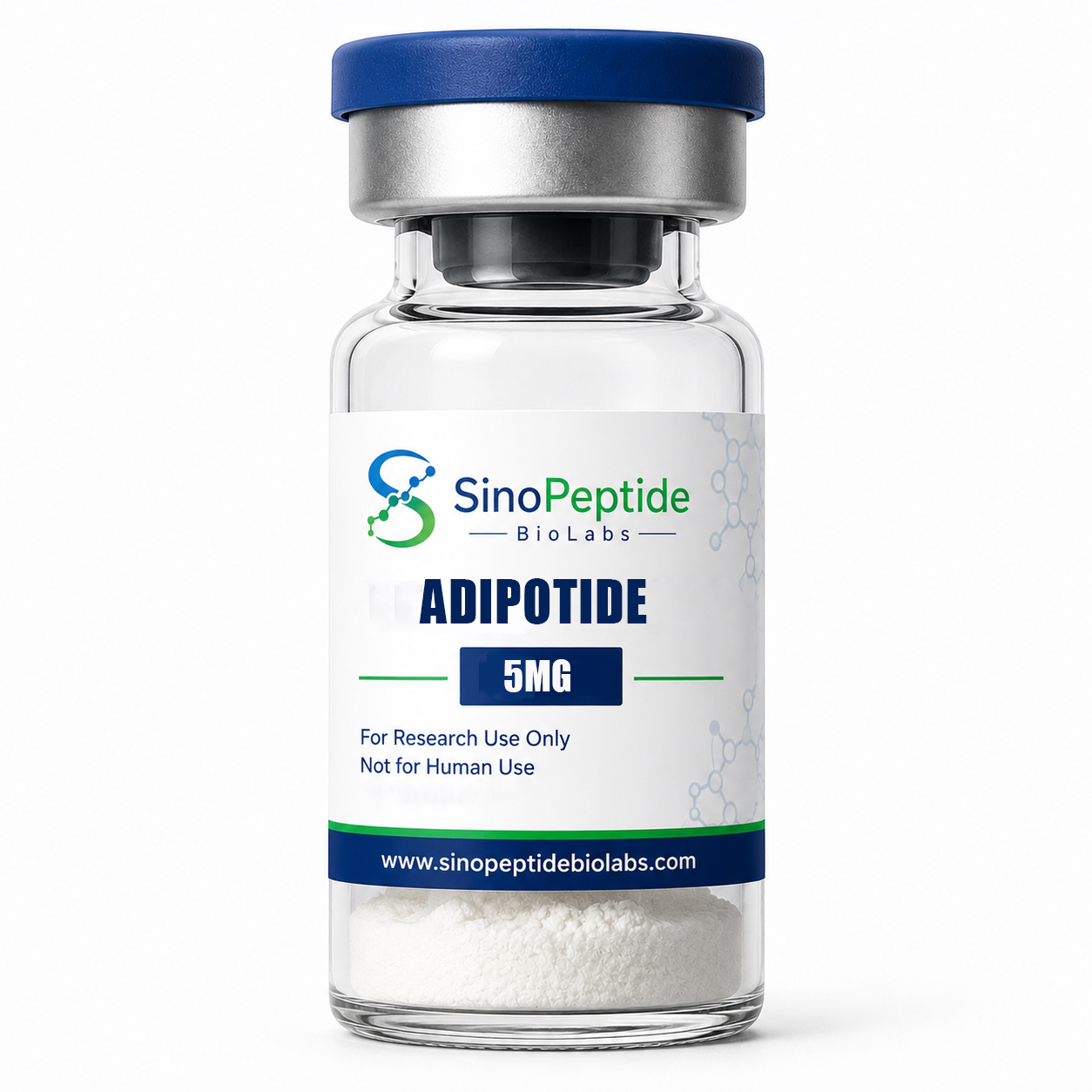
ADIPOTIDE 5MG
$185.00
Adipotide 5mg: Research, Uses, Mechanism, Safety and Scientific Information
Adipotide 5mg is a research peptide that has attracted attention because of its experimental approach to targeting adipose tissue and its potential role in obesity research. Also known as FTPP or prohibitin-targeting peptide, Adipotide is a synthetic peptidomimetic designed to target blood vessels associated with white adipose tissue.
Unlike approved medicines for weight management, Adipotide is not an established obesity treatment. Research has primarily focused on laboratory and animal models, including studies investigating its ability to target the vascular supply associated with fat tissue. A notable primate study reported reductions in body weight and abdominal fat, but kidney-related toxicity was also observed.
The term “5mg” refers to the amount of research compound contained in a particular product presentation. It does not represent an approved human dose or indicate that 5 mg is an appropriate amount for human administration.
This distinction is particularly important because products marketed online as Adipotide 5mg are generally labeled for research use only, rather than as approved medicines for human consumption. Current commercial research listings describe 5 mg presentations as lyophilized research material and explicitly state that they are not intended for human or veterinary use.
This guide explains what Adipotide 5mg is, how it has been investigated, its proposed mechanism of action, research applications, safety considerations, regulatory status, storage considerations for legitimate laboratory materials, and frequently asked questions.
What Is Adipotide 5mg?
Adipotide 5mg is a 5-milligram research presentation of Adipotide, an experimental synthetic peptide also referred to as FTPP.
Adipotide is structurally different from conventional weight-loss medicines. It was designed as a targeted molecule containing two functional components: a targeting sequence and a pro-apoptotic sequence.
The targeting component is intended to recognize prohibitin-associated structures on the vasculature of white adipose tissue. The pro-apoptotic component is designed to disrupt mitochondrial membranes after being delivered to the target cells.
This approach made Adipotide scientifically interesting because researchers were investigating whether selectively affecting the blood vessels associated with white adipose tissue could lead to changes in adipose tissue mass.
However, the experimental mechanism should not be confused with established clinical efficacy.
Adipotide has not become an approved treatment for obesity, and there is no validated human treatment regimen.
What Does 5mg Mean?
The 5mg designation indicates the nominal quantity of Adipotide contained in a particular research product.
It is important to distinguish:
- 5 mg — quantity of compound
- Concentration — amount of compound per volume after preparation
- Dose — amount administered in a specific research protocol
- Vial size — amount supplied by the manufacturer
These terms are not interchangeable.
Most importantly, a 5 mg research vial should not be interpreted as a recommended human dose. There is no established safe and effective human dosage for Adipotide.
Adipotide Also Known as FTPP
Adipotide is commonly associated with several names in research literature and commercial research catalogs.
These include:
- Adipotide
- FTPP
- Prohibitin-targeting peptide
- Prohibitin-targeting peptide 1
- Prohibitin-targeted peptidomimetic
The exact terminology can vary depending on the scientific source or supplier.
For SEO purposes, websites discussing Adipotide may naturally encounter searches such as Adipotide 5mg, Adipotide peptide, FTPP peptide, Adipotide research peptide, and Adipotide weight loss.
However, content should clearly distinguish research findings from proven medical benefits.
How Does Adipotide Work?
Adipotide was designed around a targeted mechanism involving the blood vessels associated with white adipose tissue.
The molecule contains a targeting component that recognizes prohibitin-associated structures and a pro-apoptotic component intended to affect cellular membranes.
In simplified terms, researchers investigated whether Adipotide could:
- Recognize vascular structures associated with white fat.
- Deliver its pro-apoptotic component to targeted cells.
- Disrupt mitochondrial function in those cells.
- Promote apoptosis in targeted vascular cells.
- Reduce vascular support for adipose tissue.
This mechanism is different from that of many conventional metabolic medicines.
Adipotide does not work simply by suppressing appetite in the way some established weight-management therapies do. Instead, its research concept involves targeted effects on the vasculature associated with adipose tissue.
The mechanism has therefore been of interest to researchers studying targeted peptide delivery, vascular biology, apoptosis, and adipose tissue biology.
What Is Prohibitin?
Prohibitin is a protein associated with several biological processes, including cellular signaling, mitochondrial function, and membrane-associated activity.
Researchers identified prohibitin as a potential molecular target for directing peptides toward certain vascular structures.
Adipotide was developed around this targeting concept.
The ability to target specific biological structures is an important area of pharmaceutical research because researchers hope to create molecules capable of delivering therapeutic activity selectively rather than affecting unrelated tissues.
However, successful targeting in laboratory or animal research does not automatically establish safety or effectiveness in humans.
Adipotide 5mg and Weight Loss Research
One reason Adipotide has received attention is its investigation as a potential approach to reducing adipose tissue.
In a notable study involving obese rhesus monkeys, researchers observed reductions in body weight and abdominal fat following experimental treatment. The study helped generate interest in the possibility of targeting the blood supply associated with adipose tissue.
However, the same research also identified kidney-related adverse effects.
This is an important point when evaluating claims about Adipotide.
A research result showing weight reduction in an animal model does not establish that the compound is a safe or effective human weight-loss treatment.
Current sources continue to describe Adipotide as experimental and not approved for human obesity treatment.
Therefore, website content should avoid phrases such as:
- “Guaranteed fat burner”
- “Proven human weight-loss treatment”
- “Safe weight-loss injection”
- “FDA-approved Adipotide”
- “Clinically proven 5 mg dose”
Such claims are not supported by the current evidence.
Adipotide 5mg Research Applications
Adipotide has scientific interest beyond consumer weight-loss claims.
Researchers may study the compound in areas including:
Adipose tissue biology
Adipotide has been investigated in connection with white adipose tissue and the vascular structures that support it.
Targeted peptide delivery
Its targeting sequence provides a model for investigating whether peptides can selectively deliver biological activity to specific tissues.
Apoptosis research
The pro-apoptotic component makes Adipotide relevant to studies examining programmed cell death and mitochondrial membrane disruption.
Vascular biology
Because the compound was designed to target vascular structures associated with adipose tissue, it can be relevant to experimental research into vascular targeting.
Metabolic research
Preclinical investigations have examined the relationship between adipose tissue reduction and metabolic parameters.
These research applications are fundamentally different from prescribing Adipotide to patients.
Adipotide 5mg Is Not an Approved Weight-Loss Medicine
This is one of the most important facts that should appear clearly on any website discussing Adipotide.
Adipotide is not an FDA-approved weight-loss medication.
Current research references describe the compound as experimental, with no established approved indication for obesity treatment.
Products sold online as Adipotide 5mg are commonly labeled Research Use Only (RUO).
For example, current research suppliers describe their Adipotide products as laboratory materials rather than medicines and explicitly state that they are not intended for human consumption.
This distinction should be clearly communicated to website visitors.
Adipotide 5mg Safety
Safety is a major consideration when discussing Adipotide.
Animal research has raised concerns about kidney toxicity and renal tubular dysfunction.
A scientific review of the available evidence identifies renal effects as an important limitation in the development of Adipotide.
Because human safety and efficacy have not been adequately established, it would be inappropriate to describe Adipotide 5mg as a safe human weight-loss product.
People should not use research-grade Adipotide outside an appropriately regulated research environment.
Kidney-Related Safety Concerns
Kidney effects are among the most important safety findings associated with Adipotide research.
Research involving primates identified renal abnormalities associated with experimental exposure.
This matters because the kidneys play a critical role in:
- Removing waste products
- Maintaining fluid balance
- Regulating electrolytes
- Supporting blood pressure regulation
- Maintaining overall metabolic stability
Any experimental compound associated with renal toxicity requires careful evaluation before human therapeutic use can be considered.
The existence of a kidney toxicity signal is one reason why Adipotide should not be marketed as an established consumer weight-loss therapy.
Is There an Adipotide 5mg Human Dose?
There is no validated human dose of Adipotide 5mg.
This distinction is essential.
Some websites publish dosing tables or describe animal research quantities. Such information should not be interpreted as a recommended human treatment protocol.
Animal doses cannot simply be converted into human doses by dividing or multiplying the amount in a vial.
Drug development requires dedicated human pharmacokinetic, pharmacodynamic, safety, and efficacy studies before a dose can be considered appropriate for patients.
Therefore, a website should not advertise “Adipotide 5mg dosage” as though a standardized human regimen exists.
For responsible SEO content, it is better to explain that the 5 mg designation describes the research-product quantity rather than an established clinical dose.
Why You Should Not Confuse a 5mg Vial With a 5mg Dose
This is another important distinction.
A vial containing 5 mg of research compound simply describes the amount supplied.
It does not automatically mean:
- 5 mg should be administered at one time
- 5 mg should be administered daily
- 5 mg should be administered weekly
- 5 mg is safe for humans
- 5 mg is effective for weight loss
Research protocols use carefully controlled experimental conditions, and different studies can use different concentrations, administration methods, and experimental models.
Consequently, consumers should not use online vial descriptions to create their own treatment protocols.
Adipotide 5mg and Human Clinical Research
Adipotide has attracted interest partly because researchers investigated whether its mechanism could translate from laboratory and animal research into human applications.
However, the clinical development history has not resulted in an approved treatment.
Current research summaries report that human development was limited and that safety concerns, particularly involving the kidneys, have been significant.
This illustrates an important principle in pharmaceutical development:
A promising laboratory mechanism does not guarantee a successful medicine.
A compound must demonstrate acceptable safety, reproducible efficacy, appropriate pharmacology, manufacturing quality, and a favorable benefit-risk profile before it can become an approved treatment.
Adipotide 5mg vs Approved Weight-Loss Medicines
Adipotide should not be compared directly with approved weight-management medicines as though they have the same evidence base.
Approved medicines undergo extensive evaluation involving:
- Preclinical studies
- Human clinical trials
- Dose-finding studies
- Safety monitoring
- Manufacturing controls
- Regulatory review
- Post-market safety monitoring
Adipotide does not have the same established clinical evidence base.
Therefore, a website should avoid positioning Adipotide as a substitute for approved obesity treatments.
People seeking treatment for overweight or obesity should discuss evidence-based options with a qualified healthcare professional.
What Is a Research-Grade Adipotide 5mg Product?
A research-grade Adipotide 5mg product is generally supplied as a lyophilized powder.
Current research suppliers list 5 mg Adipotide presentations and identify them as research-use materials rather than approved medicines.
Lyophilization, commonly known as freeze-drying, is used for many research peptides because it can improve stability during storage.
However, research-grade status does not mean that a product is suitable for human administration.
A product may be chemically characterized for research purposes while still lacking:
- Pharmaceutical approval
- Human clinical validation
- Sterile injectable certification
- Validated clinical dosing
- Guaranteed therapeutic efficacy
Therefore, laboratory research material should be treated differently from a regulated prescription medicine.
Adipotide 5mg Storage for Research
Storage requirements depend on the specific supplier and formulation.
Current research product listings commonly recommend storing lyophilized Adipotide under frozen conditions and protecting it from light and moisture.
Researchers should always follow the storage conditions supplied with the specific batch.
Important considerations may include:
- Temperature
- Humidity
- Light exposure
- Container integrity
- Freeze-thaw exposure
- Long-term stability
- Manufacturer-specific handling instructions
Research laboratories should also maintain appropriate documentation for material storage and handling.
Adipotide 5mg Purity and Certificate of Analysis
When purchasing legitimate research material, researchers may look for documentation such as a Certificate of Analysis (COA).
A COA can provide information about a particular batch, potentially including:
- Identity testing
- Purity testing
- Assay results
- Batch number
- Testing date
- Analytical method
- Manufacturer information
Some research suppliers publish batch-specific testing information. For example, current listings show Adipotide products with reported HPLC purity and other analytical information.
However, a reported purity percentage should not be interpreted as proof of clinical safety.
A highly pure research chemical can still be unsuitable for human use.
How to Evaluate Adipotide 5mg Research Products
Researchers evaluating a supplier should consider more than the advertised price.
Important factors include:
Batch identification
The product should have a traceable batch or lot number.
Analytical testing
Look for appropriate analytical testing, such as HPLC and mass spectrometry where applicable.
Certificate of Analysis
A batch-specific COA can help researchers evaluate the reported characteristics of the material.
Storage information
The supplier should provide clear storage requirements.
Research-use labeling
The product should be clearly labeled according to its intended research use.
Supplier transparency
Reliable research suppliers should provide appropriate technical documentation rather than making unsupported medical claims.
Adipotide 5mg Price
The price of Adipotide 5mg varies between suppliers and markets.
Current online research listings show substantial variation in pricing for 5 mg presentations. Some listings are priced below $50 per vial, while others are higher depending on the supplier, testing documentation, packaging, and market. These listings should be regarded as market observations rather than recommendations or evidence of product quality.
When comparing research products, price should not be the only consideration.
Researchers should also consider:
- Purity
- Batch documentation
- Testing methods
- Supplier reputation
- Packaging
- Storage
- Shipping conditions
- Regulatory labeling
The cheapest product is not necessarily the most appropriate research material.
Buying Adipotide 5mg Online
People searching for “Adipotide 5mg for sale” will find products from various research suppliers.
However, buyers should carefully distinguish research materials from approved medicines.
A responsible research supplier should clearly identify the material as intended for laboratory research and should not claim that it is an approved treatment for obesity or another disease.
Before purchasing research material, researchers should check:
- Product identity
- Batch number
- Certificate of Analysis
- Purity information
- Storage conditions
- Research-use labeling
- Supplier contact information
- Shipping requirements
Research products should be used only within appropriate laboratory and institutional frameworks.
Adipotide 5mg and SEO Search Intent
For websites targeting the keyword “Adipotide 5mg,” understanding search intent is important.
Users may search for:
- Adipotide 5mg
- Adipotide 5mg peptide
- Adipotide 5mg research peptide
- Adipotide 5mg price
- Adipotide 5mg for sale
- Adipotide 5mg research
- Adipotide peptide
- FTPP peptide
- Adipotide weight loss
- Adipotide benefits
- Adipotide mechanism
- Adipotide safety
- Adipotide dosage
- Adipotide 5mg vial
A strong SEO page should address these topics naturally without repeating the primary keyword excessively.
Keyword stuffing can make medical content difficult to read and may reduce trust.
Instead, create topical relevance by explaining the compound, scientific background, evidence, limitations, safety, research applications, and product specifications.
Frequently Asked Questions About Adipotide 5mg
What is Adipotide 5mg?
Adipotide 5mg is a research presentation containing 5 milligrams of the experimental peptide Adipotide, also known as FTPP. It has been investigated primarily in preclinical research involving adipose tissue and vascular targeting.
Is Adipotide 5mg FDA approved?
No. Adipotide is not an FDA-approved treatment for obesity or weight loss. Current references describe it as an experimental compound rather than an approved medicine.
Is Adipotide a weight-loss drug?
No. Although Adipotide has been investigated for its potential effects on adipose tissue and body weight in animal models, it is not an established or approved human weight-loss drug.
What does 5mg mean in Adipotide 5mg?
The 5 mg designation refers to the quantity of compound supplied in a research product. It should not be interpreted as an established human dose.
Does Adipotide have a proven human dosage?
No. There is no validated safe and effective human dosage for Adipotide.
What is FTPP?
FTPP is another name associated with Adipotide. It refers to the experimental prohibitin-targeting peptide designed to deliver a pro-apoptotic component to targeted vascular structures.
How does Adipotide work?
Adipotide was designed to target prohibitin-associated structures on the vasculature of white adipose tissue and deliver a pro-apoptotic component. Researchers have studied whether this targeted activity could affect adipose tissue.
What are the major safety concerns?
Renal toxicity is a significant concern identified during experimental research. Kidney-related changes have limited the development of Adipotide as a potential therapeutic compound.
Is Adipotide 5mg safe for humans?
Its safety and effectiveness have not been established for human treatment. Research-grade Adipotide should not be presented as a safe human medicine.
How is Adipotide 5mg supplied?
Research suppliers commonly describe Adipotide as a lyophilized powder. Product specifications vary between suppliers and batches.
Does Adipotide 5mg require refrigeration?
Storage requirements depend on the specific product and supplier. Current research listings commonly recommend frozen storage for lyophilized material, protected from light and moisture. Researchers should follow the manufacturer’s batch-specific instructions.
Can Adipotide 5mg be used for weight loss?
Adipotide should not be promoted or used as a self-directed weight-loss treatment. Research into its weight-related effects has primarily involved preclinical models, and human safety and efficacy have not been established.
Final Thoughts on Adipotide 5mg
Adipotide 5mg is an experimental research peptide that has attracted scientific attention because of its novel approach to targeting the vasculature associated with white adipose tissue.
Its research history is particularly interesting because it combines targeted peptide delivery with a pro-apoptotic mechanism. Preclinical studies generated interest in the possibility of affecting adipose tissue by targeting its vascular environment.
However, scientific interest should not be confused with clinical approval.
Adipotide is not an established human weight-loss medicine, and there is no validated human dose. Kidney-related toxicity has been an important safety concern in experimental research.
For this reason, Adipotide 5mg should be described accurately as a research compound rather than as an approved therapeutic product.
For research websites, the strongest and most trustworthy approach is to provide clear information about the compound’s identity, mechanism, research history, limitations, product specifications, analytical testing, storage requirements, and research-use status.
A well-structured page can target valuable searches such as “Adipotide 5mg,” “Adipotide peptide,” “FTPP peptide,” “Adipotide research peptide,” “Adipotide mechanism,” “Adipotide safety,” and “Adipotide 5mg price” without making unsupported medical claims.
Ultimately, Adipotide remains a subject of scientific research rather than a validated treatment for obesity. Any future therapeutic development would require robust human clinical evidence demonstrating an acceptable balance between potential benefits and risks.
Be the first to review “ADIPOTIDE 5MG”
Related products
Pure Peptides
Pure Peptides
Pure Peptides
Pure Peptides
Pure Peptides
Pure Peptides
Pure Peptides
Pure Peptides
Reviews
There are no reviews yet.