

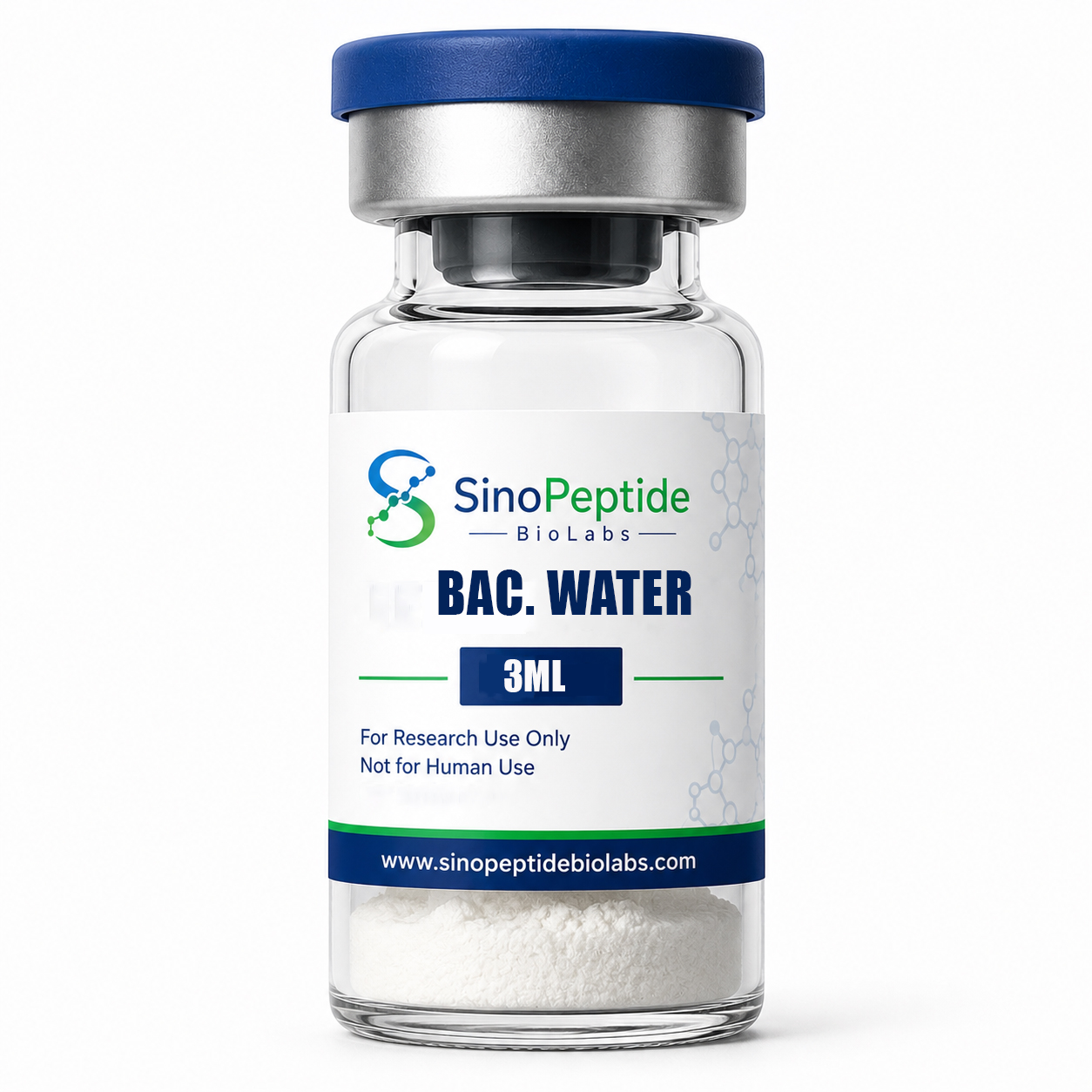
Bacteriostatic water (Bac water) 3ml
$5.00
10 Vials/ Kits
Bacteriostatic Water (Bac Water) 3ml: Complete Guide
Bacteriostatic Water (Bac Water) 3ml is a small-volume presentation of bacteriostatic water, a sterile water-based preparation containing a preservative that helps inhibit microbial growth. In pharmaceutical products, Bacteriostatic Water for Injection (BWFI) is specifically formulated for use as a diluent for medications that require dilution or dissolution before administration.
The term “Bac water” is commonly used as a shortened name for bacteriostatic water. However, not every product sold online under this informal name has the same formulation, sterility standard, or regulatory status. This makes it important to distinguish an approved pharmaceutical product from a research-only benzyl alcohol solution.
Official U.S. labeling for one established Bacteriostatic Water for Injection product describes a sterile, nonpyrogenic preparation containing water for injection and either 0.9% (9 mg/mL) or 1.1% (11 mg/mL) benzyl alcohol, depending on the specific product. It is supplied in a multiple-dose container and is intended for dilution or dissolution of drugs according to the applicable medication instructions.
A 3 mL product, however, should not automatically be assumed to have the same formulation as every other bacteriostatic-water product. The actual label, manufacturer, concentration, sterility status, and intended use should always be verified.
This comprehensive guide explains what Bacteriostatic Water 3ml means, how it differs from sterile water, why benzyl alcohol is used, its role in pharmaceutical and research settings, quality considerations, storage, safety, and common questions.
What Is Bacteriostatic Water?
Bacteriostatic Water for Injection is sterile water containing a bacteriostatic preservative. The preservative helps inhibit the growth of microorganisms after repeated withdrawals from a properly manufactured multi-dose container.
According to official labeling, Bacteriostatic Water for Injection is intended as a drug diluent. It is not itself an active medication. Instead, it may be used to dilute or dissolve certain medications when the medication’s labeling specifically permits the use of bacteriostatic water.
The word bacteriostatic is important.
It means that the formulation contains an agent intended to inhibit bacterial growth. It does not mean that the product is a sterilizing solution capable of eliminating all microorganisms.
Key characteristics of pharmaceutical bacteriostatic water can include:
- Sterile formulation
- Nonpyrogenic preparation
- Water for Injection as the aqueous vehicle
- Benzyl alcohol as a preservative
- Multi-dose container
- Intended for drug dilution or dissolution
- Product-specific concentration and labeling
The exact characteristics depend on the manufacturer and product.
What Does “Bac Water” Mean?
Bac water is an informal abbreviation for bacteriostatic water.
You may see the following terms used interchangeably in online searches:
- Bac water
- Bacteriostatic water
- Bacteriostatic Water for Injection
- BWFI
- Bacteriostatic sterile water
- Bacteriostatic diluent
For SEO purposes, using both “bacteriostatic water” and “bac water” is useful because different users search for different terms.
However, scientific and pharmaceutical content should use the formal name Bacteriostatic Water for Injection when referring specifically to the regulated pharmaceutical preparation.
What Does 3ml Mean?
The 3ml portion of the product name refers to the volume of liquid in the container.
Milliliters measure volume, not concentration or mass.
Therefore:
3ml ≠ 3mg
and:
3ml ≠ 3%
A 3 mL container can contain a particular concentration of benzyl alcohol or another formulation component depending on the product.
For example, if a product is labeled as containing 0.9% benzyl alcohol (9 mg/mL), then 3 mL represents 27 mg of benzyl alcohol mathematically.
However, not every product labeled “bacteriostatic water 3ml” necessarily uses a 0.9% benzyl alcohol formulation. Official labeling demonstrates that different pharmaceutical bacteriostatic-water products can have different benzyl alcohol concentrations.
Always check the actual product label.
Bacteriostatic Water 3ml Composition
A pharmaceutical bacteriostatic-water formulation generally contains:
- Water for Injection
- A bacteriostatic preservative
Benzyl alcohol is a common preservative used in bacteriostatic water.
One official DailyMed label describes Bacteriostatic Water for Injection as containing 0.9% or 1.1% benzyl alcohol, depending on the product.
Another FDA-reviewed pharmaceutical formulation specifies 1.1% benzyl alcohol in Bacteriostatic Water for Injection.
This is why a high-quality product page should not claim that every bacteriostatic water product contains exactly the same concentration.
Typical Product Specification Table
| Feature | Bacteriostatic Water 3ml |
|---|---|
| Product type | Bacteriostatic water |
| Common abbreviation | Bac water / BWFI |
| Volume | 3ml |
| Primary vehicle | Water for Injection in pharmaceutical products |
| Preservative | Commonly benzyl alcohol |
| Sterility | Must be verified from the label |
| Intended purpose | Drug dilution or dissolution when permitted |
| Container | Product-specific |
| Concentration | Manufacturer-specific |
| Regulatory status | Depends on the specific product |
| Storage | Follow manufacturer labeling |
Why Is Benzyl Alcohol Used in Bacteriostatic Water?
Benzyl alcohol can function as a bacteriostatic preservative.
Its role is particularly relevant in multi-dose preparations because repeated withdrawals can create opportunities for microbial contamination.
Official labeling describes benzyl alcohol as the bacteriostatic preservative in Bacteriostatic Water for Injection.
However, the presence of benzyl alcohol does not mean a product can be handled without appropriate sterile technique.
The preservative is not a substitute for proper manufacturing, storage, handling, and contamination-control procedures.
Bacteriostatic Water vs Sterile Water
One of the most important distinctions for anyone researching bac water is the difference between Bacteriostatic Water for Injection and Sterile Water for Injection.
They are not interchangeable products.
Sterile Water for Injection
Sterile Water for Injection is a sterile, preservative-free water preparation used as a diluent for certain medications when specified by their labeling.
Bacteriostatic Water for Injection
Bacteriostatic Water for Injection contains a bacteriostatic preservative, commonly benzyl alcohol, and is supplied in appropriate pharmaceutical containers for its labeled diluent applications.
Comparison
| Feature | Bacteriostatic Water | Sterile Water for Injection |
|---|---|---|
| Water vehicle | Water for Injection | Water for Injection |
| Preservative | Commonly benzyl alcohol | No preservative |
| Multi-dose formulation | Some products | Generally not equivalent |
| Intended use | Drug dilution when labeled | Drug dilution when labeled |
| Benzyl alcohol | Present in many formulations | Absent |
| Neonatal suitability | Important restriction | Product-specific |
| Interchangeable? | No | No |
The choice between these products depends on the specific medication and its approved labeling.
Bacteriostatic Water 3ml for Pharmaceutical Use
Bacteriostatic water is used as a diluent for certain medications.
Official labeling for specific drugs identifies Bacteriostatic Water for Injection as an appropriate diluent in particular circumstances. For example, FDA labeling for LEUKINE describes reconstitution with either preservative-free Sterile Water for Injection or Bacteriostatic Water for Injection containing 0.9% benzyl alcohol, while specifying different considerations for neonates and infants.
This demonstrates an important principle:
Bacteriostatic water is not a universal diluent for every medication.
Compatibility depends on:
- The active drug
- The drug formulation
- Preservatives
- pH
- Stability
- Route of administration
- Manufacturer instructions
- Patient population
The medication’s official prescribing information should therefore determine whether bacteriostatic water is appropriate.
Bacteriostatic Water 3ml and Research
Bacteriostatic water is also frequently discussed in laboratory and peptide-research settings.
However, researchers should distinguish between:
Pharmaceutical Bacteriostatic Water for Injection
and
Research-grade aqueous benzyl alcohol solutions.
They may have similar terminology but are not necessarily equivalent.
A current DailyMed-listed 0.9% benzyl alcohol laboratory solution, for example, is explicitly labeled for research use only and states that it is not intended for injection, skin application, or oral intake.
This distinction is essential when creating an SEO product page.
A website should not describe an ordinary research solution as pharmaceutical bacteriostatic water unless the product actually meets the applicable pharmaceutical specifications.
Bacteriostatic Water for Peptide Research
The term “bac water” is frequently searched alongside peptide-related keywords.
Some research communities use bacteriostatic water terminology when discussing peptide laboratory work. Nevertheless, the appropriate diluent for a specific experimental compound depends on its formulation and the research protocol.
A research article should therefore avoid making blanket statements such as:
“Bacteriostatic water is suitable for every peptide.”
That is too broad.
Peptide stability can be affected by:
- pH
- temperature
- concentration
- solvent composition
- preservatives
- peptide sequence
- container material
- light exposure
- oxidation
- aggregation
- storage duration
Researchers should evaluate compatibility rather than assuming that every peptide behaves identically in bacteriostatic water.
Bacteriostatic Water 3ml and Peptide Reconstitution
The phrase “peptide reconstitution” is frequently associated with bac water online.
For a medically approved peptide or other drug, the correct diluent and preparation method should come from the medication’s official instructions.
For experimental peptides, there may be no validated human-use reconstitution protocol at all.
Therefore, a responsible research-oriented product page can state that bacteriostatic water is used as a diluent for certain compatible formulations, but should not present it as a universal solution.
This is especially important because some peptides may require a specific pH, solvent, or formulation environment to maintain stability.
Is Bacteriostatic Water Injectable?
This question requires a precise answer.
Pharmaceutical Bacteriostatic Water for Injection is specifically manufactured for use as a drug diluent in parenteral applications when its labeling permits it.
Official labeling describes the preparation as intended for parenteral use after addition of drugs requiring dilution or dissolution.
But a product merely advertised online as “bac water” should not automatically be assumed to be injectable.
The product must be:
- Specifically labeled for the intended route
- Sterile
- Manufactured under appropriate quality controls
- Within its expiration period
- Properly packaged
- Suitable for the particular medication
- Used according to applicable labeling or professional instructions
A research-only product should not be treated as an injectable pharmaceutical.
Bacteriostatic Water 3ml Safety
Bacteriostatic water has important safety considerations.
The most significant involves benzyl alcohol exposure.
Official Bacteriostatic Water for Injection labeling carries a warning:
Not for use in neonates.
This warning exists because benzyl alcohol exposure can be hazardous in newborns.
FDA labeling for LEUKINE likewise specifies use of preservative-free sterile water rather than benzyl-alcohol-containing bacteriostatic water when administering to neonates or infants.
Why Benzyl Alcohol Matters
Benzyl alcohol is useful as a preservative, but exposure considerations depend on:
- Age
- Route
- Quantity
- Frequency
- Medical condition
- Formulation
- Duration of exposure
This is why pharmaceutical labels provide specific restrictions.
Bacteriostatic Water Is Not the Same as Pure Water
Another common misconception is that bacteriostatic water is simply “sterile water.”
It is not.
Bacteriostatic water contains a preservative.
Sterile Water for Injection does not contain a preservative.
The difference can be clinically important.
For example, official labeling for LEUKINE distinguishes between sterile water without preservatives and bacteriostatic water containing 0.9% benzyl alcohol, particularly because of benzyl alcohol exposure in neonates and infants.
Quality Standards for Bacteriostatic Water 3ml
If a website is selling or describing a 3 mL bacteriostatic-water product, quality documentation should be clearly presented.
Important information includes:
Sterility
For pharmaceutical injectable products, sterility is a fundamental requirement.
Endotoxin / Pyrogen Control
Parenteral products require appropriate control of pyrogenic contamination.
Benzyl Alcohol Concentration
The actual preservative concentration should be specified.
pH
The formulation should have a defined pH range.
Water Quality
Pharmaceutical water should meet applicable requirements for Water for Injection.
Container Integrity
The container and closure system should protect the sterile product.
Lot Traceability
The batch or lot number should allow the product to be traced to manufacturing and testing records.
Expiration Date
The product should be used only within the manufacturer’s labeled shelf life.
Certificate of Analysis for Bac Water
A Certificate of Analysis (COA) can help document the quality of a specific batch.
Depending on the product, documentation may include:
- Product name
- Lot number
- Manufacturing date
- Expiration date
- Appearance
- pH
- Preservative concentration
- Sterility testing
- Endotoxin testing
- Identification
- Assay or concentration
- Manufacturer
- Quality-control approval
For pharmaceutical products, the official package labeling and regulatory documentation remain particularly important.
A generic COA from an unrelated batch should not be treated as proof of the quality of the current lot.
Storage of Bacteriostatic Water 3ml
Storage requirements vary by manufacturer.
For example, FDA-approved bacteriostatic-water products have had labeled storage ranges such as controlled room temperature, while other specific formulations may carry different storage requirements.
Therefore, the correct SEO content should not claim that every bac water product must be refrigerated or that every product can be stored at room temperature.
Instead:
Follow the storage conditions printed on the product’s current official label.
Important storage factors can include:
- Temperature
- Light exposure
- Container integrity
- Expiration date
- Contamination prevention
The container should remain sealed and protected from inappropriate environmental conditions.
What Does “Bacteriostatic” Mean?
The word bacteriostatic means that a substance inhibits the growth or multiplication of bacteria.
It does not necessarily mean that the substance kills all bacteria.
This distinction is important when discussing preserved pharmaceutical preparations.
The preservative helps control microbial growth, but proper aseptic handling remains essential.
Bacteriostatic Water 3ml vs Bacteriostatic Saline
Bacteriostatic water should also be distinguished from Bacteriostatic 0.9% Sodium Chloride Injection.
Bacteriostatic saline contains sodium chloride in addition to benzyl alcohol.
DailyMed describes Bacteriostatic 0.9% Sodium Chloride Injection as a sterile, nonpyrogenic, isotonic solution containing 9 mg/mL sodium chloride and 0.9% (9 mg/mL) benzyl alcohol.
Comparison
| Product | Main vehicle | Preservative | Primary distinction |
|---|---|---|---|
| Bacteriostatic Water | Water for Injection | Commonly benzyl alcohol | No sodium chloride |
| Bacteriostatic Saline | 0.9% sodium chloride solution | Benzyl alcohol | Contains sodium chloride |
| Sterile Water | Water for Injection | None | Preservative-free |
These products should not be substituted for one another without appropriate compatibility information.
Common Uses of Bacteriostatic Water
Depending on the specific pharmaceutical labeling, bacteriostatic water may be used as a diluent for drugs requiring dilution or dissolution before administration.
Examples of pharmaceutical labeling demonstrate that bacteriostatic water can be specified for particular injectable drugs.
Potential applications include:
- Reconstitution of certain injectable medications
- Dilution of compatible pharmaceutical products
- Pharmaceutical formulation
- Certain laboratory research applications when a research-grade product is specifically labeled for that purpose
The precise use should always follow the product and medication documentation.
Common Mistakes When Buying Bac Water 3ml
Mistake 1: Assuming Every Bac Water Product Is Pharmaceutical
Online terminology can be inconsistent.
Always verify the manufacturer and regulatory status.
Mistake 2: Ignoring Benzyl Alcohol Concentration
Different products may contain different preservative concentrations. Official examples include both 0.9% and 1.1% formulations.
Mistake 3: Assuming Research Grade Means Injectable
Research-grade materials may not be sterile or approved for human administration.
Mistake 4: Treating Bac Water as Universal
Different drugs have different compatibility requirements.
Mistake 5: Ignoring Neonatal Warnings
Benzyl-alcohol-containing bacteriostatic water is specifically contraindicated for use in neonates according to official labeling.
How to Choose Bacteriostatic Water 3ml
When evaluating a 3 mL product, consider the following checklist:
Product Identity
Confirm that the product is actually bacteriostatic water and not simply a benzyl alcohol solution.
Sterility
Verify that the product is specifically labeled as sterile if sterile material is required.
Intended Use
Determine whether the product is pharmaceutical, laboratory, or research-only.
Preservative
Check the type and concentration of preservative.
Manufacturer
Look for an identifiable manufacturer with traceable documentation.
Lot Number
The product should have a traceable batch or lot number.
Expiration Date
Check the expiry or use-by date.
Packaging
Inspect the vial or container for damage or compromised seals.
Documentation
Look for official labeling and, where appropriate, batch-specific quality documentation.
Frequently Asked Questions
What is Bacteriostatic Water 3ml?
Bacteriostatic Water 3ml refers to a 3 mL presentation of bacteriostatic water. Pharmaceutical bacteriostatic water is sterile water containing a bacteriostatic preservative, commonly benzyl alcohol.
What is Bac Water?
“Bac water” is a common abbreviation for bacteriostatic water.
What is Bacteriostatic Water used for?
Pharmaceutical Bacteriostatic Water for Injection is used as a diluent for certain medications when their labeling permits it.
Does Bacteriostatic Water contain benzyl alcohol?
Many pharmaceutical formulations do. Official labeling includes products containing 0.9% or 1.1% benzyl alcohol.
Is Bacteriostatic Water the same as Sterile Water?
No. Bacteriostatic water contains a preservative, while Sterile Water for Injection is preservative-free.
Is 3ml a concentration?
No. 3 mL is a measurement of volume.
Is Bacteriostatic Water injectable?
Pharmaceutical Bacteriostatic Water for Injection is a parenteral drug diluent when used according to its labeling. A product merely described online as “bac water” should not automatically be assumed to be injectable.
Can bacteriostatic water be used with every medication?
No. Compatibility depends on the medication and its official instructions.
Is Bacteriostatic Water safe for newborns?
Official labeling warns that benzyl-alcohol-containing Bacteriostatic Water for Injection is not for use in neonates.
Does bacteriostatic mean sterile?
No. “Bacteriostatic” describes inhibition of microbial growth; it does not by itself establish sterility.
How should Bacteriostatic Water 3ml be stored?
Follow the current manufacturer’s label. Storage requirements can differ between products. Official examples include controlled-room-temperature storage and other product-specific conditions.
Can research-grade bac water be used for human injection?
A research-only product should not be represented or used as an injectable pharmaceutical. Sterility, manufacturing standards, formulation, and regulatory status must be established for products intended for human administration.
Final Thoughts on Bacteriostatic Water 3ml
Bacteriostatic Water (Bac Water) 3ml is a useful search term for a small-volume bacteriostatic-water product, but accurate product identification is essential.
Pharmaceutical Bacteriostatic Water for Injection is a sterile, nonpyrogenic preparation used as a diluent for compatible medications. Official product labeling shows that benzyl alcohol is commonly used as the bacteriostatic preservative, with formulations including both 0.9% and 1.1% concentrations.
The 3 mL designation refers to container volume and does not by itself indicate concentration, sterility, or intended route of use.
For SEO and scientific accuracy, a website should clearly distinguish:
- Bacteriostatic Water for Injection
- Sterile Water for Injection
- Bacteriostatic saline
- Research-only benzyl alcohol solutions
- Other laboratory diluents
This distinction is particularly important because a current DailyMed-listed research-only 0.9% benzyl alcohol solution specifically states that it is not for injection, skin application, or oral intake, despite being described as a bacteriostatic aqueous solution.
When evaluating a Bacteriostatic Water 3ml product, buyers should verify the manufacturer, formulation, benzyl alcohol concentration, sterility, intended use, lot number, expiration date, storage requirements, and applicable regulatory documentation.
The most reliable product pages focus on these verifiable specifications rather than making broad claims that all bac water products are identical or suitable for every medication.
Important disclaimer: This article is provided for educational and research-information purposes. It does not provide instructions for self-injection, medication reconstitution, dosing, or administration. Pharmaceutical products should be used only according to their official labeling and appropriate professional guidance.
Bacteriostatic Water 3ml Bacteriostatic Water 3ml Bacteriostatic Water 3ml Bacteriostatic Water 3ml Bacteriostatic Water 3ml Bacteriostatic Water 3ml Bacteriostatic Water 3ml Bacteriostatic Water 3ml Bacteriostatic Water 3ml Bacteriostatic Water 3ml Bacteriostatic Water 3ml Bacteriostatic Water 3ml Bacteriostatic Water 3ml Bacteriostatic Water 3ml Bacteriostatic Water 3ml Bacteriostatic Water 3mlBacteriostatic Water 3mlBacteriostatic Water 3ml Bacteriostatic Water 3ml Bacteriostatic Water 3ml Bacteriostatic Water 3ml Bacteriostatic Water 3ml Bacteriostatic Water 3ml Bacteriostatic Water 3ml Bacteriostatic Water 3ml Bacteriostatic Water 3ml Bacteriostatic Water 3ml Bacteriostatic Water 3ml Bacteriostatic Water 3ml Bacteriostatic Water 3ml Bacteriostatic Water 3ml Bacteriostatic Water 3ml Bacteriostatic Water 3ml Bacteriostatic Water 3ml Bacteriostatic Water 3ml Bacteriostatic Water 3ml Bacteriostatic Water 3ml Bacteriostatic Water 3ml Bacteriostatic Water 3ml Bacteriostatic Water 3ml Bacteriostatic Water 3ml Bacteriostatic Water 3ml Bacteriostatic Water 3ml Bacteriostatic Water 3ml Bacteriostatic Water 3ml Bacteriostatic Water 3ml Bacteriostatic Water 3ml Bacteriostatic Water 3ml
Be the first to review “Bacteriostatic water (Bac water) 3ml”
Related products
Pure Peptides
Pure Peptides
Pure Peptides

Pure Peptides
Pure Peptides
Pure Peptides
Pure Peptides
Pure Peptides
Reviews
There are no reviews yet.