

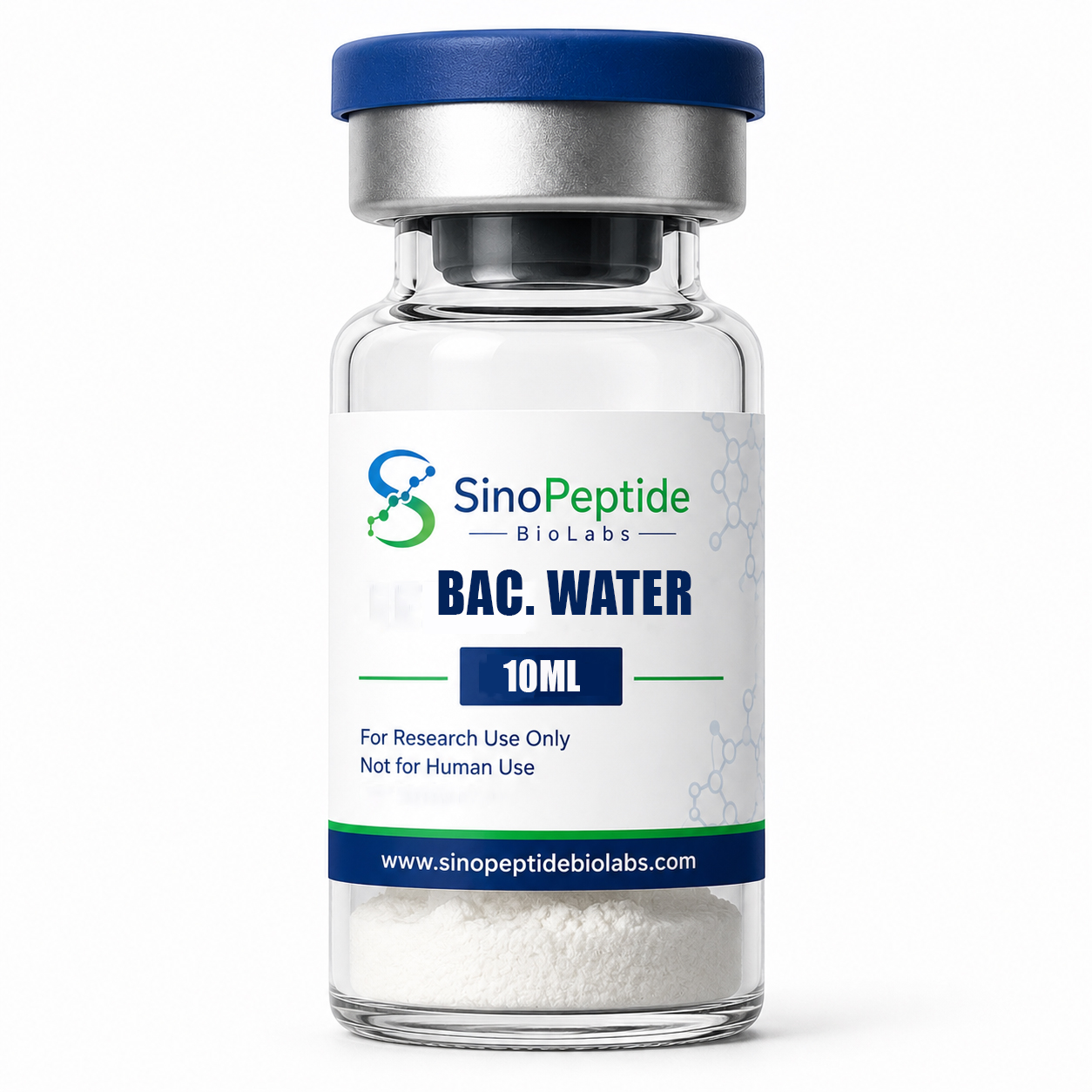
Bacteriostatic water (Bac water) 10ml
$10.00
10 Vials/ Kits
Bacteriostatic Water (Bac Water) 10ml: Complete Guide
Bacteriostatic Water (Bac Water) 10ml is a small-volume pharmaceutical diluent commonly associated with the preparation of certain injectable medications. Unlike ordinary sterile water, bacteriostatic water contains a preservative—commonly benzyl alcohol—that helps inhibit the growth of microorganisms when the product is manufactured and labeled for multidose use.
A commonly marketed pharmaceutical formulation contains 0.9% benzyl alcohol, equivalent to 9 mg/mL, although formulations and container sizes can vary by manufacturer. Official DailyMed labeling describes Bacteriostatic Water for Injection, USP as a sterile, nonpyrogenic preparation of Water for Injection containing benzyl alcohol as a bacteriostatic preservative.
The 10 mL designation refers to the volume of the vial. It does not describe the concentration, potency, or amount of any medication that may later be diluted with the product.
Because bacteriostatic water is associated with injectable medicines, it is important to distinguish genuine pharmaceutical products from laboratory or research-only solutions that may contain a similar concentration of benzyl alcohol but are not intended for injection.
This guide explains what Bac Water 10ml is, how it differs from sterile water, what benzyl alcohol does, common pharmaceutical applications, quality considerations, storage, safety, and frequently asked questions.
What Is Bacteriostatic Water 10ml?
Bacteriostatic Water for Injection (BWFI) is sterile water containing a bacteriostatic preservative.
The term “bacteriostatic” means that the formulation contains an agent intended to inhibit the growth of microorganisms. It does not mean that the solution is a universal disinfectant or that contamination is impossible.
A pharmaceutical bacteriostatic water product may be supplied in a multidose vial, allowing repeated withdrawals under appropriate aseptic conditions. Current DailyMed labeling describes Bacteriostatic Water for Injection as a sterile, nonpyrogenic preparation intended for parenteral use after compatible drugs have been added or dissolved according to their labeling.
A 10 mL vial simply means the container holds 10 milliliters of the formulation.
The important product characteristics include:
- Sterility
- Preservative concentration
- Intended route
- Pharmaceutical grade
- Manufacturer
- Lot number
- Expiration date
- Storage requirements
- Compatibility with the medication being prepared
What Does “Bac Water” Mean?
“Bac Water” is a common informal abbreviation for bacteriostatic water.
Other terms that may appear in product descriptions include:
- Bac Water
- Bacteriostatic Water
- Bacteriostatic Water for Injection
- BWFI
- Bacteriostatic Water USP
- Bacteriostatic diluent
However, these terms should not automatically be applied to every online product described as “bac water.”
For example, some current listings describe a 0.9% benzyl alcohol laboratory solution as research-only and specifically state that it is not for injection, skin application, or oral intake.
Therefore, buyers should always check the exact product label.
What Is in Bacteriostatic Water 10ml?
A pharmaceutical Bacteriostatic Water for Injection product generally contains:
- Water for Injection
- A bacteriostatic preservative, commonly benzyl alcohol
One official DailyMed formulation lists 0.9% benzyl alcohol, equivalent to 9 mg/mL, while another historical presentation contains 1.1% benzyl alcohol. This illustrates why the exact manufacturer’s label matters.
For a 0.9% formulation:
9 mg/mL × 10 mL = approximately 90 mg benzyl alcohol
This is a description of the formulation’s concentration and volume, not a dosage recommendation.
Why Is Benzyl Alcohol Added to Bacteriostatic Water?
Benzyl alcohol serves as a bacteriostatic preservative in certain pharmaceutical water formulations.
Its purpose is to inhibit microbial growth in a properly manufactured and packaged multidose preparation.
This makes bacteriostatic water different from preservative-free sterile water.
However, benzyl alcohol does not mean that a vial can be handled carelessly.
Proper handling remains essential, including:
- Maintaining aseptic technique
- Keeping the container properly closed
- Avoiding contamination of the stopper
- Following manufacturer storage instructions
- Observing the labeled expiration date
- Inspecting the product before use
A preservative should not be interpreted as a guarantee that contaminated material is safe to use.
Bacteriostatic Water vs. Sterile Water
One of the most common questions surrounding Bac Water is how it differs from sterile water.
The basic distinction is the presence of a preservative.
| Feature | Bacteriostatic Water | Sterile Water |
|---|---|---|
| Sterile when properly manufactured | Yes | Yes |
| Benzyl alcohol | Commonly present | No preservative |
| Intended use | Diluent for compatible medications | Diluent for compatible medications |
| Multidose use | Certain products | Usually not intended as a multidose preserved preparation |
| Neonatal suitability | Benzyl alcohol-containing products are generally avoided in neonates | May be preferred when appropriate |
| Product-specific instructions | Required | Required |
The choice between bacteriostatic water and sterile water depends on the medication, patient, route, formulation, and official prescribing information.
They should not be treated as interchangeable products.
Is Bacteriostatic Water the Same as Saline?
No.
Bacteriostatic Water is water for injection containing a bacteriostatic preservative.
Bacteriostatic 0.9% Sodium Chloride Injection contains sodium chloride as well as benzyl alcohol.
For example, an official DailyMed label for bacteriostatic 0.9% sodium chloride describes each milliliter as containing sodium chloride 9 mg and benzyl alcohol 9 mg/mL.
This distinction is important because sodium chloride changes the composition and characteristics of the solution.
Therefore:
Bacteriostatic Water ≠ Bacteriostatic Saline
The appropriate diluent depends on the medication’s official instructions.
What Is Bacteriostatic Water 10ml Used For?
Pharmaceutical Bacteriostatic Water for Injection is generally intended as a diluent or vehicle for compatible injectable medicines.
The official labeling for one pharmaceutical product describes its use after adding drugs that require dilution or dissolution in an aqueous vehicle before injection.
Potential pharmaceutical applications may therefore include:
- Reconstitution of compatible powdered medications
- Dilution of certain injectable drugs
- Pharmaceutical preparation according to approved instructions
- Multidose medication preparation where specifically permitted
The exact medication compatibility must always be established from the medication’s prescribing information.
Bacteriostatic Water for Medication Reconstitution
Some injectable medicines are supplied as a dry powder or lyophilized preparation.
Before administration, the medication may need to be dissolved using a specified diluent.
Depending on the medicine, the manufacturer’s instructions may identify:
- Bacteriostatic Water for Injection
- Sterile Water for Injection
- Sodium chloride solution
- Another compatible diluent
These diluents are not universally interchangeable.
A medication’s prescribing information should therefore be checked before selecting a diluent.
Bacteriostatic Water 10ml and Peptide Research
“Bac Water” is widely discussed online in connection with peptide products and research materials.
This creates an important distinction between pharmaceutical Bacteriostatic Water for Injection and laboratory-only benzyl alcohol solutions.
A genuine pharmaceutical bacteriostatic water product is manufactured and labeled for a defined pharmaceutical purpose.
By contrast, some products marketed online for research contain water and 0.9% benzyl alcohol but explicitly state that they are for research only and not for injection.
Therefore, the fact that a research solution contains 0.9% benzyl alcohol does not automatically make it pharmaceutical bacteriostatic water.
For laboratory experiments, researchers should select a product that matches the requirements of the validated research protocol.
Is Bac Water 10ml Injectable?
This question requires an important distinction.
Pharmaceutical Bacteriostatic Water for Injection is specifically manufactured as an injectable diluent for compatible medications.
However, it is generally not intended to be injected by itself as a medication. Its purpose is to act as a vehicle or diluent for compatible drugs.
Furthermore, not every product marketed as “Bac Water” is pharmaceutical bacteriostatic water.
Some laboratory products explicitly state:
Not for injection.
Current DailyMed information for one 0.9% benzyl alcohol laboratory solution identifies it as research-only and specifically excludes injection, skin application, and oral intake.
Therefore, the exact label is more important than the product’s informal name.
Can Bacteriostatic Water Be Used With Any Medication?
No.
Compatibility is medication-specific.
Some medicines require:
- Sterile Water for Injection
- Bacteriostatic Water for Injection
- Sodium chloride injection
- Dextrose solution
- A manufacturer-supplied diluent
- Another specific solvent
Using an inappropriate diluent can affect:
- Solubility
- Stability
- pH
- Drug concentration
- Chemical compatibility
- Sterility
- Patient safety
For this reason, users should follow the medication manufacturer’s approved reconstitution instructions.
Bacteriostatic Water 10ml and Sterility
Sterility is particularly important for products intended for parenteral use.
Official pharmaceutical labeling describes Bacteriostatic Water for Injection as a sterile, nonpyrogenic preparation.
A sterile pharmaceutical product is manufactured under controlled conditions and must meet applicable quality requirements.
This is fundamentally different from a generic bottle of purified water containing benzyl alcohol.
A product should not be assumed to be sterile simply because:
- It is clear
- It contains benzyl alcohol
- It is sold in a vial
- The seller calls it “Bac Water”
- It is described as bacteriostatic
Sterility is a product-quality attribute that must be supported by appropriate manufacturing and labeling.
Bacteriostatic Water 10ml Safety
Bacteriostatic water is not risk-free.
The primary safety considerations relate to:
- Benzyl alcohol exposure
- Contamination
- Incorrect medication compatibility
- Improper handling
- Incorrect storage
- Use in populations for whom benzyl alcohol is inappropriate
The product should only be used according to its official labeling and the instructions for the medication being prepared.
Benzyl Alcohol and Newborns
One of the most important warnings associated with bacteriostatic water concerns neonates and low-birth-weight infants.
FDA labeling warns that serious and potentially fatal reactions can occur in neonates and low-birth-weight infants exposed to benzyl alcohol-containing drugs. The reported “gasping syndrome” can involve central nervous system depression, metabolic acidosis, and gasping respirations.
For this reason, official bacteriostatic water labeling includes a warning:
Not for use in neonates.
When appropriate, preservative-free alternatives may be selected for neonatal applications.
This is a particularly important point for healthcare professionals and caregivers.
Bacteriostatic Water and Aseptic Technique
The presence of a preservative does not eliminate the need for appropriate aseptic technique.
When a multidose vial is used in a clinical setting, healthcare professionals follow appropriate procedures to minimize contamination.
Important principles include:
- Inspecting the vial
- Checking the seal
- Cleaning the vial stopper appropriately
- Using sterile equipment
- Avoiding contact with sterile surfaces
- Preventing cross-contamination
- Following institutional protocols
The exact procedure should be determined by trained healthcare professionals and applicable clinical guidelines.
How to Store Bacteriostatic Water 10ml
Storage requirements vary by manufacturer and product.
One official pharmaceutical Bacteriostatic Water label specifies storage at 20°C to 25°C (68°F to 77°F) under controlled room-temperature conditions.
However, storage instructions should always be taken from the specific product label.
General considerations include:
- Store within the labeled temperature range.
- Protect the product as instructed.
- Keep the container sealed.
- Do not use a product with a damaged seal.
- Check the expiration date.
- Do not use visibly contaminated or abnormal solution.
A research-only product may have completely different storage instructions from a pharmaceutical product.
What Does a 10ml Bac Water Vial Mean?
The 10ml designation describes the container volume.
It does not mean:
- 10 mg
- 10 IU
- 10 doses
- 10 injections
- 10 units of medication
It simply indicates that the vial contains approximately 10 milliliters of the solution when supplied according to its labeled volume.
If the formulation contains 0.9% benzyl alcohol, the concentration is approximately 9 mg/mL.
The total amount of benzyl alcohol represented in 10 mL would therefore be approximately 90 mg.
Again, this is a formulation calculation and not an administration recommendation.
Bacteriostatic Water 10ml Quality Checklist
When evaluating a pharmaceutical Bac Water product, several characteristics are worth checking.
1. Product Name
The packaging should clearly identify the product as Bacteriostatic Water for Injection if it is intended for pharmaceutical use.
2. Manufacturer
A legitimate pharmaceutical product should identify the manufacturer or responsible company.
3. Lot Number
A lot or batch number supports traceability.
4. Expiration Date
Check the expiration date before use.
5. Preservative Information
The label should identify the preservative and concentration where applicable.
6. Sterility Statement
Pharmaceutical injectable products should clearly identify their sterile status.
7. Regulatory Information
Look for appropriate pharmaceutical labeling and regulatory identification for the market in which the product is sold.
8. Packaging Integrity
Do not use products with broken seals, damaged containers, or questionable labeling.
Pharmaceutical Bac Water vs. Research-Only Bac Water
This distinction is especially important for online buyers.
| Characteristic | Pharmaceutical Bacteriostatic Water | Research/Laboratory Solution |
|---|---|---|
| Pharmaceutical labeling | Yes | May not have it |
| Sterility | Specified by pharmaceutical label | Depends on product |
| Intended use | Compatible injectable drugs | Laboratory/research applications |
| Injection | Only as labeled pharmaceutical diluent | Often explicitly prohibited |
| Regulatory status | Applicable pharmaceutical regulation | May be research-only/unapproved |
| Benzyl alcohol | Commonly present | May be present |
| COA | May be available | Often supplied by research vendors |
| Clinical use | Product-specific | Not automatically appropriate |
The concentration of benzyl alcohol alone does not establish equivalence.
Bacteriostatic Water vs. 0.9% Benzyl Alcohol Solution
These products can look similar in online search results but may have fundamentally different intended uses.
A pharmaceutical Bacteriostatic Water for Injection formulation is sterile water with a bacteriostatic preservative and is labeled as a drug diluent.
In contrast, a current DailyMed listing for a 0.9% benzyl alcohol laboratory solution states that the product is intended for research use and is not for injection, skin application, or oral intake.
Therefore:
0.9% benzyl alcohol solution ≠ automatically pharmaceutical Bacteriostatic Water for Injection.
This distinction should be clearly stated on any responsible product page.
Common Misconceptions About Bac Water
Myth 1: All Bac Water products are injectable
Not necessarily.
Only a properly manufactured and labeled pharmaceutical product intended for injection-related use should be treated as such.
Myth 2: Benzyl alcohol makes water sterile
Incorrect.
Benzyl alcohol functions as a bacteriostatic preservative in certain formulations. It does not turn an improperly manufactured or contaminated product into a sterile injectable product.
Myth 3: Bacteriostatic water can replace every diluent
Incorrect.
Medication compatibility is product-specific.
Myth 4: Bacteriostatic water is the same as saline
Incorrect.
Bacteriostatic water and bacteriostatic sodium chloride are different formulations. Bacteriostatic sodium chloride contains sodium chloride in addition to benzyl alcohol.
Myth 5: A 10ml vial is automatically intended for repeated injections
Incorrect.
Container volume does not determine intended use.
The product’s official labeling determines whether it is a multidose pharmaceutical preparation.
Myth 6: Research-grade Bac Water is equivalent to pharmaceutical Bac Water
Incorrect.
A research-only product can have a similar chemical composition while lacking the manufacturing, sterility, regulatory status, or intended use of a pharmaceutical injectable diluent.
Frequently Asked Questions About Bacteriostatic Water 10ml
What is Bacteriostatic Water 10ml?
It is a 10 mL presentation of bacteriostatic water. Pharmaceutical versions generally contain sterile Water for Injection plus a bacteriostatic preservative such as benzyl alcohol.
What is Bac Water used for?
Pharmaceutical Bacteriostatic Water for Injection is used as a diluent or vehicle for compatible injectable medications when specified by the medication’s labeling.
Does Bac Water contain benzyl alcohol?
Many pharmaceutical formulations do. One official formulation contains 0.9% benzyl alcohol, or 9 mg/mL.
How much benzyl alcohol is in 10ml of 0.9% Bac Water?
At 0.9%, the concentration is approximately 9 mg/mL. Therefore, 10 mL contains approximately 90 mg of benzyl alcohol.
Is Bac Water the same as sterile water?
No. Bacteriostatic water generally contains a preservative, whereas sterile water for injection is preservative-free.
Is Bac Water the same as saline?
No. Saline contains sodium chloride. Bacteriostatic saline may also contain benzyl alcohol, but it is a different formulation from bacteriostatic water.
Can Bacteriostatic Water be used with any injectable medication?
No. The appropriate diluent depends on the specific medication and its official prescribing information.
Is Bacteriostatic Water safe for babies?
Benzyl alcohol-containing preparations should generally not be used in neonates. FDA labeling warns about serious and potentially fatal adverse effects associated with benzyl alcohol exposure in neonates and low-birth-weight infants.
How should Bac Water 10ml be stored?
Follow the exact manufacturer’s storage instructions. One current pharmaceutical formulation specifies controlled room-temperature storage of 20°C to 25°C.
Can research-grade Bac Water be injected?
Do not assume so. Some research-only benzyl alcohol solutions explicitly state that they are not for injection.
What should I check before purchasing Bac Water?
Check the manufacturer, product classification, sterility information, benzyl alcohol concentration, lot number, expiration date, packaging integrity, and intended use.
Final Thoughts on Bacteriostatic Water (Bac Water) 10ml
Bacteriostatic Water (Bac Water) 10ml is a small-volume presentation of bacteriostatic water, commonly used in pharmaceutical settings as a diluent for compatible injectable medicines.
The defining characteristic of pharmaceutical bacteriostatic water is not simply the presence of water or benzyl alcohol. It is the complete formulation, manufacturing quality, sterility, labeling, and intended pharmaceutical use.
A commonly used pharmaceutical formulation contains 0.9% benzyl alcohol, equivalent to approximately 9 mg/mL, although formulations can vary.
It is also important to distinguish pharmaceutical Bacteriostatic Water for Injection from research-only solutions containing benzyl alcohol. Current labeling for one research-only product explicitly states that it is not intended for injection, skin application, or oral intake.
For patients and healthcare professionals, the safest approach is to use only a product whose official labeling matches the intended medical application and to follow the instructions for the medication being prepared.
Medical disclaimer: This article is for educational and SEO purposes and does not provide individualized medication-reconstitution or injection instructions. Pharmaceutical bacteriostatic water should be used only according to its official labeling and the instructions of the compatible medication. If you are uncertain whether a particular vial is appropriate for medical use, consult a pharmacist or qualified healthcare professional.
Bacteriostatic water (Bac water) 10ml Bacteriostatic water (Bac water) 10ml Bacteriostatic water (Bac water) 10ml Bacteriostatic water (Bac water) 10ml Bacteriostatic water (Bac water) 10ml Bacteriostatic water (Bac water) 10ml Bacteriostatic water (Bac water) 10ml Bacteriostatic water (Bac water) 10ml Bacteriostatic water (Bac water) 10ml Bacteriostatic water (Bac water) 10ml Bacteriostatic water (Bac water) 10ml Bacteriostatic water (Bac water) 10ml Bacteriostatic water (Bac water) 10ml Bacteriostatic water (Bac water) 10ml Bacteriostatic water (Bac water) 10ml Bacteriostatic water (Bac water) 10ml Bacteriostatic water (Bac water) 10ml Bacteriostatic water (Bac water) 10ml Bacteriostatic water (Bac water) 10ml Bacteriostatic water (Bac water) 10ml Bacteriostatic water (Bac water) 10ml Bacteriostatic water (Bac water) 10ml Bacteriostatic water (Bac water) 10ml Bacteriostatic water (Bac water) 10ml Bacteriostatic water (Bac water) 10ml Bacteriostatic water (Bac water) 10ml Bacteriostatic water (Bac water) 10ml Bacteriostatic water (Bac water) 10ml Bacteriostatic water (Bac water) 10ml Bacteriostatic water (Bac water) 10ml Bacteriostatic water (Bac water) 10ml Bacteriostatic water (Bac water) 10ml Bacteriostatic water (Bac water) 10ml Bacteriostatic water (Bac water) 10ml
Be the first to review “Bacteriostatic water (Bac water) 10ml”
Related products
Pure Peptides
Pure Peptides
Pure Peptides
Pure Peptides
Pure Peptides
Pure Peptides
Pure Peptides
Pure Peptides
Reviews
There are no reviews yet.