
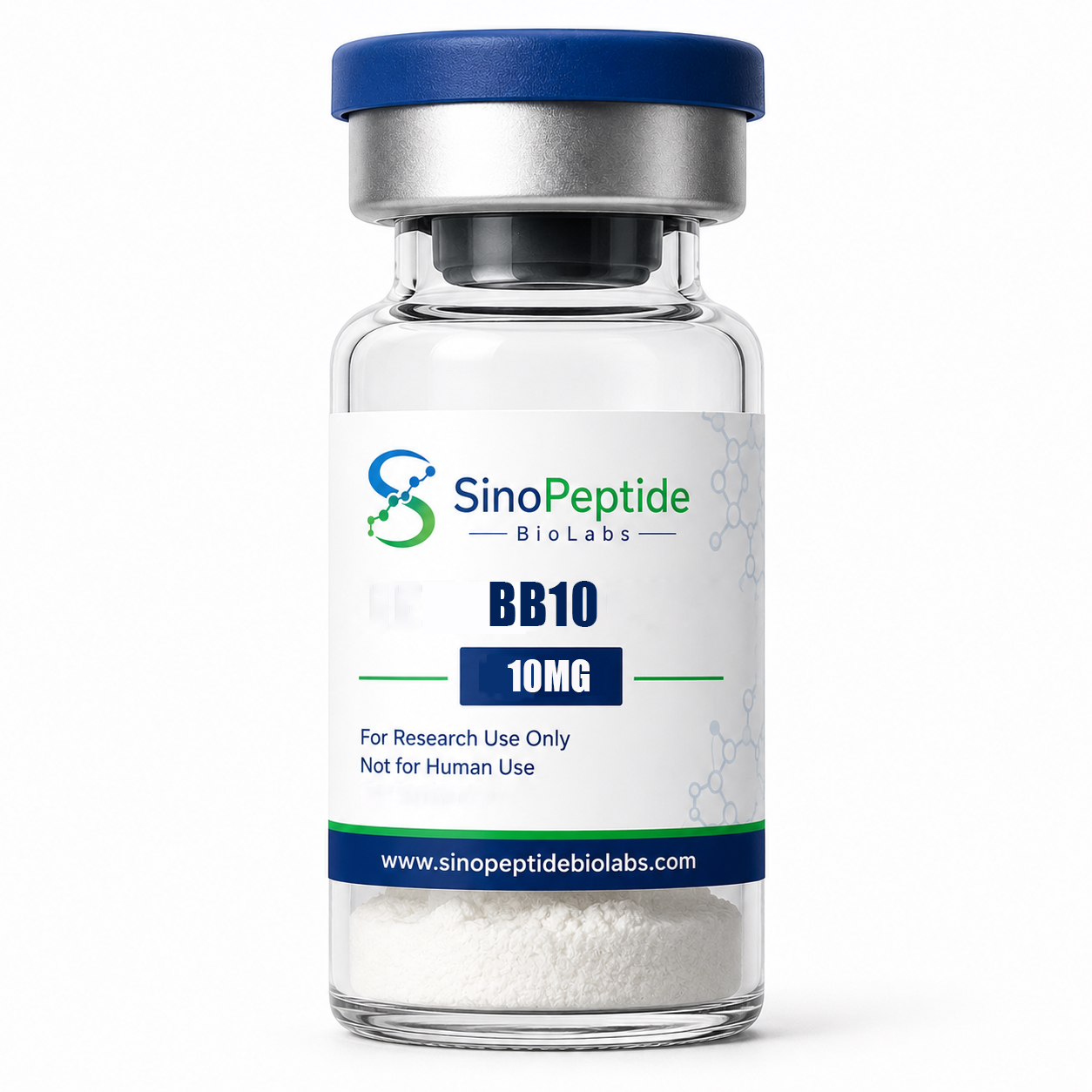
BPC 5mg + TB 5mg 10mg
$110.00
10 Vials/ Kits
BPC 5mg + TB 5mg 10mg: Complete Research Peptide Guide
BPC 5mg + TB 5mg 10mg is a peptide combination generally used to describe a formulation containing 5mg of BPC-157 and 5mg of Thymosin Beta-4 (TB-4), giving a combined labeled peptide quantity of 10mg. Both peptides have attracted scientific interest because of their involvement in experimental research concerning cellular signaling, tissue biology, vascular processes, inflammation, and cellular migration.
The terminology used for combination peptide products can sometimes be confusing. In this case, the individual quantities are important: 5mg refers to the labeled amount of BPC-157, another 5mg refers to the labeled amount of Thymosin Beta-4, and 10mg represents the combined amount of the two peptides.
BPC-157 and Thymosin Beta-4 are distinct molecules with different biological characteristics. Although research involving the two peptides overlaps in areas such as tissue biology and cellular processes, evidence concerning one peptide should not automatically be interpreted as evidence for the combination.
This guide provides an educational overview of BPC 5mg + TB 5mg 10mg, including its composition, scientific background, mechanisms of interest, research applications, quality considerations, storage principles, regulatory considerations, and frequently asked questions.
Research-use note: BPC-157 and Thymosin Beta-4 are experimental peptide compounds. Information in this article is provided for educational and research purposes and should not be interpreted as instructions for human administration, dosing, diagnosis, or treatment. The regulatory status of peptide products varies by jurisdiction and by specific formulation.
What Is BPC 5mg + TB 5mg 10mg?
The name BPC 5mg + TB 5mg 10mg generally describes a combination containing two peptide components:
- BPC-157 — 5mg
- Thymosin Beta-4 — 5mg
- Total labeled peptide quantity — 10mg
The product name therefore communicates both the individual peptide quantities and the total amount.
BPC-157 is a synthetic peptide that has been investigated primarily in preclinical research. Thymosin Beta-4, often abbreviated Tβ4 or TB-4, is a naturally occurring peptide that has been studied extensively in cellular and tissue biology.
The combination may be of interest to researchers studying biological processes involving cellular signaling, vascular responses, cell migration, cytoskeletal organization, and tissue remodeling.
However, the presence of two experimental peptides in one formulation does not establish that they produce a synergistic effect. Any claim of synergy should be supported by direct experimental evidence involving the actual combination.
Understanding the 5mg + 5mg + 10mg Label
One of the most important aspects of this product is understanding its labeling.
If a product is described as BPC 5mg + TB 5mg 10mg, the most straightforward interpretation is:
| Component | Labeled Amount |
|---|---|
| BPC-157 | 5mg |
| Thymosin Beta-4 | 5mg |
| Combined peptide quantity | 10mg |
The 10mg figure therefore represents the total labeled quantity of the two peptides.
It does not necessarily represent the amount of either individual peptide.
This distinction is useful for both consumers researching peptide products and laboratories maintaining accurate experimental records.
The term “10mg” should also not be confused with concentration. Concentration depends on the amount of peptide relative to the volume of a particular formulation or solution.
What Is BPC-157?
BPC-157 is a synthetic peptide that has been investigated in experimental biological research.
The compound has attracted scientific attention because preclinical studies have explored its relationship with several biological processes.
Areas of BPC-157 research include:
- Gastrointestinal biology
- Vascular signaling
- Cellular responses
- Inflammatory pathways
- Oxidative stress
- Experimental tissue models
- Musculoskeletal research
- Wound-related biological processes
Much of the scientific literature concerning BPC-157 involves laboratory and animal models.
This distinction is essential. Findings from preclinical research can help scientists identify potential mechanisms and generate hypotheses, but they do not automatically establish safety or effectiveness in humans.
What Is Thymosin Beta-4?
Thymosin Beta-4, commonly abbreviated Tβ4, is a naturally occurring peptide found in many tissues and cell types.
It has been extensively studied in cell biology and tissue-related research.
One of the most recognized biological roles of Tβ4 involves its interaction with actin, an important structural protein inside cells.
Actin participates in processes including:
- Cell shape
- Cellular movement
- Cytoskeletal organization
- Cell migration
- Intracellular structure
- Tissue remodeling
Because of these functions, Thymosin Beta-4 has been investigated in studies involving cellular migration, wound biology, vascular development, and tissue responses.
Why Are BPC-157 and Thymosin Beta-4 Combined?
BPC-157 and Thymosin Beta-4 are sometimes discussed together because research involving both peptides includes overlapping areas of biological interest.
BPC-157 research has examined vascular signaling, inflammatory pathways, and experimental tissue models.
Thymosin Beta-4 research has examined actin regulation, cellular migration, angiogenesis-related processes, and tissue biology.
This creates a scientific rationale for investigating the compounds in related research areas.
However, there is an important distinction between overlapping mechanisms and proven combination effects.
Two compounds can affect related biological pathways without necessarily producing an additive or synergistic outcome when combined.
Therefore, researchers should evaluate evidence involving the specific combination rather than assuming that results observed with individual peptides apply directly to BPC 5mg + TB 5mg 10mg.
BPC-157 Research Background
BPC-157 has been investigated in numerous preclinical models.
Researchers have explored possible relationships between the peptide and processes involving vascular function, inflammatory signaling, gastrointestinal biology, and experimental tissue responses.
Gastrointestinal Research
Some of the earliest and most frequently discussed research involving BPC-157 concerns gastrointestinal models.
Experimental studies have examined the peptide in relation to gastrointestinal tissue and vascular responses.
These findings have contributed to scientific interest in the compound.
However, laboratory findings should not be presented as proof that BPC-157 is an established treatment for gastrointestinal disorders.
Vascular Research
Another area of investigation concerns vascular biology.
Research has examined potential interactions between BPC-157 and biological pathways associated with blood vessels and endothelial responses.
These studies are relevant to understanding how experimental compounds may influence cellular and vascular signaling.
Musculoskeletal Research
BPC-157 has also been investigated in experimental models involving tendons, ligaments, muscles, and connective tissues.
These studies are frequently cited in discussions surrounding BPC-157.
Nevertheless, animal research cannot automatically be translated into predictable human outcomes.
Thymosin Beta-4 Research Background
Thymosin Beta-4 has a broader history within cellular and molecular biology research.
Because it interacts with actin and is involved in cellular processes, researchers have investigated Tβ4 in several fields.
Actin Regulation
Actin is an important component of the cytoskeleton.
Tβ4 can bind actin monomers and influence their availability for polymerization. This makes the peptide relevant to studies of cell structure and movement.
Cell Migration
Cell migration is important in many biological processes.
Researchers have investigated Tβ4 because of its relationship with cytoskeletal organization and cellular movement.
Angiogenesis Research
Tβ4 has also been studied in experimental angiogenesis models.
Angiogenesis refers to the formation of new blood vessels from existing vessels.
Because vascular development and remodeling are important components of tissue biology, Tβ4 continues to attract interest in this area.
Wound Biology
Research involving Tβ4 has also examined processes associated with wound biology.
These studies can involve cellular migration, vascular responses, extracellular matrix interactions, and inflammatory signaling.
Again, experimental findings should not automatically be presented as evidence of an approved treatment.
BPC 5mg + TB 5mg 10mg and Tissue Research
The combination of BPC-157 and Thymosin Beta-4 is particularly interesting from a research perspective because both peptides have been investigated in areas associated with tissue biology.
Research topics can include:
- Cellular migration
- Vascular signaling
- Inflammation
- Cell survival
- Tissue remodeling
- Cytoskeletal organization
- Experimental wound models
- Endothelial responses
The overlap provides opportunities for researchers to investigate how different signaling pathways interact.
However, the existence of overlapping research topics does not establish that the two peptides necessarily work together in a clinically meaningful way.
A scientifically responsible product page should therefore distinguish between:
What is known about the individual peptides and what has actually been demonstrated about the combination.
BPC-157 vs Thymosin Beta-4
Although these peptides are often grouped together, they are chemically and biologically distinct.
| Characteristic | BPC-157 | Thymosin Beta-4 |
|---|---|---|
| General classification | Synthetic experimental peptide | Naturally occurring peptide |
| Major research areas | Gastrointestinal, vascular and tissue-related models | Actin, cell migration, vascular and tissue biology |
| Cellular research | Yes | Yes |
| Preclinical research | Extensive | Extensive |
| Primary biological interest | Multiple signaling pathways | Actin regulation and cellular processes |
| Combination evidence | Limited/experimental | Limited/experimental |
The distinction is important because the mechanisms and evidence base for the two compounds are not identical.
What Does 5mg BPC-157 Mean?
The 5mg BPC-157 component refers to the labeled amount of BPC-157 in the formulation.
This number describes quantity rather than clinical potency.
It does not independently tell researchers:
- The purity of the peptide
- The concentration of a prepared solution
- The biological activity
- The stability of the formulation
- The appropriate experimental conditions
Those characteristics require additional information and testing.
What Does 5mg TB Mean?
The 5mg TB component generally refers to 5mg of Thymosin Beta-4.
As with BPC-157, the number describes quantity.
A scientifically accurate product description should make clear that the 5mg specification is not itself a human dosing recommendation or proof of therapeutic effectiveness.
What Does the Total 10mg Mean?
The total 10mg is generally the combined amount of the two peptide components:
5mg BPC-157 + 5mg Thymosin Beta-4 = 10mg total peptide
This is useful information for product identification and laboratory documentation.
It should not be interpreted as meaning that either peptide individually contains 10mg.
Clear labeling helps avoid confusion and makes product information easier to understand.
Potential Research Applications
Cellular Signaling Research
Both BPC-157 and Tβ4 have been investigated in relation to cellular signaling.
Researchers may examine how experimental peptides influence specific pathways under controlled conditions.
Tissue Biology
Tissue biology is another area where the two peptides have overlapping research interest.
Studies can examine cellular responses, extracellular matrix interactions, vascular processes, and remodeling.
Vascular Research
Both compounds have been investigated in experimental contexts involving vascular processes.
Researchers may examine endothelial responses and signaling pathways associated with blood vessels.
Inflammation Research
Inflammatory signaling is another area of preclinical investigation.
Researchers can use controlled experimental systems to examine how compounds influence inflammatory pathways.
Cell Migration
Tβ4 is particularly relevant to cell migration research because of its relationship with actin dynamics.
Researchers may investigate how cytoskeletal changes influence movement and cellular organization.
Quality Considerations for BPC 5mg + TB 5mg 10mg
Quality is one of the most important considerations when evaluating research peptide materials.
The product name and packaging alone cannot establish chemical identity or purity.
Certificate of Analysis
A Certificate of Analysis (COA) can provide information about a particular batch.
Depending on the testing laboratory, the documentation may include:
- Product identity
- Batch number
- Purity
- Analytical method
- Testing date
- Molecular mass
- Laboratory information
A COA can support quality assessment but does not constitute proof of clinical safety.
HPLC Testing
High-performance liquid chromatography (HPLC) is commonly used to evaluate peptide purity.
It can help separate compounds within a sample and characterize the material under specified testing conditions.
Mass Spectrometry
Mass spectrometry can provide molecular mass information that helps support peptide identity.
When combined with other analytical methods, it can contribute to more comprehensive characterization.
Batch Traceability
Batch or lot numbers help connect a specific product to its analytical documentation.
This is valuable for laboratory recordkeeping and experimental reproducibility.
How to Evaluate a Research Peptide Supplier
When evaluating BPC 5mg + TB 5mg 10mg for legitimate research purposes, look for transparent information.
Useful documentation may include:
- Exact product name
- Peptide composition
- Individual quantities
- Total quantity
- Batch number
- Purity information
- Analytical testing
- Storage instructions
- Intended-use statement
- Manufacturer or supplier information
Be cautious of product pages that rely exclusively on promotional claims without supporting documentation.
Statements promising guaranteed results should not be treated as scientific evidence.
Storage of BPC 5mg + TB 5mg 10mg
Peptides can be sensitive to environmental factors such as heat, moisture, light, and repeated temperature fluctuations.
Storage requirements depend on the exact formulation and manufacturer.
General laboratory principles include:
- Follow product-specific storage instructions.
- Keep containers appropriately sealed.
- Protect sensitive materials from unnecessary heat and light.
- Minimize unnecessary temperature changes.
- Maintain clean handling procedures.
- Keep appropriate batch and storage records.
The stability of a dry peptide may differ from the stability of a prepared solution.
For that reason, researchers should not automatically apply generic storage instructions to every peptide formulation.
Research-Grade Peptides vs Approved Medicines
A major distinction in peptide research is the difference between a research material and an approved pharmaceutical product.
Research peptides may be manufactured and sold for laboratory investigations without having undergone the complete clinical development and regulatory review required for an approved medicine.
Differences may include:
- Manufacturing requirements
- Clinical evidence
- Regulatory oversight
- Labeling
- Quality standards
- Intended use
- Distribution requirements
Therefore, a product marketed as BPC 5mg + TB 5mg 10mg should not automatically be described as an approved treatment.
Safety and Regulatory Considerations
BPC-157 and Thymosin Beta-4 should be considered within the context of the available scientific evidence.
Research peptides may have limited human clinical data for proposed applications. This means there can be uncertainty concerning long-term effects, appropriate medical applications, interactions, and product-specific risks.
Potential concerns with poorly characterized peptide products can include:
- Incorrect peptide identity
- Impurities
- Contamination
- Inaccurate labeling
- Degradation
- Improper storage
- Unknown formulation characteristics
Anyone considering experimental peptides for personal medical use should consult a qualified healthcare professional.
Research information should not replace professional medical evaluation.
Common Misconceptions About BPC 5mg + TB 5mg 10mg
Myth 1: The 10mg means 10mg of BPC-157
Not necessarily. If the formulation contains 5mg BPC-157 and 5mg Thymosin Beta-4, the 10mg figure represents the combined quantity.
Myth 2: Two peptides automatically work better together
A combination does not automatically establish synergy. Direct experimental evidence is required to support claims about combined effects.
Myth 3: Preclinical research proves human effectiveness
Animal and laboratory findings are valuable for scientific investigation but do not automatically establish human clinical efficacy.
Myth 4: A COA proves a peptide is safe for human use
A COA can provide analytical information about a batch but does not constitute regulatory approval or proof of clinical safety.
Myth 5: All BPC-157 products are identical
Different products may vary in formulation, purity, manufacturing practices, analytical documentation, and storage requirements.
Frequently Asked Questions
What is BPC 5mg + TB 5mg 10mg?
BPC 5mg + TB 5mg 10mg generally refers to a formulation containing 5mg of BPC-157 and 5mg of Thymosin Beta-4, for a combined labeled peptide quantity of 10mg.
What does BPC 5mg mean?
It generally indicates that the formulation contains a labeled 5mg quantity of BPC-157.
What does TB 5mg mean?
TB 5mg generally refers to 5mg of Thymosin Beta-4.
Why is the product called 10mg?
The 10mg designation generally represents the combined amount of the two peptides: 5mg BPC-157 plus 5mg Thymosin Beta-4.
What is BPC-157?
BPC-157 is a synthetic experimental peptide investigated in preclinical research involving cellular, gastrointestinal, vascular, and tissue-related biological processes.
What is Thymosin Beta-4?
Thymosin Beta-4 is a naturally occurring peptide that has been investigated in cellular biology, actin regulation, cell migration, vascular research, and tissue-related processes.
Why are BPC-157 and Thymosin Beta-4 combined?
The peptides have overlapping areas of research, including cellular signaling, vascular biology, and tissue-related processes. However, overlapping research areas do not establish a clinically proven synergistic effect.
Is BPC 5mg + TB 5mg 10mg FDA approved?
A product marketed as a research peptide should not automatically be considered an FDA-approved pharmaceutical. Regulatory status depends on the specific product and jurisdiction.
What should I look for in a BPC 5mg + TB 5mg 10mg product?
For legitimate research applications, relevant considerations include peptide identity, individual quantities, purity information, batch traceability, analytical testing, storage instructions, and supplier transparency.
Does 10mg indicate a human dose?
No. The 10mg designation identifies the combined labeled quantity of the two peptide components. It should not be interpreted as a recommended human dose.
How should these peptides be stored?
Storage depends on the specific formulation and manufacturer. Product-specific storage instructions should take precedence over generalized recommendations.
Is BPC-157 the same as Thymosin Beta-4?
No. They are different peptides with distinct molecular characteristics and biological research profiles.
Conclusion
BPC 5mg + TB 5mg 10mg generally describes a combination formulation containing 5mg of BPC-157 and 5mg of Thymosin Beta-4, producing a total labeled peptide quantity of 10mg.
BPC-157 has attracted attention in preclinical research involving gastrointestinal biology, vascular processes, inflammation, and experimental tissue models. Thymosin Beta-4 has been extensively investigated in cellular biology, particularly in relation to actin regulation, cell migration, vascular processes, and tissue remodeling.
The combination is scientifically interesting because the two peptides have overlapping areas of research. However, evidence involving one peptide should not automatically be interpreted as evidence for the combined formulation. Claims of synergy require direct research on the combination itself.
For research purposes, product quality should be evaluated through objective information such as peptide identity, purity testing, HPLC analysis, mass spectrometry, batch traceability, certificates of analysis, and appropriate storage documentation.
The terminology is also important. 5mg BPC-157 + 5mg Thymosin Beta-4 equals 10mg total peptide, but the 10mg figure does not mean 10mg of each component and does not represent a recommended human dose.
A responsible SEO resource should clearly distinguish experimental research from established medical treatment. This approach provides readers with scientifically useful information while avoiding unsupported claims about efficacy or guaranteed outcomes.
Disclaimer: This article is for educational and research-information purposes only. It is not medical advice and does not provide instructions for human administration, dosing, diagnosis, or treatment.
BPC 5mg + TB 5mg 10mg BPC 5mg + TB 5mg 10mg BPC 5mg + TB 5mg 10mg BPC 5mg + TB 5mg 10mg BPC 5mg + TB 5mg 10mg BPC 5mg + TB 5mg 10mg BPC 5mg + TB 5mg 10mg BPC 5mg + TB 5mg 10mg BPC 5mg + TB 5mg 10mg BPC 5mg + TB 5mg 10mg BPC 5mg + TB 5mg 10mg BPC 5mg + TB 5mg 10mg BPC 5mg + TB 5mg 10mg BPC 5mg + TB 5mg 10mg BPC 5mg + TB 5mg 10mg BPC 5mg + TB 5mg 10mg
Be the first to review “BPC 5mg + TB 5mg 10mg”
Related products
Pure Peptides
Pure Peptides
Pure Peptides
Pure Peptides
Pure Peptides
Pure Peptides
Pure Peptides
Pure Peptides
Reviews
There are no reviews yet.