

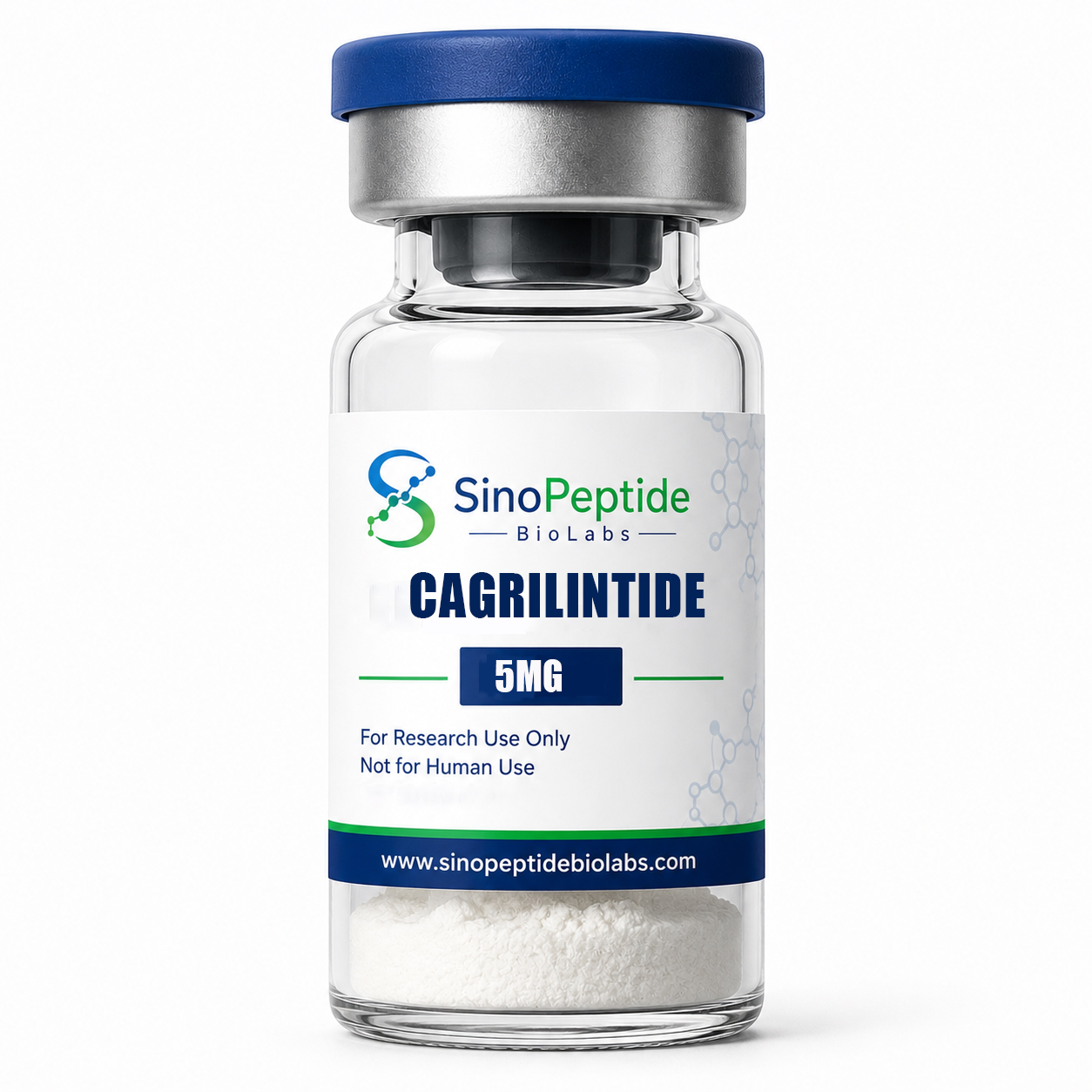
Cagrilintide 5mg
$116.00
10Vials/ Kits
Cagrilintide 5mg: Complete Research Peptide and Clinical Evidence Guide
Cagrilintide 5mg is a product specification referring to a stated quantity of cagrilintide, an investigational long-acting analogue of the pancreatic hormone amylin. Cagrilintide has attracted substantial scientific interest because of its effects on appetite regulation, satiety, energy balance, and body weight.
Unlike GLP-1 receptor agonists such as semaglutide, cagrilintide works primarily through the amylin and calcitonin receptor pathways. This gives it a distinct pharmacological profile and has made amylin-based compounds an important area of modern metabolic research.
Cagrilintide has been investigated both as a standalone compound and in combination with semaglutide. The combination, known as CagriSema, has produced substantial weight reductions in large randomized clinical trials. However, it is essential not to confuse evidence for CagriSema with evidence for a standalone Cagrilintide 5mg product. The major phase 3 CagriSema studies used 2.4mg of cagrilintide plus 2.4mg of semaglutide, not a 5mg cagrilintide formulation.
As of 2026, FDA states that cagrilintide is not a component of an FDA-approved drug and has not been found safe and effective for any condition, and the agency states that cagrilintide cannot be used in compounding under federal law.
This guide explains what Cagrilintide 5mg means, how cagrilintide works, its research history, clinical evidence, relationship with semaglutide, quality considerations, regulatory status, safety considerations, and frequently asked questions.
What Is Cagrilintide?
Cagrilintide is a long-acting analogue of amylin, a peptide hormone naturally produced by pancreatic beta cells and released alongside insulin after food intake.
Amylin contributes to the regulation of:
- Appetite
- Satiety
- Gastric emptying
- Post-meal glucagon secretion
- Food intake
- Energy balance
Cagrilintide was developed to provide a longer-acting pharmacological approach to amylin receptor signaling.
Research describes cagrilintide as an amylin analogue with activity involving amylin receptors and the calcitonin receptor. Structural research published in 2026 has further characterized how cagrilintide interacts with these receptor systems.
Because appetite and energy regulation involve multiple biological pathways, researchers have also investigated whether combining amylin signaling with other metabolic pathways can produce complementary effects.
This is the scientific rationale behind CagriSema, the combination of cagrilintide and semaglutide.
What Does Cagrilintide 5mg Mean?
The phrase Cagrilintide 5mg contains two important pieces of information:
- Cagrilintide identifies the active compound.
- 5mg identifies the stated quantity of the compound.
The 5mg designation should not automatically be interpreted as a recommended clinical dose.
This distinction is especially important because the major clinical studies of cagrilintide have used different quantities.
For example, a phase 2 cagrilintide monotherapy study evaluated weekly doses ranging from 0.3mg to 4.5mg.
The later phase 3 CagriSema trials evaluated 2.4mg cagrilintide combined with 2.4mg semaglutide.
Therefore, a product labeled Cagrilintide 5mg should not be described as if it were a 5mg clinical-trial formulation.
The product quantity and the clinically studied dose are separate concepts.
How Does Cagrilintide Work?
Cagrilintide is designed to mimic important actions of the natural hormone amylin.
Amylin is released by pancreatic beta cells after meals. It participates in appetite and metabolic regulation through both peripheral and central mechanisms.
Research indicates that amylin signaling can influence:
- Meal termination
- Satiety
- Food intake
- Gastric motility
- Glucagon regulation
- Energy balance
Cagrilintide is a longer-acting analogue intended to reproduce aspects of this signaling for a prolonged period.
A 2026 review of amylin-based therapies describes amylin as a hormone that promotes meal termination, slows gastric emptying, and suppresses glucagon secretion, while cagrilintide is being developed as a long-acting amylin-based therapy.
Cagrilintide and Amylin Receptors
Amylin receptors are complex receptor systems involving the calcitonin receptor and receptor activity-modifying proteins (RAMPs).
Research has identified multiple amylin receptor subtypes, helping explain why amylin signaling can affect different physiological processes.
Cagrilintide has been characterized as a compound capable of activating both amylin and calcitonin receptor systems.
Recent structural studies have provided additional information about the molecular interaction between cagrilintide and these receptors.
This receptor activity is central to understanding why cagrilintide differs from conventional GLP-1 receptor agonists.
Cagrilintide and Appetite Regulation
One of the major research interests surrounding cagrilintide is appetite regulation.
Amylin signaling contributes to the sensation of fullness following food consumption.
Research into central nervous system pathways indicates that amylin can influence neural regions involved in food intake and satiety, including pathways in the hindbrain and hypothalamus.
Cagrilintide is designed to provide longer-lasting activation of this biological pathway.
This has made it an important research candidate for obesity and metabolic disease studies.
However, describing this mechanism does not establish that every Cagrilintide 5mg product produces a particular degree of weight loss or appetite suppression.
Clinical outcomes depend on the exact compound, formulation, study population, duration, dose, and other factors.
Cagrilintide and Gastric Emptying
Natural amylin influences gastrointestinal physiology, including gastric emptying.
Slowing gastric emptying can contribute to prolonged fullness following a meal.
This mechanism is relevant to metabolic research because appetite regulation is not controlled solely by the brain.
Signals involving the gastrointestinal tract, pancreas, and central nervous system interact to regulate food intake and energy balance.
Cagrilintide’s activity in these pathways is therefore an important part of its research profile.
Cagrilintide 5mg Research Applications
Cagrilintide has been studied in several areas of metabolic research.
1. Obesity Research
Obesity is one of the principal areas of cagrilintide development.
Researchers have evaluated cagrilintide for effects on:
- Body weight
- Appetite
- Waist circumference
- Satiety
- Energy intake
- Metabolic parameters
- Treatment tolerability
A phase 2 randomized trial evaluated cagrilintide in adults with overweight or obesity and found dose-dependent reductions in body weight across the studied dose range.
2. Amylin Signaling Research
Cagrilintide provides a useful research tool for investigating the physiological effects of prolonged amylin receptor activation.
Research questions can include:
- How does amylin signaling affect appetite?
- Which receptor subtypes contribute to satiety?
- How does prolonged receptor stimulation alter energy balance?
- How does amylin signaling interact with GLP-1 pathways?
- What determines tolerability of long-acting amylin analogues?
3. Metabolic Research
Cagrilintide is also studied in the context of broader metabolic physiology.
Researchers may examine:
- Body composition
- Energy intake
- Glucose regulation
- Insulin-related pathways
- Glucagon
- Blood pressure
- Lipid metabolism
Importantly, not every metabolic effect observed in combination therapy can be attributed to cagrilintide alone.
Clinical Research on Cagrilintide
The evidence base for cagrilintide has developed considerably over the past several years.
One important study was a randomized phase 2 trial published in The Lancet.
The study included 706 participants assigned to cagrilintide, liraglutide, or placebo. Cagrilintide doses ranged from 0.3mg to 4.5mg once weekly.
At week 26, mean weight reductions under the trial’s product estimand ranged from approximately 6.0% to 10.8% across the cagrilintide dose groups, compared with approximately 3.0% for placebo. The 4.5mg cagrilintide group had a mean reduction of 10.8%.
The most frequent adverse events were gastrointestinal disorders and administration-site reactions.
This study is particularly relevant when discussing Cagrilintide 5mg because it demonstrates that the highest dose in that particular phase 2 study was 4.5mg, rather than 5mg.
Consequently, it would be inaccurate to say that the 5mg product specification represents a dose established by that trial.
Cagrilintide and CagriSema
One of the most significant developments in cagrilintide research has been its combination with semaglutide.
The combination is commonly referred to as CagriSema.
Cagrilintide targets amylin-related signaling, whereas semaglutide activates the GLP-1 receptor.
These pathways are biologically distinct but both influence appetite and metabolic regulation.
Researchers have therefore investigated whether targeting both pathways can produce complementary effects.
REDEFINE 1: Cagrilintide and Semaglutide
The REDEFINE 1 trial was a large phase 3a randomized study involving adults with overweight or obesity who did not have diabetes.
Participants were assigned to:
- Cagrilintide plus semaglutide
- Semaglutide alone
- Cagrilintide alone
- Placebo
The combination used 2.4mg of cagrilintide and 2.4mg of semaglutide.
At week 68, the estimated mean body-weight change was −20.4% with the combination compared with −3.0% with placebo under the treatment-policy estimand.
Gastrointestinal adverse events occurred in 79.6% of participants receiving the combination and 39.9% receiving placebo, with events described as mainly transient and mild to moderate.
These results provide important evidence for the cagrilintide-semaglutide combination.
They do not, however, establish that a standalone Cagrilintide 5mg product has the same effects.
REDEFINE 2: CagriSema in Type 2 Diabetes
REDEFINE 2 examined adults with overweight or obesity and type 2 diabetes.
Again, the combination contained:
2.4mg cagrilintide + 2.4mg semaglutide.
At week 68, the estimated mean body-weight change was −13.7% with cagrilintide-semaglutide compared with −3.4% with placebo.
Gastrointestinal adverse events were reported in 72.5% of participants receiving the combination and 34.4% receiving placebo.
The trial provides additional evidence for combination therapy in a population with type 2 diabetes.
It should not be used as evidence that a 5mg cagrilintide-only product has an equivalent effect.
Why 5mg Should Not Be Confused With 2.4mg
This is an important SEO and scientific distinction.
A product page may target the phrase Cagrilintide 5mg, but the article should not suggest that 5mg was the standard amount used in CagriSema’s major phase 3 studies.
The evidence can be summarized as follows:
| Research context | Cagrilintide amount |
|---|---|
| Phase 2 monotherapy dose range | 0.3–4.5mg |
| Phase 2 highest studied dose | 4.5mg |
| REDEFINE 1 CagriSema | 2.4mg |
| REDEFINE 2 CagriSema | 2.4mg |
| Cagrilintide 5mg product label | 5mg stated quantity |
This distinction improves the credibility of the product page and prevents the common mistake of equating a commercial product quantity with a clinical-trial dose.
Cagrilintide vs Semaglutide
Cagrilintide and semaglutide belong to different pharmacological categories.
| Feature | Cagrilintide | Semaglutide |
|---|---|---|
| Primary pathway | Amylin-related receptors | GLP-1 receptor |
| Hormone modeled | Amylin | GLP-1 |
| Main research area | Appetite and weight regulation | Glucose and weight regulation |
| Long-acting design | Yes | Yes |
| Standalone research | Yes | Yes |
| Combination research | With semaglutide | With cagrilintide |
Semaglutide has an established clinical and regulatory history in several indications, whereas cagrilintide remains an investigational compound in the United States.
Therefore, the regulatory status of semaglutide should not be transferred to cagrilintide.
Cagrilintide vs CagriSema
These terms are also frequently confused.
Cagrilintide is one compound.
CagriSema refers to the combination of cagrilintide and semaglutide.
Therefore:
Cagrilintide 5mg ≠ CagriSema.
A standalone cagrilintide product should not be described as if it contains semaglutide unless the product documentation specifically establishes that it does.
This is especially important for SEO pages because searches for “cagrilintide” and “CagriSema” can overlap substantially while referring to different formulations.
Cagrilintide 5mg Quality Considerations
For research materials, product quality should be evaluated using objective documentation rather than marketing claims.
Important considerations include:
Product Identity
The material should be clearly identified as cagrilintide.
Purity
Analytical testing can help characterize chemical purity and related substances.
Molecular Identity
Mass spectrometry or other suitable analytical methods may be used to support molecular identification.
HPLC Analysis
High-performance liquid chromatography can provide information about chromatographic purity and related peaks.
Certificate of Analysis
A batch-specific COA should ideally identify:
- Product name
- Batch number
- Test date
- Analytical method
- Purity
- Identity
- Specifications
- Results
- Testing laboratory or manufacturer
Batch Traceability
Batch-level documentation is particularly important when research results need to be reproduced.
Why Purity Alone Is Not Enough
A common misconception is that a stated purity percentage automatically establishes safety or suitability for human use.
It does not.
Chemical purity is only one component of overall product quality.
Other factors can include:
- Identity
- Impurity profile
- Residual solvents
- Endotoxin control
- Sterility where applicable
- Container integrity
- Stability
- Manufacturing controls
- Label accuracy
A research product can therefore have a high stated analytical purity while still not being an approved pharmaceutical product.
Cagrilintide Storage and Stability
Storage requirements depend on the specific product formulation and manufacturer.
Peptide materials may be affected by:
- Temperature
- Moisture
- Light
- Oxygen
- Container conditions
- Freeze-thaw exposure
- Formulation
- Reconstitution
For this reason, generic internet storage instructions should not replace product-specific technical documentation.
A professional product page should direct users to the manufacturer’s validated storage information rather than making unsupported universal stability claims.
Cagrilintide Safety Considerations
Cagrilintide remains an investigational compound in the United States.
Clinical trials have reported gastrointestinal adverse events as common with cagrilintide and cagrilintide-containing treatment regimens.
In the phase 2 monotherapy study, gastrointestinal events were more frequent with cagrilintide than placebo, with nausea among the commonly reported events. Administration-site reactions were also reported.
The large CagriSema trials likewise reported gastrointestinal adverse events frequently.
Clinical-trial safety data should not automatically be applied to an unapproved commercial product because formulation, manufacturing, dose, population, and quality controls may differ.
Current Regulatory Status of Cagrilintide
Regulatory status is particularly important for Cagrilintide 5mg content.
As of 2026, FDA states that:
- Cagrilintide is not a component of an FDA-approved drug.
- It has not been found by FDA to be safe and effective for any condition.
- Cagrilintide cannot be used in compounding under federal law.
FDA has also taken enforcement action against businesses marketing cagrilintide as an unapproved drug. In a March 2026 warning letter, FDA stated that cagrilintide products marketed by Prime Sciences were unapproved new drugs under federal law.
This means a website selling or discussing Cagrilintide 5mg should avoid describing the product as an FDA-approved weight-loss medicine.
It should also avoid implying that regulatory approval exists simply because the compound has undergone clinical trials.
Clinical development and regulatory approval are separate stages.
Cagrilintide 5mg and Research Use
If a product is genuinely intended for laboratory research, its website content should clearly identify the intended purpose.
Research-use content should focus on:
- Molecular identity
- Analytical characterization
- Research applications
- Scientific literature
- Storage information
- Quality documentation
- Regulatory status
It should not make unsupported claims that a research product is suitable for treating obesity, diabetes, metabolic disease, or other medical conditions.
This approach also helps create more credible SEO content because search engines increasingly reward useful, transparent, evidence-based information.
Common Misconceptions About Cagrilintide 5mg
Myth 1: Cagrilintide 5mg was the standard clinical-trial dose
Not according to the major published trials.
The phase 2 monotherapy study evaluated doses up to 4.5mg, while the major CagriSema phase 3 trials used 2.4mg of cagrilintide.
Myth 2: Cagrilintide is the same as semaglutide
No.
Cagrilintide is an amylin analogue, while semaglutide is a GLP-1 receptor agonist.
Myth 3: Cagrilintide 5mg is CagriSema
No.
CagriSema contains both cagrilintide and semaglutide.
Myth 4: Clinical-trial results prove that every cagrilintide product works identically
No.
Clinical results apply to the specific compound, formulation, dose, population, and study conditions investigated.
Myth 5: Cagrilintide is FDA approved for weight loss
FDA currently states that cagrilintide is not a component of an FDA-approved drug and has not been found safe and effective for any condition.
Frequently Asked Questions About Cagrilintide 5mg
What is Cagrilintide 5mg?
Cagrilintide 5mg refers to a product specification containing a stated 5mg quantity of cagrilintide. The 5mg label should not automatically be interpreted as an established clinical dose.
What is cagrilintide?
Cagrilintide is a long-acting analogue of the pancreatic hormone amylin and is being investigated for metabolic and weight-management applications.
How does cagrilintide work?
Cagrilintide acts through amylin-related receptor pathways and also has activity at the calcitonin receptor. These pathways are involved in appetite, satiety, gastrointestinal physiology, and energy regulation.
Is Cagrilintide 5mg the same as CagriSema?
No. CagriSema is a combination of cagrilintide and semaglutide.
What dose of cagrilintide was studied in clinical trials?
Different trials studied different amounts. A major phase 2 monotherapy study evaluated 0.3mg through 4.5mg, while the phase 3 CagriSema studies used 2.4mg cagrilintide with 2.4mg semaglutide.
Is Cagrilintide FDA approved?
FDA currently states that cagrilintide is not a component of an FDA-approved drug and has not been found safe and effective for any condition.
Has cagrilintide been studied for weight loss?
Yes. Randomized clinical trials have investigated cagrilintide alone and in combination with semaglutide for adults with overweight or obesity.
What is the difference between cagrilintide and semaglutide?
Cagrilintide is an amylin analogue, whereas semaglutide is a GLP-1 receptor agonist. They target different biological pathways.
What are the common adverse events reported in cagrilintide studies?
Gastrointestinal events, including nausea, constipation, and diarrhea, have been reported frequently in clinical studies. Administration-site reactions have also been reported.
Does Cagrilintide 5mg mean 5mg is an approved dose?
No. A product’s stated quantity should not be confused with an approved or clinically recommended dose.
How can Cagrilintide 5mg product quality be evaluated?
Relevant documentation includes product identity, batch number, analytical purity, molecular characterization, HPLC or comparable testing, mass spectrometry where appropriate, and a batch-specific Certificate of Analysis.
Research-Use and Regulatory Disclaimer
Cagrilintide is an investigational compound and should not be presented as an FDA-approved treatment.
This article is intended for educational and research-information purposes. It does not establish that a particular Cagrilintide 5mg product is safe, effective, sterile, or appropriate for human administration.
The clinical evidence discussed above relates to specific investigational formulations and study protocols. Results from clinical trials should not automatically be applied to independently manufactured, compounded, or commercially marketed products.
Individuals seeking treatment for obesity, diabetes, or another medical condition should consult a qualified healthcare professional and use products that are legally authorized for the intended indication and jurisdiction.
Conclusion
Cagrilintide 5mg is a product specification associated with cagrilintide, an investigational long-acting amylin analogue that has become an important subject in obesity and metabolic research.
Cagrilintide works through biological pathways associated with amylin and calcitonin receptors, influencing mechanisms involved in satiety, appetite, gastric physiology, and energy balance.
Clinical research has produced substantial interest in cagrilintide. A phase 2 study demonstrated significant weight reductions across cagrilintide dose groups, with doses up to 4.5mg.
Further research investigated cagrilintide together with semaglutide in the combination known as CagriSema. The REDEFINE 1 and REDEFINE 2 phase 3 studies used 2.4mg of cagrilintide together with 2.4mg of semaglutide and reported substantial reductions in body weight compared with placebo.
The distinction between these clinical formulations and a Cagrilintide 5mg product is essential. The 5mg label identifies the stated product quantity; it does not establish that 5mg is an approved or clinically validated dose.
Regulatory status is equally important. FDA currently states that cagrilintide is not a component of an FDA-approved drug and has not been found safe and effective for any condition.
For a high-quality Cagrilintide 5mg website page, the strongest approach is therefore to emphasize accurate scientific information, transparent product specifications, analytical quality, current regulatory status, and appropriate distinctions between cagrilintide monotherapy, CagriSema research, and approved metabolic medicines.
This evidence-based approach provides useful information for researchers and readers while avoiding exaggerated claims about efficacy, safety, or regulatory approval.
Be the first to review “Cagrilintide 5mg”
Related products
Pure Peptides
Pure Peptides
Pure Peptides
Pure Peptides
Pure Peptides
Pure Peptides
Pure Peptides
Pure Peptides
Reviews
There are no reviews yet.