

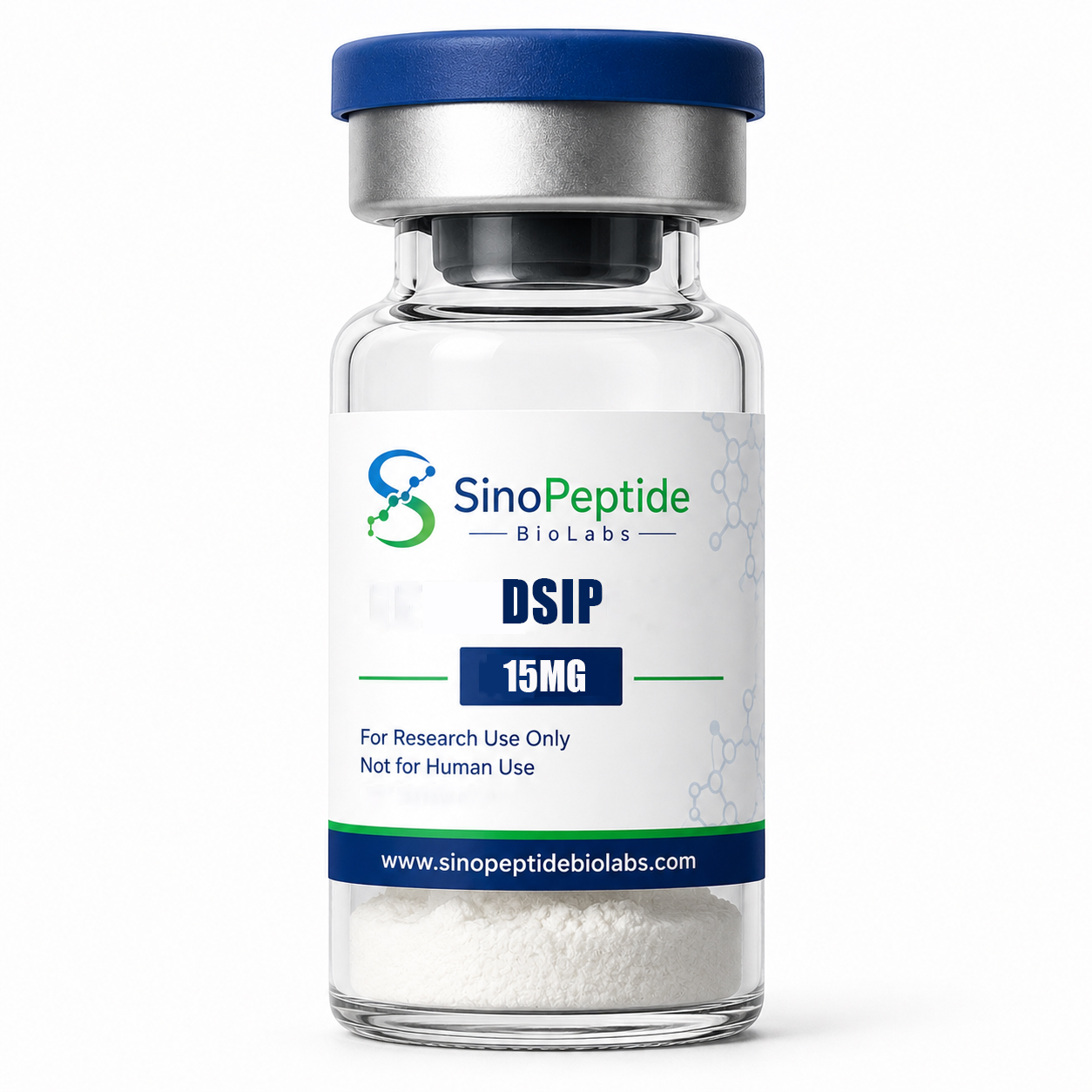
DSIP 15mg
$100.00
10 Vials/ Kits
DSIP 15mg: Research, Mechanism, Sleep Studies, Benefits & Safety
Introduction
DSIP 15mg is a research product associated with Delta Sleep-Inducing Peptide (DSIP), a small peptide that has been investigated for decades in sleep physiology, neurobiology, circadian regulation, stress responses, and related areas of neuroscience.
DSIP is also known as emideltide in current U.S. Food and Drug Administration materials. FDA documents describe emideltide as a nonapeptide and distinguish between emideltide free base and emideltide acetate. Neither form is a component of an FDA-approved drug.
The scientific history of DSIP is unusual. Early research proposed that DSIP might act as an endogenous sleep-related signaling peptide. Animal and early human studies investigated its relationship with sleep, particularly slow-wave or delta sleep. Researchers also examined possible effects involving circadian rhythms, stress, neurotransmitter systems, and other physiological processes.
However, later scientific reviews have emphasized that the biological role of naturally occurring DSIP remains unresolved. A 2006 review described the evidence connecting DSIP directly to sleep regulation as weak and noted that the DSIP gene, precursor protein, and specific receptor had not been clearly established.
This distinction is essential when creating accurate content about DSIP 15mg.
Although DSIP has a long history of experimental investigation, it should not be presented as a proven sleep medication or as an FDA-approved treatment for insomnia, anxiety, withdrawal, or other medical conditions.
The 15mg designation refers to the stated quantity of material in a research product. It does not establish a clinically validated human dose.
This guide examines DSIP 15mg, including its history, molecular characteristics, sleep research, proposed mechanisms, potential research applications, safety considerations, regulatory status, product-quality factors, and frequently asked questions.
What Is DSIP?
DSIP stands for Delta Sleep-Inducing Peptide.
It is a short peptide historically investigated for its possible role in sleep regulation. Classic literature describes DSIP as a nonapeptide, meaning that it consists of nine amino acids.
The peptide was originally isolated during research into endogenous factors potentially involved in sleep.
Early experiments suggested that DSIP could influence sleep patterns in several animal species. Researchers subsequently investigated whether the peptide might contribute to the biological regulation of sleep and wakefulness.
The early scientific literature examined DSIP in connection with:
- Slow-wave sleep
- Delta-wave activity
- Sleep onset
- Circadian rhythms
- Stress responses
- Neurotransmitter activity
- Locomotor activity
- Neuroendocrine signaling
- Drug-response pathways
However, the scientific interpretation of DSIP has evolved.
While early studies presented DSIP as a potential sleep-promoting factor, later reviews questioned whether naturally occurring DSIP is actually a primary physiological sleep regulator.
Therefore, modern descriptions should present DSIP as an experimental neuropeptide and research subject, rather than simply calling it a clinically established sleep peptide.
What Does DSIP 15mg Mean?
The term DSIP 15mg generally identifies a research product containing a stated quantity of DSIP.
The 15mg quantity should not be interpreted as a recommended medical dose.
Product quantity and experimental dosage are different concepts.
A laboratory may use different concentrations depending on:
- Experimental model
- Research objective
- Cell type
- Assay design
- Pharmacokinetic considerations
- Route of experimental administration
- Study protocol
Consequently, a 15mg research product does not establish how much DSIP should be administered to a person.
For accurate SEO content, it is better to describe DSIP 15mg as a research quantity rather than a “15mg dose.”
DSIP and the History of Sleep Research
DSIP has a long history in experimental sleep science.
Early investigations explored the possibility that biological substances circulating during sleep could influence sleep behavior. DSIP emerged from this line of research and was subsequently characterized and synthesized.
Classic research reported that DSIP could influence sleep in various animal models, although responses differed between species. One early review reported delta-sleep-related effects in rabbits, rats, mice, and humans, while noting differences in effects across species.
Researchers subsequently conducted studies examining DSIP in humans.
Some early clinical experiments reported changes in sleep architecture, sleep onset, or sleep efficiency following experimental administration. However, the results were not uniformly strong, and later assessments questioned the clinical significance of the findings.
This history makes DSIP scientifically interesting while also demonstrating why early experimental results should not automatically be treated as modern clinical evidence.
How Does DSIP Work?
The precise biological mechanism of DSIP remains incompletely understood.
This is one of the most important scientific limitations surrounding the compound.
Early studies suggested that DSIP might influence several neurophysiological processes, including neurotransmitter activity, circadian regulation, and stress-related systems. Researchers also proposed mechanisms involving adrenergic transmission.
However, a definitive DSIP receptor and complete physiological signaling pathway have not been firmly established.
A later review specifically emphasized the unresolved nature of the DSIP mechanism and noted uncertainty concerning the peptide’s endogenous biology.
Therefore, claims that DSIP has a single clearly established mechanism should be avoided.
DSIP and Slow-Wave Sleep
The relationship between DSIP and slow-wave sleep is the basis of much of the peptide’s scientific interest.
Slow-wave sleep is the deeper portion of non-REM sleep characterized by prominent low-frequency brain activity.
Early DSIP experiments suggested that the peptide could influence delta or slow-wave sleep under particular experimental conditions. A historical review reported sleep-related activity in multiple animal species and humans.
Some early human experiments also reported changes in sleep patterns following DSIP administration.
For example, an early controlled study involving healthy volunteers reported increased sleep during an observation period following experimental DSIP administration, along with changes in subsequent sleep measures.
However, these studies were small and old, and they do not provide the type of modern evidence required to establish DSIP as a standard treatment for sleep disorders.
DSIP and Insomnia Research
Insomnia has been one of the conditions investigated in historical DSIP studies.
Early clinical investigations examined whether DSIP could influence sleep in individuals experiencing insomnia. Some studies reported improvements in sleep measures following experimental administration.
However, another double-blind study involving chronic insomnia patients found that although some objective sleep measures improved, the overall effects were weak and several other measures did not change. The authors concluded that short-term DSIP treatment was unlikely to provide a major therapeutic benefit for chronic insomnia.
This is an important distinction for SEO content.
It is reasonable to state that DSIP has been studied in insomnia research.
It is not accurate to state that DSIP is a proven insomnia treatment.
DSIP and Circadian Rhythm Research
DSIP has also been investigated in relation to circadian biology.
Early research reported effects involving locomotor activity rhythms and other physiological rhythms. Researchers proposed that DSIP could influence aspects of biological timing in addition to its proposed sleep-related effects.
This has contributed to continued interest in DSIP as a research subject in:
- Sleep-wake regulation
- Circadian biology
- Neuroendocrine signaling
- Behavioral physiology
- Stress biology
Nevertheless, the precise physiological role of endogenous DSIP remains unresolved.
DSIP and Stress Research
Research has investigated DSIP in connection with stress and neurophysiological responses.
Historical studies reported that DSIP could influence physiological responses associated with stress and could interact with the effects of various pharmacological agents.
These findings contributed to the broader hypothesis that DSIP may participate in neuroendocrine or adaptive responses.
However, evidence from historical experiments does not establish DSIP as a clinically validated treatment for stress or anxiety.
A responsible research article should therefore describe stress-related effects as areas of investigation, not established therapeutic benefits.
DSIP and Neurotransmitter Research
Researchers have also examined DSIP’s possible influence on neurotransmitter systems.
Historical literature reported changes involving neurotransmitter levels and electrophysiological activity following DSIP exposure.
Some researchers proposed that DSIP could affect adrenergic transmission.
However, the exact mechanism remains uncertain.
This uncertainty is one reason modern research should distinguish between:
Observed experimental effects
and
Established molecular mechanisms.
DSIP has documented experimental history, but its complete molecular biology remains unresolved.
DSIP and Pain Research
DSIP has historically been investigated beyond sleep.
Some experimental literature explored its relationship with pain thresholds and neurophysiological responses. A historical review described effects involving pain threshold, thermoregulation, heart rate, blood pressure, and immune-related processes.
These findings generated hypotheses about broader biological roles.
However, there is insufficient contemporary evidence to describe DSIP as an established analgesic or pain treatment.
For SEO purposes, “DSIP pain research” can be discussed as a historical research topic, but claims such as “DSIP treats chronic pain” should be avoided.
DSIP and Withdrawal Research
Another historical area of investigation involved withdrawal symptoms.
An early study examined DSIP in people experiencing withdrawal from alcohol or opioids and reported beneficial effects in the evaluable participants.
However, this was an early study with limitations, including participants who were lost or considered unsuitable for evaluation.
Consequently, it should not be interpreted as modern evidence establishing DSIP as an approved treatment for substance withdrawal.
The appropriate description is that DSIP has historically been investigated in withdrawal-related research.
DSIP and Human Research
Unlike many experimental peptides that have only been studied in laboratory animals, DSIP has a history of early human experimentation.
Published human studies investigated:
- Sleep
- Sleep architecture
- Sleep onset
- Alertness
- Psychophysiological responses
- Insomnia
- Withdrawal symptoms
Some early studies reported physiological or sleep-related effects.
However, the human evidence is limited by several factors:
- Small study populations
- Old study designs
- Limited replication
- Historical methodology
- Uncertainty regarding mechanism
- Lack of modern large-scale clinical trials
- Lack of contemporary evidence establishing long-term safety
Therefore, the existence of historical human studies does not mean DSIP has been clinically validated under modern standards.
What Are the Potential Research Benefits of DSIP?
Searches for “DSIP benefits” are common, but this phrase needs careful interpretation.
Research has investigated DSIP in several areas.
Sleep Research
The most recognizable research area is sleep physiology.
Researchers have studied DSIP in relation to slow-wave sleep, sleep onset, and sleep architecture.
Circadian Research
DSIP has also been studied for possible effects on circadian and locomotor rhythms.
Stress Research
Historical experiments have examined interactions between DSIP and stress-related physiological responses.
Neurotransmitter Research
Researchers have investigated effects on neurotransmitter systems and electrophysiological activity.
Withdrawal Research
Historical clinical studies examined DSIP in alcohol- and opioid-withdrawal settings.
Neuroendocrine Research
The peptide has been investigated in relation to hormonal and physiological regulation.
These areas represent research interests rather than proven clinical benefits.
DSIP Safety
Safety is a particularly important consideration for DSIP research products.
Current FDA materials identify emideltide (DSIP) as a substance for which important safety questions remain unresolved. FDA states that compounded drugs containing emideltide may pose immunogenicity risks for certain routes of administration and may present complexities involving peptide-related impurities and active pharmaceutical ingredient characterization. The agency also states that it lacks sufficient information to determine whether the substance could cause harm when administered to humans through the proposed route.
This does not mean that every research sample is necessarily unsafe.
It means that the available evidence is insufficient to establish a reliable human safety profile.
Researchers should therefore treat DSIP as an experimental compound and pay careful attention to:
- Identity
- Purity
- Impurities
- Aggregation
- Analytical characterization
- Batch consistency
- Experimental conditions
DSIP and Immunogenicity
Because DSIP is a peptide, immune responses are one of the safety considerations relevant to its development and potential administration.
Immunogenicity refers to the ability of a substance to trigger an immune response.
FDA has specifically identified potential immunogenicity concerns for compounded drugs containing emideltide through certain routes of administration.
The risk can depend on multiple factors, including:
- Peptide sequence
- Purity
- Aggregation
- Impurities
- Formulation
- Route of administration
- Frequency and duration of exposure
Consequently, a research product’s nominal peptide quantity alone cannot establish safety.
Is DSIP 15mg FDA Approved?
No. DSIP 15mg should not be described as an FDA-approved medication.
Current FDA documentation identifies DSIP under the name emideltide and states that neither emideltide free base nor emideltide acetate is a component of an FDA-approved drug.
FDA reviewed nominations for emideltide-related bulk drug substances for potential inclusion on the 503A Bulks List. The agency’s 2026 materials also state that there is no applicable USP or National Formulary drug-substance monograph for either emideltide free base or its acetate form.
Importantly, being discussed by an FDA advisory committee or appearing in FDA documents does not mean that a compound has received drug approval.
Therefore, a DSIP 15mg product page should avoid claims such as:
- “FDA-approved DSIP”
- “FDA-approved sleep peptide”
- “FDA-approved insomnia treatment”
- “Clinically proven DSIP therapy”
DSIP vs. Emideltide
DSIP and emideltide refer to the same research peptide in the context of current FDA documentation.
FDA explicitly states that emideltide is also referred to as Delta Sleep Inducing Peptide (DSIP).
The terminology can therefore be useful for SEO.
A well-optimized website can naturally target both:
- DSIP 15mg
- Delta Sleep-Inducing Peptide
- Emideltide 15mg
- Emideltide research
- DSIP peptide research
However, keyword usage should remain natural rather than repetitive.
DSIP 15mg Product Quality
For research applications, product quality and analytical documentation are important.
A reputable research product page should provide transparent information about the material being offered.
Certificate of Analysis
A Certificate of Analysis (COA) can provide information about:
- Peptide identity
- Purity
- Batch or lot number
- Testing methodology
- Laboratory information
- Date of analysis
A batch-specific COA is generally more useful than a generic document that cannot be connected to the product lot.
Peptide Identity
Researchers should verify that the material is clearly identified as DSIP or emideltide.
This is especially important because DSIP-related terminology can vary between scientific literature, commercial listings, and regulatory documents.
Purity
Purity is another important consideration for peptide research.
Peptide-related impurities or degradation products can potentially influence experimental outcomes and are among the quality considerations identified by FDA in its evaluation of emideltide-related substances.
Transparent Labeling
A research product should clearly distinguish itself from an approved pharmaceutical product.
Useful product-page information can include:
- Compound name
- Quantity
- Research-use designation
- Batch information
- Analytical documentation
- Storage information supported by supplier documentation
- Appropriate research disclaimer
Why Researchers Study DSIP
DSIP remains scientifically interesting because it occupies a unique position in the history of sleep and neuropeptide research.
Its study has raised broader questions about:
- How sleep is biologically regulated
- Whether circulating peptides can influence sleep
- How neuropeptides interact with neurotransmitter systems
- How circadian rhythms are regulated
- How sleep and stress systems interact
- How endogenous signaling molecules influence behavior
Even though some early hypotheses have remained unresolved, the historical literature provides useful context for neuroscience and sleep research.
DSIP 15mg Research Applications
Potential research applications can include investigations into:
Sleep physiology
Researchers can examine DSIP-related effects on sleep architecture and sleep-wake behavior.
Neurobiology
DSIP can be investigated in studies involving neuropeptide signaling and brain physiology.
Circadian biology
Researchers can explore relationships between DSIP and biological timing.
Stress physiology
Experimental models can investigate interactions between DSIP and stress-related responses.
Neurotransmitter signaling
DSIP has historically been investigated in connection with neurotransmitter systems.
Peptide pharmacology
Researchers can study the pharmacological characteristics of a short neuropeptide and its analogues.
Analytical chemistry
DSIP-related materials can be investigated for identity, purity, degradation, and peptide characterization.
Common Misconceptions About DSIP 15mg
“DSIP is a proven sleeping medication.”
Not established. Historical studies investigated DSIP’s effects on sleep, but modern evidence does not establish it as an FDA-approved sleep medication.
“15mg is the recommended DSIP dose.”
No. Fifteen milligrams describes the stated product quantity and does not establish a clinically validated dosage.
“DSIP has no safety concerns.”
That conclusion is not supported. Current FDA materials identify unresolved safety questions, including potential immunogenicity and peptide-related impurities.
“DSIP has never been studied in humans.”
Incorrect. Historical human studies investigated DSIP in relation to sleep and other physiological effects.
“Because DSIP was studied in clinical trials, it is approved.“
Clinical research and regulatory approval are different things. Current FDA materials state that neither emideltide free base nor emideltide acetate is a component of an FDA-approved drug.
Frequently Asked Questions About DSIP 15mg
What is DSIP 15mg?
DSIP 15mg refers to a research product containing a stated quantity of Delta Sleep-Inducing Peptide, also known as emideltide. DSIP is a short nonapeptide investigated primarily in sleep and neuroscience research.
What does DSIP stand for?
DSIP stands for Delta Sleep-Inducing Peptide.
What is emideltide?
Emideltide is the name used by the FDA for DSIP. FDA documents explicitly identify emideltide as Delta Sleep Inducing Peptide.
Is DSIP a peptide?
Yes. DSIP is described in FDA materials as a nonapeptide.
What is DSIP studied for?
DSIP has been investigated in sleep research, circadian biology, neurophysiology, stress research, neurotransmitter research, and historically in withdrawal-related research.
Does DSIP improve sleep?
Historical human and animal studies reported sleep-related effects, but the evidence is old and inconsistent. A controlled insomnia study found some objective improvements but concluded that short-term DSIP treatment was unlikely to provide a major therapeutic benefit.
Is DSIP FDA approved?
No. FDA states that neither emideltide free base nor emideltide acetate is a component of an FDA-approved drug.
Is DSIP safe?
A complete modern human safety profile has not been established. FDA currently identifies unresolved safety concerns involving immunogenicity, peptide-related impurities, and API characterization.
What does 15mg mean?
It refers to the stated quantity of DSIP in a research product. It does not establish a recommended human dosage.
Is DSIP the same as emideltide?
Yes. Current FDA documentation uses emideltide as the name for DSIP.
Has DSIP been studied in humans?
Yes. Historical clinical studies examined DSIP in healthy volunteers and individuals with insomnia, among other research populations.
Why is DSIP called a sleep peptide?
It received this name because early research investigated its potential ability to influence sleep, particularly delta or slow-wave sleep. Later research has questioned how important DSIP is as a natural sleep-regulating factor.
SEO Strategy for DSIP 15mg
A high-quality page targeting DSIP 15mg should establish topical relevance without making unsupported medical claims.
The primary keyword should appear naturally in:
- SEO title
- H1
- Introduction
- Meta description
- URL
- At least one H2 heading
- Product description
- FAQ section
- Relevant image alt text
Secondary keywords can expand the semantic coverage of the page.
Important keyword clusters include:
DSIP peptide
Delta Sleep-Inducing Peptide
DSIP 15mg
DSIP research
DSIP sleep research
DSIP mechanism
DSIP safety
DSIP insomnia research
emideltide
emideltide 15mg
DSIP peptide research
DSIP neuroscience research
The goal should be topical completeness rather than keyword density.
Internal Linking Suggestions
To strengthen topical authority, the DSIP 15mg page can link to related educational pages such as:
- What Is DSIP?
- DSIP and Sleep Research
- Peptide Research Guide
- Research Peptide Safety Guide
- Understanding Certificates of Analysis
- DSIP vs. Other Research Peptides
- Sleep and Circadian Rhythm Research
- Experimental Peptide Regulatory Guide
- Neuropeptide Research Overview
These internal links can help search engines understand the relationship between individual product pages and the site’s broader research-peptide content.
Final Thoughts on DSIP 15mg
DSIP 15mg is associated with a long-standing but still unresolved area of peptide and sleep research.
Delta Sleep-Inducing Peptide, now also referred to as emideltide in FDA materials, is a nonapeptide that was originally investigated as a possible endogenous sleep-related signaling molecule.
Early research reported sleep-related effects in animals and humans, particularly involving slow-wave or delta sleep. Researchers subsequently investigated DSIP in connection with sleep architecture, circadian rhythms, stress responses, neurotransmitter activity, and other physiological processes.
Historical human studies are particularly interesting because they reported changes in sleep behavior and sleep measurements following experimental DSIP administration. However, these studies were generally small and conducted decades ago. Other research produced weaker results, and a later scientific review concluded that the hypothesis of DSIP as a natural sleep factor remained poorly documented.
This makes DSIP a good example of why scientific history and clinical evidence must be distinguished.
The current regulatory situation is also important. FDA identifies DSIP as emideltide and states that neither emideltide free base nor emideltide acetate is a component of an FDA-approved drug. FDA has also highlighted unresolved concerns involving potential immunogenicity, peptide-related impurities, and insufficient information to determine whether compounded products containing emideltide could cause harm when administered through the proposed routes.
For this reason, DSIP 15mg should be positioned accurately as an experimental research peptide, not as an established sleep medication or proven treatment.
For research-focused websites, the strongest SEO strategy is to provide useful scientific information covering DSIP’s history, sleep research, proposed mechanisms, human research, limitations, safety considerations, regulatory status, and product-quality documentation.
The 15mg designation represents product quantity rather than a validated human dose. Researchers should rely on appropriate experimental protocols, institutional requirements, analytical documentation, and qualified scientific or medical professionals when determining how experimental substances may be studied.
Research Disclaimer: DSIP/emideltide is an experimental peptide. This article is provided for educational and research-information purposes only and does not constitute medical advice, a dosing recommendation, or an instruction for human administration. DSIP should not be represented as an FDA-approved treatment for insomnia, sleep disorders, anxiety, withdrawal, pain, or other medical conditions.
DSIP 15mg DSIP 15mg DSIP 15mg DSIP 15mg DSIP 15mg DSIP 15mg DSIP 15mg DSIP 15mg DSIP 15mg DSIP 15mg DSIP 15mgDSIP 15mg DSIP 15mg DSIP 15mg DSIP 15mg DSIP 15mg DSIP 15mg DSIP 15mg DSIP 15mg DSIP 15mg DSIP 15mg DSIP 15mg DSIP 15mg
Be the first to review “DSIP 15mg”
Related products
Pure Peptides
Pure Peptides
Pure Peptides
Pure Peptides
Pure Peptides
Pure Peptides
Pure Peptides
Pure Peptides
Reviews
There are no reviews yet.