

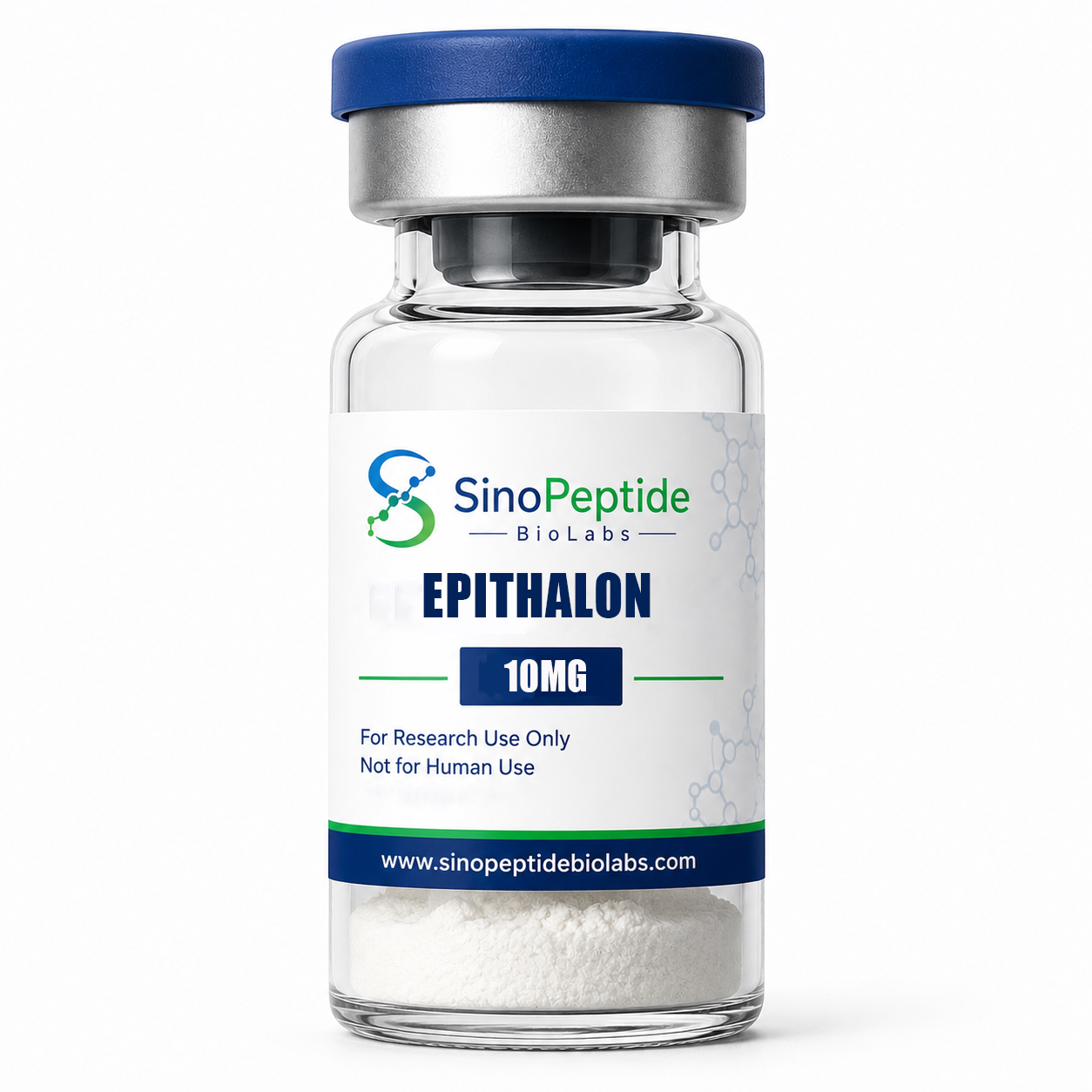
Epithalon 10mg
$45.00
10 Vials/ Kits
Epithalon 10mg: Research, Mechanism, Telomere Studies, Benefits & Safety
Introduction
Epithalon 10mg, commonly spelled Epitalon in scientific literature, is an experimental synthetic tetrapeptide that has attracted interest in aging, telomere, pineal-gland, cellular biology, and longevity research.
Epitalon is generally identified as the tetrapeptide Ala-Glu-Asp-Gly (AEDG). The compound was developed from research involving Epithalamin, a preparation derived from pineal tissue, and has subsequently been studied independently in laboratory and animal research.
Interest in Epitalon has particularly focused on its possible relationship with telomerase activity and telomere biology. Telomeres are protective DNA-protein structures at chromosome ends, and changes in telomere length are widely investigated as one component of cellular aging research.
Recent laboratory research has continued to investigate Epitalon’s effects on telomere length, telomerase-related pathways, and cellular models. A 2025 publication reported telomere-length changes in human cell lines following Epitalon exposure and investigated possible involvement of telomerase and alternative lengthening of telomeres (ALT).
However, laboratory findings should not be confused with proven human anti-aging effects.
Epitalon remains an experimental research peptide, and current FDA materials identify important gaps in human safety information. FDA states that it did not identify clinical studies assessing the safety of epitalon-related bulk drug substances administered to humans and notes potential immunogenicity concerns associated with aggregation and peptide-related impurities.
The 10mg designation describes the stated quantity of material in a research product. It should not be interpreted as a recommended human dose or medical treatment protocol.
This comprehensive guide explains what Epithalon 10mg is, how Epitalon has been studied, its relationship with telomeres and telomerase, potential research applications, sleep and aging research, safety considerations, FDA status, product-quality factors, and frequently asked questions.
What Is Epithalon?
Epithalon, also widely spelled Epitalon, is a synthetic tetrapeptide consisting of four amino acids:
Alanine – Glutamic Acid – Aspartic Acid – Glycine (Ala-Glu-Asp-Gly or AEDG).
Scientific literature generally describes Epitalon as a tetrapeptide derived conceptually from research involving pineal peptide preparations. A recent review describes Epitalon as a tetrapeptide synthesized based on the amino-acid composition of Epithalamin, a bovine pineal-gland extract.
This distinction is important because Epitalon and Epithalamin are not identical products.
Epitalon is a defined tetrapeptide, whereas Epithalamin refers to a more complex pineal-derived preparation.
Research into Epitalon has included:
- Telomere biology
- Telomerase activity
- Cellular aging
- Oxidative stress
- Pineal biology
- Melatonin-related research
- Neuroendocrine signaling
- Cellular senescence
- Longevity research
- Antioxidant research
- Experimental sleep research
Despite this broad research history, the available evidence does not establish Epitalon as a proven anti-aging therapy.
What Does Epithalon 10mg Mean?
Epithalon 10mg generally refers to a research product containing a stated quantity of Epitalon.
The number 10mg represents product quantity.
It does not automatically represent:
- A recommended human dose
- A therapeutic dose
- An FDA-approved dosage
- A validated longevity protocol
- A clinical treatment schedule
This distinction is particularly important for experimental peptides.
Laboratory studies may use concentrations or exposure conditions that cannot be directly converted into a human administration protocol.
Therefore, a research website should describe Epithalon 10mg as a research quantity rather than marketing it as a 10mg clinical dose.
Epithalon vs. Epitalon: Are They the Same?
Yes, Epithalon and Epitalon are commonly used names for the same tetrapeptide research compound.
Other spellings can also appear in scientific and commercial literature, including:
- Epitalon
- Epithalon
- Epithalone
For SEO purposes, using both Epithalon 10mg and Epitalon 10mg naturally throughout the page can help capture different search terms.
However, the content should make clear that these names generally refer to the same research peptide rather than separate products.
Epitalon and Telomere Research
Telomeres are specialized structures located at the ends of chromosomes.
They help protect chromosome ends during cell division and are an important subject of research into cellular aging.
Because telomere shortening is associated with replicative aging in many cell types, scientists have investigated whether compounds that influence telomere maintenance could affect cellular aging processes.
Epitalon has become particularly well known because research has investigated its potential relationship with telomerase activity.
Recent laboratory research has reported that Epitalon exposure can influence telomere length in certain human cell lines and investigated potential involvement of telomerase-related mechanisms.
These findings are scientifically interesting, but they should be interpreted carefully.
An effect on telomere length in cultured cells does not demonstrate that Epitalon extends human lifespan or prevents age-related diseases.
What Is Telomerase?
Telomerase is an enzyme complex involved in maintaining telomere sequences.
In certain cell types, telomerase helps compensate for telomere shortening associated with cell division.
Telomerase activity is therefore a major area of research in:
- Aging biology
- Stem-cell biology
- Cancer biology
- Cellular senescence
- Regenerative research
- Genomic stability
Epitalon research has investigated whether the peptide can influence telomerase-related pathways.
A recent study in human cell lines reported changes involving hTERT expression and telomerase activity, along with telomere-length changes under experimental conditions.
However, telomerase biology is complex.
Increasing telomerase activity is not automatically equivalent to producing a beneficial anti-aging effect. Telomerase also has important relationships with cellular proliferation and cancer biology.
For this reason, claims that simply increasing telomerase activity is universally beneficial are scientifically incomplete.
Epitalon and Cellular Aging Research
Cellular aging is another important area of Epitalon research.
Scientists study cellular aging through several mechanisms, including:
- Telomere shortening
- DNA damage
- Oxidative stress
- Mitochondrial dysfunction
- Cellular senescence
- Altered gene expression
- Loss of proteostasis
Epitalon has been investigated in relation to several of these processes.
A recent review summarized research suggesting that Epitalon has been studied for possible geroprotective, antioxidant, neuroprotective, and other biological effects. However, the same review emphasizes that the precise mechanisms responsible for the compound’s different reported effects remain incompletely understood.
This makes Epitalon an interesting experimental molecule but does not establish a clinical anti-aging indication.
Epitalon and Longevity Research
The term “longevity peptide” is frequently associated with Epitalon.
The scientific rationale for this interest comes from research into:
- Telomere maintenance
- Telomerase activity
- Cellular aging
- Pineal biology
- Oxidative stress
- Neuroendocrine regulation
Some animal and laboratory studies have reported findings interpreted as potentially relevant to aging biology.
However, lifespan extension in experimental models does not automatically establish lifespan extension in humans.
A scientifically responsible article should therefore describe Epitalon as a longevity research compound rather than claiming that it increases human lifespan.
Epitalon and Pineal Gland Research
The history of Epitalon is closely connected with research into the pineal gland.
The pineal gland is an endocrine structure involved in the regulation of melatonin production and circadian physiology.
Epitalon was developed in the context of research involving pineal peptides, particularly Epithalamin.
Researchers have investigated whether Epitalon can influence biological pathways associated with pineal function and neuroendocrine regulation.
A recent review reports experimental findings involving melatonin synthesis, immune-related signaling, enzyme activity, and other biological pathways.
However, the exact physiological role of Epitalon in humans remains unresolved.
Epitalon and Melatonin Research
Melatonin is an important hormone involved in sleep-wake and circadian regulation.
Because Epitalon has a historical connection with pineal research, scientists have investigated possible relationships between Epitalon and melatonin synthesis.
Experimental literature has reported changes in melatonin-related pathways following Epitalon exposure.
This has contributed to interest in Epitalon and sleep research.
Nevertheless, these findings do not establish Epitalon as a clinically validated sleep medication.
A website should therefore avoid making claims such as “Epitalon cures insomnia” or “Epitalon is a natural melatonin replacement.”
Epitalon and Sleep Research
Sleep is another area associated with Epitalon research.
The connection largely originates from its relationship with pineal biology and melatonin regulation.
Researchers have investigated whether Epitalon can influence:
- Circadian signaling
- Melatonin production
- Sleep-wake patterns
- Neuroendocrine regulation
- Pineal-gland activity
The FDA’s 2026 review of epitalon-related bulk substances specifically evaluated a proposed use involving insomnia, but this review should not be confused with FDA approval.
Current FDA materials continue to identify significant gaps in safety information for epitalon-related substances.
Therefore, Epitalon should not be described as an approved insomnia treatment.
Epitalon and Oxidative Stress Research
Oxidative stress occurs when reactive molecules and antioxidant defenses become imbalanced.
Oxidative stress is studied extensively in connection with:
- Aging
- Mitochondrial biology
- Inflammation
- Cellular damage
- Neurodegeneration
- Metabolic disease
Experimental Epitalon studies have investigated possible antioxidant and cellular-protective properties.
A recent review summarizes research describing antioxidant and neuroprotective effects among the biological activities investigated for Epitalon.
However, evidence of antioxidant activity in experimental systems does not establish that Epitalon treats oxidative-stress-related disease in humans.
Epitalon and Neuroprotection Research
Epitalon has also been investigated in experimental neuroscience.
Research has explored potential relationships with:
- Neuronal aging
- Oxidative stress
- Neuroendocrine signaling
- Cellular protection
- Cognitive and neurological processes
A recent review summarizes reported neuroprotective effects in experimental systems.
However, these findings remain insufficient to establish Epitalon as a treatment for Alzheimer’s disease, Parkinson’s disease, dementia, or other neurological disorders.
Potential Research Benefits of Epithalon 10mg
Searches for “Epitalon benefits” and “Epithalon benefits” are common.
For scientifically accurate SEO content, these should be described as potential research effects, not proven human benefits.
Research has examined Epitalon in relation to:
1. Telomere biology
Studies have investigated possible effects on telomere length and telomerase-related pathways.
2. Cellular aging
Epitalon has been studied as a potential modulator of processes associated with cellular aging.
3. Pineal biology
The peptide has a historical connection with pineal peptide research.
4. Melatonin pathways
Research has examined possible effects on melatonin synthesis and related biological pathways.
5. Oxidative stress
Experimental studies have investigated possible antioxidant effects.
6. Neurobiology
Epitalon has been studied in experimental models involving neuroprotective and neuroendocrine processes.
7. Longevity research
Animal and laboratory studies have generated interest in whether Epitalon may influence mechanisms associated with aging.
These research areas justify continued scientific investigation but do not establish Epitalon as a proven human therapy.
Epitalon Safety
Safety is one of the most important considerations when discussing Epithalon 10mg.
Current FDA materials state that no clinical studies assessing the safety of epitalon-related bulk drug substances administered to humans were identified in the agency’s review. FDA also reports that no pharmacokinetic data were found for epitalon free base or epitalon acetate.
This means there is insufficient evidence to establish a comprehensive human safety profile.
The absence of reported adverse events in a particular database should not be interpreted as proof of safety. FDA specifically notes the limitations of spontaneous adverse-event reporting systems.
Epitalon and Immunogenicity
One important safety consideration for peptide products is immunogenicity.
Immunogenicity describes the potential for a substance to trigger an immune response.
FDA has identified potential immunogenicity concerns for compounded drugs containing epitalon through certain routes of administration. The agency specifically cites potential aggregation and peptide-related impurities as factors that may contribute to risk.
This highlights why peptide identity and analytical characterization matter.
A product’s stated peptide quantity alone cannot establish its safety or quality.
Epitalon and Peptide-Related Impurities
Peptide synthesis can produce related substances such as:
- Truncated sequences
- Modified peptides
- Oxidation products
- Aggregates
- Residual synthesis-related materials
The presence and significance of impurities depend on the manufacturing process and analytical testing.
FDA’s current review specifically identifies peptide-related impurities and aggregation as concerns relevant to epitalon-related compounded products.
For research applications, researchers should therefore consider analytical documentation rather than relying solely on a supplier’s stated purity percentage.
Is Epitalon 10mg FDA Approved?
No. Epitalon 10mg should not be described as an FDA-approved medication or anti-aging treatment.
FDA’s orphan-drug database shows that Epitalon received an orphan designation in 2010 for investigation related to retinitis pigmentosa, but the designation was subsequently withdrawn or revoked and the product is listed as not FDA approved for that orphan indication.
This is an important distinction.
An orphan-drug designation is not the same thing as FDA marketing approval.
Furthermore, FDA’s current 2026 materials continue to evaluate epitalon-related bulk drug substances in the context of compounding and safety considerations.
Therefore, a product page should not claim that Epitalon is:
- FDA approved
- An FDA-approved anti-aging treatment
- An FDA-approved longevity drug
- An FDA-approved sleep medication
- An approved treatment for retinitis pigmentosa
What Was the Epitalon Orphan Drug Designation?
The FDA database records an Epitalon orphan designation dated September 2, 2010, for treatment of retinitis pigmentosa.
The database currently identifies the designation as withdrawn or revoked, with FDA approval status listed as not FDA approved for the orphan indication.
This history is worth mentioning because online product pages sometimes incorrectly describe an orphan designation as proof of FDA approval.
It is not.
An orphan designation is a regulatory development designation that can provide incentives for development of products intended for rare diseases. It does not itself demonstrate efficacy, safety, or marketing authorization.
Epitalon 10mg Research Applications
Epithalon 10mg may be relevant to laboratory research involving several biological areas.
Telomere Research
Researchers can investigate effects on telomere length, telomerase activity, and related molecular pathways.
Cellular Aging Research
Epitalon can be studied in experimental models of cellular senescence and aging.
Pineal Biology
The compound can be investigated in research related to pineal peptides and neuroendocrine signaling.
Circadian Research
Researchers can examine relationships between Epitalon, melatonin, and circadian pathways.
Oxidative Stress Research
Experimental models can be used to investigate antioxidant and cellular-protection pathways.
Neurobiology
Epitalon has been investigated in experimental neuroscience and neuroprotective research.
Peptide Pharmacology
The compound can also be used as a research subject for studying the properties and biological activity of short synthetic peptides.
What to Look for in an Epitalon 10mg Research Product
Product documentation is important when working with experimental peptides.
Certificate of Analysis
A Certificate of Analysis (COA) should ideally provide information such as:
- Compound identity
- Reported purity
- Batch or lot number
- Testing methodology
- Testing date
- Laboratory information
A batch-specific COA is preferable to a generic document that cannot be associated with a particular lot.
Peptide Identity
The product should clearly identify the compound as Epitalon/Epithalon.
Researchers should also be aware that Epitalon is distinct from the more complex pineal preparation Epithalamin.
Purity
Purity is relevant to experimental reproducibility.
Impurities can affect experimental results, particularly in sensitive biological assays.
Analytical Characterization
Depending on the intended research application, analytical methods may include techniques such as chromatography and mass spectrometry.
The appropriate method depends on the experimental requirements.
Epitalon vs. Epithalamin
These names are sometimes confused.
Epitalon/Epithalon refers to the defined tetrapeptide Ala-Glu-Asp-Gly.
Epithalamin refers to a pineal-derived polypeptide preparation.
Epitalon was developed in the context of research involving Epithalamin, but the two should not be treated as identical substances.
This distinction is particularly important for SEO content because historical findings involving Epithalamin should not automatically be attributed to purified Epitalon.
Epitalon vs. Other Anti-Aging Peptides
Epitalon is often grouped online with various compounds described as “anti-aging peptides.”
However, different peptides can have completely different molecular structures and biological mechanisms.
For example, research peptides may differ in:
- Amino-acid sequence
- Molecular weight
- Target pathways
- Receptor interactions
- Cellular effects
- Pharmacokinetics
- Safety evidence
- Regulatory status
Therefore, Epitalon should be evaluated based on its own evidence rather than broad claims made about unrelated peptide compounds.
Common Misconceptions About Epithalon 10mg
“Epitalon is proven to extend human lifespan.”
There is not sufficient clinical evidence to establish that Epitalon extends human lifespan.
Laboratory and animal research cannot automatically be translated into human longevity outcomes.
“Epitalon is FDA approved.”
No. FDA lists Epitalon as not FDA approved for the orphan indication for which it previously received a designation.
“The orphan designation proves Epitalon works.”
No. Orphan designation is not the same as FDA marketing approval.
“10mg is the standard Epitalon dose.”
No. Ten milligrams describes a product quantity and does not establish a clinically validated dosage.
“Epitalon is the same as Epithalamin.”
No. Epitalon is a defined tetrapeptide, while Epithalamin is a more complex pineal-derived preparation.
“Telomerase activation is automatically beneficial.”
Not necessarily. Telomerase has complex roles in cellular biology, including relationships with cellular proliferation and cancer biology. Therefore, telomerase-related research requires careful interpretation.
Frequently Asked Questions About Epithalon 10mg
What is Epithalon 10mg?
Epithalon 10mg refers to a research product containing a stated quantity of Epitalon, a synthetic tetrapeptide commonly identified by the amino-acid sequence Ala-Glu-Asp-Gly.
Is Epithalon the same as Epitalon?
Yes. Epithalon and Epitalon are commonly used names for the same tetrapeptide.
What is Epitalon made of?
Epitalon is generally described as the tetrapeptide Ala-Glu-Asp-Gly (AEDG).
What is Epitalon studied for?
Research has investigated Epitalon in connection with telomere biology, telomerase activity, cellular aging, pineal biology, melatonin-related pathways, oxidative stress, neurobiology, and longevity.
Does Epitalon lengthen telomeres?
Recent laboratory research has reported telomere-length changes in human cell lines following Epitalon exposure. However, these findings are experimental and do not establish that Epitalon safely lengthens telomeres in humans as a clinical intervention.
Does Epitalon activate telomerase?
Research has investigated Epitalon’s relationship with telomerase and hTERT expression, including recent cell-line studies. The complete biological mechanism remains an active research question.
Is Epitalon an anti-aging drug?
It is better described as an experimental aging and longevity research peptide. It is not an FDA-approved anti-aging drug.
Is Epitalon FDA approved?
No. FDA’s orphan-drug database states that the previous Epitalon orphan designation was withdrawn or revoked and that Epitalon is not FDA approved for that indication.
Is Epitalon safe?
A comprehensive modern human safety profile has not been established. FDA’s review identified no clinical studies assessing safety of epitalon-related bulk drug substances administered to humans and highlighted potential immunogenicity concerns.
What does 10mg mean?
It refers to the stated quantity of Epitalon in a research product. It should not be interpreted as a medically recommended dose.
Is Epitalon the same as Epithalamin?
No. Epitalon is a defined tetrapeptide, while Epithalamin is a more complex pineal-derived preparation.
Is Epitalon studied for sleep?
Yes. Its connection with pineal biology and melatonin-related pathways has contributed to sleep and circadian research. However, Epitalon is not an FDA-approved insomnia treatment.
SEO Strategy for Epithalon 10mg
A strong SEO page targeting Epithalon 10mg should cover both the commercial keyword and its broader scientific topic.
The primary keyword can naturally appear in:
- SEO title
- H1
- Introduction
- Meta description
- URL slug
- Product description
- One or more H2 headings
- FAQ section
- Image alt text
Semantic keywords should include both spellings:
Epithalon 10mg
Epitalon 10mg
Epitalon peptide
Epithalon peptide
Epitalon research
Epitalon telomeres
Epitalon telomerase
Epitalon anti-aging research
Epitalon longevity research
Epitalon safety
Epitalon FDA status
Using these terms naturally helps establish topical relevance without resorting to keyword stuffing.
Suggested Internal Links
For a website selling or documenting research compounds, consider linking the Epithalon 10mg page to related educational resources such as:
- What Is Epitalon?
- Epitalon and Telomere Research
- Telomerase and Cellular Aging Explained
- Research Peptide Safety Guide
- How to Read a Peptide Certificate of Analysis
- Epitalon vs. Epithalamin
- Mitochondrial and Longevity Research
- Experimental Peptide Regulatory Guide
- Research Peptide Quality Guide
These internal links can create a strong topical cluster around Epitalon, aging biology, telomeres, and research peptides.
Final Thoughts on Epithalon 10mg
Epithalon 10mg is associated with a long history of experimental research into aging biology, telomeres, telomerase, pineal signaling, oxidative stress, and cellular physiology.
Epitalon is generally described as the tetrapeptide Ala-Glu-Asp-Gly (AEDG) and emerged from research involving pineal-derived peptide preparations.
One of the most important areas of interest is telomere biology. Recent laboratory research has investigated Epitalon’s ability to influence telomere length and telomerase-related mechanisms in human cell lines. These findings provide additional scientific interest but remain laboratory evidence rather than proof of a human anti-aging effect.
Epitalon research has also explored possible effects involving pineal biology, melatonin synthesis, oxidative stress, neuroprotection, and other cellular processes. A recent review describes a substantial experimental literature while also noting that the precise mechanisms underlying the peptide’s different reported effects remain incompletely understood.
The regulatory situation is equally important.
FDA’s current materials indicate that human safety information for epitalon-related bulk drug substances is limited. FDA did not identify clinical studies assessing the safety of epitalon-related substances administered to humans and reported no pharmacokinetic data for epitalon free base or acetate.
FDA also identifies potential immunogenicity concerns involving aggregation and peptide-related impurities.
Epitalon’s previous orphan-drug designation for retinitis pigmentosa should also be interpreted correctly. FDA’s database records the designation as withdrawn or revoked and states that Epitalon is not FDA approved for that indication.
For these reasons, Epithalon 10mg should be positioned as an experimental research peptide, not as a proven anti-aging medication, longevity treatment, sleep drug, or approved therapy.
From an SEO perspective, the strongest approach is to provide comprehensive information covering Epitalon’s identity, telomere research, telomerase biology, cellular aging, pineal research, safety, regulatory status, product quality, and limitations of the evidence.
The 10mg label represents product quantity rather than a clinically validated human dose.
For research-focused applications, attention should be given to accurate compound identification, analytical documentation, batch-specific testing where available, and responsible interpretation of experimental results.
Research Disclaimer: Epitalon/Epithalon is an experimental research peptide. This article is provided for educational and research-information purposes only. It is not medical advice, does not establish a dosage or administration protocol, and does not represent Epitalon as an FDA-approved treatment, anti-aging therapy, longevity drug, sleep medication, or treatment for any disease.
Epithalon 10mg Epithalon 10mg Epithalon 10mg Epithalon 10mg Epithalon 10mg Epithalon 10mg Epithalon 10mg Epithalon 10mg Epithalon 10mg Epithalon 10mg Epithalon 10mgEpithalon 10mg Epithalon 10mg Epithalon 10mg Epithalon 10mg Epithalon 10mg Epithalon 10mg Epithalon 10mg Epithalon 10mg Epithalon 10mg Epithalon 10mg Epithalon 10mg Epithalon 10mg
Be the first to review “Epithalon 10mg”
Related products
Pure Peptides
Pure Peptides
Pure Peptides
Pure Peptides
Pure Peptides
Pure Peptides
Pure Peptides
Pure Peptides
Reviews
There are no reviews yet.