
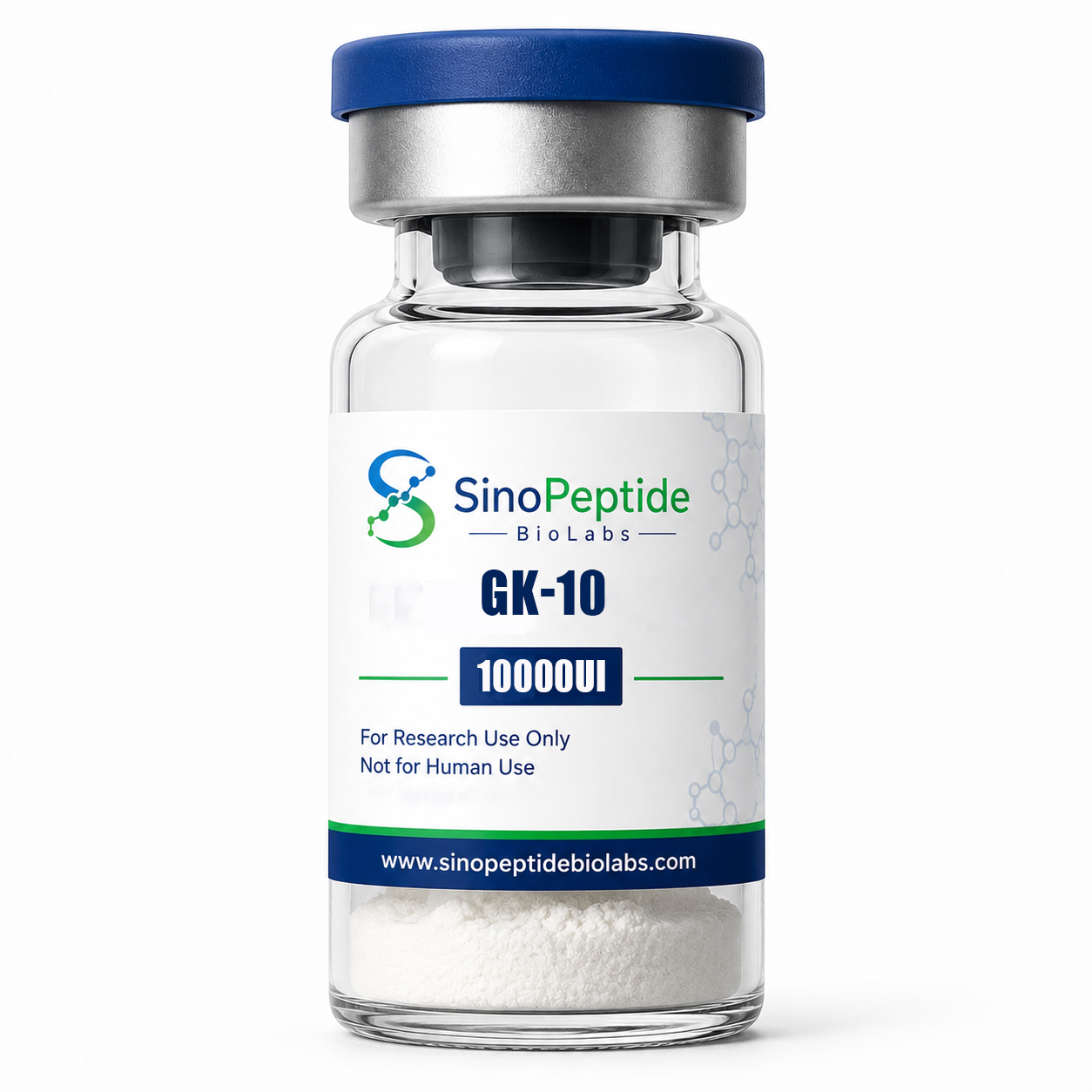
G10k 10000ui
$165.00
10 Vials/ Kits
G10K 10000 IU: HCG Uses, Mechanism, Safety, Dosage Information & Research
What Is G10K 10000 IU?
G10K 10000 IU is a product/catalog designation commonly used for human chorionic gonadotropin (hCG) containing 10,000 international units (IU) per vial.
Current peptide and research-product catalogs use G10K as a shorthand for an HCG 10,000-IU presentation. However, the catalog code itself is not a universal pharmaceutical standard, so the exact product, formulation, manufacturer, quality specifications, and regulatory status should always be confirmed from the product documentation.
Human chorionic gonadotropin is a naturally occurring glycoprotein hormone produced by the placenta during pregnancy. Pharmaceutical hCG preparations have been used in reproductive medicine because hCG has biological activity similar to luteinizing hormone (LH).
In males, hCG can stimulate the Leydig cells of the testes to produce androgens. In females, hCG can act in an LH-like manner and is used in specific fertility protocols to trigger ovulation after appropriate ovarian stimulation.
The presence of 10,000 IU on a product label describes the quantity or potency represented by the vial. It should not automatically be interpreted as a recommended dose for every person or condition.
FDA-listed prescription hCG products include 10,000-unit presentations, demonstrating that this strength exists within legitimate pharmaceutical formulations.
G10K 10000 IU HCG at a Glance
| Property | Information |
|---|---|
| Product designation | G10K 10000 IU |
| Active substance | Human chorionic gonadotropin (hCG) |
| Hormone class | Gonadotropin |
| Biological activity | Primarily LH-like |
| Common presentation | 10,000 IU per vial |
| Primary biological targets | LH/hCG receptors |
| Male reproductive research | Yes |
| Female fertility applications | Yes |
| Prescription hCG products | Yes |
| FDA-recognized 10,000-unit presentations | Yes |
| Standard dose for everyone | No |
| Product-specific formulation | Must be verified |
| Research-product status | Depends on the specific product |
| Administration | Product- and indication-specific |
A key point is that G10K is generally a catalog designation, whereas hCG is the actual active hormone.
What Is Human Chorionic Gonadotropin?
Human chorionic gonadotropin, commonly abbreviated hCG, is a glycoprotein hormone associated with pregnancy and reproductive physiology.
The hormone consists of two subunits:
- Alpha subunit
- Beta subunit
The alpha subunit has substantial structural similarity to the alpha subunits of other pituitary glycoprotein hormones, including LH, FSH, and TSH. The beta subunit provides much of the specificity that distinguishes hCG from these hormones.
Pharmaceutical hCG is used because its biological activity overlaps substantially with LH.
This LH-like activity explains why hCG has applications in reproductive medicine.
Current DailyMed labeling describes hCG as a polypeptide hormone produced by the human placenta and notes its ability to stimulate gonadal steroid hormone production.
What Does G10K Mean?
The term G10K is generally a shorthand product code.
In catalogs, the naming convention commonly works as follows:
- G = HCG product category/code
- 10K = 10,000 IU
For example, some catalogs list:
- G2K = HCG 2,000 IU
- G5K = HCG 5,000 IU
- G10K = HCG 10,000 IU
This convention can be seen in current product catalogs.
However, consumers and researchers should not assume that all products carrying the same code are identical.
Two products can both be labeled G10K while differing in:
- Manufacturer
- Source material
- Formulation
- Excipients
- Packaging
- Sterility specifications
- Analytical testing
- Intended use
- Regulatory status
Therefore, the actual product label and documentation should always take precedence over a catalog abbreviation.
How Does HCG Work?
The primary biological action of hCG is closely related to luteinizing hormone (LH).
HCG binds to the LH/hCG receptor, activating signaling pathways involved in gonadal steroidogenesis.
The basic pathway can be summarized as:
HCG → LH/hCG receptor → intracellular signaling → gonadal steroid production
The physiological consequences differ between males and females.
HCG in Males
In males, hCG acts on Leydig cells in the testes.
Activation of the LH/hCG receptor stimulates androgen production, particularly testosterone.
This is why hCG has been investigated and used in certain clinical situations involving male reproductive hormone function.
HCG in Females
In females, hCG can act similarly to LH.
LH plays an important role in the final stages of follicular development and ovulation.
Under appropriately controlled fertility protocols, hCG may therefore be used as an ovulatory trigger.
The exact treatment protocol depends on the patient’s reproductive status, other fertility medications, and physician-directed treatment plan.
G10K 10000 IU and Male Reproductive Health
One of the major areas associated with hCG is male reproductive endocrinology.
HCG’s LH-like activity can stimulate testicular androgen production.
This biological effect has made hCG relevant to clinical situations involving:
- Hypogonadotropic hypogonadism
- Testicular androgen production
- Certain male fertility protocols
- Selected cases involving impaired gonadotropin signaling
FDA/DailyMed labeling includes hCG dosing regimens for selected cases of hypogonadotropic hypogonadism in males.
However, hCG is not simply a general-purpose testosterone supplement.
Its biological action depends on the condition being treated and the function of the hypothalamic-pituitary-gonadal axis.
HCG and Testosterone Production
HCG’s relationship with testosterone is one of the most frequently searched topics associated with the hormone.
In males, hCG activates the LH/hCG receptor on Leydig cells.
This stimulates the testes to produce androgens.
Consequently, hCG can influence endogenous testicular testosterone production under appropriate physiological conditions.
However, testosterone production is only one component of reproductive health.
Other factors include:
- Sperm production
- Sertoli cell function
- FSH activity
- Testicular function
- Hypothalamic signaling
- Pituitary gonadotropin secretion
- Overall reproductive health
Therefore, hCG should not be described as a universal solution for every form of low testosterone or infertility.
HCG and Male Fertility
Male fertility is another important area in which hCG is clinically relevant.
Sperm production requires coordinated hormonal signaling involving the hypothalamus, pituitary gland, and testes.
LH-like activity from hCG can support Leydig-cell androgen production.
In certain forms of hypogonadotropic hypogonadism, restoring gonadotropin signaling may be part of a fertility-management strategy.
However, treatment can require more than hCG alone.
Depending on the underlying diagnosis, specialists may evaluate:
- Testosterone
- LH
- FSH
- Semen parameters
- Estradiol
- Prolactin
- Thyroid function
- Testicular volume
- Medical history
This is why self-directed use of a 10,000-IU vial is inappropriate.
HCG and Female Fertility
HCG also has an important role in reproductive medicine for women.
Because hCG has LH-like biological activity, it can be used in carefully controlled fertility protocols.
According to current labeling, hCG may be used to induce ovulation and pregnancy in appropriately selected women following pretreatment with menotropins.
In this context, hCG effectively provides an LH-like signal involved in the final stages of follicular maturation and ovulation.
This is very different from taking hCG for general hormonal purposes.
Fertility treatment requires medical monitoring because ovarian stimulation can involve significant risks.
G10K 10000 IU and Ovulation
The association between HCG 10000 IU and ovulation is based on hCG’s LH-like activity.
In appropriate fertility protocols, hCG can provide the hormonal signal that triggers ovulation after ovarian stimulation.
FDA/DailyMed labeling identifies 5,000 to 10,000 USP units as a labeled range for a specific ovulation-induction context following appropriate menotropin pretreatment.
This does not mean that every person should use a 10,000-IU vial or that 10,000 IU is universally appropriate.
Fertility treatment is individualized and generally involves clinical assessment and monitoring.
G10K 10000 IU Dosage: Understanding the Label
One of the most important SEO and medical distinctions is the difference between product strength and individual dosage.
A vial labeled:
HCG 10,000 IU
indicates the amount of hCG represented by that vial.
It does not automatically tell you:
- How much a particular patient should receive
- How frequently it should be administered
- Which route should be used
- How long treatment should continue
- Whether it is appropriate for a specific medical condition
Official hCG labeling contains different regimens depending on the indication, demonstrating that there is no single universal hCG dose.
For example, the FDA-listed labeling contains different dosing approaches for male hypogonadotropic hypogonadism, prepubertal cryptorchidism, and ovulation induction.
Therefore:
G10K 10000 IU is a product strength, not a universal treatment instruction.
HCG 10000 IU vs G10K
From an SEO perspective, G10K 10000 IU and HCG 10000 IU are closely related search terms.
However, they are not conceptually identical.
G10K is generally a catalog or product code.
HCG 10000 IU describes the active hormone and its labeled quantity.
A product page can naturally target both phrases:
- G10K 10000 IU
- G10K HCG
- HCG 10000 IU
- hCG 10,000 IU
- human chorionic gonadotropin 10,000 IU
This allows the content to capture both product-specific and informational search intent without excessive keyword repetition.
HCG 10000 IU Benefits: What Does the Evidence Support?
HCG should not be marketed using broad “benefit” claims that imply it improves everyone’s health.
Its established biological effects are more specific.
1. LH-Like Activity
HCG can activate LH/hCG receptors.
2. Testicular Androgen Production
In males with functioning Leydig cells, hCG can stimulate androgen production.
3. Reproductive Medicine
HCG has applications in selected male and female reproductive conditions.
4. Ovulation Triggering
In appropriate fertility protocols, hCG can provide an LH-like signal associated with ovulation.
5. Testicular Function in Selected Conditions
HCG may be used in specific clinical settings involving inadequate endogenous gonadotropin stimulation.
These are more accurate descriptions than generalized claims such as “HCG boosts health,” “burns fat,” or “increases fertility in everyone.”
HCG Does Not Have a Proven Fat-Loss Effect
This distinction is especially important for SEO because hCG has historically been associated with weight-loss programs.
Current prescribing information for hCG specifically states that the hormone has no known effect on fat mobilization, appetite, hunger, or body-fat distribution.
Therefore, a website should avoid marketing G10K 10000 IU as a proven fat-burning product.
Claims such as:
- “HCG melts fat”
- “HCG suppresses appetite”
- “HCG causes rapid fat loss”
- “HCG targets belly fat”
are not supported by the current prescribing information.
This is an important example of how evidence-based SEO can improve both credibility and compliance.
G10K 10000 IU and HCG Research
HCG is also used in laboratory and biomedical research involving reproductive endocrinology.
Research applications can include investigation of:
- LH receptor signaling
- Gonadal steroidogenesis
- Testicular function
- Ovarian physiology
- Corpus luteum biology
- Reproductive hormone pathways
Research-grade G10K products found in online catalogs may be explicitly labeled for laboratory research rather than human use. For example, current research-product listings describe G10K as HCG 10,000 IU and identify such products as laboratory research materials.
This distinction is essential.
A research product should not automatically be treated as equivalent to an FDA-approved pharmaceutical product.
Is G10K 10000 IU FDA Approved?
The answer requires an important distinction.
HCG is an established prescription biological drug, and FDA records include 10,000-unit presentations. For example, the FDA Purple Book lists chorionic gonadotropin products with 10,000-unit presentations, and current DailyMed labeling describes prescription hCG containing 10,000 USP units per vial.
However, that does not mean that every product sold online under the catalog code G10K is FDA-approved.
FDA approval applies to specific pharmaceutical products, manufacturers, formulations, and indications.
A research product labeled “G10K HCG 10000 IU” should therefore not be represented as an FDA-approved medicine merely because FDA-approved hCG products exist.
This distinction is critical for accurate product SEO.
G10K 10000 IU Research Product vs Prescription HCG
| Feature | Research G10K Product | Prescription HCG |
|---|---|---|
| Active substance | Usually labeled hCG | hCG |
| Strength | Often 10,000 IU | 10,000 USP units in certain products |
| Intended use | Depends on product labeling | Approved clinical indications |
| FDA approval | Must be verified for the specific product | Applies to specific approved products |
| Manufacturing standards | Product-specific | Regulated pharmaceutical manufacturing |
| Clinical use | Should not be assumed | Defined by prescribing information |
| Documentation | COA/product records may vary | Official labeling available |
| Patient use | Not automatically appropriate | Prescription and physician-directed |
This table helps prevent one of the most common misconceptions surrounding research peptides and hormone products.
G10K 10000 IU Safety
HCG is biologically active and should not be considered risk-free.
Safety depends on:
- Medical indication
- Patient characteristics
- Dose
- Duration
- Other medications
- Hormonal status
- Product formulation
Prescription labeling contains warnings and precautions that should be reviewed before clinical use.
Because hCG affects gonadal hormone production, inappropriate use can alter endocrine function.
Potential adverse effects can include hormonal and reproductive effects, injection-related reactions, and condition-specific complications.
Women undergoing fertility treatment require particular medical supervision because gonadotropin therapy can contribute to ovarian hyperstimulation and related complications.
HCG Safety in Men
In men, hCG can alter androgen production.
Depending on the clinical context, changes in testosterone and estrogen activity can occur.
Potential issues may include:
- Hormonal fluctuations
- Gynecomastia
- Acne
- Fluid retention
- Mood-related changes
- Injection-site reactions
The actual risk depends on the treatment context and individual characteristics.
HCG should therefore be used according to a qualified clinician’s prescription rather than based solely on the vial strength.
HCG Safety in Women
HCG is widely associated with fertility treatment, but fertility treatment requires appropriate monitoring.
Potential concerns include ovarian enlargement and ovarian hyperstimulation syndrome in susceptible patients.
Patients receiving fertility treatment may therefore undergo:
- Ultrasound monitoring
- Hormonal testing
- Follicular assessment
- Clinical monitoring
HCG should not be used casually as a fertility supplement.
G10K 10000 IU and Product Quality
If a website is publishing an SEO product page for G10K 10000 IU, product transparency is particularly important.
A responsible product page should distinguish between:
What the product label states
and
What has independently been demonstrated about the specific batch.
Important documentation may include:
Product Identity
The documentation should clearly identify hCG or human chorionic gonadotropin.
Batch Number
A batch or lot number helps connect a product with its testing documentation.
Certificate of Analysis
Where available, a COA can provide batch-specific analytical information.
Potency
Because hCG is expressed in IU, potency testing is particularly relevant.
Purity
Purity and potency are different measurements and should not be treated as interchangeable.
Sterility
A claim of sterility should be supported by appropriate documentation rather than assumed from the appearance of the product.
Storage
Storage requirements should come from the actual manufacturer’s documentation.
Why COA Documentation Matters for G10K
A Certificate of Analysis (COA) can help establish what was tested in a particular batch.
However, a COA should not automatically be interpreted as proof that a product is:
- FDA approved
- Clinically effective
- Suitable for human use
- Manufactured under pharmaceutical standards
Instead, it provides analytical information about the tested batch.
When evaluating G10K 10000 IU, useful documentation may include:
- Batch number
- Test date
- Identity testing
- Potency/assay
- Purity
- Microbiological testing where relevant
- Endotoxin testing where relevant
- Laboratory identification
Research-product vendors currently publish different kinds of batch information, illustrating why consumers should examine the actual documentation rather than relying only on marketing language.
HCG 10000 IU Storage Considerations
Storage depends on the specific formulation and manufacturer.
For example, current U.S. prescription hCG labeling provides specific storage instructions for unopened and reconstituted product and states that reconstituted solution should be refrigerated and discarded after the specified period.
However, these instructions should not automatically be transferred to an unrelated research product.
The correct storage conditions should always come from the product’s official documentation.
Important factors can include:
- Temperature
- Light exposure
- Reconstitution status
- Container integrity
- Expiration date
- Freeze/thaw exposure
G10K 10000 IU and Reconstitution
Some pharmaceutical hCG products are supplied as lyophilized powder with a separate diluent.
For example, current DailyMed labeling describes a 10,000-unit hCG vial supplied with a diluent and provides manufacturer-specific reconstitution instructions.
However, reconstitution instructions are product-specific.
A research vial may have a different formulation, concentration, diluent, or intended use.
Therefore, a generic internet reconstitution recipe should not replace the instructions supplied with the actual product.
For a medically responsible SEO page, it is better to explain this distinction than to provide a universal preparation procedure.
G10K 10000 IU vs HMG
HCG and HMG are both gonadotropin-related products, but they are not identical.
HCG primarily provides LH-like activity.
HMG, or human menopausal gonadotropin, contains gonadotropin activity associated with both FSH and LH.
Their biological roles therefore differ.
In fertility treatment, clinicians may use different gonadotropins depending on the reproductive goal and underlying condition.
The products should not be treated as interchangeable.
G10K 10000 IU vs LH
HCG and LH have related biological effects because both can activate the LH/hCG receptor.
However, they are different hormones.
HCG is produced naturally by the placenta during pregnancy, whereas LH is produced by the pituitary gland.
One practical advantage of hCG in medicine is its LH-like activity and relatively long biological persistence compared with endogenous LH.
This makes hCG useful in specific reproductive protocols.
Common Misconceptions About G10K 10000 IU
Myth 1: G10K is a unique drug
Not necessarily.
G10K is commonly used as a catalog code for HCG 10,000 IU.
Myth 2: Every G10K product is FDA approved
No.
FDA approval applies to specific pharmaceutical products, not generic catalog codes.
Myth 3: 10,000 IU is everyone’s correct dose
No.
Different indications have different treatment regimens.
Myth 4: HCG is a fat-burning hormone
Current prescribing information states that HCG has no known effect on fat mobilization, appetite, hunger, or body-fat distribution.
Myth 5: Research-grade HCG is automatically equivalent to prescription HCG
No.
Manufacturing, formulation, quality controls, intended use, and regulatory status may differ.
Frequently Asked Questions About G10K 10000 IU
What is G10K 10000 IU?
G10K 10000 IU is commonly used as a product/catalog designation for human chorionic gonadotropin containing 10,000 IU per vial.
What does G10K stand for?
G10K is commonly used as shorthand for an HCG 10,000-IU presentation. It is a catalog designation rather than the generic name of the hormone.
What is HCG?
HCG, or human chorionic gonadotropin, is a glycoprotein hormone with LH-like biological activity.
What does HCG do in men?
HCG can stimulate LH/hCG receptors on Leydig cells, promoting androgen production.
What does HCG do in women?
In appropriately selected fertility protocols, HCG can provide an LH-like signal associated with ovulation.
Is G10K 10000 IU FDA approved?
Specific prescription hCG products containing 10,000 units are represented in FDA records. However, a commercial product using the catalog code G10K is not automatically FDA approved simply because the code corresponds to HCG 10,000 IU.
Is HCG a peptide?
HCG is a glycoprotein hormone made of alpha and beta subunits. It is more accurately described as a gonadotropin hormone rather than a conventional synthetic peptide.
Is HCG used for fertility?
Yes. Prescription hCG has established applications in selected male and female reproductive conditions.
Is 10,000 IU a standard HCG dose?
No. The appropriate regimen depends on the indication and the specific prescription product. Official labeling contains different regimens for different clinical situations.
Can HCG be used for weight loss?
HCG should not be marketed as a proven weight-loss treatment. Current prescribing information states that it has no known effect on fat mobilization, appetite, hunger, or body-fat distribution.
What is the difference between G10K and HCG?
G10K is a product/catalog code commonly used for HCG 10,000 IU. HCG is the actual hormone.
Is G10K the same as G5K?
They generally refer to different HCG strengths: G5K is commonly used for 5,000 IU and G10K for 10,000 IU. Product documentation should always be checked.
Does every G10K vial contain exactly the same formulation?
No. Formulation and excipients can vary between manufacturers and products.
What should I check before purchasing G10K 10000 IU?
Review the product identity, manufacturer, batch information, COA where available, potency, purity testing, intended use, storage requirements, and regulatory status.
SEO Content Strategy for G10K 10000 IU
A strong SEO page targeting G10K 10000 IU should not rely on repeated use of the exact keyword.
Instead, the page should establish topical relevance through related search terms.
Important semantic topics include:
- Human chorionic gonadotropin
- HCG 10000 IU
- hCG mechanism
- LH receptor
- Male fertility
- Female fertility
- Ovulation induction
- Testosterone production
- Hypogonadotropic hypogonadism
- HCG safety
- HCG clinical use
- HCG prescription
- HCG research
- G10K HCG
- HCG 10,000 IU vial
This creates a more comprehensive topic cluster while keeping the primary keyword natural.
Suggested Internal Links for a G10K 10000 IU Product Page
For a website selling or discussing research and pharmaceutical products, relevant internal links could include:
- HMG 75 IU — for information about gonadotropin products.
- Gonadorelin 2 mg — for hypothalamic reproductive hormone signaling.
- Bacteriostatic Water — only where legally and medically appropriate.
- HCG 5000 IU — for comparison of HCG presentations.
- Male fertility research — educational reproductive endocrinology content.
- Female fertility research — educational ovulation and fertility content.
- Certificate of Analysis guide — explaining batch testing and documentation.
- Research peptide safety guide — general information about evaluating research products.
Internal links should point to genuinely relevant pages rather than being inserted solely for keyword manipulation.
Final Thoughts on G10K 10000 IU
G10K 10000 IU is commonly used as a product code for human chorionic gonadotropin (hCG) at 10,000 IU per vial.
HCG is a biologically active gonadotropin with important reproductive functions. Its activity is closely related to luteinizing hormone, allowing it to stimulate the LH/hCG receptor.
In males, this can stimulate Leydig-cell androgen production. In appropriately selected fertility settings, hCG can also provide an LH-like signal involved in ovulation.
FDA records and current prescription labeling confirm that 10,000-unit hCG pharmaceutical presentations exist.
At the same time, G10K is a catalog designation rather than a guarantee of pharmaceutical quality or regulatory approval. A product sold under that code should be evaluated according to its specific manufacturer, formulation, documentation, intended use, and regulatory status.
The 10,000-IU figure should also not be interpreted as a universal treatment dose. Official hCG labeling contains different regimens for different clinical indications, illustrating why treatment decisions require indication-specific medical assessment.
For SEO purposes, the strongest content strategy is to connect the primary keyword G10K 10000 IU with closely related concepts such as HCG 10000 IU, human chorionic gonadotropin, HCG mechanism, male fertility, female fertility, ovulation induction, testosterone production, safety, clinical use, and regulatory status.
Most importantly, product content should avoid unsupported promises. HCG should not be presented as a universal testosterone booster, fertility cure, or fat-burning product. Current prescribing information specifically states that HCG has no known effect on fat mobilization, appetite, hunger, or body-fat distribution.
An evidence-based, transparent approach gives readers useful information while helping the page build credibility around a medically sensitive keyword.
Medical disclaimer: This article is provided for educational and informational purposes only. It does not diagnose medical conditions, prescribe treatment, or establish an individualized HCG regimen. HCG is a biologically active prescription hormone in approved pharmaceutical products. The identity, quality, formulation, intended use, and regulatory status of any specific G10K 10000 IU product should be verified from its official documentation and, where relevant, with a qualified healthcare professional.
G10K 10000 IU G10K 10000 IU G10K 10000 IU G10K 10000 IU G10K 10000 IU G10K 10000 IU G10K 10000 IU G10K 10000 IU G10K 10000 IU G10K 10000 IU G10K 10000 IU G10K 10000 IU G10K 10000 IU G10K 10000 IU G10K 10000 IU G10K 10000 IU G10K 10000 IU
Be the first to review “G10k 10000ui”
Related products
Pure Peptides
Pure Peptides
Pure Peptides
Pure Peptides
Pure Peptides
Pure Peptides
Pure Peptides
Pure Peptides
Reviews
There are no reviews yet.