


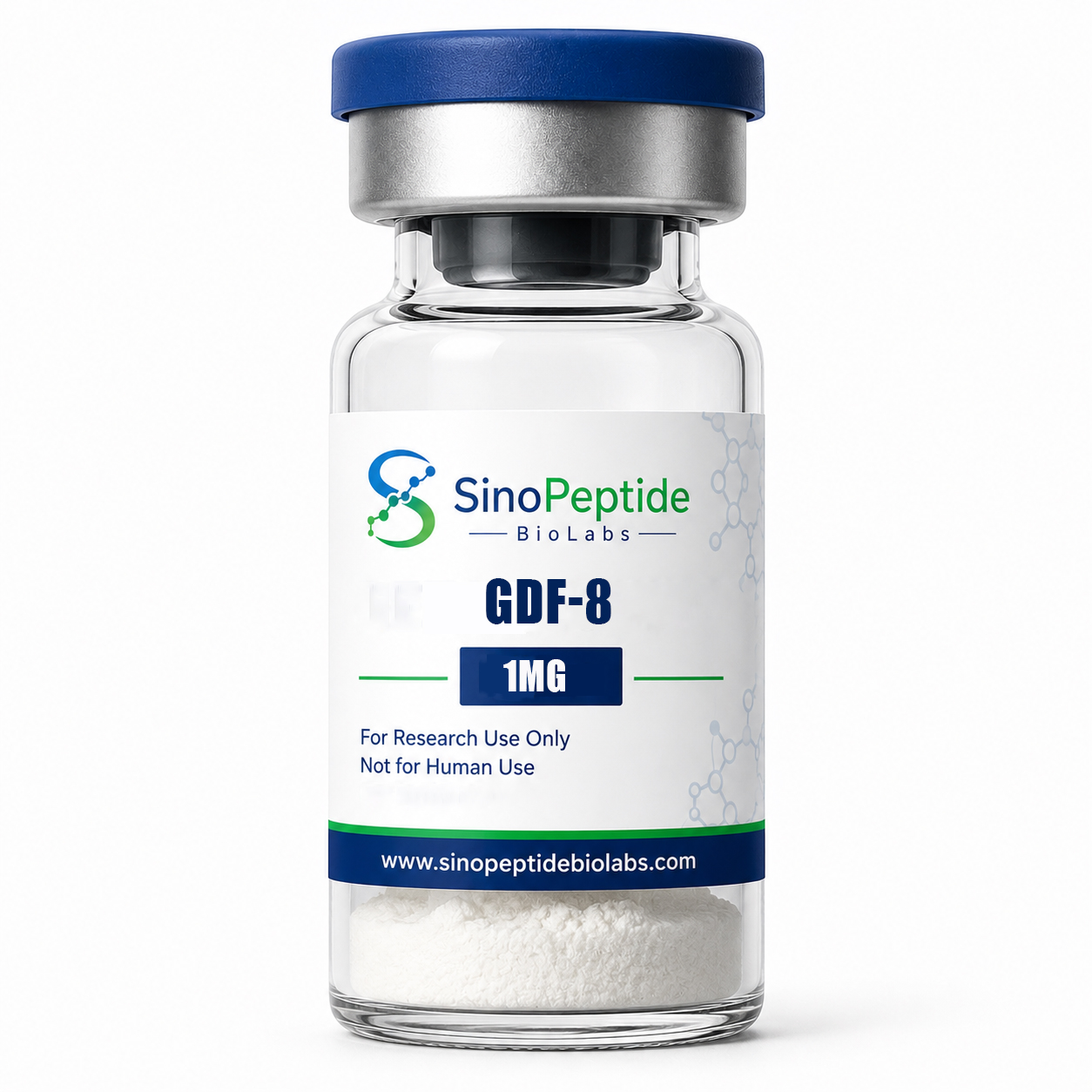
GDF-8 1mg
$175.00
GDF-8 1mg: Myostatin Research, Uses, Benefits, Safety and Complete Guide
GDF-8 1mg is a research preparation associated with growth and differentiation factor 8 (GDF-8), more commonly known as myostatin. GDF-8 is a member of the transforming growth factor-beta (TGF-β) superfamily and plays an important role in regulating skeletal-muscle growth and development.
Unlike many peptides marketed online for muscle growth, GDF-8 itself is not a muscle-building compound. Myostatin acts as a biological brake on muscle growth. Research into GDF-8 has therefore focused heavily on understanding what happens when the myostatin pathway is reduced, blocked, or genetically disrupted.
This distinction is important when evaluating a product labeled GDF-8 1mg. The “1mg” describes the stated quantity of material and should not automatically be interpreted as a clinically established human dose.
Scientific interest in GDF-8 has expanded considerably since myostatin was identified as a regulator of skeletal-muscle mass. Research now covers muscle development, muscle wasting, sarcopenia, muscular dystrophies, metabolic health, exercise adaptation, and potential therapies that target the myostatin pathway.
At the same time, GDF-8 research remains technically complex. Studies involving GDF-8 itself should not be confused with studies involving myostatin inhibitors, such as monoclonal antibodies that block GDF-8 signaling.
This guide explains what GDF-8 is, what GDF-8 1mg means, how myostatin works, what current research shows, potential research applications, safety and regulatory considerations, and commonly asked questions.
What Is GDF-8?
GDF-8 stands for Growth and Differentiation Factor 8.
It is commonly called myostatin, and the terms GDF-8 and myostatin generally refer to the same biological growth factor.
GDF-8 belongs to the TGF-β superfamily, a large group of signaling proteins involved in cellular growth, differentiation, tissue development, and homeostasis.
Myostatin is particularly well known for its role in skeletal muscle.
Research has established GDF-8 as an important negative regulator of skeletal-muscle growth. In simple terms, myostatin helps prevent muscle from growing beyond certain biological limits.
This is why researchers became interested in myostatin inhibition.
If reducing myostatin signaling can increase muscle mass, then drugs that interfere with the pathway could potentially be investigated for conditions involving muscle loss.
That concept has led to decades of research into:
- myostatin antibodies
- myostatin propeptides
- follistatin-based approaches
- ActRIIB pathway inhibitors
- receptor-blocking antibodies
- gene-based approaches
- other experimental myostatin-targeting therapies
Importantly, these are different from administering GDF-8 itself.
What Does GDF-8 1mg Mean?
The phrase GDF-8 1mg generally indicates a research product containing a stated quantity of GDF-8/myostatin.
The 1mg refers to the amount of material, not necessarily to a clinically validated dose.
This distinction is critical.
A product labeled GDF-8 1mg should not automatically be interpreted as:
- a recommended human dose
- an FDA-approved dose
- a therapeutic dose
- a muscle-building dose
- a validated research dose for every experimental model
The appropriate interpretation depends on the product’s formulation, molecular form, purity, experimental application, and accompanying technical documentation.
For scientific and SEO purposes, it is therefore better to describe GDF-8 1mg as a research quantity rather than calling 1mg a standard dose.
GDF-8 vs Myostatin: Are They the Same?
Yes.
GDF-8 is commonly known as myostatin.
The terms may be used interchangeably in scientific literature.
Other terms that may appear include:
- Growth and Differentiation Factor 8
- Growth/Differentiation Factor 8
- GDF8
- GDF-8
- MSTN
- Myostatin
- Myostatin protein
- Myostatin growth factor
The gene encoding myostatin is generally referred to as MSTN, while GDF8 is another commonly used designation.
However, researchers may distinguish between different molecular forms of myostatin, including precursor, latent, and mature forms.
This matters because the biological activity of myostatin depends on its processing and activation.
How Does GDF-8 Work?
GDF-8 is synthesized as a precursor protein.
Like other members of the TGF-β family, myostatin undergoes protein processing that produces a biologically active C-terminal growth-factor domain. The mature signaling molecule interacts with activin receptors, particularly ActRIIA and ActRIIB, and subsequently engages type I receptors and intracellular SMAD signaling.
The simplified pathway can be described as:
GDF-8 → ActRII receptors → type I receptor signaling → SMAD2/3 → changes in muscle-growth pathways
This signaling network contributes to the regulation of:
- muscle-cell growth
- muscle-cell differentiation
- satellite-cell activity
- protein synthesis
- protein breakdown
- muscle regeneration
- skeletal-muscle size
Myostatin signaling can also interact with pathways involving Akt, mTOR, FoxO, and the ubiquitin-proteasome system, which helps explain its influence on muscle protein turnover.
Why Is GDF-8 Called a Negative Regulator of Muscle Growth?
The term negative regulator means that GDF-8 generally limits muscle growth rather than promoting it.
This was demonstrated dramatically in genetic research.
Animals with disrupted myostatin signaling can develop substantially greater muscle mass than animals with normal myostatin activity. Similar naturally occurring mutations have been identified in several species, including cattle and humans.
These observations helped establish the biological importance of myostatin.
Research subsequently demonstrated that myostatin can influence muscle-cell proliferation, differentiation, satellite-cell behavior, and muscle protein metabolism.
Consequently, researchers began asking a different question:
What happens when GDF-8 is blocked?
This question is the basis of much of today’s myostatin therapeutic research.
GDF-8 1mg and Muscle Growth Research
GDF-8 itself should not be described as a conventional muscle-building peptide.
Instead, it is a regulator of muscle growth.
The research interest surrounding GDF-8 largely concerns the opposite strategy: reducing or blocking myostatin signaling.
Animal studies have shown that disruption of myostatin can produce substantial increases in skeletal-muscle mass. Reviews of the field describe myostatin as a major negative regulator of muscle size.
This has led researchers to investigate whether myostatin inhibition could potentially help people affected by:
- muscle wasting
- muscular dystrophies
- sarcopenia
- disuse-related muscle loss
- certain metabolic disorders
- other conditions involving impaired muscle mass
However, increased muscle mass does not automatically translate into improved physical function.
That distinction has been an important challenge in clinical myostatin research.
What Is Myostatin Inhibition?
Myostatin inhibition means reducing the biological activity or signaling of GDF-8.
Researchers have developed several strategies to investigate this pathway.
These include:
Anti-myostatin antibodies
These antibodies are designed to bind myostatin and prevent it from activating its normal signaling pathway.
Myostatin propeptides
The naturally occurring propeptide portion of myostatin can interact with mature myostatin and regulate its activity.
Follistatin-based approaches
Follistatin can bind several members of the TGF-β family and influence signaling pathways associated with muscle growth.
ActRIIB-targeting therapies
Because GDF-8 signals through activin type II receptors, blocking these receptors can affect myostatin and other ligands.
Gene-based approaches
Experimental genetic strategies have also investigated whether reducing myostatin expression can influence muscle development.
These approaches should not be confused with GDF-8 itself.
GDF-8 1mg vs Myostatin Inhibitors
This is one of the most important distinctions for anyone researching GDF-8.
| Characteristic | GDF-8 / Myostatin | Myostatin Inhibitor |
|---|---|---|
| Biological role | Limits muscle growth | Designed to reduce myostatin signaling |
| Natural protein | Yes | Usually engineered therapeutic compound |
| Main research question | How myostatin regulates muscle | What happens when myostatin is blocked |
| Muscle effect under investigation | Regulatory/braking role | Potential increase in muscle mass |
| Clinical development | Research molecule | Several inhibitors have entered clinical research |
| Meaning of 1mg | Product quantity | Product-specific quantity |
Therefore, an article that describes GDF-8 1mg as a muscle-growth enhancer without explaining this distinction can be scientifically misleading.
Potential Research Applications of GDF-8
GDF-8 research has expanded beyond basic muscle biology.
Researchers have investigated the myostatin pathway in several areas.
1. Skeletal-Muscle Biology
This remains the central area of GDF-8 research.
Studies examine how myostatin controls:
- muscle-fiber size
- muscle-cell differentiation
- satellite-cell behavior
- protein synthesis
- protein degradation
- muscle regeneration
GDF-8 provides an important model for understanding how the body regulates muscle mass.
2. Muscle Atrophy Research
Myostatin has attracted considerable interest in muscle-wasting research.
Physical inactivity, immobilization, aging, and disease can contribute to loss of muscle mass and function.
A 2026 review described myostatin as an important component of inactivity-related muscle atrophy and discussed signaling involving ActRIIB, SMAD2/3, Akt, mTOR, FoxO, and protein-degradation pathways.
This research is helping scientists understand why muscle loss occurs and whether targeting myostatin could be therapeutically useful.
GDF-8 and Sarcopenia Research
Sarcopenia is the progressive loss of muscle mass and physical function associated with aging.
Because GDF-8 negatively regulates muscle growth, myostatin inhibition has been studied as a possible strategy for addressing age-related muscle loss.
Recent reviews continue to investigate myostatin-targeted approaches for sarcopenia, including antibodies and other pathway modulators.
However, researchers still need to establish which patients might benefit, what degree of muscle increase is clinically meaningful, and whether changes in muscle size consistently translate into improvements in strength, mobility, and quality of life.
GDF-8 and Muscular Dystrophy Research
Muscular dystrophies are another major area of myostatin research.
The rationale is straightforward:
If excessive myostatin signaling limits muscle growth, then reducing that signal could potentially increase muscle mass in people with muscle-wasting disorders.
Numerous myostatin-targeting approaches have therefore entered preclinical and clinical research.
However, translation from animal models to humans has been challenging.
A 2025 review noted that although preclinical results have been promising, clinical trials of myostatin inhibition in muscular dystrophies have generally not produced the expected improvements in muscle function or fitness.
This is an important lesson when interpreting GDF-8 research:
Increasing muscle mass is not necessarily equivalent to improving functional performance.
GDF-8 and Human Clinical Research
There is a substantial difference between research on GDF-8 biology and clinical trials of GDF-8 inhibitors.
Researchers have conducted human studies using antibodies that block GDF-8.
For example, a randomized Phase 1 study published in 2025 evaluated an anti-GDF8 antibody, trevogrumab, alone and in combination with an anti-activin A antibody. The study enrolled 82 participants and examined safety, pharmacokinetics, muscle volume, body composition, and other outcomes.
The study found that combined GDF8 and activin A blockade produced greater muscle growth than either antibody alone.
However, this does not mean that a research preparation labeled GDF-8 1mg has the same properties as an anti-GDF8 antibody.
These are fundamentally different biological products.
The clinical study involved a specifically engineered therapeutic antibody, not administration of generic GDF-8 protein.
Is GDF-8 1mg FDA Approved?
A product labeled GDF-8 1mg should not be represented as an FDA-approved GDF-8 medication.
The FDA approval of a particular drug targeting the myostatin pathway would not automatically mean that every GDF-8 research preparation is approved.
This distinction is particularly important because the myostatin field includes several different types of molecules.
In September 2026, the FDA approved apitegromab for spinal muscular atrophy. Apitegromab is a specific therapeutic that selectively inhibits myostatin activation; it is not GDF-8 itself.
Therefore, websites should not use the existence of an approved myostatin-pathway drug to imply that GDF-8 1mg itself is an approved medicine.
Is GDF-8 1mg Safe?
The safety of a specific GDF-8 1mg research product depends on the product’s identity, formulation, purity, intended route, manufacturing controls, and intended experimental application.
A research preparation should not automatically be assumed to be suitable for human administration.
Important factors include:
- molecular identity
- purity
- aggregation
- endotoxin contamination
- sterility
- formulation
- storage conditions
- route of administration
- species used in research
- experimental concentration
Human clinical safety data for a particular research-grade GDF-8 preparation cannot be assumed simply because GDF-8 has been studied extensively.
GDF-8 1mg Dosage
There is no universal human dosage recommendation for a product simply labeled GDF-8 1mg.
The term “1mg” indicates quantity, not necessarily therapeutic dosage.
A responsible scientific article should avoid presenting an arbitrary GDF-8 dosing schedule as a medically established protocol.
Experimental research can involve different concentrations, routes, species, formulations, and study objectives.
Therefore, researchers should rely on the experimental protocol and validated product documentation relevant to their specific study rather than treating “1mg” as a universal dose.
GDF-8 1mg Reconstitution
A generic reconstitution protocol should not be assumed for every GDF-8 1mg product.
The appropriate handling of recombinant proteins can depend on:
- protein formulation
- buffer composition
- concentration
- excipients
- aggregation sensitivity
- container type
- storage conditions
- intended laboratory application
Before laboratory use, researchers should consult the manufacturer’s technical documentation, certificate of analysis, safety information, and validated handling instructions.
A website should avoid presenting a single reconstitution procedure as universally applicable to all GDF-8 products.
GDF-8 1mg Storage
Storage requirements can vary according to the formulation and manufacturer’s specifications.
Protein-based research materials may be sensitive to:
- temperature
- repeated freeze-thaw cycles
- light
- agitation
- concentration
- pH
- buffer composition
For this reason, product-specific storage instructions should take priority over generic internet recommendations.
Researchers should follow the manufacturer’s stated storage conditions and applicable laboratory procedures.
How to Evaluate a GDF-8 1mg Research Product
If your website sells or discusses GDF-8 1mg as a research product, transparent technical information can help readers evaluate product quality.
Important information may include:
1. Protein identity
The documentation should clearly identify the molecule as GDF-8/myostatin.
2. Molecular form
It can be important to know whether the material represents precursor, propeptide-associated, mature, recombinant, or another specified form.
3. Purity
Purity claims should be supported by appropriate analytical testing.
4. Certificate of analysis
A COA can provide useful information about the specific lot.
5. Endotoxin information
For laboratory applications where endotoxin levels matter, relevant testing should be documented.
6. Sterility information
A research product should not automatically be considered sterile.
7. Lot number
Lot-specific identification improves traceability.
8. Storage requirements
Clear storage instructions should be provided.
9. Research-use labeling
The product’s intended use and regulatory status should be accurately described.
These factors can strengthen both the scientific credibility and E-E-A-T profile of an SEO page.
GDF-8 1mg and Muscle Research: What the Evidence Really Shows
The evidence surrounding GDF-8 can be summarized in several layers.
Strong biological evidence
There is extensive evidence that GDF-8/myostatin acts as a negative regulator of skeletal-muscle growth.
This conclusion is supported by genetic, animal, molecular, and physiological research.
Strong mechanistic evidence
Researchers have identified important components of the myostatin signaling pathway, including ActRII receptors and downstream SMAD signaling.
Myostatin also interacts with pathways controlling protein synthesis and degradation.
Extensive therapeutic research
Scientists have developed numerous approaches for inhibiting myostatin.
These include antibodies, receptor-targeting therapies, propeptide approaches, and other experimental technologies.
More limited clinical translation
Although myostatin inhibition can increase muscle mass, translating that effect into meaningful improvements in human muscle function has proven difficult in several disease settings.
This is why a scientifically accurate GDF-8 article should not promise muscle gain or performance enhancement.
GDF-8 and Metabolic Research
Myostatin research has also expanded into metabolism.
Scientists have investigated whether myostatin influences:
- glucose metabolism
- adipose tissue
- energy balance
- insulin sensitivity
- body composition
- metabolic adaptation
Research suggests that myostatin may have effects extending beyond skeletal muscle, although the mechanisms and clinical importance of these effects remain under investigation.
This has encouraged researchers to explore myostatin-targeted approaches in obesity and metabolic disease.
The field remains experimental, and biological effects observed in animals cannot automatically be translated into human treatment recommendations.
GDF-8 and Exercise Research
Exercise can influence the biological pathways involved in muscle growth and adaptation.
Because myostatin is a negative regulator of muscle growth, researchers have studied how resistance and endurance exercise affect myostatin expression and signaling.
These studies are relevant to understanding:
- muscle adaptation
- hypertrophy
- recovery
- training response
- muscle maintenance
However, measuring myostatin in blood or muscle does not provide a simple measure of athletic performance.
A 2026 review also noted that circulating myostatin measurements can be difficult to interpret because different molecular forms and assay methods can produce different results.
GDF-8 vs BPC-157
GDF-8 and BPC-157 are very different research compounds.
| Feature | GDF-8 | BPC-157 |
|---|---|---|
| Common name | Myostatin | BPC-157 |
| Biological category | TGF-β superfamily growth factor | Synthetic pentadecapeptide |
| Main research area | Muscle regulation | Tissue and inflammatory research |
| Muscle effect | Negative regulator of muscle growth | Not a myostatin regulator |
| Research status | Investigational | Investigational |
| Established human therapeutic dose | Not established for research GDF-8 products | Not established |
The two compounds should not be presented as interchangeable.
GDF-8 1mg and Athletic Use
The myostatin pathway has attracted interest in sports science because reducing myostatin signaling can increase muscle mass in experimental models.
However, this also makes myostatin-related agents relevant to anti-doping rules.
The World Anti-Doping Agency has identified myostatin inhibitors and agents that affect activin receptor signaling among prohibited substances or classes. WADA’s scientific materials specifically discuss anti-myostatin antibodies and related activin-signaling inhibitors as areas of sports drug testing.
Athletes subject to anti-doping rules should therefore check the current prohibited list and obtain professional guidance before using any research compound associated with the myostatin pathway.
Importantly, this does not mean that GDF-8 itself should be confused with every myostatin inhibitor. The exact substance and mechanism matter.
Common Misconceptions About GDF-8 1mg
Myth 1: GDF-8 is a muscle-building peptide
Not exactly.
GDF-8/myostatin is a negative regulator of muscle growth.
Much of the muscle-building research concerns inhibiting GDF-8, not administering it.
Myth 2: GDF-8 1mg is the standard dose
Not established.
One milligram describes the stated amount of material. It does not automatically represent a validated human dosage.
Myth 3: GDF-8 and myostatin inhibitors are the same thing
No.
GDF-8 is the biological growth factor. Myostatin inhibitors are designed to reduce its activity or signaling.
Myth 4: Myostatin inhibition automatically improves strength
Not necessarily.
Clinical development has demonstrated that increasing muscle mass and improving functional outcomes are separate challenges.
Myth 5: Research-grade GDF-8 is approved for human use
No.
Research-grade material should not be represented as an approved pharmaceutical product without appropriate regulatory authorization.
Frequently Asked Questions About GDF-8 1mg
What is GDF-8 1mg?
GDF-8 1mg generally refers to a research preparation containing a stated 1mg quantity of growth and differentiation factor 8, also known as myostatin.
What is GDF-8 also called?
GDF-8 is commonly called myostatin. The gene is generally designated MSTN.
Does GDF-8 increase muscle mass?
GDF-8 itself acts as a negative regulator of skeletal-muscle growth. Research showing increased muscle mass generally involves reducing or blocking GDF-8 signaling rather than increasing GDF-8 activity.
What are the benefits of GDF-8?
GDF-8 is not best described in terms of conventional “benefits.” Its biological role is to regulate and limit skeletal-muscle growth. Researchers study this pathway because manipulating it may have therapeutic implications for muscle-loss disorders.
Is GDF-8 1mg FDA approved?
A research product labeled GDF-8 1mg should not be described as an FDA-approved medication. Regulatory approval applies to specific products and indications, not simply to the existence of a naturally occurring protein.
Is GDF-8 the same as myostatin?
Yes. GDF-8 is the commonly used scientific designation for myostatin.
Is GDF-8 the same as a myostatin inhibitor?
No. GDF-8 is the target or signaling protein, while myostatin inhibitors are designed to reduce its biological activity.
Is there a human GDF-8 1mg dosage?
There is no universal clinically validated human dosage that can be inferred from the label “GDF-8 1mg.”
What is GDF-8 used for in research?
GDF-8 is used in research involving muscle growth, muscle differentiation, muscle wasting, regeneration, metabolic biology, signaling pathways, and therapeutic development.
Does GDF-8 help bodybuilding?
GDF-8 is not appropriately characterized as a bodybuilding product. Because myostatin limits muscle growth, bodybuilding interest generally centers on experimental myostatin inhibition rather than administration of GDF-8.
What is myostatin inhibition?
Myostatin inhibition involves reducing GDF-8 activity or signaling. Researchers have investigated antibodies, receptor-targeting molecules, propeptides, and other approaches.
Is GDF-8 safe?
Safety depends on the specific product, formulation, route, concentration, and experimental context. A research-grade GDF-8 product should not automatically be assumed to be safe for human administration.
What is the difference between GDF-8 and GDF-11?
GDF-8 and GDF-11 are different members of the TGF-β superfamily. They have related molecular characteristics but should not be treated as the same protein.
Final Thoughts on GDF-8 1mg
GDF-8 1mg refers to a stated quantity of growth and differentiation factor 8, better known as myostatin.
GDF-8 is one of the best-studied biological regulators of skeletal-muscle mass. Research has demonstrated that myostatin functions as a negative regulator of muscle growth, with important effects on muscle-cell differentiation, satellite-cell biology, protein metabolism, and signaling pathways.
This biology has created considerable interest in myostatin inhibition.
Scientists have investigated whether reducing GDF-8 signaling could help address muscle-wasting disorders, sarcopenia, muscular dystrophies, metabolic disease, and other conditions.
Human clinical research has produced important insights, including evidence that specifically designed anti-GDF8 therapies can alter muscle mass. A 2025 Phase 1 trial involving GDF8 and activin A antibodies demonstrated measurable effects on muscle growth and body composition.
However, these results should not be interpreted as evidence that a product labeled GDF-8 1mg is a muscle-building medicine.
The distinction between GDF-8 itself and GDF-8 inhibitors is fundamental.
For research-oriented websites, the most scientifically accurate approach is to describe GDF-8 as an investigational biological growth factor and explain its role in regulating muscle growth. Product quantity, such as 1mg, should be presented separately from dosage or therapeutic claims.
As research continues, a better understanding of the GDF-8/myostatin pathway may contribute to new treatments for muscle loss and related disorders. For now, however, claims about a specific GDF-8 1mg product should remain grounded in its verified product specifications and the published scientific evidence.
Be the first to review “GDF-8 1mg”
Related products
Pure Peptides
Pure Peptides
Pure Peptides
Pure Peptides
Pure Peptides
Pure Peptides
Pure Peptides
Pure Peptides
Reviews
There are no reviews yet.