
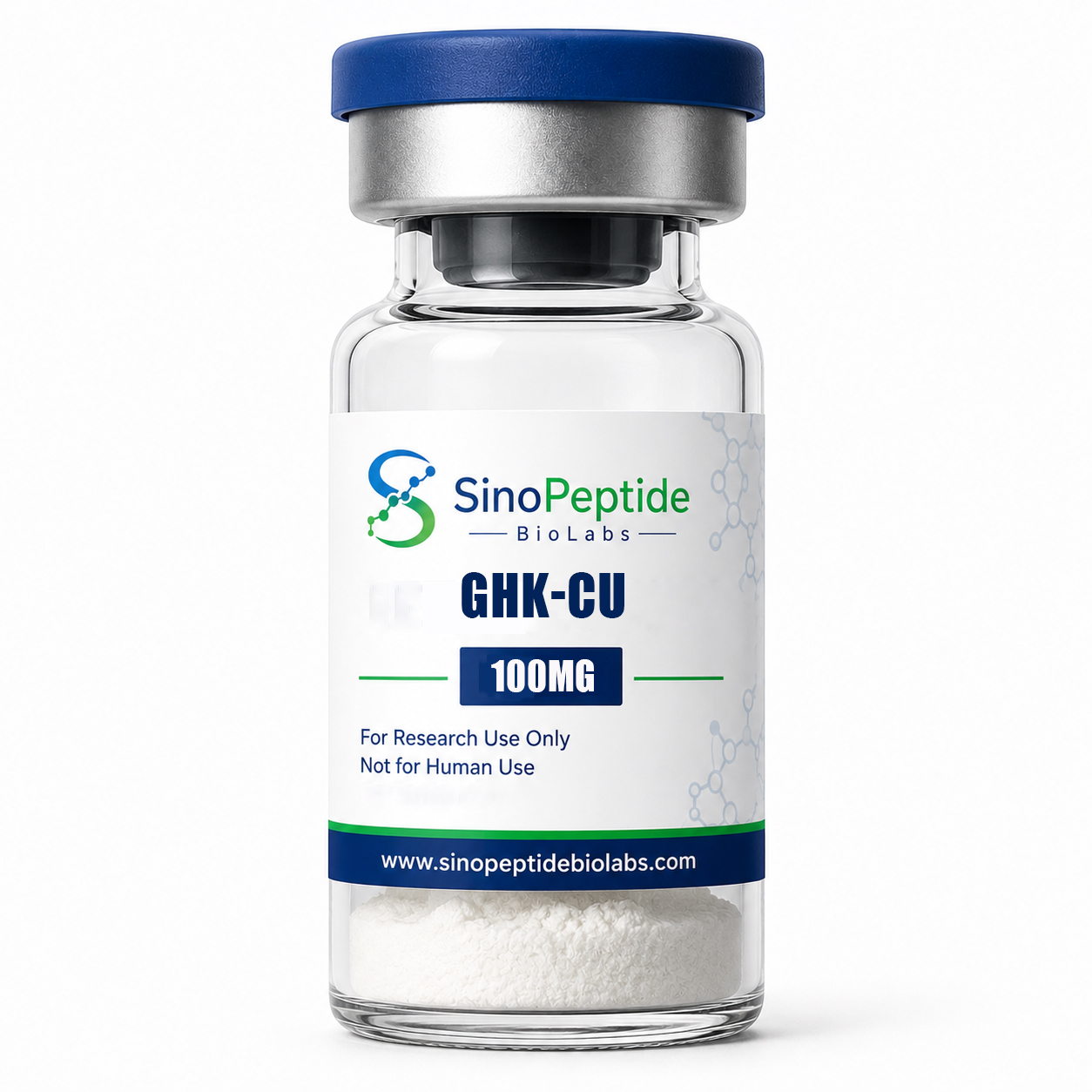
GHK – Cu 100mg
$55.00
GHK-Cu 100mg: Complete Copper Peptide Research Guide, Benefits, Uses, Safety & Quality
GHK-Cu 100mg is a research peptide product containing 100 milligrams of glycyl-L-histidyl-L-lysine copper, commonly known as GHK-Cu or copper tripeptide-1. GHK-Cu has attracted extensive scientific interest because of its involvement in research surrounding skin regeneration, extracellular-matrix remodeling, collagen production, wound healing, inflammation, oxidative stress, and tissue repair.
GHK-Cu is formed from the naturally occurring tripeptide GHK (glycyl-L-histidyl-L-lysine) and copper ions. Research has shown that GHK has a strong affinity for copper and can form the biologically relevant GHK-Cu complex. Scientific investigations have explored how this copper-bound peptide interacts with fibroblasts, keratinocytes, extracellular-matrix proteins, inflammatory signaling, and tissue-remodeling pathways.
The term 100mg describes the quantity of product or peptide specified by the product label. It should not automatically be interpreted as a standardized clinical dose or recommendation for human administration.
This comprehensive guide explains what GHK-Cu 100mg is, how copper tripeptide research works, potential research applications, collagen and skin research, wound-healing evidence, product quality, analytical testing, safety considerations, storage, regulatory status, and frequently asked questions.
What Is GHK-Cu 100mg?
GHK-Cu is a copper complex of the naturally occurring tripeptide GHK.
GHK stands for:
Glycyl-L-Histidyl-L-Lysine
When GHK binds copper, it forms the copper-peptide complex commonly referred to as GHK-Cu.
GHK-Cu is also associated with the cosmetic ingredient name Copper Tripeptide-1.
A GHK-Cu 100mg product therefore refers to a material containing 100mg of the specified GHK-Cu compound or formulation, depending on the manufacturer’s labeling.
This distinction matters because product quantity and experimental concentration are not interchangeable concepts.
A 100mg product does not automatically mean:
- 100mg per administration
- 100mg as a clinical dose
- 100mg as a cosmetic concentration
- 100mg as an established therapeutic amount
Researchers should use the specific product documentation and experimental protocol when determining how a material is evaluated.
GHK-Cu Chemical Identity
GHK-Cu is based on the short peptide GHK, which consists of three amino acids:
- Glycine
- Histidine
- Lysine
The histidine residue has an important role in copper coordination.
Copper is an essential trace element involved in numerous biological processes, including enzymatic reactions, connective-tissue biology, oxidative processes, and cellular metabolism.
The interaction between GHK and copper has therefore attracted considerable biochemical interest.
Research suggests that GHK can bind copper with high affinity and that GHK-Cu may participate in biological processes associated with tissue remodeling and repair.
GHK-Cu and Copper Peptide Research
GHK-Cu has been investigated for decades.
Early research examined its influence on fibroblasts, collagen expression, wound repair, and tissue remodeling. Later research expanded into areas including:
- Skin regeneration
- Extracellular-matrix remodeling
- Collagen biology
- Elastin research
- Fibroblast activity
- Keratinocyte activity
- Inflammation
- Oxidative stress
- Angiogenesis
- Hair-follicle biology
- Cosmetic dermatology
- Biomaterials and wound-healing systems
A major scientific review described GHK as a natural peptide found in human plasma, saliva, and urine and discussed its ability to form a complex with copper. The review summarized research involving collagen, glycosaminoglycans, fibroblasts, wound repair, skin elasticity, and other tissue-remodeling processes.
However, the strength of evidence varies substantially between different applications.
Cell studies and animal models can demonstrate biological activity without establishing that a particular GHK-Cu product produces the same effect in humans.
How Does GHK-Cu Work?
The biological activity of GHK-Cu is complex.
Rather than functioning through a single clearly defined receptor, research suggests that GHK-Cu can influence multiple processes involved in tissue remodeling and cellular signaling.
Areas investigated include:
- Collagen synthesis
- Extracellular-matrix organization
- Fibroblast activity
- Keratinocyte migration
- Growth-factor signaling
- Inflammatory pathways
- Oxidative stress
- Angiogenesis
- Tissue remodeling
GHK-Cu has therefore become an important research compound in studies investigating how small peptides and metal-peptide complexes influence tissue repair.
One reason the compound is scientifically interesting is the combination of peptide signaling and copper coordination.
GHK-Cu and Collagen Research
Collagen is one of the most abundant structural proteins in the human body and plays a major role in skin structure and connective tissue.
As skin ages, changes in collagen production and extracellular-matrix organization contribute to changes in:
- Skin thickness
- Elasticity
- Firmness
- Structural integrity
- Wrinkle formation
- Wound-repair capacity
GHK-Cu has been investigated for its relationship with collagen synthesis and extracellular-matrix remodeling.
Research summarized in PubMed has reported effects involving collagen and other matrix components, including glycosaminoglycans and proteoglycans.
This provides a biological rationale for studying GHK-Cu in skin-aging and tissue-regeneration models.
Nevertheless, increased collagen-related activity in a laboratory model should not automatically be translated into a guaranteed cosmetic or medical outcome.
GHK-Cu and Fibroblast Research
Fibroblasts are important connective-tissue cells involved in extracellular-matrix production and wound repair.
They contribute to the production and organization of structural components such as:
- Collagen
- Elastin-associated matrix
- Proteoglycans
- Other extracellular-matrix proteins
GHK-Cu research has examined how the compound influences fibroblast activity and tissue-remodeling pathways.
Experimental studies have reported effects on fibroblast behavior, collagen-related processes, and repair mechanisms.
This makes fibroblasts an important model system for researchers investigating GHK-Cu.
However, fibroblast responses in cell culture cannot by themselves establish clinical effectiveness.
GHK-Cu and Skin Regeneration
Skin regeneration is one of the most widely discussed research applications of GHK-Cu.
The skin must constantly balance:
- Cellular proliferation
- Differentiation
- Extracellular-matrix synthesis
- Inflammation
- Oxidative stress
- Barrier restoration
- Tissue remodeling
GHK-Cu has been investigated across several of these processes.
A review of GHK research described effects associated with skin repair, collagen and glycosaminoglycan synthesis, fibroblast activity, keratinocyte proliferation, and tissue remodeling.
More recent reviews continue to identify GHK-Cu as a promising research compound in regenerative and aesthetic applications while also emphasizing limitations in standardized clinical evidence.
A 2026 systematic review specifically concluded that GHK-Cu has demonstrated regenerative, anti-inflammatory, and antioxidant properties in preclinical models but noted a lack of standardized clinical guidelines.
GHK-Cu and Wound-Healing Research
Wound healing involves several overlapping stages:
- Hemostasis
- Inflammation
- Proliferation
- Remodeling
Each stage involves multiple cell types and signaling pathways.
GHK-Cu has been investigated in experimental wound-healing models because of its potential influence on cellular migration, extracellular-matrix remodeling, collagen biology, and inflammatory signaling.
Older experimental work specifically examined GHK-Cu in skin wound models and cultured fibroblasts.
More recent research continues to explore GHK-Cu in advanced wound-healing formulations.
For example, a 2026 study investigated a GHK-Cu-containing hydrogel system for diabetic wound research and reported effects involving tissue repair, angiogenesis, antioxidant activity, and antibacterial activity in the experimental system.
These results are scientifically interesting but should not be interpreted as proof that commercially available GHK-Cu 100mg products are treatments for diabetic wounds or other medical conditions.
GHK-Cu and Extracellular-Matrix Remodeling
The extracellular matrix provides structural support for tissues and participates in cell signaling.
Important components include:
- Collagen
- Elastin
- Proteoglycans
- Glycosaminoglycans
- Fibronectin
- Matrix-associated enzymes
Research has suggested that GHK-Cu can influence several components involved in extracellular-matrix remodeling.
This is one reason the peptide is frequently investigated in:
- Skin biology
- Tissue regeneration
- Wound repair
- Cosmetic science
- Fibroblast research
- Aging research
The concept of matrix remodeling is particularly important because healthy tissue repair requires not simply producing more collagen but coordinating synthesis, degradation, organization, and replacement.
GHK-Cu and Inflammation Research
Inflammation is an essential part of tissue repair, but excessive or prolonged inflammation can interfere with normal regeneration.
Research involving GHK-Cu has examined inflammatory signaling and oxidative processes.
Some studies have reported changes in inflammatory mediators and oxidative pathways in experimental models.
This has led to interest in GHK-Cu as a potential research tool for understanding the relationship between inflammation and tissue remodeling.
The evidence should nevertheless be interpreted according to the model used.
An anti-inflammatory effect in cultured cells does not establish that GHK-Cu is an approved anti-inflammatory treatment in humans.
GHK-Cu and Antioxidant Research
Oxidative stress occurs when reactive oxygen species and antioxidant defenses become imbalanced.
Oxidative processes are relevant to:
- Aging
- Skin damage
- Inflammation
- Tissue injury
- Cellular stress
Research has explored whether GHK-Cu can influence antioxidant-related pathways.
Copper itself is biologically important because it participates in several enzymes and redox processes.
The interaction between copper and the GHK peptide is therefore an important area of biochemical research.
GHK-Cu and Hair Research
GHK-Cu has also been investigated in relation to hair follicles and hair biology.
Hair follicles are complex mini-organs involving:
- Dermal papilla cells
- Keratinocytes
- Fibroblast-like cells
- Extracellular matrix
- Growth-factor signaling
- Vascular support
Experimental literature has reported effects involving hair-follicle size and related tissue processes.
This has contributed to interest in copper peptides within cosmetic and hair-care research.
However, the evidence should not be presented as proof that GHK-Cu 100mg is an established treatment for hair loss.
Researchers should distinguish between laboratory observations, cosmetic formulations, and controlled clinical evidence.
GHK-Cu 100mg in Cosmetic Research
GHK-Cu is widely associated with cosmetic research, particularly in products designed around skin appearance and aging.
Research topics include:
- Fine lines
- Skin firmness
- Elasticity
- Photodamage
- Skin density
- Extracellular-matrix remodeling
- Barrier-related processes
A recent review examining topical GHK specifically noted that although GHK-Cu and related compounds are widely used in cosmetic products, important questions remain regarding skin permeability, physicochemical properties, and clinical effectiveness.
This is an important distinction for accurate SEO content.
GHK-Cu can be described as a well-studied cosmetic and research ingredient without claiming that every GHK-Cu product has proven anti-aging effects.
What Does 100mg Mean?
The 100mg designation identifies the quantity stated for the product.
It does not automatically establish:
- A human dosage
- A recommended amount
- A therapeutic concentration
- A cosmetic concentration
- A standardized clinical protocol
Different GHK-Cu formulations can have very different concentrations, delivery systems, and intended uses.
Researchers should therefore evaluate the actual specification of the material rather than interpreting “100mg” as a universal administration instruction.
GHK-Cu 100mg Quality and Purity
Quality control is essential when working with research peptides.
A GHK-Cu 100mg product should ideally have documentation supporting its:
- Identity
- Purity
- Copper-peptide composition
- Batch consistency
- Manufacturing traceability
- Storage requirements
A Certificate of Analysis (COA) can provide useful information about the specific batch.
Researchers should look for analytical testing such as:
HPLC
High-performance liquid chromatography can help assess chromatographic purity and identify related impurities or degradation products.
Mass Spectrometry
Mass spectrometry can help confirm molecular identity and molecular mass.
Copper Characterization
For a copper-peptide complex, appropriate analytical characterization of the copper component and peptide complex can provide additional confidence in product identity.
Batch Testing
A batch number should ideally connect the product to its corresponding analytical documentation.
Why a COA Matters for GHK-Cu
A Certificate of Analysis is particularly useful because peptide products can vary between batches.
A credible COA should ideally include:
| Parameter | Purpose |
|---|---|
| Product identity | Confirms the material being tested |
| Batch number | Provides traceability |
| Purity | Indicates chromatographic purity |
| Analytical method | Shows how the result was obtained |
| Molecular identity | Helps verify the expected compound |
| Manufacturing date | Provides production information |
| Testing date | Indicates when analysis occurred |
| Storage information | Helps maintain stability |
A generic certificate that does not correspond to the actual lot provides less evidence of product quality.
GHK-Cu 100mg Storage and Stability
Peptides and peptide complexes can be sensitive to environmental conditions.
Potential stability factors include:
- Temperature
- Humidity
- Light
- Oxygen exposure
- Container integrity
- Formulation
- pH
- Repeated exposure to environmental conditions
The appropriate storage conditions depend on the exact GHK-Cu formulation.
Researchers should follow the manufacturer’s documented storage specifications rather than applying a universal storage rule to every copper peptide.
GHK-Cu 100mg Safety Considerations
Safety should be evaluated according to the specific formulation and route of administration.
This is particularly important for injectable GHK-Cu products.
The FDA currently identifies GHK-Cu for injectable routes of administration among bulk drug substances that raise significant safety concerns. The agency states that compounded injectable GHK-Cu may pose immunogenicity risks because of potential aggregation and peptide-related impurities and notes that limited human data are available to inform safety considerations.
This means that an online product labeled GHK-Cu 100mg should not automatically be represented as an approved injectable medicine.
Researchers should also consider possible risks associated with:
- Peptide impurities
- Aggregation
- Contamination
- Incorrect identity
- Formulation differences
- Unknown long-term effects
- Route-specific safety
GHK-Cu Regulatory Status
Regulatory status depends on jurisdiction, formulation, route, and intended use.
In the United States, the FDA’s 2026 compounding materials distinguish between injectable and non-injectable GHK-Cu nominations.
As of the April 2026 update, FDA reported that GHK-Cu for injectable routes had been removed from one category following withdrawal of nominations, while the agency intended to consult its Pharmacy Compounding Advisory Committee regarding possible inclusion on the 503A bulk list. The May 2026 update separately stated that GHK-Cu excluding injectable routes was placed back into Category 1 for evaluation.
These compounding-list proceedings should not be confused with FDA approval of GHK-Cu as a drug.
A website should therefore avoid describing GHK-Cu 100mg as an FDA-approved medicine unless a specific product has an applicable approval.
GHK-Cu vs GHK
GHK and GHK-Cu are related but not identical.
GHK is the tripeptide:
Gly-His-Lys
GHK-Cu is the copper-associated complex of GHK.
Copper binding is an important part of the biological and chemical identity of GHK-Cu.
Researchers should therefore avoid using GHK and GHK-Cu as interchangeable terms when discussing experimental results.
GHK-Cu vs Copper Tripeptide-1
GHK-Cu is commonly associated with Copper Tripeptide-1, particularly in cosmetic ingredient terminology.
However, product specifications can differ.
When comparing products, researchers should verify:
- Exact chemical identity
- Copper content
- Purity
- Formulation
- Intended use
- Analytical documentation
The name alone should not be treated as sufficient evidence that two products are identical.
GHK-Cu vs Other Copper Peptides
Several copper-containing peptides have been studied in scientific research.
GHK-Cu is distinctive because it is based on the naturally occurring GHK tripeptide.
Other copper-peptide complexes can have different peptide sequences and therefore different chemical and biological properties.
For example, recent research has investigated several copper(II)-tripeptide complexes and found that different peptide ligands can produce different coordination behavior and biological effects.
This reinforces the importance of verifying chemical identity rather than assuming all copper peptides behave the same way.
Common Misconceptions About GHK-Cu 100mg
Myth 1: 100mg Is a Standard GHK-Cu Dose
No.
It describes the product quantity and should not automatically be interpreted as a human administration amount.
Myth 2: GHK-Cu Is Only a Cosmetic Ingredient
Not exactly.
GHK-Cu has been studied in cosmetic science, but its research history also includes wound healing, tissue remodeling, fibroblast biology, extracellular-matrix research, and other experimental areas.
Myth 3: GHK-Cu Has Proven Every Anti-Aging Claim
No.
Although research is promising, evidence varies by application. A 2024 review specifically noted that clinical evidence for topical GHK-Cu remains limited.
Myth 4: All GHK-Cu Products Are the Same
No.
Products can differ in purity, formulation, copper-peptide composition, manufacturing quality, and analytical documentation.
Myth 5: Research Evidence Means an Online Product Is an Approved Medicine
No.
Scientific literature and regulatory approval are separate concepts.
How to Evaluate GHK-Cu 100mg for Research
Researchers evaluating GHK-Cu 100mg should consider several factors.
1. Confirm Chemical Identity
Verify that the material is actually GHK-Cu and determine whether the manufacturer specifies the exact form.
2. Review the COA
A batch-specific COA is preferable to generic documentation.
3. Examine Purity Testing
Look for HPLC or another suitable analytical method.
4. Verify Molecular Identity
Mass spectrometry can provide useful confirmation.
5. Check Batch Traceability
The batch number should connect the product to its analytical results.
6. Examine Formulation
Determine whether the product is supplied as a dry material, solution, cosmetic ingredient, or another formulation.
7. Verify Intended Use
Do not assume that a research material is appropriate for human or clinical use.
8. Review Regulatory Information
Regulatory requirements differ between cosmetic ingredients, research materials, compounded substances, and approved drugs.
Frequently Asked Questions About GHK-Cu 100mg
What is GHK-Cu 100mg?
GHK-Cu 100mg is a product containing a stated 100mg quantity of GHK-Cu, also known as copper tripeptide-1, for research or formulation purposes depending on the product’s labeling.
What is GHK-Cu?
GHK-Cu is a copper complex involving the tripeptide glycyl-L-histidyl-L-lysine, or GHK.
What does GHK stand for?
GHK stands for glycyl-L-histidyl-L-lysine, a naturally occurring tripeptide.
What does the Cu mean in GHK-Cu?
“Cu” refers to copper. GHK has a strong affinity for copper and forms the copper-peptide complex known as GHK-Cu.
What is GHK-Cu studied for?
Research has investigated GHK-Cu in skin biology, collagen and extracellular-matrix remodeling, wound healing, fibroblast activity, inflammation, oxidative stress, angiogenesis, and cosmetic science.
Does GHK-Cu increase collagen?
Research suggests that GHK-Cu can influence collagen-related and extracellular-matrix processes. However, the magnitude and clinical relevance of these effects depend on the experimental model and formulation.
Is GHK-Cu a growth factor?
No. GHK-Cu is a copper-peptide complex rather than a conventional growth factor.
Is GHK-Cu the same as GHK?
No. GHK is the tripeptide, while GHK-Cu refers to its copper-associated complex.
What does 100mg mean?
It identifies the quantity specified for the product. It does not establish a standardized human dose.
Is GHK-Cu FDA approved?
GHK-Cu should not be described as an FDA-approved drug. FDA’s current compounding materials specifically raise safety concerns about injectable GHK-Cu and note limited human safety information.
Is GHK-Cu used in cosmetics?
GHK-Cu is widely associated with cosmetic formulations and has been investigated for skin-aging and skin-repair applications. However, evidence and formulation performance vary.
How is GHK-Cu purity tested?
Potential analytical approaches include HPLC, mass spectrometry, and other methods appropriate for characterizing the peptide and copper complex.
What should be included in a GHK-Cu COA?
A useful COA may include product identity, batch number, purity, analytical method, molecular characterization, testing date, and other relevant quality information.
The Future of GHK-Cu Research
GHK-Cu remains an active research topic because tissue regeneration involves multiple interconnected biological pathways.
Current research is moving beyond simple topical formulations and exploring:
- Advanced delivery systems
- Hydrogels
- Biomaterials
- Wound-healing scaffolds
- Nanoparticle formulations
- Regenerative medicine
- Skin-aging research
- Fibroblast signaling
- Extracellular-matrix remodeling
Recent research has investigated GHK-Cu in advanced wound-healing systems, while newer reviews continue to examine its regenerative potential and limitations.
This suggests that future research may provide a better understanding of how copper-peptide chemistry can be incorporated into controlled tissue-repair systems.
Conclusion
GHK-Cu 100mg refers to a product containing a specified quantity of GHK-Cu, a copper complex of the naturally occurring tripeptide glycyl-L-histidyl-L-lysine.
GHK-Cu has a substantial research history involving skin biology, collagen, fibroblasts, extracellular-matrix remodeling, wound healing, inflammation, oxidative stress, angiogenesis, and cosmetic science.
Research suggests that GHK-Cu can influence several biological processes involved in tissue remodeling. Experimental studies have examined its effects on fibroblasts, collagen-related pathways, cellular migration, and wound repair, while more recent research is investigating advanced GHK-Cu delivery systems and regenerative applications.
At the same time, the scientific evidence should be presented accurately. Not every proposed benefit has been established through large, well-controlled human clinical trials. A recent review of topical GHK specifically identified limitations in the clinical evidence surrounding GHK-Cu’s effectiveness and skin permeability.
Product quality is equally important. Researchers evaluating GHK-Cu 100mg should look for appropriate analytical documentation, including batch-specific COAs, HPLC purity testing, molecular identity testing, manufacturing traceability, and clearly defined storage requirements.
The 100mg quantity should not be interpreted as a standardized human dose.
Finally, regulatory status must be separated from scientific interest. FDA’s current materials raise specific safety concerns about injectable GHK-Cu, including potential immunogenicity associated with aggregation and peptide-related impurities and limited human safety information.
For these reasons, GHK-Cu 100mg is best presented as a research and formulation material whose biological properties continue to be investigated, rather than as a universally established medical treatment.
Research-use disclaimer: This information is provided for educational and scientific research purposes. It does not constitute medical advice, a treatment recommendation, or instructions for human administration. GHK-Cu products should be evaluated according to their specific formulation, intended use, analytical documentation, and applicable regulations.
GHK-Cu 100mg GHK-Cu 100mg GHK-Cu 100mg GHK-Cu 100mg GHK-Cu 100mgGHK-Cu 100mg GHK-Cu 100mg GHK-Cu 100mg GHK-Cu 100mg GHK-Cu 100mg GHK-Cu 100mg GHK-Cu 100mg
Be the first to review “GHK – Cu 100mg”
Related products
Pure Peptides
Pure Peptides
Pure Peptides
Pure Peptides
Pure Peptides
Pure Peptides
Pure Peptides
Pure Peptides
Reviews
There are no reviews yet.