
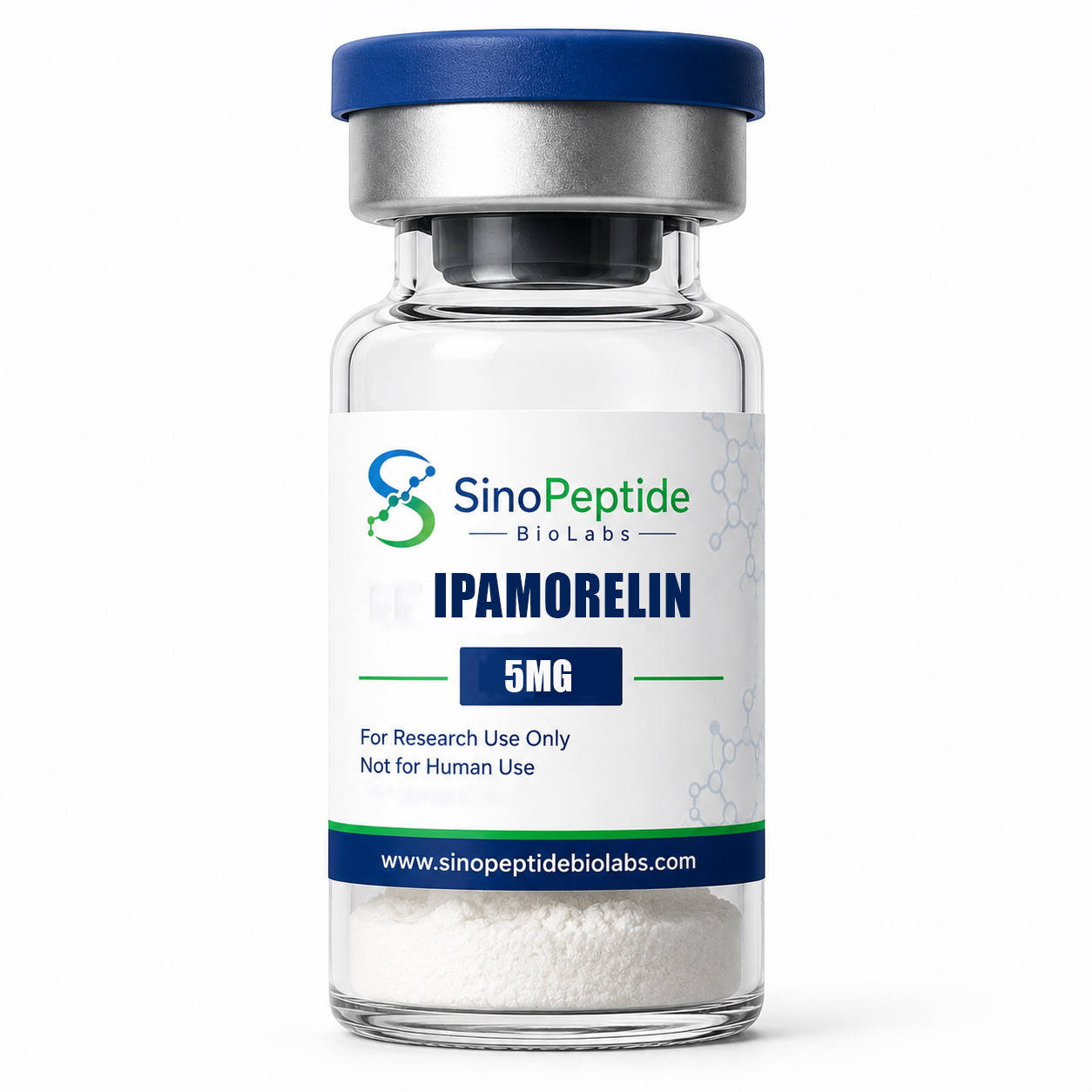
ipamorelin 5mg
$45.00
10 Vials/ Kits
Ipamorelin 5mg: Research, Mechanism, Benefits, Safety & Uses
Introduction to Ipamorelin 5mg
Ipamorelin is a synthetic pentapeptide that has attracted significant interest in peptide pharmacology because of its ability to stimulate the release of growth hormone (GH).
Unlike growth hormone itself, Ipamorelin belongs to the class of compounds known as growth hormone secretagogues. These compounds are studied for their ability to influence endogenous GH secretion rather than directly supplying recombinant human growth hormone.
The peptide was developed as a selective growth hormone-releasing peptide and has been investigated in laboratory and human studies for its pharmacokinetics, pharmacodynamics, GH response, and potential therapeutic applications. Early pharmacological research characterized Ipamorelin as a potent GH secretagogue acting through a GHRP-like receptor.
The term Ipamorelin 5mg generally describes a product containing 5 milligrams of Ipamorelin. The “5mg” designation refers to the quantity of peptide in the product and should not automatically be interpreted as a recommended human dose.
Current regulatory information is especially important when discussing Ipamorelin. FDA materials have identified concerns regarding the characterization, impurity profile, aggregation, immunogenicity, and limited clinical safety and effectiveness data associated with Ipamorelin-related substances used in compounded products.
For that reason, accurate SEO content should distinguish between scientific research, historical clinical investigation, and approved medical use.
What Is Ipamorelin?
Ipamorelin is a synthetic pentapeptide growth hormone secretagogue.
Its molecular sequence is:
Aib-His-D-2-Nal-D-Phe-Lys-NH₂
The original pharmacological research described Ipamorelin as a potent and selective GH-releasing peptide. In experimental models, it stimulated GH release through a GHRP-like receptor while demonstrating a pharmacological profile distinct from some earlier growth hormone secretagogues.
This selectivity is one of the reasons Ipamorelin became an important research compound.
Traditional growth hormone secretagogues such as GHRP-2 and GHRP-6 can influence multiple endocrine pathways. Ipamorelin was developed with the goal of producing a more selective GH response.
Researchers subsequently investigated its:
- Growth hormone activity
- Receptor pharmacology
- Pharmacokinetics
- Pharmacodynamics
- Endocrine effects
- Route-dependent absorption
- Safety profile
- Potential clinical applications
What Does Ipamorelin 5mg Mean?
Ipamorelin 5mg indicates that a product contains 5 milligrams of Ipamorelin.
This terminology should not be confused with a clinically established dosage recommendation.
The amount of peptide contained in a research product is different from the amount used in a particular scientific experiment or clinical trial.
A product labeled 5mg does not, by itself, establish:
- appropriate human dosing,
- frequency of administration,
- clinical efficacy,
- route of administration,
- sterility,
- purity,
- regulatory approval,
- or suitability for human use.
For responsible product content, “5mg” should therefore be described as the product quantity.
Ipamorelin Molecular Structure
Ipamorelin is a relatively small peptide consisting of five amino acids.
Its structure was developed through medicinal chemistry research involving earlier growth hormone-releasing peptides.
The original research identified Ipamorelin as a pentapeptide with strong GH-releasing activity. Laboratory studies showed that it could stimulate GH secretion in cultured pituitary cells and experimental models.
The incorporation of modified amino-acid components helped create a molecule with a distinctive pharmacological profile.
Understanding the molecular structure is important because peptide structure can influence:
- receptor binding,
- metabolic stability,
- biological activity,
- clearance,
- tissue distribution,
- and degradation.
How Does Ipamorelin Work?
Ipamorelin and Growth Hormone Release
The primary research interest in Ipamorelin is its ability to stimulate the release of growth hormone.
Instead of supplying GH directly, Ipamorelin acts as a secretagogue, meaning it signals the body to release endogenous GH.
The original pharmacological research demonstrated that Ipamorelin stimulates GH release through a GHRP-like receptor mechanism.
This distinction is important.
Growth Hormone
Growth hormone is a peptide hormone produced primarily by the pituitary gland.
Growth Hormone Secretagogue
A growth hormone secretagogue is a compound that stimulates endogenous GH secretion.
Ipamorelin belongs to the second category.
Ipamorelin and the Ghrelin/Growth Hormone Secretagogue Receptor
Growth hormone secretagogues are associated with the growth hormone secretagogue receptor (GHS-R) system.
This receptor system is closely related to ghrelin signaling.
Research into Ipamorelin has focused on its ability to activate GHRP-associated pathways and promote GH secretion.
The pharmacological distinction between Ipamorelin and other secretagogues is one of its most important research characteristics.
Rather than simply describing Ipamorelin as a “growth hormone peptide,” it is more scientifically accurate to describe it as a synthetic growth hormone secretagogue.
Ipamorelin and Growth Hormone Research
Growth hormone has many physiological roles.
It contributes to processes involving:
- growth and development,
- protein metabolism,
- tissue maintenance,
- bone physiology,
- energy metabolism,
- and regulation of insulin-like growth factor pathways.
Because GH secretion changes naturally throughout life, researchers have investigated compounds that can modify GH release.
Ipamorelin is one such compound.
Early studies demonstrated that Ipamorelin could stimulate GH release in experimental systems. Human pharmacokinetic and pharmacodynamic research subsequently evaluated how the peptide behaves in the body and how GH responds to exposure.
However, demonstrating GH release does not automatically establish a clinical benefit for healthy individuals.
That distinction is important when evaluating online claims about Ipamorelin.
Ipamorelin Pharmacokinetics
Human pharmacokinetic research has provided information about how Ipamorelin behaves following administration.
A human volunteer study examined different infusion rates and measured both Ipamorelin and GH concentrations.
Researchers reported dose-proportional pharmacokinetics and a relatively short terminal half-life of approximately two hours. GH stimulation occurred as a distinct episode, with peak GH response occurring around 0.67 hours in the study conditions.
These findings are useful for understanding the relationship between peptide exposure and GH secretion.
However, pharmacokinetic findings from controlled research should not be converted into self-administration instructions.
The study conditions, route, formulation, participant population, and monitoring environment all matter.
Ipamorelin and Growth Hormone Response
The relationship between Ipamorelin exposure and GH secretion is an important research topic.
Human pharmacodynamic modeling found that Ipamorelin produced measurable GH stimulation across the investigated exposure range. Researchers used mathematical models to describe the relationship between Ipamorelin concentration and GH production.
This type of research helps scientists understand:
- how quickly GH responds,
- how long the response lasts,
- how peptide concentration affects GH release,
- and how individual responses differ.
Importantly, individual variability was observed in the pharmacodynamic parameters.
That means biological responses cannot necessarily be predicted from product quantity alone.
Ipamorelin vs. GHRP-2 and GHRP-6
Ipamorelin is often compared with other growth hormone secretagogues, particularly GHRP-2 and GHRP-6.
All belong to a broader research field involving compounds that influence GH secretion.
However, their molecular structures and pharmacological profiles are different.
Ipamorelin
Research characteristics include:
- Pentapeptide structure
- GH secretagogue activity
- GHRP-like receptor activity
- Selective GH-releasing profile
- Human pharmacokinetic research
GHRP-2
GHRP-2 is another growth hormone-releasing peptide that has been studied for endocrine effects.
GHRP-6
GHRP-6 is also a GH secretagogue and has been extensively investigated in experimental research.
Ipamorelin was specifically developed to provide potent GH-releasing activity with a different selectivity profile.
The compounds should therefore not be treated as interchangeable.
Ipamorelin and Selectivity
Selectivity is one of the most frequently discussed characteristics of Ipamorelin.
The original research described Ipamorelin as a selective GH secretagogue. Its development involved structural modifications designed to produce strong GH-releasing activity while differentiating it pharmacologically from older GHRPs.
This characteristic has contributed to continued interest in Ipamorelin research.
Nevertheless, “selective” does not mean “risk-free.”
A compound can have a relatively selective pharmacological profile while still producing clinically important effects or presenting formulation-related risks.
Potential Research Applications of Ipamorelin
Ipamorelin has been investigated in several areas of scientific and medical research.
Growth Hormone Physiology
One of the central applications is the study of GH secretion.
Researchers can use growth hormone secretagogues to investigate how the pituitary responds to specific signaling molecules.
Pharmacokinetic Research
Ipamorelin has been used to investigate:
- absorption,
- distribution,
- metabolism,
- clearance,
- and concentration-response relationships.
Human studies have helped characterize its pharmacokinetic and pharmacodynamic properties.
Endocrine Research
Because Ipamorelin affects GH release, it has potential research relevance to endocrine physiology.
Researchers can investigate interactions among:
- growth hormone,
- pituitary signaling,
- metabolic pathways,
- and related endocrine hormones.
Postoperative Ileus Research
Ipamorelin has also been investigated historically in research involving postoperative ileus.
However, this area requires particular caution.
FDA’s evaluation of Ipamorelin-related substances discusses the evidence and safety concerns associated with proposed uses involving postoperative ileus and growth hormone deficiency.
Therefore, historical investigation should not be presented as evidence that Ipamorelin is an approved treatment for postoperative ileus.
Ipamorelin and Growth Hormone Deficiency Research
Growth hormone deficiency is another area in which Ipamorelin has been investigated.
The theoretical rationale is straightforward: if a compound can stimulate endogenous GH secretion, researchers may investigate whether it has potential applications in disorders involving inadequate GH production.
However, the evidence must be distinguished from established treatment.
FDA’s 2024 review stated that available information did not provide sufficient evidence supporting the safety and effectiveness of Ipamorelin-related bulk substances for proposed compounded uses involving growth hormone deficiency.
There are already FDA-approved treatments for certain forms of growth hormone deficiency.
Consequently, Ipamorelin should not be marketed as an FDA-approved replacement for established GH therapies.
Ipamorelin 5mg Safety
Safety is an essential part of any discussion about Ipamorelin.
Although the peptide has been studied experimentally and in humans, the available evidence does not justify describing every Ipamorelin product as safe.
FDA has specifically identified several concerns involving Ipamorelin acetate and Ipamorelin free base in the context of compounded drug products.
These include potential risks related to:
- peptide impurities,
- aggregation,
- immunogenicity,
- incomplete characterization,
- insufficient safety information,
- and limited evidence supporting effectiveness for proposed uses.
FDA also noted serious adverse events in a clinical study in which Ipamorelin was administered intravenously for research involving gastric motility, including hypokalemia, insomnia, hyperglycemia, nausea, vomiting, abdominal distention, and deaths. FDA stated that it was unclear whether the deaths were related to Ipamorelin.
This does not establish that all routes or formulations produce the same risk profile.
Rather, it demonstrates why route, formulation, product quality, and clinical context matter.
Why Peptide Quality Matters
Peptides present quality-control challenges that differ from many conventional small-molecule drugs.
FDA has highlighted concerns involving peptide:
- aggregation,
- impurities,
- immunogenicity,
- characterization,
- concentration,
- and storage conditions.
These issues are particularly relevant for injectable peptide products.
A product labeled “Ipamorelin 5mg” does not by itself establish that the material is:
- sterile,
- endotoxin-free,
- correctly identified,
- accurately quantified,
- chemically pure,
- or suitable for human administration.
For research purposes, appropriate analytical documentation can therefore be valuable.
What Is a Certificate of Analysis?
A Certificate of Analysis (COA) is a document intended to provide analytical information about a particular batch.
Depending on the supplier and testing laboratory, a COA may contain information concerning:
- product identity,
- purity,
- batch number,
- analytical testing,
- peptide content,
- testing dates,
- and other quality parameters.
A COA should be evaluated critically.
A document carrying the title “COA” does not automatically prove that a product meets pharmaceutical standards.
For research procurement, buyers should consider whether the documentation identifies the testing methodology, batch, laboratory, and relevant analytical results.
Is Ipamorelin FDA Approved?
Ipamorelin is not an FDA-approved drug in the United States.
FDA documents from its Pharmacy Compounding Advisory Committee specifically state that Ipamorelin free base and Ipamorelin acetate are not components of an FDA-approved drug. The agency also noted that neither substance had an applicable USP or National Formulary drug-substance monograph at the time of its evaluation.
FDA’s current bulk-substance information also identifies Ipamorelin acetate under its category of substances presenting potential significant safety concerns in the compounding context.
This is an important distinction for SEO content.
A website should not describe Ipamorelin 5mg as:
- FDA-approved,
- an FDA-approved GH treatment,
- an FDA-approved anti-aging medication,
- or an FDA-approved muscle-building product.
Ipamorelin Research vs. Approved Medical Treatment
There is a substantial difference between a compound being studied in scientific research and being approved as a medicine.
Research Compound
A research compound may be investigated to understand:
- biological mechanisms,
- pharmacological activity,
- safety,
- pharmacokinetics,
- and potential therapeutic applications.
Approved Medicine
An approved medicine has undergone regulatory review for specific uses and meets applicable requirements concerning quality, safety, efficacy, manufacturing, and labeling.
Ipamorelin’s scientific research history does not mean that every commercially available Ipamorelin 5mg product is an approved medicine.
This distinction should be clearly communicated in responsible product content.
Ipamorelin and Anti-Aging Claims
Ipamorelin is frequently discussed online in connection with aging, body composition, recovery, and other wellness topics.
Some of these claims are based on the biological relationship between GH and various physiological processes.
However, the existence of a physiological relationship does not establish that Ipamorelin produces a particular anti-aging outcome in humans.
Therefore, terms such as “anti-aging peptide,” “fat-burning peptide,” or “muscle-building peptide” should be used cautiously and only when supported by appropriate clinical evidence.
For an evidence-based website, it is better to focus on documented pharmacology and research.
Ipamorelin and Body Composition Research
Growth hormone has relationships with fat metabolism, protein metabolism, and other physiological processes.
This has generated interest in GH secretagogues for body-composition research.
However, the presence of GH stimulation does not automatically establish that Ipamorelin causes clinically meaningful fat loss or muscle gain.
Body composition is influenced by numerous factors, including:
- nutrition,
- physical activity,
- sleep,
- age,
- endocrine status,
- genetics,
- and overall health.
Consequently, SEO content should avoid promising specific body-composition results from Ipamorelin 5mg.
Ipamorelin and Muscle Growth
The relationship between GH and muscle physiology has contributed to interest in Ipamorelin among sports and fitness communities.
Nevertheless, evidence that a compound stimulates GH is not equivalent to evidence that it produces predictable increases in muscle mass or athletic performance.
The human pharmacology literature establishes GH-secretagogue activity, but this should not be converted into unsupported claims of guaranteed muscle growth.
A scientifically responsible description is that Ipamorelin has been studied for its ability to stimulate endogenous GH secretion.
Ipamorelin in Laboratory Research
Ipamorelin may be of interest to researchers studying:
- peptide pharmacology,
- endocrine signaling,
- GH secretion,
- pituitary physiology,
- receptor pharmacology,
- pharmacokinetics,
- pharmacodynamics,
- and growth hormone secretagogue pathways.
Laboratory research involving peptides should follow applicable institutional safety requirements and validated protocols.
A research designation should also be clearly separated from claims about human treatment.
Ipamorelin 5mg Storage and Product Handling
Peptide stability can depend on factors including:
- temperature,
- moisture,
- light,
- formulation,
- container characteristics,
- and storage duration.
The correct handling requirements depend on the specific formulation and manufacturer’s validated stability information.
For that reason, a website should not invent universal storage temperatures or handling instructions for every Ipamorelin 5mg product.
Researchers should follow the product-specific documentation supplied by the manufacturer or qualified laboratory supplier.
Frequently Asked Questions About Ipamorelin 5mg
What is Ipamorelin 5mg?
Ipamorelin 5mg refers to a product containing 5 milligrams of the synthetic peptide Ipamorelin. Ipamorelin is a growth hormone secretagogue studied for its ability to stimulate endogenous GH release.
What does Ipamorelin do?
Ipamorelin has been studied primarily for its ability to stimulate growth hormone secretion. Human pharmacokinetic and pharmacodynamic research has demonstrated a measurable GH response following exposure.
Is Ipamorelin a growth hormone?
No. Ipamorelin is not growth hormone itself. It is a growth hormone secretagogue, meaning it is studied for its ability to stimulate endogenous GH release.
Is Ipamorelin FDA approved?
No. FDA documents state that Ipamorelin free base and Ipamorelin acetate are not components of an FDA-approved drug in the United States.
Is Ipamorelin safe?
The safety profile depends on the formulation, route, product quality, and clinical context. FDA has identified concerns involving potential peptide impurities, aggregation, immunogenicity, and limited safety information for Ipamorelin-related compounded substances.
Is Ipamorelin the same as GHRP-6?
No. Both are growth hormone secretagogues, but they are structurally and pharmacologically distinct peptides.
What is Ipamorelin acetate?
Ipamorelin acetate is the acetate salt form of Ipamorelin. FDA has evaluated Ipamorelin acetate separately from Ipamorelin free base in its compounding-related reviews.
Has Ipamorelin been studied in humans?
Yes. Human studies have examined its pharmacokinetics and pharmacodynamics, including its relationship with GH secretion.
Does Ipamorelin increase growth hormone?
Human research demonstrates that Ipamorelin can stimulate GH release under controlled study conditions. The clinical significance of that effect depends on the population, formulation, route, and intended indication.
What should I look for when evaluating Ipamorelin 5mg research material?
Important quality considerations can include batch identification, analytical characterization, purity testing, and appropriate documentation such as a verifiable Certificate of Analysis. Product labeling alone does not establish sterility, purity, or suitability for human use.
Internal Link Suggestions
To strengthen topical authority and improve site navigation, consider linking the Ipamorelin 5mg page to relevant educational and related peptide pages.
Suggested internal links:
- Ipamorelin 10mg →
/ipamorelin-10mg/ - GHRP-2 Acetate →
/ghrp-2-acetate/ - GHRP-6 Acetate →
/ghrp-6-acetate/ - CJC-1295 No DAC →
/cjc-1295-no-dac/ - CJC-1295 With DAC →
/cjc-1295-with-dac/ - Sermorelin Acetate →
/sermorelin-acetate/ - HGH Research →
/hgh-research/ - Peptide Research Guide →
/peptide-research-guide/ - Certificate of Analysis Guide →
/certificate-of-analysis-guide/
Use internal links naturally and ensure that the destination pages provide genuinely relevant information.
Recommended SEO Keyword Placement
Primary Keyword
Ipamorelin 5mg
The primary keyword should appear naturally in:
- SEO title
- H1
- Introduction
- At least one H2
- Meta description
- URL slug
- FAQ section
- Image alt text where appropriate
Avoid repeating the exact phrase excessively.
Secondary Keywords
Recommended supporting keywords include:
- Ipamorelin peptide
- Ipamorelin 5mg peptide
- Ipamorelin research
- Ipamorelin mechanism
- Ipamorelin safety
- Ipamorelin acetate
- Ipamorelin growth hormone
- Ipamorelin GH secretagogue
- Ipamorelin pharmacology
- Ipamorelin clinical research
- Ipamorelin FDA status
- Ipamorelin research peptide
- Ipamorelin and growth hormone
- Ipamorelin peptide research
Long-Tail Keywords
Useful long-tail search phrases include:
- What is Ipamorelin 5mg?
- What is Ipamorelin peptide?
- How does Ipamorelin work?
- Does Ipamorelin increase growth hormone?
- Is Ipamorelin FDA approved?
- Ipamorelin 5mg research
- Ipamorelin mechanism of action
- Ipamorelin safety research
- Ipamorelin acetate research
- Ipamorelin pharmacokinetics
- Ipamorelin growth hormone secretagogue
- Ipamorelin vs GHRP-6
Final Thoughts on Ipamorelin 5mg
Ipamorelin is a scientifically interesting synthetic peptide with a well-defined place in growth hormone secretagogue research.
Its original development identified it as a potent and selective GH-releasing pentapeptide. Subsequent human research has investigated its pharmacokinetics and pharmacodynamics, demonstrating that Ipamorelin can produce a measurable GH response under controlled experimental conditions.
These characteristics have made Ipamorelin relevant to research involving:
- growth hormone physiology,
- endocrine signaling,
- receptor pharmacology,
- peptide pharmacokinetics,
- pituitary function,
- and growth hormone secretagogue pathways.
At the same time, its research profile should not be confused with regulatory approval.
FDA’s evaluations have identified important uncertainties and potential safety concerns surrounding Ipamorelin-related bulk substances, including peptide aggregation, impurities, immunogenicity, incomplete characterization, and limited evidence supporting safety and effectiveness for proposed compounded uses.
Therefore, a high-quality Ipamorelin 5mg product page should emphasize scientific accuracy, transparent product documentation, responsible terminology, and a clear distinction between research findings and established medical treatment.
The most accurate description is that Ipamorelin is an investigational growth hormone secretagogue studied for its ability to stimulate endogenous growth hormone release.
Medical & Research Disclaimer: This content is for educational and informational purposes only. It does not provide medical advice, diagnosis, treatment recommendations, dosing instructions, or instructions for self-administration. Ipamorelin is not an FDA-approved drug in the United States. Research findings should not be interpreted as proof that a commercially available Ipamorelin 5mg product is safe or effective for human use. Always consult an appropriately qualified healthcare professional regarding medical decisions and follow applicable laws, regulations, institutional requirements, and product-specific documentation.
Ipamorelin 5mg Ipamorelin 5mg Ipamorelin 5mg Ipamorelin 5mg Ipamorelin 5mg Ipamorelin 5mg Ipamorelin 5mg Ipamorelin 5mg Ipamorelin 5mg Ipamorelin 5mg Ipamorelin 5mg Ipamorelin 5mg Ipamorelin 5mg Ipamorelin 5mg Ipamorelin 5mg Ipamorelin 5mg Ipamorelin 5mg Ipamorelin 5mg Ipamorelin 5mg Ipamorelin 5mg Ipamorelin 5mg Ipamorelin 5mg Ipamorelin 5mg
Be the first to review “ipamorelin 5mg”
Related products
Pure Peptides
Pure Peptides
Pure Peptides
Pure Peptides
Pure Peptides
Pure Peptides
Pure Peptides
Pure Peptides
Reviews
There are no reviews yet.