
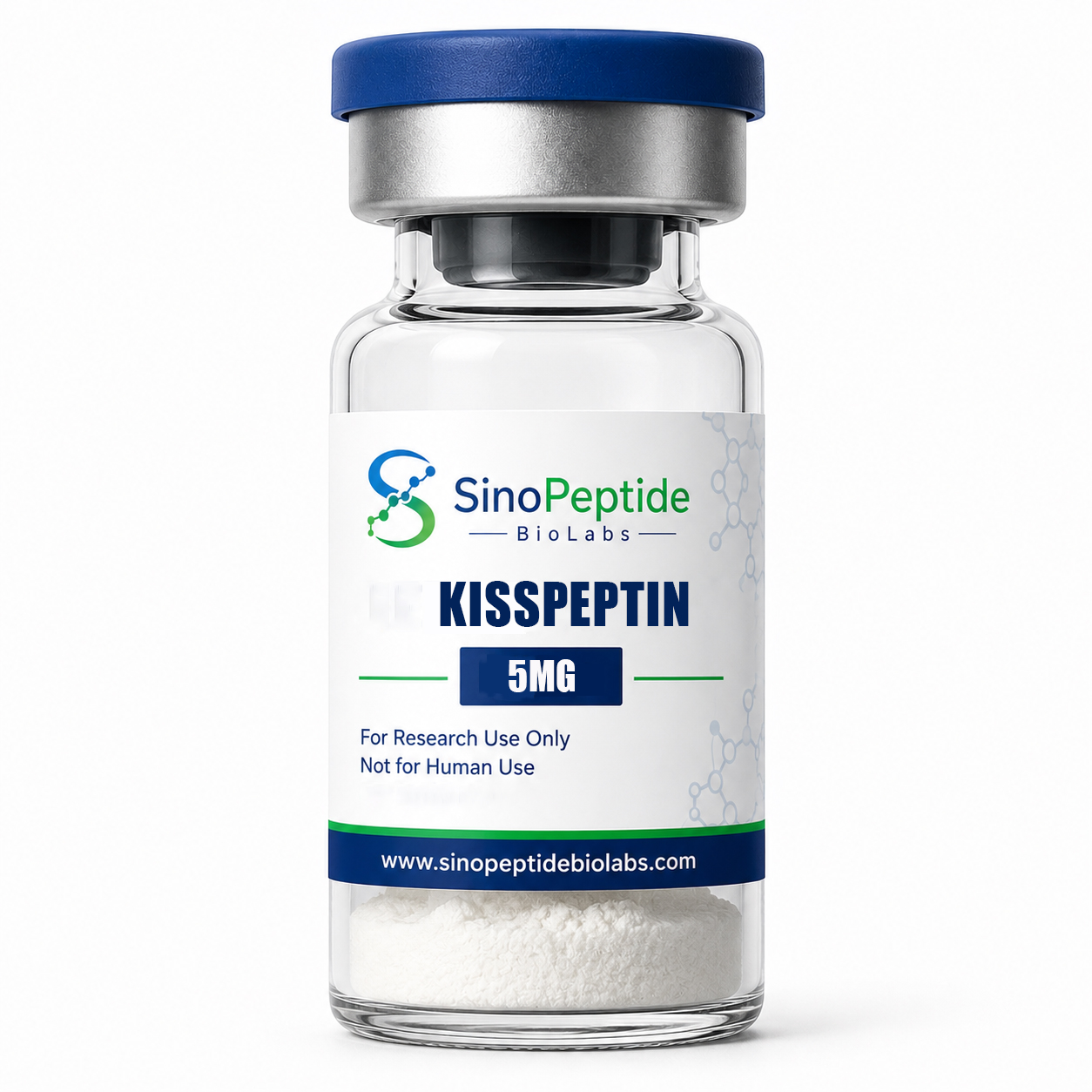
KissPeptin 10 5mg
$65.00
10 Vials/ Kits
KissPeptin 10 5mg: Uses, Mechanism, Benefits, Safety & Research
What Is KissPeptin 10 5mg?
KissPeptin 10 5mg generally refers to a product containing 5 milligrams of Kisspeptin-10, a biologically active peptide involved in regulation of the reproductive hormone system.
Kisspeptin-10 is the C-terminal decapeptide of the naturally occurring kisspeptin family and is capable of activating the KISS1 receptor (KISS1R). Kisspeptin signaling plays an important role upstream of gonadotropin-releasing hormone (GnRH), which in turn regulates pituitary secretion of luteinizing hormone (LH) and follicle-stimulating hormone (FSH).
This makes Kisspeptin-10 particularly interesting in reproductive endocrinology.
However, the term “Kisspeptin 10 5mg” should not be interpreted as meaning that 5 mg is an established clinical dose. Human research has used substantially smaller quantities and different administration protocols depending on the study. For example, published studies have examined intravenous and subcutaneous administration using doses expressed in micrograms or nanomoles per kilogram rather than a universal 5 mg dose.
Therefore, a 5 mg label should be understood primarily as a product quantity or formulation designation, unless the specific product’s regulatory documentation states otherwise.
KissPeptin 10 5mg at a Glance
| Feature | Information |
|---|---|
| Product | Kisspeptin-10 |
| Common spelling | Kisspeptin 10 / Kisspeptin-10 |
| Quantity in keyword | 5 mg |
| Peptide family | Kisspeptins |
| Receptor | KISS1R |
| Major biological pathway | Kisspeptin → GnRH → LH/FSH |
| Primary research area | Reproductive endocrinology |
| Research interests | Fertility, reproductive hormone signaling, hypogonadism, puberty |
| Hormones studied | LH, FSH, testosterone and reproductive hormones |
| Clinical status | Primarily investigational/research use; status varies by jurisdiction |
| Common research routes | Intravenous and subcutaneous administration |
| Established universal 5 mg dose | No |
| Key safety consideration | Product quality, peptide characterization, route-specific safety and medical supervision |
How Does Kisspeptin-10 Work?
The primary biological role of Kisspeptin-10 is connected to the hypothalamic-pituitary-gonadal (HPG) axis.
The pathway can be simplified as:
Kisspeptin → KISS1R → GnRH → LH/FSH → gonadal function
Kisspeptin-producing neurons in the hypothalamus communicate with GnRH neurons through KISS1R signaling.
When kisspeptin activates this receptor, it can stimulate GnRH secretion. GnRH then acts on the pituitary gland to regulate the release of LH and FSH.
These hormones subsequently influence the testes or ovaries.
This pathway is one reason kisspeptin has attracted substantial scientific interest in reproductive medicine. Reviews of human research describe kisspeptin as an important upstream regulator of GnRH secretion and reproductive hormone signaling.
What Is KISS1R?
KISS1R, also called the kisspeptin receptor, is the receptor through which kisspeptin exerts its principal reproductive effects.
It was previously known as GPR54.
The interaction between kisspeptin and KISS1R is essential for normal reproductive development and function. Genetic disruptions affecting KISS1 or KISS1R have been associated with abnormalities of puberty and reproductive function.
This provides an important biological explanation for why kisspeptin research extends beyond simply measuring testosterone.
Kisspeptin acts near the top of the reproductive hormone signaling cascade.
Kisspeptin-10 and GnRH
One of the most important relationships in understanding KissPeptin 10 5mg is its relationship with GnRH.
GnRH is produced by specialized neurons in the hypothalamus.
Its pulsatile secretion stimulates the pituitary gland to release LH and FSH.
Kisspeptin is an upstream regulator of this process.
Human research has demonstrated that administration of Kisspeptin-10 can produce rapid changes in LH secretion, supporting its ability to activate the reproductive hormone axis.
This is why researchers sometimes use Kisspeptin-10 as a physiological probe for studying GnRH neuronal function.
Kisspeptin-10 and LH
Luteinizing hormone (LH) is one of the principal hormones affected by kisspeptin signaling.
In a human study involving healthy men, intravenous Kisspeptin-10 produced a rapid and dose-dependent increase in serum LH. At a tested dose of 1 μg/kg, LH increased substantially within approximately 30 minutes.
The same study also found that prolonged Kisspeptin-10 infusion increased LH secretion and altered LH pulse characteristics.
These findings demonstrate an important physiological effect, but they should not automatically be translated into a claim that a commercially labeled 5 mg product will produce a predictable testosterone or fertility outcome.
Clinical research doses and commercial product quantities are not interchangeable concepts.
Kisspeptin-10 and FSH
Kisspeptin signaling can also affect follicle-stimulating hormone (FSH).
FSH is important for reproductive function in both sexes.
In males, FSH participates in the regulation of spermatogenesis through its effects on Sertoli cells.
In females, FSH plays important roles in follicular development and ovarian function.
Human studies have shown changes in FSH following Kisspeptin-10 administration, although the magnitude and timing of the response depend on factors including sex, reproductive state, dose and route of administration.
Kisspeptin-10 and Testosterone
Kisspeptin-10 can influence testosterone indirectly through the reproductive hormone axis.
The basic pathway is:
Kisspeptin → GnRH → LH → Leydig cells → testosterone
Human research has demonstrated that Kisspeptin-10 administration can increase LH and, under certain experimental conditions, testosterone.
For example, prolonged Kisspeptin-10 infusion in healthy men increased testosterone alongside changes in LH secretion.
However, this does not establish Kisspeptin-10 as a general testosterone-boosting treatment.
A temporary experimental increase in testosterone is different from demonstrating a safe, effective and approved therapy for testosterone deficiency.
Kisspeptin-10 and Female Reproductive Function
Kisspeptin is also highly relevant to female reproductive physiology.
The HPG axis regulates:
- Pubertal development
- Menstrual cycling
- Follicular development
- Ovulation
- Ovarian hormone production
- Fertility
Research indicates that kisspeptin signaling participates in the control of GnRH secretion and therefore influences the downstream reproductive hormone cascade.
Importantly, the response to Kisspeptin-10 can vary according to menstrual-cycle stage.
A human study found that healthy women showed different responses to Kisspeptin-10 depending on reproductive phase, demonstrating that the physiology is more complex than simply administering a peptide to increase LH or FSH.
Kisspeptin-10 and Fertility Research
Fertility is one of the most promising areas of kisspeptin research.
Because kisspeptin sits upstream of GnRH, researchers have investigated whether manipulating this pathway could provide new approaches to reproductive disorders.
Potential research applications include:
- Hypothalamic reproductive dysfunction
- Hypogonadotropic hypogonadism
- Certain forms of infertility
- Assisted reproductive technology
- Ovulation-related research
- Puberty disorders
- Reproductive hormone testing
A systematic review identified numerous clinical trials investigating kisspeptin and related pathways in reproductive medicine. However, the existence of clinical trials does not mean Kisspeptin-10 is established as a routine fertility treatment.
Kisspeptin-10 and Hypogonadotropic Hypogonadism
Researchers have investigated Kisspeptin-10 in people with disorders involving impaired reproductive hormone signaling.
In idiopathic hypogonadotropic hypogonadism, reproductive hormone production can be impaired because of abnormalities affecting GnRH signaling.
A clinical study used exogenous kisspeptin as a physiological probe to examine the functional capacity of GnRH neurons in individuals with this condition.
This type of research is valuable because it can help researchers determine where dysfunction occurs within the reproductive hormone pathway.
However, it does not mean that an online Kisspeptin-10 product is a clinically validated treatment for hypogonadotropic hypogonadism.
Kisspeptin-10 and Puberty Research
Kisspeptin signaling is also closely associated with puberty.
The activation of the reproductive axis during puberty requires increased GnRH activity.
Because kisspeptin is an important upstream regulator of GnRH neurons, researchers have studied its role in initiating and controlling reproductive maturation.
Genetic evidence further supports the importance of KISS1/KISS1R signaling in normal puberty. Mutations affecting this pathway can cause pubertal abnormalities.
These findings provide an important biological foundation for kisspeptin research in pediatric endocrinology.
They should not, however, be interpreted as evidence for unsupervised Kisspeptin-10 use in children or adolescents.
Potential Benefits of Kisspeptin-10
When discussing KissPeptin 10 5mg benefits, it is important to distinguish established biological effects from potential therapeutic applications.
Research-supported effects include:
1. Stimulation of LH
Human studies demonstrate that Kisspeptin-10 can stimulate LH secretion.
2. Modulation of FSH
Changes in FSH have also been documented in human research.
3. Activation of the reproductive hormone axis
Kisspeptin acts upstream of GnRH and therefore provides a mechanism for stimulating the HPG axis.
4. Testosterone stimulation under experimental conditions
In certain male studies, Kisspeptin-10 increased testosterone alongside increased LH.
5. Research value in reproductive endocrinology
Kisspeptin can be used experimentally to investigate GnRH neuronal function and reproductive hormone physiology.
These effects should not be converted into unsupported marketing claims such as “Kisspeptin-10 cures infertility” or “Kisspeptin-10 permanently increases testosterone.”
KissPeptin 10 5mg Dosage
The phrase “KissPeptin 10 5mg dosage” requires particular care.
A 5 mg vial or container quantity does not establish that 5 mg is an appropriate human dose.
Published human studies have used much smaller experimental amounts.
For example, one human study examined intravenous bolus doses between 0.01 and 3.0 μg/kg, while other protocols used continuous infusions at specific microgram- or nanomole-based rates.
A recent 2026 study also evaluated subcutaneous Kisspeptin-10 using carefully controlled research infusion protocols rather than treating 5 mg as a standard clinical dose.
Therefore:
5 mg should not be presented as a standard Kisspeptin-10 dose.
The appropriate dose, if a peptide is being investigated clinically, depends on the specific research protocol, formulation, route and medical indication.
Why a 5mg Vial Does Not Mean a 5mg Injection
This distinction is important for both consumers and SEO content.
A product labeled:
Kisspeptin-10 5mg
may simply indicate that the vial contains 5 mg of peptide.
It does not necessarily mean:
- 5 mg should be administered at once
- 5 mg should be administered weekly
- 5 mg should be administered daily
- 5 mg is a clinically validated dose
- the entire vial is intended for one administration
Human Kisspeptin-10 studies generally use carefully controlled experimental dosing based on body weight, infusion rate, concentration and study objectives.
Kisspeptin-10 Administration
Human research has investigated several administration approaches, including intravenous and subcutaneous administration.
A 2011 study evaluated intravenous Kisspeptin-10 boluses and prolonged infusion in healthy men.
More recent research has investigated controlled subcutaneous administration and found that intermittent administration can sustain gonadotropin responses over a period of days in healthy men.
These protocols are research procedures and should not be treated as universal injection instructions.
For an unspecified KissPeptin 10 5mg vial, a website should avoid providing a generic reconstitution or injection protocol because formulation, sterility and concentration may vary between products.
Kisspeptin-10 Side Effects and Safety
The safety profile of Kisspeptin-10 requires careful interpretation because human research remains relatively limited compared with established medicines.
The FDA specifically identifies Kisspeptin-10 among bulk drug substances for which compounded use may present safety concerns. The agency notes potential risks involving immunogenicity, peptide-related impurities and difficulties with active pharmaceutical ingredient characterization.
This is particularly relevant to products marketed online.
A laboratory peptide is not automatically equivalent to a pharmaceutical-grade, approved medicine.
Product quality can influence safety independently of the biological effects of the peptide itself.
Potential Safety Considerations
Anyone evaluating a Kisspeptin-10 product should consider:
- Source and manufacturer
- Peptide identity
- Purity
- Batch testing
- Certificate of analysis
- Sterility where applicable
- Endotoxin testing where applicable
- Storage requirements
- Intended use
- Regulatory status
- Route of administration
The FDA’s concerns about peptide characterization and impurities are particularly relevant when evaluating compounded or non-approved Kisspeptin-10 products.
Is Kisspeptin-10 FDA Approved?
Kisspeptin-10 should not be marketed as an FDA-approved fertility, testosterone, bodybuilding or anti-aging medication.
The FDA maintains a substance record for Kisspeptin-10, identifying it as a human hormone/protein and providing its molecular identity. This database entry should not be confused with FDA approval of a finished Kisspeptin-10 medicine.
The FDA has also identified Kisspeptin-10 as a bulk substance associated with safety concerns for certain compounded uses.
Consequently, commercial content should distinguish:
Kisspeptin-10 as a biologically characterized research peptide
from
an FDA-approved finished pharmaceutical product.
Is Kisspeptin-10 a Testosterone Booster?
Not in the conventional sense.
Kisspeptin-10 can stimulate the reproductive hormone pathway that leads to LH secretion, and LH can stimulate testosterone production in the testes.
Human studies have demonstrated increased testosterone under specific experimental conditions.
However, describing Kisspeptin-10 simply as a “testosterone booster” is misleading.
It is better described as a research peptide that activates reproductive hormone signaling upstream of LH and testosterone production.
This distinction makes the content more scientifically accurate and reduces the risk of unsupported medical claims.
Can Kisspeptin-10 Increase Fertility?
Kisspeptin is being studied because of its central role in reproductive physiology.
Research suggests that stimulating kisspeptin signaling can activate GnRH and downstream reproductive hormones, creating potential therapeutic applications for selected reproductive disorders.
However, increasing LH or FSH is not automatically equivalent to improving fertility.
Fertility depends on multiple factors, including:
- Ovulatory function
- Sperm production
- Gonadal function
- Reproductive anatomy
- Hormonal balance
- Age
- Partner-related factors
- Underlying medical conditions
Therefore, a website should avoid claiming that Kisspeptin-10 directly or universally improves fertility.
Kisspeptin-10 vs Kisspeptin-54
Kisspeptin-10 and Kisspeptin-54 are related peptides derived from the same precursor.
Both activate KISS1R.
However, they differ in pharmacokinetic characteristics.
Reviews of human research indicate that Kisspeptin-54 generally has a longer terminal half-life than Kisspeptin-10, which can make the two molecules behave differently when administered experimentally.
Human research directly comparing the two forms has found that both can stimulate gonadotropin secretion, although responses depend on dose and experimental conditions.
Therefore, Kisspeptin-10 should not be treated as simply interchangeable with Kisspeptin-54.
Kisspeptin-10 vs GnRH
Kisspeptin and GnRH operate at different points in the reproductive hormone pathway.
Kisspeptin acts upstream by stimulating GnRH neurons.
GnRH acts directly on the pituitary to regulate LH and FSH release.
A human comparison study found that GnRH produced stronger gonadotropin responses than Kisspeptin-10 at the tested doses. Researchers nevertheless highlighted the physiological interest of kisspeptin because it stimulates the reproductive axis upstream.
This distinction is important when describing the mechanism of Kisspeptin-10.
Kisspeptin-10 Research in Men
A substantial portion of early human Kisspeptin-10 research has involved healthy men.
Studies have investigated:
- LH secretion
- FSH secretion
- LH pulse frequency
- Testosterone
- GnRH activity
- Age-related reproductive responses
One study found that Kisspeptin-10 increased LH secretion in healthy men in a dose-dependent manner.
Another study found that men across different age groups retained responsiveness to Kisspeptin-10, although testosterone responses differed with age.
More recent research has explored whether subcutaneous administration can sustain reproductive hormone stimulation over multiple days.
Kisspeptin-10 Research in Women
Research in women demonstrates that responses can depend strongly on reproductive state.
In one study, Kisspeptin-10 produced different hormonal responses during different phases of the menstrual cycle. Gonadotropin responses were more apparent during the preovulatory phase than during the follicular phase under the tested conditions.
This is an important reason not to present Kisspeptin-10 as a simple universal hormone-boosting peptide.
Female reproductive endocrinology is strongly influenced by menstrual-cycle stage and feedback between ovarian hormones and the hypothalamic-pituitary system.
New Research on Chronic Kisspeptin-10 Administration
Research continues to develop.
A 2026 randomized study investigated acute and chronic subcutaneous Kisspeptin-10 administration in healthy men. Researchers reported that intermittent administration over 12 days sustained increases in gonadotropins and testosterone, whereas continuous infusion produced a different response pattern.
This is significant for the scientific understanding of Kisspeptin-10 because it demonstrates that administration pattern matters.
The findings also reinforce why a fixed statement such as “Kisspeptin-10 5 mg should be taken every week” would not accurately reflect the research literature.
Kisspeptin-10 and Tachyphylaxis
Another interesting research question is whether repeated exposure to kisspeptin causes reduced responsiveness.
Earlier research found that prolonged kisspeptin exposure could continue to influence reproductive hormone secretion under certain experimental conditions.
The newer 2026 study further examined different continuous and intermittent administration schedules and demonstrated different hormonal response patterns.
These findings remain primarily relevant to research and protocol development rather than routine self-administration.
KissPeptin 10 5mg for Research
A product labeled KissPeptin 10 5mg may be marketed as a research peptide.
If so, the product page should clearly identify its intended use.
Important information can include:
- Peptide name
- Sequence or identity
- Molecular information
- Purity specification
- Batch number
- Certificate of analysis
- Manufacturer
- Storage conditions
- Intended use
- Regulatory status
A research-labeled product should not be represented as equivalent to a prescription medicine.
How to Evaluate a Kisspeptin-10 Product
For buyers researching a Kisspeptin 10 5mg peptide, product documentation is important.
Look for evidence supporting:
Identity
The product should be clearly identified as Kisspeptin-10 rather than a different kisspeptin isoform or analog.
Purity
The manufacturer should provide an appropriate purity specification and analytical documentation.
Batch information
A legitimate certificate of analysis should correspond to the relevant batch or lot.
Peptide characterization
Because peptide impurities can affect safety and performance, characterization is particularly important.
Storage
The product should include manufacturer-specific storage information.
Intended use
Research material should be clearly separated from approved pharmaceutical products.
These points are particularly relevant because the FDA has raised concerns about peptide impurities and API characterization for Kisspeptin-10 in compounded settings.
What Does KissPeptin 10 5mg Mean?
The simplest interpretation is:
KissPeptin 10 = the peptide identity.
5mg = the stated quantity.
It does not automatically mean:
- 5 mg is the recommended human dose
- The product is FDA approved
- The product is pharmaceutical grade
- The product is sterile
- The product is intended for human injection
- The entire 5 mg should be administered at once
This clarification is particularly valuable for SEO because many searches for “Kisspeptin 10 5mg” combine a product name with a quantity without specifying whether the user wants research information, product specifications or clinical information.
Frequently Asked Questions About KissPeptin 10 5mg
What is KissPeptin 10 5mg?
KissPeptin 10 5mg generally refers to 5 mg of the peptide Kisspeptin-10. Kisspeptin-10 activates KISS1R and participates in regulation of GnRH and reproductive hormone signaling.
What does Kisspeptin-10 do?
Kisspeptin-10 stimulates KISS1R signaling, which can increase GnRH activity and downstream secretion of LH and FSH under experimental conditions.
Is Kisspeptin-10 a fertility drug?
Kisspeptin is being investigated for potential applications in reproductive medicine, but Kisspeptin-10 should not be presented as a universally approved fertility treatment.
Does Kisspeptin-10 increase testosterone?
Human studies have demonstrated testosterone increases under specific experimental conditions, generally alongside activation of LH and the reproductive hormone axis.
Is 5mg the normal Kisspeptin-10 dose?
No universal 5 mg clinical dose has been established. Human research has used much smaller and protocol-specific doses.
Is Kisspeptin-10 FDA approved?
A substance record exists for Kisspeptin-10, but that should not be confused with FDA approval of a finished Kisspeptin-10 pharmaceutical. The FDA has also identified safety concerns relating to compounded Kisspeptin-10.
What is KISS1R?
KISS1R is the receptor activated by kisspeptin. It plays a central role in transmitting kisspeptin signals to GnRH neurons.
What is the difference between Kisspeptin-10 and Kisspeptin-54?
Both are kisspeptin peptides that activate KISS1R, but they differ in structure and pharmacokinetic properties. Kisspeptin-54 generally has a longer terminal half-life than Kisspeptin-10 in humans.
Can Kisspeptin-10 improve fertility?
Kisspeptin is being investigated for fertility-related applications because of its role in GnRH regulation. However, clinical research does not justify claiming that a commercial 5 mg product universally improves fertility.
Is Kisspeptin-10 the same as GnRH?
No. Kisspeptin acts upstream of GnRH and stimulates GnRH neurons, whereas GnRH acts directly on the pituitary.
Can Kisspeptin-10 be used for bodybuilding?
Kisspeptin-10 is primarily a reproductive-endocrinology research peptide. There is not adequate evidence to describe it as an established bodybuilding drug.
Is Kisspeptin-10 a peptide hormone?
Yes. Kisspeptin-10 is a peptide derived from the human KISS1 precursor and functions as a ligand for KISS1R.
Final Perspective on KissPeptin 10 5mg
KissPeptin 10 5mg is a useful search term for information about a peptide at the center of modern reproductive-endocrinology research.
Kisspeptin-10 is biologically important because it activates KISS1R, stimulates the hypothalamic reproductive pathway and can influence GnRH, LH, FSH and, under certain experimental conditions, testosterone. Human studies have demonstrated rapid LH responses following Kisspeptin-10 administration and have investigated both acute and longer-duration administration.
Research has also explored potential applications involving infertility, hypogonadotropic hypogonadism, puberty and reproductive hormone disorders. However, the existence of promising research does not mean that Kisspeptin-10 is an established treatment for every fertility or hormone-related condition.
For the specific keyword KissPeptin 10 5mg, the most important technical distinction is between product quantity and clinical dosage. Published human studies have used carefully controlled doses expressed in micrograms or nanomoles and have employed specific experimental protocols. A 5 mg vial should therefore not automatically be described as a 5 mg human administration dose.
Product quality is another important consideration. The FDA has identified potential concerns surrounding compounded Kisspeptin-10, including immunogenicity, peptide-related impurities and difficulties in active pharmaceutical ingredient characterization.
For an authoritative SEO page, the strongest approach is therefore to explain what Kisspeptin-10 is, how the KISS1R-GnRH pathway works, what human studies have actually demonstrated, what remains investigational, and why a 5 mg product quantity should not be confused with a validated clinical dose.
This approach supports search visibility for related terms including Kisspeptin 10 5mg, Kisspeptin-10 peptide, Kisspeptin 5mg, Kisspeptin-10 benefits, Kisspeptin-10 research, Kisspeptin fertility, Kisspeptin testosterone, KISS1R, GnRH, LH and FSH, while keeping the content scientifically responsible and aligned with current evidence.
KissPeptin 10 5mg KissPeptin 10 5mg KissPeptin 10 5mg KissPeptin 10 5mg KissPeptin 10 5mg KissPeptin 10 5mg KissPeptin 10 5mg KissPeptin 10 5mg KissPeptin 10 5mg KissPeptin 10 5mg KissPeptin 10 5mg KissPeptin 10 5mg KissPeptin 10 5mg KissPeptin 10 5mg KissPeptin 10 5mg KissPeptin 10 5mg KissPeptin 10 5mg
Be the first to review “KissPeptin 10 5mg”
Related products
Pure Peptides
Pure Peptides
Pure Peptides
Pure Peptides
Pure Peptides
Pure Peptides
Pure Peptides
Pure Peptides
Reviews
There are no reviews yet.