
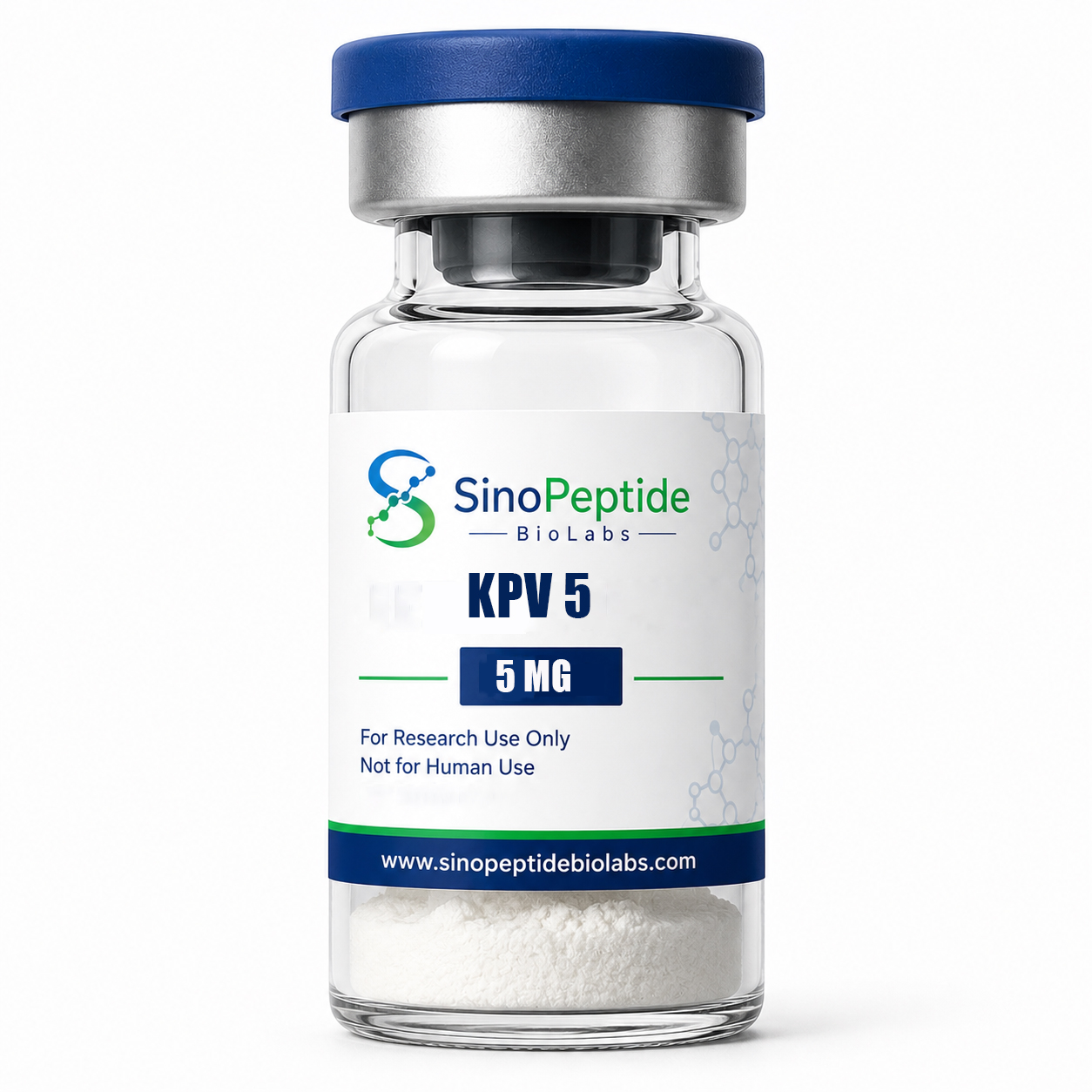
KPV 5mg
$55.00
KPV 5mg: Uses, Research, Benefits, Safety and Complete Guide
KPV 5mg is a peptide product description commonly encountered in the research-peptide market. KPV, also known as Lys-Pro-Val, is a short tripeptide consisting of three amino acids: lysine, proline and valine. It corresponds to the C-terminal portion of alpha-melanocyte-stimulating hormone (α-MSH).
KPV has attracted scientific interest because laboratory and animal studies have reported potentially anti-inflammatory and tissue-protective effects. Research has investigated KPV in models involving intestinal inflammation, skin inflammation and other inflammatory processes. However, these findings should not be confused with established clinical benefits in humans.
An important point for anyone researching KPV 5mg is its current evidence and regulatory status. The FDA’s 2026 briefing material states that it did not identify clinical studies or human exposure data for KPV by any route and that potential safety risks in humans are therefore unknown.
This guide explains what KPV is, what “5mg” means, why researchers are interested in it, what the existing evidence shows, how KPV differs from α-MSH, product-quality considerations, safety limitations and frequently asked questions.
What Is KPV?
KPV is a three-amino-acid peptide composed of:
- K — Lysine
- P — Proline
- V — Valine
The sequence is associated with the C-terminal tripeptide of α-MSH and is also referred to in scientific literature as α-MSH(11–13). Researchers have investigated KPV because some of the anti-inflammatory properties associated with α-MSH appear to be retained in this much smaller peptide fragment.
Unlike α-MSH, KPV is not simply a smaller version of the complete hormone with identical biological activity. Research suggests that KPV can produce anti-inflammatory effects through mechanisms that differ from conventional melanocortin receptor signaling. The precise molecular mechanism remains an area of investigation.
KPV 5mg at a glance
| Feature | Description |
|---|---|
| Common name | KPV |
| Chemical description | Lys-Pro-Val |
| Peptide type | Tripeptide |
| Relationship to α-MSH | C-terminal α-MSH fragment |
| Common research description | α-MSH(11–13) |
| Listed amount | 5 mg, where specified by a product |
| Evidence stage | Primarily preclinical |
| Human clinical evidence | Not established |
| FDA-approved medicine | No established FDA-approved KPV indication |
| Primary research interest | Inflammation and tissue-related research |
The 5mg designation describes the stated mass of peptide in a product. It does not establish a clinically validated dose, treatment schedule or therapeutic strength.
What Does KPV 5mg Mean?
When a product is described as KPV 5mg, “5mg” refers to the amount of KPV stated on the product documentation.
This is different from:
- concentration,
- volume,
- purity,
- biological activity,
- dosage,
- or a clinically established treatment amount.
For example, 5mg may describe the total amount of peptide in a vial or other research preparation, but the actual formulation and concentration depend on the manufacturer’s documentation.
Most importantly, 5mg should not be interpreted as a recommended human dose.
The FDA’s current briefing material indicates that it has not identified clinical studies or human exposure data for KPV. Consequently, there is no established human dosing framework comparable with an approved prescription medicine.
What Does KPV Stand For?
KPV stands for the amino acid sequence:
Lysine-Proline-Valine
The three-letter abbreviation comes from the standard amino acid abbreviations:
- Lysine = K
- Proline = P
- Valine = V
KPV is therefore considerably smaller than the parent α-MSH peptide.
Its small molecular structure has contributed to scientific interest because researchers have investigated whether it can preserve some anti-inflammatory properties associated with α-MSH without reproducing all of the biological effects of the larger hormone.
KPV and Alpha-MSH
Understanding the relationship between KPV and α-MSH is important when evaluating claims about KPV 5mg.
Alpha-MSH is a naturally occurring peptide involved in several physiological processes, including regulation of inflammatory responses and melanocortin signaling.
KPV represents the C-terminal tripeptide of α-MSH.
Research published in the scientific literature has suggested that KPV retains anti-inflammatory activity observed with α-MSH while lacking the complete receptor-binding structure responsible for some of α-MSH’s other effects.
However, this does not mean KPV has the same clinical effects as α-MSH.
The distinction is particularly important because online marketing sometimes describes KPV as if its research findings have already been demonstrated in humans.
That conclusion is not supported by the current human evidence base.
How Does KPV Work?
The precise mechanism of KPV is still being investigated.
Preclinical studies suggest that KPV may influence inflammatory signaling pathways and inflammatory mediator production.
Research has investigated interactions involving pathways such as NF-κB and inflammatory cytokines. Some studies also suggest that KPV’s effects may not depend on the classical melanocortin receptors used by α-MSH.
In one experimental study, KPV reduced inflammatory cell accumulation in a mouse model of peritonitis. Researchers concluded that its activity appeared different from that of several melanocortin receptor agonists and suggested involvement with inflammatory signaling rather than conventional MC3/MC4 receptor activation.
These findings are scientifically interesting, but they remain preclinical findings.
A mechanism demonstrated in cells or animals does not automatically establish that the same effect will occur in humans.
KPV 5mg and Anti-Inflammatory Research
Anti-inflammatory activity is one of the main reasons KPV has received scientific attention.
A review of α-MSH-related peptides described KPV as retaining significant anti-inflammatory activity and discussed its potential as a future research candidate for inflammatory conditions.
Other experimental research has examined KPV in animal models of intestinal inflammation.
For example, a study published in Inflammatory Bowel Diseases evaluated KPV in two mouse models of inflammatory bowel disease. The researchers reported improvements in several inflammatory measures, including reduced inflammatory changes and reduced myeloperoxidase activity.
These results are useful for understanding why KPV continues to be investigated.
They do not, however, establish KPV as a proven treatment for inflammatory bowel disease in people.
KPV and Gut Research
The gastrointestinal tract is one of the most frequently discussed areas of KPV research.
Researchers have investigated KPV in experimental models of intestinal inflammation, including chemically induced colitis.
In animal research, KPV treatment was associated with reduced inflammatory changes and improved outcomes in experimental colitis models.
This has led to scientific interest in whether KPV could eventually have applications in inflammatory bowel conditions.
However, an important distinction must be maintained:
Animal-model evidence is not equivalent to human clinical evidence.
A compound can produce promising results in rodents but later prove ineffective, unsafe or impractical in human clinical trials.
For this reason, KPV should currently be described as a research peptide, rather than a proven treatment for Crohn’s disease, ulcerative colitis or another gastrointestinal disorder.
KPV and Skin Research
KPV has also attracted interest in skin-related research.
The anti-inflammatory properties of α-MSH and related peptides have been investigated in models involving skin inflammation and tissue responses. Researchers have proposed that KPV could potentially have applications in inflammatory skin research.
Some experimental work has also investigated KPV-related effects in cells and tissue models.
However, evidence from cell culture or animal experiments should not be presented as proof that KPV can treat:
- eczema,
- psoriasis,
- acne,
- dermatitis,
- rosacea,
- wounds,
- burns,
- or other human skin conditions.
Such claims would go beyond the available clinical evidence.
KPV and Wound-Healing Research
Wound healing is another area in which KPV has been investigated experimentally.
The biological rationale comes partly from research into inflammation and tissue repair.
Because excessive or prolonged inflammation can interfere with normal tissue recovery, researchers have explored whether anti-inflammatory peptides could influence healing processes.
KPV therefore remains an interesting candidate for laboratory investigation.
Nevertheless, “research interest” does not mean “clinically proven wound-healing treatment.”
There are currently insufficient human data to establish the effectiveness, appropriate administration method or safety of KPV for wound treatment.
Is KPV 5mg FDA Approved?
The phrase KPV 5mg should not be presented as an FDA-approved medicine.
Current FDA briefing documentation specifically states that the agency did not identify clinical studies or human exposure data for KPV through any route and that potential safety risks in humans are unknown.
Therefore, a website should avoid claims such as:
- “FDA-approved KPV 5mg”
- “FDA-approved KPV treatment”
- “Clinically proven KPV”
- “FDA-approved anti-inflammatory peptide”
unless referring to a completely different product with appropriate regulatory authorization.
The safest SEO wording is to describe KPV as an investigational or research peptide and clearly separate preclinical research from established medical treatment.
Is KPV 5mg Safe?
Human safety has not been adequately established.
This is one of the most important corrections to make in SEO content about KPV.
A product being a small peptide does not automatically make it safe for human use.
Safety evaluation normally requires information such as:
- Human clinical trials
- Pharmacokinetic studies
- Dose-ranging studies
- Adverse-event monitoring
- Immunogenicity assessment
- Product-quality testing
- Long-term safety data
The FDA’s 2026 briefing document specifically notes the absence of clinical studies or human exposure data and states that potential human safety risks are unknown.
Consequently, websites should not describe KPV as “completely safe,” “side-effect free” or “proven safe.”
Does KPV Have Side Effects?
Because adequate human clinical research is lacking, a reliable list of human side effects cannot currently be established.
This does not mean that KPV has no potential adverse effects.
It means that the available evidence is insufficient to characterize its safety profile in people.
Possible concerns with unapproved peptide products can include:
- Incorrect identity
- Incorrect concentration
- Contamination
- Endotoxin exposure
- Impurities
- Aggregation
- Sterility problems for products intended for injection
- Unexpected immune reactions
- Unknown pharmacological effects
These concerns are particularly important when products are obtained from unregulated sources.
KPV 5mg Dosage: What You Should Know
Searches for “KPV 5mg dosage” are common, but there is an important scientific limitation.
There is currently no established, clinically validated human dosage for KPV.
Therefore, an SEO article should not present a specific injection schedule, daily amount or reconstitution protocol as if it were an approved medical regimen.
The fact that a product is labeled 5mg does not establish how much should be administered to a person.
This distinction is critical for responsible pharmaceutical and health content.
A research quantity and a therapeutic dose are not the same thing.
KPV 5mg Reconstitution
Some products marketed as research peptides may be supplied in a dry or lyophilized form.
However, the correct preparation method depends on the exact product, intended research application and manufacturer’s documentation.
There is no universal KPV reconstitution protocol that should be presented as a medically validated instruction.
For SEO content, it is better to state:
Follow the manufacturer’s research documentation and applicable laboratory procedures for preparation. KPV has not been established as an approved human therapeutic product.
This avoids presenting unvalidated instructions as medical advice.
KPV 5mg Storage
Storage requirements depend on the formulation, packaging and manufacturer’s specifications.
A product’s documentation should specify the appropriate conditions.
Factors that can influence peptide stability include:
- Temperature
- Moisture
- Light
- Repeated temperature changes
- Container integrity
- Reconstitution status
- Duration of storage
Because KPV does not have a standardized approved pharmaceutical formulation, generic internet storage instructions should not be treated as universally applicable.
The product-specific documentation should always take priority.
KPV 5mg Product Quality
Quality is particularly important when discussing research peptides.
A reliable research product should ideally have traceable documentation identifying:
Manufacturer
The supplier or manufacturer should be clearly identified.
Batch or lot number
A traceable lot number can help connect the product to laboratory testing.
Certificate of Analysis
A Certificate of Analysis (COA) may provide information about identity, purity and testing.
However, consumers should understand that a COA by itself does not transform an unapproved research peptide into an approved medicine.
Analytical testing
Depending on the product and laboratory, analytical methods may include techniques such as:
- HPLC
- Mass spectrometry
- Identity testing
- Purity analysis
- Microbiological testing
The precise testing package varies by supplier.
KPV 5mg and Purity
Purity is a major consideration in peptide research.
A label stating “KPV 5mg” does not, by itself, prove that the entire stated amount consists of correctly identified, uncontaminated KPV.
Potential impurities can originate from:
- Synthesis by-products
- Incomplete peptide sequences
- Degradation products
- Residual solvents
- Manufacturing contamination
- Improper storage
For this reason, independent analytical verification can be valuable in research settings.
A pharmaceutical website should avoid guaranteeing purity unless the claim is supported by appropriate testing documentation.
KPV vs BPC-157
KPV and BPC-157 are sometimes discussed together because both are marketed online as research peptides associated with inflammation and tissue-related research.
They are nevertheless different compounds.
KPV is a three-amino-acid fragment associated with α-MSH.
BPC-157 is a different peptide with a separate amino acid sequence and research history.
Neither should automatically be described as an approved treatment simply because both have generated preclinical research interest.
Comparisons should focus on the scientific literature rather than marketing claims.
KPV vs α-MSH
KPV is a fragment of α-MSH, but it is not interchangeable with the full peptide.
α-MSH is a larger melanocortin peptide that interacts with melanocortin receptors and has several physiological effects.
KPV lacks the full receptor-binding structure of α-MSH.
Research suggests that KPV can retain anti-inflammatory activity while operating through mechanisms that differ from conventional melanocortin receptor signaling.
Therefore, KPV should be considered a distinct research molecule rather than simply “α-MSH in a smaller dose.”
Potential Research Applications of KPV
Current research interest in KPV includes several areas.
Inflammation
Researchers have investigated whether KPV can influence inflammatory signaling.
Gastrointestinal research
Animal studies have examined KPV in experimental models of intestinal inflammation.
Skin research
KPV and related α-MSH peptides have been investigated in relation to inflammatory skin processes.
Tissue repair
Researchers have explored possible relationships between inflammatory signaling and tissue recovery.
Cellular signaling
Laboratory studies have investigated KPV’s effects on inflammatory pathways and cellular responses.
These areas represent research applications, not established medical indications.
Why KPV Research Is Interesting
KPV is scientifically interesting because it represents an example of how a small peptide fragment can retain some biological properties associated with a larger signaling molecule.
Researchers are particularly interested in whether KPV can influence inflammation without reproducing all of the broader effects associated with α-MSH.
Its small size also makes it an interesting molecule for pharmaceutical research.
However, promising biological characteristics do not eliminate the need for clinical development.
Before KPV could be considered an established human treatment, researchers would need to demonstrate:
- Reliable manufacturing
- Appropriate formulation
- Pharmacological activity
- Human safety
- Appropriate pharmacokinetics
- Dose-response relationships
- Clinical efficacy
- Acceptable long-term safety
KPV 5mg for Sale: What Buyers Should Verify
People searching for “KPV 5mg for sale” should understand that products marketed online may not be approved medicines.
Before evaluating a research product, check:
- Exact peptide identity
- Amount stated on the label
- Manufacturer or supplier
- Batch number
- Expiration information
- Certificate of Analysis
- Purity testing
- Storage instructions
- Intended-use statement
- Applicable regulatory information
Avoid websites making unrealistic claims such as:
- “Guaranteed cure”
- “100% safe”
- “No side effects”
- “FDA-approved KPV”
- “Clinically proven in humans”
- “Guaranteed gut healing”
Such statements are inconsistent with the current evidence base.
KPV 5mg and Research-Use-Only Products
KPV is commonly discussed in the context of research peptides.
A research-use-only designation means the material is being supplied for legitimate laboratory or scientific research rather than established human treatment.
It should not be used as a substitute for an approved medication.
This distinction is especially important for health-related SEO content because searchers may interpret product descriptions as medical recommendations.
A credible website should make the intended-use status immediately clear.
KPV 5mg and Human Clinical Research
The lack of human clinical evidence is currently one of the biggest limitations surrounding KPV.
The FDA’s 2026 assessment reported that it did not identify clinical studies or human exposure data for KPV through any route.
This means that important questions remain unanswered.
For example:
- How is KPV absorbed in humans?
- How long does it remain in the body?
- What is the appropriate therapeutic concentration?
- What dose would be effective?
- What dose could be harmful?
- Does KPV produce clinically meaningful benefits?
- What adverse reactions could occur with long-term exposure?
These questions require properly designed human studies.
KPV 5mg: Important SEO and Medical Accuracy Notes
For a pharmaceutical or research website, content about KPV should avoid overclaiming.
Avoid:
“ KPV 5mg cures inflammation.”
Better:
“Preclinical studies have investigated KPV for potential anti-inflammatory effects.”
Avoid:
“KPV 5mg treats inflammatory bowel disease.”
Better:
“Animal studies have investigated KPV in experimental models of intestinal inflammation.”
Avoid:
“KPV is completely safe.”
Better:
“Human safety has not been adequately established.”
This approach creates more trustworthy medical content while still targeting relevant search intent.
Frequently Asked Questions About KPV 5mg
What is KPV 5mg?
KPV 5mg refers to a product described as containing 5mg of KPV, a tripeptide composed of lysine, proline and valine. KPV is derived from the C-terminal portion of α-MSH and has been studied primarily in laboratory and animal models.
What does KPV stand for?
KPV stands for lysine-proline-valine, the three amino acids that make up the peptide.
What is KPV used for?
KPV is primarily a research compound investigated for potential anti-inflammatory and tissue-related effects. It is not established as an approved human treatment.
Is KPV FDA approved?
KPV should not be represented as an FDA-approved drug. The FDA’s 2026 briefing document reported no identified clinical studies or human exposure data for KPV.
Is KPV 5mg a medication?
The term “KPV 5mg” does not by itself identify an approved medication. Products sold under this description may be research materials rather than authorized pharmaceutical products.
Does KPV reduce inflammation?
Laboratory and animal studies have reported anti-inflammatory effects. For example, research has demonstrated activity in experimental models of inflammation and colitis. However, these findings have not established clinical effectiveness in humans.
Can KPV treat inflammatory bowel disease?
There is preclinical research involving KPV and experimental colitis, but this does not establish KPV as a treatment for inflammatory bowel disease in humans.
Is KPV safe for humans?
Human safety has not been adequately established. The FDA reported that it had not identified clinical studies or human exposure data for KPV.
What is the correct KPV 5mg dosage?
There is no established, clinically validated human dosage for KPV. A product labeled 5mg should not be interpreted as a medically recommended dose.
Does KPV need to be refrigerated?
Storage depends on the specific product and manufacturer. Users should follow the applicable product documentation rather than assuming a universal storage requirement.
What is the difference between KPV and BPC-157?
They are different peptides. KPV is a three-amino-acid α-MSH-related peptide, whereas BPC-157 is a separate peptide with a different sequence and research profile.
Is KPV the same as alpha-MSH?
No. KPV is the C-terminal tripeptide portion of α-MSH. It is much smaller and does not have the complete structure of α-MSH.
Does KPV have human clinical trials?
The FDA’s 2026 briefing document states that it did not identify clinical studies or human exposure data for KPV through any route.
Final Thoughts on KPV 5mg
KPV 5mg is a research-peptide term referring to a stated amount of KPV, a three-amino-acid sequence consisting of lysine, proline and valine.
KPV is scientifically interesting because preclinical studies have reported anti-inflammatory activity in cellular and animal models. Research has particularly examined inflammatory pathways and experimental intestinal inflammation.
However, the distinction between preclinical research and proven human medicine is essential.
Current FDA material states that the agency did not identify clinical studies or human exposure data for KPV and therefore considers potential human safety risks unknown.
Consequently, KPV should not be marketed as a proven treatment for inflammation, inflammatory bowel disease, skin disease, wound healing or other medical conditions.
For websites targeting the keyword KPV 5mg, the strongest long-term SEO strategy is to provide accurate, transparent and evidence-based information. Explaining what KPV is, its relationship to α-MSH, the current research evidence, product-quality considerations and the limitations of human data can help create useful content without making unsupported medical claims.
Be the first to review “KPV 5mg”
Related products
Pure Peptides
Pure Peptides
Pure Peptides
Pure Peptides
Pure Peptides
Pure Peptides
Pure Peptides
Pure Peptides
Reviews
There are no reviews yet.