
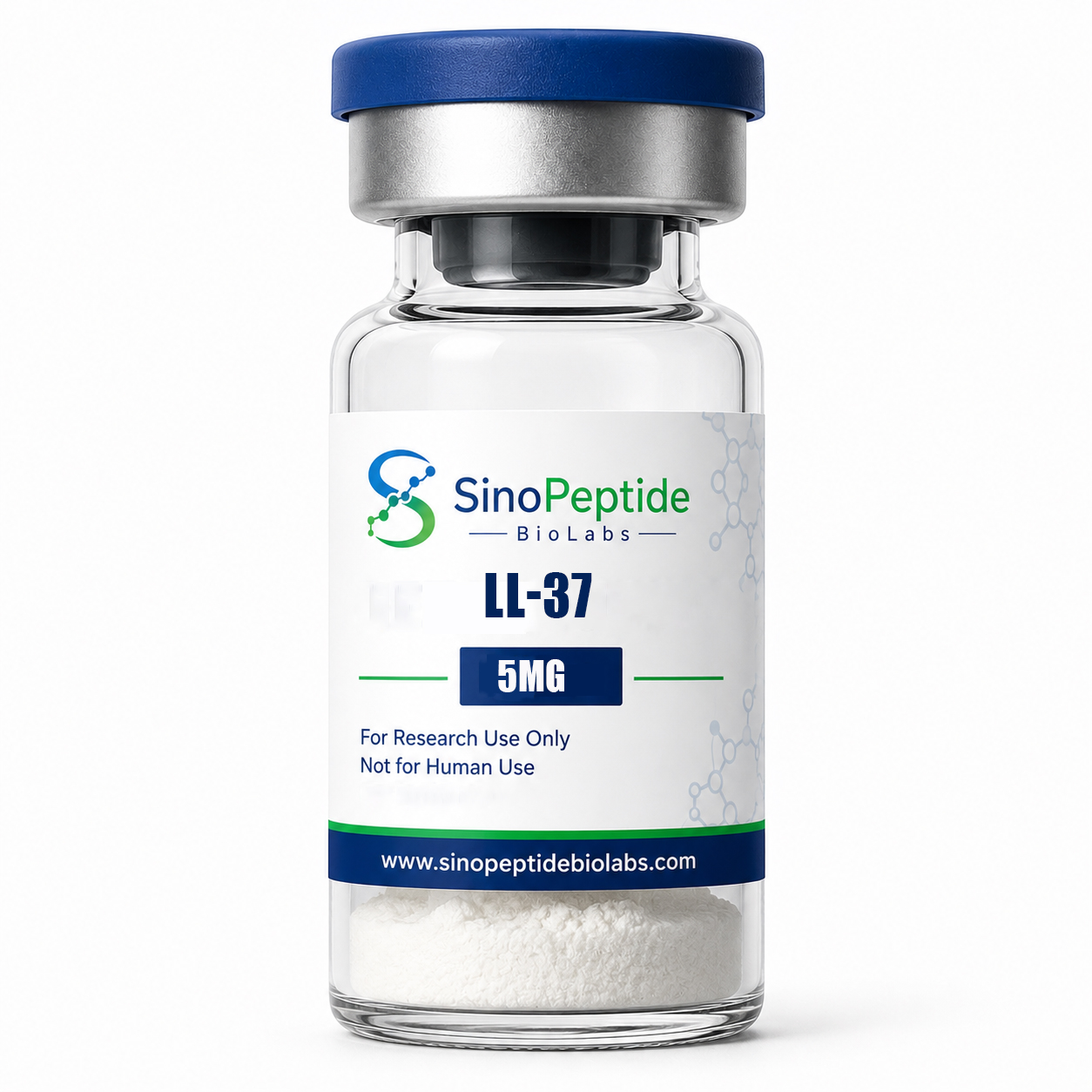
LL37 5mg
$95.00
10Vials/ Kits
LL-37 5mg: Complete Research Peptide Guide, Mechanism, Uses, Safety & Quality
LL-37 5mg is a research-product specification referring to a stated 5 milligram quantity of LL-37, a naturally occurring human antimicrobial peptide belonging to the cathelicidin family. LL-37 is best known for its role in innate immunity, where it participates in antimicrobial defense, inflammatory signaling, cellular migration, and tissue-repair processes.
Unlike many synthetic research peptides, LL-37 has a direct biological counterpart in humans. It is the only human cathelicidin identified to date and is produced from the precursor protein hCAP18, which is processed to generate the mature LL-37 peptide.
Scientific interest in LL-37 extends well beyond antimicrobial activity. Research has examined its relationships with:
- Innate immune defense
- Bacterial membrane disruption
- Wound healing
- Keratinocyte migration
- Angiogenesis
- Inflammatory signaling
- Chemotaxis
- Tissue remodeling
- Host-pathogen interactions
- Skin and epithelial biology
Human studies have investigated topical LL-37 in difficult-to-heal wounds. A phase IIb randomized controlled trial involving 148 people with hard-to-heal venous leg ulcers did not find a statistically significant improvement in healing across the entire study population, although a post-hoc subgroup analysis involving larger wounds produced findings that researchers considered worthy of further investigation.
Consequently, LL-37 should be described as an experimental research peptide with substantial biological and preclinical interest, rather than as an established treatment for infection, wounds, inflammation, or other diseases.
The 5mg designation indicates the stated quantity of LL-37 in the product. It does not establish a human therapeutic dose, administration protocol, or clinical indication.
What Is LL-37 5mg?
LL-37 is a 37-amino-acid antimicrobial peptide derived from the human cathelicidin precursor hCAP18.
It belongs to a broader family of antimicrobial peptides that form part of the body’s first-line defense against microorganisms.
The name LL-37 reflects the mature peptide sequence and its structure. LL-37 is a cationic, amphipathic peptide, meaning that it has positively charged regions and structural characteristics that allow interaction with negatively charged microbial membranes.
This physical chemistry is important to its antimicrobial activity.
A product labeled LL-37 5mg therefore represents a defined amount of the peptide. The product quantity should be distinguished from:
- Peptide concentration
- Formulation
- Purity
- Route of administration
- Experimental concentration
- Clinical dose
- Regulatory status
A 5mg research product should not automatically be interpreted as a 5mg human treatment dose.
LL-37 Peptide Structure and Biological Identity
LL-37 is derived from the human cathelicidin precursor protein hCAP18.
When hCAP18 is processed by appropriate enzymes, the mature LL-37 peptide is released.
This places LL-37 within the innate immune system rather than making it simply a laboratory-designed antimicrobial molecule.
LL-37 has several properties relevant to its biological function:
- Positive net charge
- Amphipathic structure
- Interaction with biological membranes
- Ability to interact with microbial components
- Ability to interact with host-cell receptors
- Modulation of inflammatory pathways
These properties allow LL-37 to participate in both direct antimicrobial defense and host-cell signaling.
That dual role is one reason LL-37 has become an important subject in immunology and wound-healing research.
How Does LL-37 Work?
LL-37 does not have a single mechanism of action.
Its biological effects depend on the target organism, tissue environment, concentration, cellular context, and other molecules present.
Several mechanisms have been investigated.
1. Interaction With Microbial Membranes
One of the best-known properties of LL-37 is its ability to interact with microbial membranes.
Many bacterial membranes contain negatively charged components. The positively charged nature of LL-37 facilitates electrostatic interaction with these structures.
After binding to microbial membranes, LL-37 can disrupt membrane organization and permeability.
This can contribute to antimicrobial activity.
2. Interaction With Microbial Components
LL-37 can also interact with microbial molecules such as lipopolysaccharide and other pathogen-associated structures.
These interactions are relevant to research into:
- Host-pathogen interactions
- Innate immune activation
- Inflammatory signaling
- Bacterial recognition
- Endotoxin responses
3. Cellular Signaling
LL-37 is not simply a membrane-disrupting antimicrobial.
It can also interact with host cells and influence signaling pathways associated with:
- Cell migration
- Inflammation
- Chemotaxis
- Proliferation
- Angiogenesis
- Tissue repair
This explains why LL-37 research extends into wound healing and regenerative biology.
LL-37 and Innate Immunity
Innate immunity provides rapid defense against pathogens before the adaptive immune system develops a targeted response.
Antimicrobial peptides are an important component of this system.
LL-37 is produced by several epithelial and immune-related cell populations and can contribute to the local antimicrobial environment.
Research has examined LL-37 in tissues including:
- Skin
- Respiratory epithelium
- Gastrointestinal tissues
- Oral tissues
- Other epithelial surfaces
Its biological functions can include direct antimicrobial activity as well as modulation of host-cell responses.
This makes LL-37 relevant to research on the relationship between microorganisms and the human immune system.
LL-37 and Antimicrobial Research
LL-37 is one of the most extensively studied human antimicrobial peptides.
Researchers have investigated its activity against various microorganisms, including different bacterial species.
The basic concept is that LL-37 can interact with microbial membranes and alter their integrity.
However, antimicrobial activity in laboratory systems should not be interpreted as evidence that a commercial LL-37 product can safely or effectively treat an infection in humans.
Several variables can influence antimicrobial peptide activity, including:
- Peptide concentration
- Ionic strength
- pH
- Serum proteins
- Microbial species
- Membrane composition
- Biofilm formation
- Peptide degradation
- Tissue environment
Therefore, laboratory antimicrobial activity does not automatically translate into clinical antimicrobial efficacy.
LL-37 and Wound-Healing Research
Wound healing is one of the most interesting areas of LL-37 research.
The normal wound-healing process involves overlapping stages:
- Hemostasis
- Inflammation
- Cell proliferation
- Tissue formation
- Remodeling
LL-37 has been investigated in several of these stages.
Research has explored potential effects involving:
- Keratinocyte migration
- Cell proliferation
- Angiogenesis
- Inflammatory signaling
- Fibroblast-related processes
- Microbial control
- Tissue remodeling
Because LL-37 can combine antimicrobial and signaling properties, researchers have investigated whether it can influence the wound environment from multiple directions.
LL-37 Clinical Research in Venous Leg Ulcers
LL-37 has progressed beyond purely laboratory research.
A first-in-human randomized study evaluated topical synthetic LL-37 in people with hard-to-heal venous leg ulcers. The study included 34 participants and investigated several topical concentrations.
The researchers reported that the lower concentrations produced favorable changes in wound-healing measures and did not identify local or systemic safety concerns during the study.
However, a subsequent larger phase IIb randomized placebo-controlled trial involving 148 patients did not demonstrate a statistically significant improvement in healing across the overall study population.
A post-hoc analysis suggested possible benefit in participants with larger wounds, but the researchers explicitly described this as a finding warranting further investigation rather than definitive evidence of efficacy.
This is an important distinction for SEO content.
It is scientifically accurate to say:
“LL-37 has been investigated in clinical wound-healing trials.”
It is not accurate to say:
“LL-37 is a proven wound-healing treatment.”
LL-37 and Diabetic Foot Ulcer Research
LL-37 has also been investigated in diabetic foot-ulcer research.
A randomized double-blind controlled trial examined LL-37 cream in people with diabetic foot ulcers and evaluated wound-healing outcomes together with inflammatory and bacterial measures.
This research is relevant because diabetic wounds can involve:
- Persistent inflammation
- Impaired tissue formation
- Reduced vascular function
- Bacterial colonization
- Delayed epithelialization
LL-37 is being investigated partly because its biological properties potentially address multiple components of the wound environment.
Nevertheless, clinical evidence remains insufficient to treat LL-37 as an established standard therapy.
LL-37 and Angiogenesis Research
Angiogenesis is the formation of new blood vessels.
It is important during tissue repair because newly forming tissue requires adequate oxygen and nutrient delivery.
LL-37 has been studied for its effects on angiogenic signaling.
Experimental research has investigated relationships between LL-37 and:
- Endothelial cells
- Vascular signaling
- Cell migration
- New-vessel formation
- Tissue repair
These mechanisms are one reason LL-37 is being studied in wound biology.
However, angiogenic activity can be context-dependent. A molecule that promotes vascular signaling in one biological setting should not automatically be characterized as beneficial in every disease or tissue.
LL-37 and Keratinocyte Research
Keratinocytes are the predominant cells of the epidermis.
During wound healing, keratinocytes migrate and proliferate to help restore the epithelial barrier.
LL-37 has been investigated for its potential influence on keratinocyte behavior.
Research areas include:
- Keratinocyte migration
- Keratinocyte proliferation
- Re-epithelialization
- Barrier restoration
- Cell signaling
These findings provide a mechanistic basis for investigating LL-37 in skin and wound research.
LL-37 and Inflammation
LL-37 has a complex relationship with inflammation.
It can influence immune-cell recruitment and inflammatory signaling, but its effects are not necessarily uniformly anti-inflammatory.
Depending on the biological context, LL-37 can participate in both protective and potentially harmful inflammatory responses.
This is an important scientific distinction.
Marketing descriptions sometimes reduce LL-37 to an “anti-inflammatory peptide,” but its biology is considerably more complicated.
Researchers study LL-37 in relation to:
- Cytokine signaling
- Chemokine activity
- Immune-cell recruitment
- Pattern-recognition pathways
- Host defense
- Inflammatory regulation
The outcome may depend on tissue, concentration, receptor expression, and disease state.
LL-37 and Biofilm Research
Biofilms are structured microbial communities surrounded by an extracellular matrix.
They can make microorganisms more difficult to eliminate than free-floating bacterial cells.
LL-37 has been studied in relation to biofilm biology because antimicrobial peptides may interact with microbial membranes and biofilm-associated structures.
Research applications include:
- Biofilm formation
- Biofilm disruption
- Antimicrobial peptide resistance
- Host-pathogen interactions
- Chronic wound microbiology
This area is especially relevant to wound research, where microbial communities can influence healing.
LL-37 5mg Research Applications
A research-grade LL-37 5mg product may be relevant to several scientific fields.
Antimicrobial Peptide Research
Researchers can investigate the interaction between LL-37 and microbial membranes.
Innate Immunity Research
LL-37 provides a model for understanding endogenous antimicrobial defenses.
Wound-Healing Research
Researchers study LL-37 in relation to:
- Keratinocyte migration
- Angiogenesis
- Tissue remodeling
- Inflammation
- Microbial control
Immunology
LL-37 can be investigated as an immune-signaling molecule.
Microbiology
Researchers can evaluate antimicrobial activity against specific microorganisms under controlled experimental conditions.
Skin Biology
LL-37 is relevant to epithelial barrier function and skin immune defense.
Host-Pathogen Research
LL-37 provides an experimental model for understanding interactions between pathogens and host tissues.
What Does LL-37 5mg Mean?
The term LL-37 5mg indicates that the product contains a stated quantity of 5 milligrams.
This does not tell you:
- How much peptide is present per milliliter
- Whether it is formulated for a particular route
- Whether it is sterile
- Whether it is suitable for human administration
- Whether it is FDA-approved
- Whether it has been clinically validated
- What experimental concentration should be used
The quantity should therefore be considered a product specification.
Researchers should obtain detailed documentation for the actual formulation being evaluated.
LL-37 5mg Quality and Purity
Quality is particularly important for research peptides.
A credible LL-37 5mg product should ideally have appropriate analytical documentation.
HPLC Analysis
High-performance liquid chromatography can help evaluate chromatographic purity.
Mass Spectrometry
Mass spectrometry can help confirm molecular identity and molecular mass.
Peptide Sequence
Because peptide-related impurities can affect research results, sequence identity is important.
Certificate of Analysis
A useful COA should ideally identify:
- Product name
- Batch number
- Peptide identity
- Purity or assay
- Analytical method
- Testing date
- Laboratory information
- Specification limits
Batch Traceability
Testing should be traceable to the actual batch being evaluated.
A generic COA that cannot be connected to a particular batch provides substantially less quality assurance.
Why LL-37 Purity Matters
Research peptides can contain impurities arising from synthesis, purification, storage, or degradation.
Potential concerns include:
- Truncated peptide sequences
- Deletion sequences
- Oxidation products
- Aggregates
- Residual solvents
- Incorrect peptide sequence
- Other synthesis-related impurities
These impurities can affect experimental reproducibility and, in certain administration contexts, may also influence immunogenicity.
FDA specifically notes that compounded LL-37 may present challenges involving peptide-related impurities and API characterization and states that available safety information is insufficient for the agency to determine whether compounded LL-37 would cause harm in humans.
This makes batch-level characterization especially important.
LL-37 Storage and Stability
Peptide stability can be affected by environmental conditions.
Relevant factors may include:
- Temperature
- Moisture
- Light
- Oxygen
- pH
- Solvent
- Concentration
- Container material
- Freeze-thaw exposure
The appropriate storage conditions depend on the specific LL-37 formulation.
A dry peptide and a prepared solution should not automatically be assumed to have identical stability characteristics.
Researchers should follow the supplier’s validated storage specifications and avoid repeated handling that could compromise product integrity.
LL-37 Safety Considerations
Safety is one of the most important considerations when evaluating LL-37.
The existence of human LL-37 in the body does not mean that administering additional synthetic LL-37 is automatically safe.
Safety depends on:
- Route
- Formulation
- Purity
- Aggregation
- Dose
- Exposure duration
- Individual characteristics
- Biological context
The FDA currently lists Cathelicidin LL-37 among bulk substances that may present significant safety risks in compounding. FDA states that compounded LL-37 may pose immunogenicity risks because of potential aggregation and peptide-related impurities and that it lacks sufficient safety-related information to determine whether the drug would cause harm to humans.
FDA’s 2026 update further states that the LL-37 nomination was withdrawn and that the agency intends to consult its Pharmacy Compounding Advisory Committee before the end of February 2027 regarding potential inclusion of Cathelicidin LL-37 on the 503A bulk-drug list.
This is a regulatory evaluation issue, not evidence that LL-37 has been approved as a human medicine.
LL-37 and FDA Regulatory Status
As of September 2026, LL-37 should not be described as an FDA-approved therapeutic drug.
FDA’s current compounding materials specifically identify Cathelicidin LL-37 as a substance presenting safety concerns for compounding and note insufficient human safety information.
The agency’s April 2026 update states that the nomination for Cathelicidin LL-37 was withdrawn from the relevant category, while FDA plans further advisory-committee consideration regarding potential inclusion on the 503A bulk list.
These developments do not establish FDA approval.
It is also important to understand that compounded drugs themselves are not FDA-approved. FDA states that it does not review compounded drugs for safety, effectiveness, or quality before they are marketed.
Therefore, websites should avoid statements such as:
- “FDA-approved LL-37”
- “FDA-approved LL-37 injection”
- “Clinically approved LL-37 peptide”
unless referring to a specific future regulatory action supported by an authoritative source.
LL-37 and Male Reproductive Research
LL-37 research also involves areas that require particular caution.
FDA’s current safety assessment notes that nonclinical research findings suggest detrimental effects on male reproduction and that LL-37 can be protumorigenic in some tissues.
These findings are important to report accurately but should not be transformed into claims about confirmed human outcomes.
The appropriate scientific wording is:
“Nonclinical findings have raised reproductive and tissue-specific safety concerns.”
This accurately reflects the evidence without claiming that the same effect has been definitively demonstrated in humans.
LL-37 and Cancer Research
LL-37 has a complex relationship with cancer biology.
Researchers have reported context-dependent effects involving:
- Cell proliferation
- Immune signaling
- Angiogenesis
- Tumor microenvironment
- Cell migration
This is an important area because the same signaling pathways that can contribute to tissue repair may potentially have different effects in malignant tissues.
FDA currently notes that nonclinical research suggests LL-37 can be protumorigenic in some tissues.
This is one reason it would be inappropriate to describe LL-37 as universally beneficial or inherently “regenerative.”
LL-37 vs BPC-157
LL-37 and BPC-157 are both frequently discussed online in relation to tissue repair, but they are biologically distinct.
| Feature | LL-37 | BPC-157 |
|---|---|---|
| Biological identity | Human cathelicidin | Experimental peptide |
| Primary research area | Innate immunity and antimicrobial defense | Tissue-repair and experimental regeneration |
| Antimicrobial activity | Major research characteristic | Not comparable to LL-37 |
| Wound research | Yes | Yes |
| Human research | Limited but includes wound trials | Very limited |
| Regulatory status | Not FDA-approved | Not FDA-approved |
The two compounds should not be treated as interchangeable.
LL-37 vs Thymosin Beta-4 / TB-500
LL-37 and thymosin-related peptides also appear in tissue-repair discussions, but their biological roles differ.
LL-37 is primarily an endogenous antimicrobial peptide associated with innate immunity.
Thymosin beta-4 is a different peptide associated with actin-related cellular processes and tissue biology.
TB-500 is generally marketed as a fragment or derivative associated with thymosin beta-4 research.
Therefore, evidence for one should not be transferred to another.
Common Misconceptions About LL-37 5mg
“LL-37 is just an antibiotic peptide.”
Not exactly.
LL-37 has antimicrobial properties, but it also participates in immune signaling, cell migration, inflammation, angiogenesis, and tissue biology.
“LL-37 is a proven wound-healing drug.”
No.
LL-37 has undergone human wound-healing research, but a phase IIb trial did not demonstrate a statistically significant benefit in the overall study population.
“5mg is the clinical dose.”
No.
Five milligrams describes the stated quantity of the product.
“Human LL-37 means synthetic LL-37 is automatically safe.”
No.
Synthetic administration can produce different exposure levels, routes, formulations, and risks.
“LL-37 is FDA approved.”
No.
FDA currently identifies important safety and regulatory concerns surrounding compounded LL-37.
“LL-37 is purely anti-inflammatory.”
No.
LL-37 has complex and context-dependent effects on immune and inflammatory signaling.
Frequently Asked Questions About LL-37 5mg
What is LL-37 5mg?
LL-37 5mg refers to a product containing a stated 5mg quantity of the human antimicrobial peptide LL-37.
What is LL-37?
LL-37 is the mature peptide derived from the human cathelicidin precursor hCAP18 and is involved in innate immune defense.
What is LL-37 used for in research?
LL-37 is studied in antimicrobial research, innate immunity, wound healing, skin biology, inflammation, angiogenesis, microbiology, and host-pathogen interactions.
Is LL-37 a naturally occurring peptide?
Yes. LL-37 is an endogenous human antimicrobial peptide.
Is LL-37 an antibiotic?
LL-37 has antimicrobial activity, but it is not equivalent to a conventional antibiotic drug.
Does LL-37 help wound healing?
LL-37 has been investigated in human wound-healing studies. Results have been mixed, and a larger phase IIb trial did not demonstrate significant improvement across the overall patient population.
What does 5mg mean for LL-37?
It indicates the stated quantity of LL-37 in the product. It does not establish a recommended human dose.
Is LL-37 FDA approved?
No FDA-approved LL-37 therapeutic should be inferred from the existence of an LL-37 5mg research product. FDA currently identifies Cathelicidin LL-37 as presenting significant safety concerns in the compounding context.
How is LL-37 purity tested?
Research laboratories may use HPLC, mass spectrometry, peptide identity testing, and batch-specific analytical documentation.
What should an LL-37 COA contain?
A useful COA should identify the peptide, batch number, purity or assay, analytical method, testing date, and laboratory information.
Is LL-37 the same as BPC-157?
No. LL-37 is an endogenous human cathelicidin, whereas BPC-157 is a separate experimental peptide.
Is LL-37 the same as TB-500?
No. LL-37 and TB-500 belong to entirely different peptide research areas.
Is LL-37 used in antimicrobial research?
Yes. LL-37 is extensively investigated for its interactions with microbial membranes and host-pathogen biology.
How to Evaluate an LL-37 5mg Research Product
When evaluating an LL-37 5mg product for legitimate research purposes, several factors are important.
1. Confirm the Peptide Identity
Verify that the material is specifically identified as Cathelicidin LL-37.
2. Verify Quantity
Confirm that the stated product quantity is 5mg.
3. Review the COA
Look for batch-specific analytical documentation.
4. Check Purity
Review HPLC or other validated analytical results.
5. Confirm Molecular Identity
Mass spectrometry can provide additional evidence supporting peptide identity.
6. Examine Batch Traceability
The lot number should correspond to the analytical documentation.
7. Review Storage Requirements
Follow product-specific stability and storage information.
8. Identify Intended Use
A research peptide should be clearly distinguished from an approved pharmaceutical or finished medical treatment.
9. Avoid Unverified Medical Claims
Product descriptions should distinguish laboratory findings, animal studies, and human clinical research.
Conclusion
LL-37 5mg is a research-product specification for a stated 5 milligram quantity of LL-37, a naturally occurring human cathelicidin antimicrobial peptide.
LL-37 occupies an unusual position in peptide research because it is both an antimicrobial molecule and a signaling molecule. Research has investigated its interactions with microbial membranes, innate immune pathways, keratinocytes, endothelial cells, inflammatory signaling, and tissue-repair processes.
Human research has progressed into wound-healing studies. Early clinical research reported favorable wound-healing signals with topical LL-37, while a larger phase IIb randomized trial involving 148 participants did not identify a significant improvement in healing across the overall population.
This distinction is critical for accurate SEO content. LL-37 can legitimately be described as a research peptide with antimicrobial, immunological, and wound-healing research applications, but it should not be presented as a proven treatment for infections, chronic wounds, cancer, inflammation, or other medical conditions.
Quality is equally important. Researchers evaluating LL-37 should consider peptide identity, purity, HPLC analysis, mass spectrometry, batch traceability, COA documentation, and storage conditions.
Regulatory status also requires careful wording. FDA currently identifies Cathelicidin LL-37 among substances associated with significant safety concerns for compounding, citing potential immunogenicity, peptide-related impurities, insufficient human safety information, and nonclinical concerns involving male reproduction and potential protumorigenic effects in some tissues.
The 5mg specification should therefore be understood as a product quantity, not a recommended human dose or indication.
For a high-quality website, the strongest SEO strategy is to build topical authority around LL-37 5mg, LL-37 antimicrobial peptide research, cathelicidin biology, wound-healing research, innate immunity, LL-37 purity, HPLC testing, COA documentation, and regulatory status, while maintaining a clear distinction between experimental evidence and established clinical medicine.
Research-use disclaimer: This article is intended for educational and research-information purposes. It does not establish a human dosage, medical indication, or therapeutic efficacy for LL-37 5mg products.
LL-37 5mg LL-37 5mg LL-37 5mg LL-37 5mg LL-37 5mg LL-37 5mg LL-37 5mg LL-37 5mg LL-37 5mg LL-37 5mg LL-37 5mg LL-37 5mg LL-37 5mg LL-37 5mg LL-37 5mg LL-37 5mg LL-37 5mg LL-37 5mg LL-37 5mg LL-37 5mg LL-37 5mg
Be the first to review “LL37 5mg”
Related products
Pure Peptides
Pure Peptides
Pure Peptides
Pure Peptides
Pure Peptides
Pure Peptides
Pure Peptides
Pure Peptides
Reviews
There are no reviews yet.