

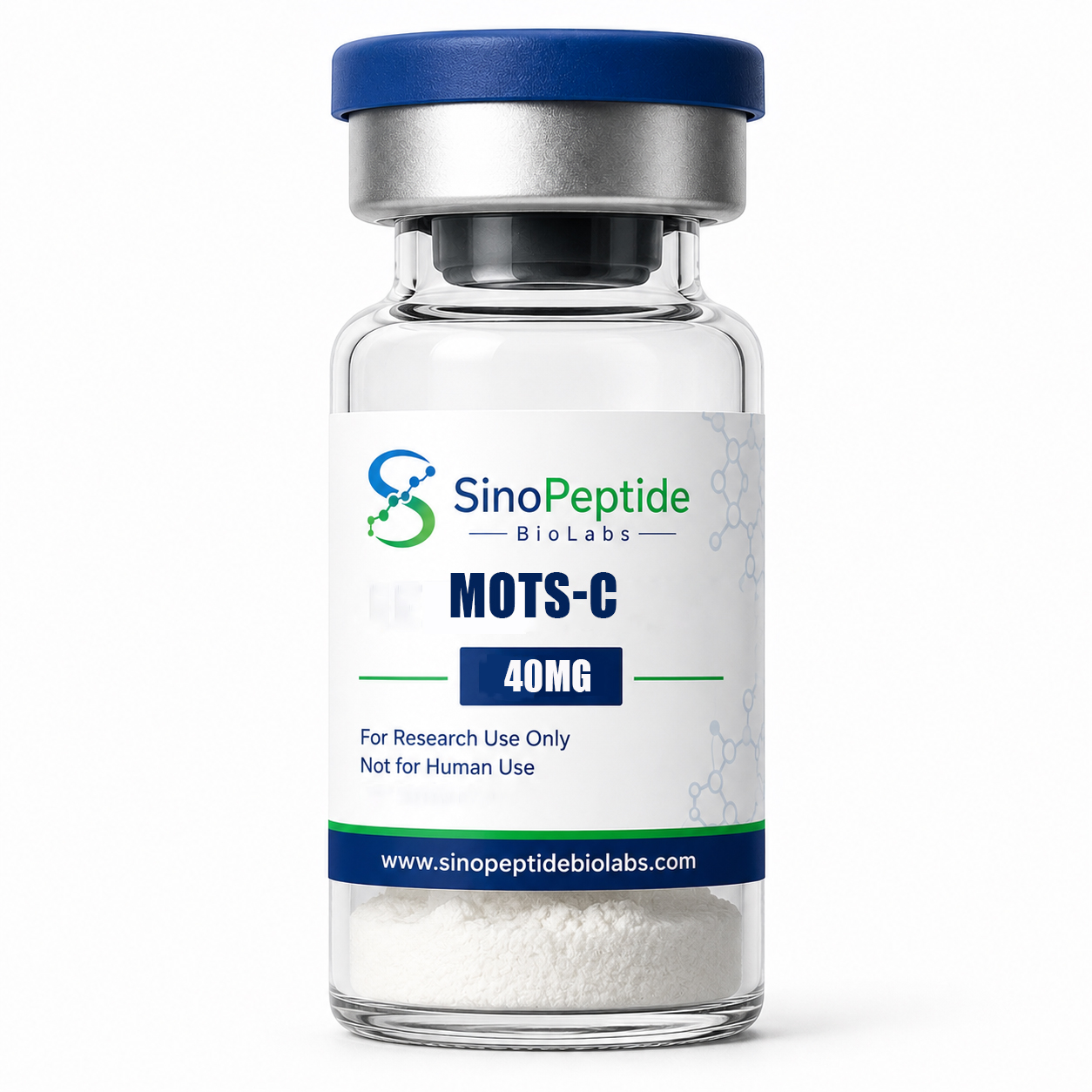
MOTS-c 40mg
$180.00
10 Vials/ Kits
MOTS-c 40mg: Research, Mechanism, Potential Benefits, Safety & Uses
Introduction
MOTS-c 40mg is a research-focused peptide associated with an emerging area of mitochondrial biology. Unlike many familiar peptides that are encoded by nuclear DNA, MOTS-c is a mitochondrial-derived peptide encoded from a short open reading frame within the mitochondrial 12S ribosomal RNA region.
Scientific interest in MOTS-c has grown because experimental research connects the peptide with cellular energy regulation, metabolic stress responses, exercise biology, glucose metabolism, and aging-related processes. Research has particularly focused on the relationship between MOTS-c and the AMP-activated protein kinase (AMPK) pathway, a major cellular system involved in energy sensing.
However, it is important to distinguish promising laboratory findings from established medical treatment. MOTS-c remains an experimental research subject rather than an FDA-approved therapeutic peptide. Current FDA materials state that there is a lack of clinical and nonclinical safety information for MOTS-c-related substances and a lack of human data for drug products containing MOTS-c administered by any route.
The 40mg designation refers to the quantity of peptide represented by a research product, not a recommended human dose. This distinction is important because research-product labeling should not be interpreted as a clinical dosing instruction.
This guide explains what MOTS-c is, how it is being studied, its biological mechanisms, potential research applications, safety considerations, regulatory status, and what researchers should consider when evaluating a MOTS-c 40mg product.
What Is MOTS-c?
MOTS-c stands for Mitochondrial Open Reading Frame of the 12S rRNA Type-C. It is a 16-amino-acid mitochondrial-derived peptide encoded within the mitochondrial genome.
Mitochondria are best known as cellular structures involved in energy production, but modern research has demonstrated that mitochondrial genetic material can encode biologically active signaling molecules. MOTS-c belongs to this emerging group of mitochondrial-derived peptides.
Research suggests that MOTS-c participates in communication between mitochondria and the nucleus. Under certain forms of metabolic or cellular stress, MOTS-c has been reported to move into the nucleus and influence the expression of genes involved in cellular stress adaptation.
This makes MOTS-c particularly interesting to researchers studying:
- Cellular energy metabolism
- Mitochondrial signaling
- Glucose metabolism
- Insulin sensitivity
- Exercise physiology
- Skeletal muscle biology
- Metabolic stress
- Aging biology
- Oxidative stress
- AMPK signaling
- Mitochondrial-derived peptides
Because much of the evidence remains preclinical or mechanistic, MOTS-c should be viewed as an area of scientific investigation rather than an established therapy.
What Does MOTS-c 40mg Mean?
The term MOTS-c 40mg generally describes a research product containing a stated quantity of MOTS-c peptide.
The number 40mg does not establish a medically recommended dose.
This distinction is especially important for experimental peptides. Product quantity, laboratory concentration, and clinical dosage are different concepts and should not be treated as interchangeable.
A research product labeled MOTS-c 40mg may therefore be relevant to laboratory investigations involving peptide characterization, cellular signaling, biochemical experiments, or other approved research applications.
Researchers evaluating a product should pay attention to the actual product documentation rather than assuming that the labeled quantity establishes a protocol for human administration.
How Does MOTS-c Work?
MOTS-c and Cellular Energy Regulation
One of the most extensively studied aspects of MOTS-c is its relationship with cellular energy metabolism.
Research has associated MOTS-c with pathways that influence how cells respond when energy availability or metabolic conditions change. One important mechanism involves the folate-AICAR-AMPK pathway.
AMPK acts as an energy sensor within cells. When cellular energy status changes, AMPK can influence processes related to energy production, nutrient utilization, and metabolic balance.
Experimental studies suggest that MOTS-c can influence metabolic pathways leading to increased AICAR-related signaling and AMPK activation.
This mechanism has made MOTS-c a subject of interest in metabolic research.
MOTS-c and AMPK
AMPK is one of the central pathways associated with MOTS-c research.
The pathway is involved in maintaining energy balance and responding to cellular energy demands. MOTS-c has been studied in relation to AMPK activation through changes involving folate metabolism and purine biosynthesis.
Researchers have proposed that this interaction may help explain some of the metabolic effects observed in experimental models.
Importantly, mechanistic findings do not automatically demonstrate that a peptide will produce the same outcomes in humans. Laboratory pathways can be biologically significant without translating into an approved treatment.
MOTS-c and Mitochondrial Signaling
MOTS-c is particularly notable because it provides an example of communication between mitochondria and the nucleus.
Mitochondria contain their own genetic material, and research into mitochondrial-derived peptides has expanded the understanding of mitochondria beyond their traditional role in energy production.
MOTS-c is encoded by the mitochondrial 12S rRNA region and has been detected in tissues and circulating plasma. Research indicates that metabolic stress and exercise can influence MOTS-c expression and signaling.
This has led scientists to investigate MOTS-c as a possible component of the body’s broader stress-adaptation system.
MOTS-c and Glucose Metabolism
Glucose metabolism is one of the most important areas of MOTS-c research.
Early experimental studies reported that MOTS-c could influence glucose metabolism in skeletal muscle. Subsequent research has investigated possible relationships between MOTS-c, insulin sensitivity, AMPK signaling, and metabolic homeostasis.
These findings have generated interest in MOTS-c research relating to:
- Insulin resistance
- Glucose utilization
- Skeletal muscle metabolism
- Metabolic flexibility
- Energy homeostasis
- Obesity research
However, promising experimental findings should not be interpreted as proof that MOTS-c can prevent, treat, or cure diabetes or other metabolic diseases in humans.
MOTS-c and Insulin Sensitivity Research
Insulin sensitivity is another frequently investigated area.
Experimental studies have suggested that MOTS-c may influence metabolic pathways involved in glucose handling and insulin responsiveness. Animal studies have produced findings supporting further investigation into MOTS-c and insulin resistance.
Researchers have therefore investigated MOTS-c in models related to metabolic dysfunction.
Nevertheless, human evidence remains insufficient to establish MOTS-c as a treatment for insulin resistance or diabetes. The FDA’s current assessment specifically identifies a lack of human data on drug products containing MOTS-c.
MOTS-c and Skeletal Muscle Research
Skeletal muscle is an important target in MOTS-c research.
Early research identified effects involving skeletal muscle glucose metabolism, while subsequent studies have explored relationships between MOTS-c, exercise, mitochondrial signaling, and metabolic adaptation.
Because skeletal muscle is a major site of glucose utilization and energy expenditure, researchers are interested in whether mitochondrial-derived peptides such as MOTS-c contribute to communication between exercise, metabolism, and cellular stress responses.
This research may have implications for understanding:
- Muscle energy metabolism
- Exercise adaptation
- Glucose utilization
- Mitochondrial signaling
- Metabolic stress
- Physical performance biology
These remain research questions rather than established clinical applications.
MOTS-c and Exercise Research
Exercise is another major area of MOTS-c investigation.
Research reviews report that MOTS-c expression can respond to exercise and metabolic stress. Experimental studies have investigated its potential involvement in exercise-related adaptation and skeletal muscle responses.
The relationship between exercise and MOTS-c is particularly interesting because exercise itself produces substantial metabolic and mitochondrial changes.
Scientists are therefore examining whether MOTS-c acts as one component of the molecular signaling network through which exercise influences metabolism.
This does not mean MOTS-c should be considered an exercise replacement or performance-enhancing treatment. Instead, the scientific interest lies in understanding the biological pathways connecting physical activity, mitochondria, and cellular adaptation.
MOTS-c and Aging Research
MOTS-c has also become increasingly prominent in aging research.
Several reviews describe associations between MOTS-c biology and age-related metabolic changes. Some research has reported that circulating MOTS-c levels may decline with age, although the biological significance of these observations requires additional investigation.
Scientists are investigating MOTS-c in connection with:
- Cellular energy regulation
- Metabolic aging
- Mitochondrial function
- Muscle homeostasis
- Oxidative stress
- Metabolic resilience
- Age-associated disease models
The term “longevity peptide” is sometimes used in online marketing, but this wording can overstate the current scientific evidence.
MOTS-c research is better described as mitochondrial and metabolic aging research until controlled human evidence establishes specific clinical effects.
Potential Research Benefits of MOTS-c
The phrase “MOTS-c benefits” is commonly searched online, but it is important to distinguish potential research effects from clinically proven benefits.
Current research has investigated MOTS-c in relation to:
1. Metabolic regulation
MOTS-c has been studied for its potential role in cellular energy balance and metabolic homeostasis.
2. AMPK signaling
Research suggests that MOTS-c can influence the AICAR-AMPK signaling pathway, which is important for cellular energy sensing.
3. Glucose metabolism
Experimental research has linked MOTS-c with glucose metabolism, particularly in skeletal muscle.
4. Exercise biology
MOTS-c has been investigated as part of the molecular response to exercise and metabolic stress.
5. Aging research
Researchers are studying possible relationships between MOTS-c levels, mitochondrial function, metabolic aging, and age-related physiological changes.
6. Cellular stress responses
MOTS-c may participate in cellular responses to metabolic stress and influence nuclear gene expression.
These areas justify continued research but do not establish MOTS-c as an approved medical treatment.
MOTS-c Safety
Safety is one of the most important considerations when evaluating MOTS-c 40mg.
Current FDA information indicates that there is insufficient clinical and nonclinical safety information for MOTS-c. The agency has also stated that it has not identified human exposure data for drug products containing MOTS-c administered by any route.
This means that the long-term safety profile of MOTS-c in humans has not been adequately established.
Immunogenicity Concerns
Peptides can potentially trigger immune responses, particularly when their purity, aggregation profile, formulation, route of administration, or manufacturing characteristics are not adequately controlled.
The FDA has specifically highlighted uncertainty regarding the immunogenic safety risk of MOTS-c and related peptide substances.
For that reason, product quality and analytical characterization are important considerations in research settings.
Is MOTS-c 40mg FDA Approved?
No. MOTS-c is not an FDA-approved drug or established FDA-approved treatment.
The FDA’s current materials describe a lack of human exposure data for drug products containing MOTS-c and insufficient information to determine important safety risks.
The FDA’s 2026 Pharmacy Compounding Advisory Committee materials likewise state that clinical and nonclinical safety information for MOTS-c-related bulk drug substances is lacking and that human data are unavailable for drug products containing these substances.
Therefore, websites should avoid describing MOTS-c 40mg as an FDA-approved treatment, medication, or proven therapy.
MOTS-c 40mg: Research Use vs. Medical Treatment
A critical distinction should be made between research use and human medical treatment.
Research use
Researchers may investigate MOTS-c in areas such as:
- Molecular biology
- Mitochondrial signaling
- Metabolic research
- Cell signaling
- AMPK biology
- Exercise physiology
- Aging research
- Peptide characterization
Medical treatment
Medical treatment requires appropriate evidence of safety, efficacy, manufacturing quality, and regulatory authorization.
MOTS-c does not currently meet the evidentiary standard necessary to describe it as an established FDA-approved therapy.
Consequently, product descriptions should avoid claims that MOTS-c 40mg treats obesity, diabetes, aging, inflammation, cardiovascular disease, or other medical conditions.
What to Look for When Evaluating MOTS-c 40mg
For legitimate research applications, product quality is an important consideration.
Researchers should look for transparent documentation covering the identity and quality of the peptide.
Certificate of Analysis
A Certificate of Analysis (COA) can provide useful information about a product’s testing.
Depending on the supplier and testing laboratory, documentation may include:
- Peptide identity
- Purity
- Analytical method
- Batch or lot number
- Testing date
- Laboratory information
- Reported peptide content
A COA should correspond to the actual batch rather than being a generic document reused across multiple products.
Peptide Identity
Correct identification is essential in peptide research. Researchers should verify that documentation clearly identifies the compound as MOTS-c and distinguishes it from other mitochondrial-derived peptides.
Purity Testing
Purity can be particularly important in peptide research because impurities, degradation products, truncated sequences, or aggregation can influence experimental outcomes.
A high-quality research workflow should therefore consider both peptide identity and analytical characterization rather than relying exclusively on marketing claims.
Transparent Labeling
A professional research product page should clearly state:
- Product name
- Quantity
- Research designation
- Batch information where applicable
- Storage information when supported by manufacturer documentation
- Analytical documentation where available
- Appropriate research-use limitations
Avoid suppliers that make unsupported claims about disease treatment or guaranteed human outcomes.
MOTS-c 40mg vs. Other Mitochondrial-Derived Peptides
MOTS-c belongs to a broader group of mitochondrial-derived peptides.
Other members of this research area include Humanin and small humanin-like peptides (SHLPs). MOTS-c differs from these molecules in its genetic origin and biological signaling mechanisms. MOTS-c is encoded within the 12S rRNA region, whereas Humanin and SHLPs are associated with the 16S rRNA region of mitochondrial DNA.
This distinction is important because mitochondrial-derived peptides should not be treated as interchangeable.
Each peptide may have different:
- Amino-acid sequences
- Cellular targets
- Receptor interactions
- Signaling pathways
- Experimental effects
- Research applications
- Safety profiles
Researchers should therefore select the specific peptide that matches the scientific question being investigated.
Why Researchers Study MOTS-c
MOTS-c is scientifically interesting because it challenges the traditional view of mitochondria as primarily energy-producing organelles.
The discovery of mitochondrial-derived peptides suggests that mitochondrial genetic material can produce signaling molecules with broader effects on cellular and systemic physiology.
MOTS-c provides a particularly interesting example because studies have connected it with:
- Mitochondrial-nuclear communication
- Energy sensing
- AMPK signaling
- Folate metabolism
- Purine biosynthesis
- Glucose metabolism
- Exercise adaptation
- Metabolic stress
- Aging biology
This combination makes MOTS-c a useful subject for ongoing laboratory research.
Common Misconceptions About MOTS-c 40mg
“MOTS-c is a proven longevity treatment.”
Current research does not establish MOTS-c as a proven longevity treatment. Aging-related findings remain an active research area.
“40mg is a recommended dose.”
No. The 40mg designation describes the quantity associated with a product. It should not automatically be interpreted as a clinical dosage.
“MOTS-c is FDA approved.”
No. Current FDA materials describe substantial gaps in human safety information.
“Animal research proves MOTS-c works in humans.”
Animal and cellular studies can identify mechanisms and generate hypotheses, but they do not establish equivalent human efficacy or safety.
“MOTS-c can replace exercise.”
There is no adequate evidence supporting that claim. Exercise and MOTS-c research overlap in several biological pathways, but this does not make the peptide a substitute for physical activity.
Frequently Asked Questions About MOTS-c 40mg
What is MOTS-c 40mg?
MOTS-c 40mg refers to a research product containing a stated quantity of the mitochondrial-derived peptide MOTS-c. MOTS-c is a 16-amino-acid peptide encoded by a short open reading frame associated with mitochondrial 12S rRNA.
What does MOTS-c do?
Research suggests that MOTS-c participates in cellular stress responses and metabolic signaling, including pathways associated with AICAR and AMPK. Studies have investigated its relationships with glucose metabolism, exercise, mitochondrial signaling, and aging.
Is MOTS-c a hormone?
MOTS-c has been described in the scientific literature as a mitochondrial-derived peptide with hormone-like signaling properties. However, its precise physiological role and clinical significance remain subjects of research.
Is MOTS-c approved by the FDA?
No. Current FDA information identifies a lack of human exposure data and insufficient safety information for MOTS-c-containing drug products.
Does MOTS-c help with weight loss?
MOTS-c has been investigated in metabolic and obesity-related research, including experimental models. However, this evidence does not establish MOTS-c as an approved or clinically proven weight-loss treatment.
Does MOTS-c increase AMPK?
Experimental research indicates that MOTS-c can influence the AICAR-AMPK pathway. This is one of the central mechanisms investigated in MOTS-c research.
Is MOTS-c studied for aging?
Yes. Researchers have investigated MOTS-c in relation to aging, metabolic changes, mitochondrial signaling, and cellular stress. However, research interest should not be confused with a proven anti-aging treatment.
What is the difference between MOTS-c and Humanin?
Both are mitochondrial-derived peptides, but they originate from different regions of mitochondrial genetic material and have distinct molecular characteristics and signaling pathways.
Is MOTS-c 40mg the same as a 40mg dose?
Not necessarily. The term 40mg describes product quantity. It does not establish a medically appropriate dosage or administration protocol.
Is MOTS-c safe?
Human safety has not been adequately established. The FDA has specifically identified gaps in clinical and nonclinical safety information and uncertainty regarding immunogenicity.
Internal Linking Suggestions for a MOTS-c Product Page
For stronger topical SEO, a website publishing this article can connect it with related educational pages.
Suggested internal links include:
- Mitochondrial-derived peptides explained
- MOTS-c research and mechanism
- AMPK signaling and cellular energy metabolism
- Peptide research guide
- Research peptide quality and COA guide
- Mitochondrial health research
- Humanin research
- Exercise and mitochondrial signaling
- Peptide safety and regulatory information
Internal links should use descriptive anchor text rather than repeatedly using exact-match commercial keywords.
SEO Content Strategy for MOTS-c 40mg
A strong SEO page for MOTS-c 40mg should balance search relevance with scientific accuracy.
The primary keyword should appear naturally in important locations such as:
- Page title
- H1
- Introduction
- One or more H2 headings
- Meta title
- Meta description
- URL slug
- Relevant image alt text
- Conclusion
Secondary phrases such as MOTS-c peptide, MOTS-c research, MOTS-c mechanism, MOTS-c safety, MOTS-c AMPK, and mitochondrial-derived peptide can broaden topical relevance.
Keyword stuffing should be avoided. Search engines increasingly reward content that demonstrates topical depth, clarity, usefulness, and trustworthy sourcing rather than repetitive keyword insertion.
Final Thoughts on MOTS-c 40mg
MOTS-c 40mg represents an interesting subject within the rapidly developing field of mitochondrial-derived peptide research.
MOTS-c is a 16-amino-acid peptide encoded within the mitochondrial 12S rRNA region. Research has connected it with mitochondrial-nuclear communication, metabolic stress responses, AMPK signaling, glucose metabolism, skeletal muscle biology, exercise adaptation, and aging-related research.
The scientific rationale is compelling enough to support continued investigation, but significant questions remain.
Most importantly, current evidence does not establish MOTS-c as an approved treatment for obesity, diabetes, aging, metabolic disease, inflammation, or other medical conditions. The FDA currently identifies substantial gaps in human safety and exposure data for drug products containing MOTS-c and has highlighted uncertainty regarding immunogenicity.
For research purposes, attention should therefore remain on accurate peptide identification, analytical characterization, appropriate documentation, experimental design, and responsible interpretation of results.
MOTS-c 40mg is best positioned as a research-focused peptide quantity within an emerging field of mitochondrial and metabolic biology, rather than as a proven therapeutic product.
Research Disclaimer: MOTS-c is an experimental peptide and is not presented here as a treatment, cure, or prevention for any disease. The information above is intended for educational and research-information purposes only and should not be interpreted as medical advice, a dosage recommendation, or an instruction for human administration.
MOTS-c 40mg MOTS-c 40mg MOTS-c 40mg MOTS-c 40mg MOTS-c 40mg MOTS-c 40mg MOTS-c 40mg MOTS-c 40mg MOTS-c 40mg MOTS-c 40mg MOTS-c 40mg MOTS-c 40mg MOTS-c 40mg MOTS-c 40mgMOTS-c 40mg MOTS-c 40mgMOTS-c 40mg MOTS-c 40mg MOTS-c 40mg MOTS-c 40mg
Be the first to review “MOTS-c 40mg”
Related products
Pure Peptides
Pure Peptides
Pure Peptides
Pure Peptides
Pure Peptides

Pure Peptides
Pure Peptides

Pure Peptides
Reviews
There are no reviews yet.