
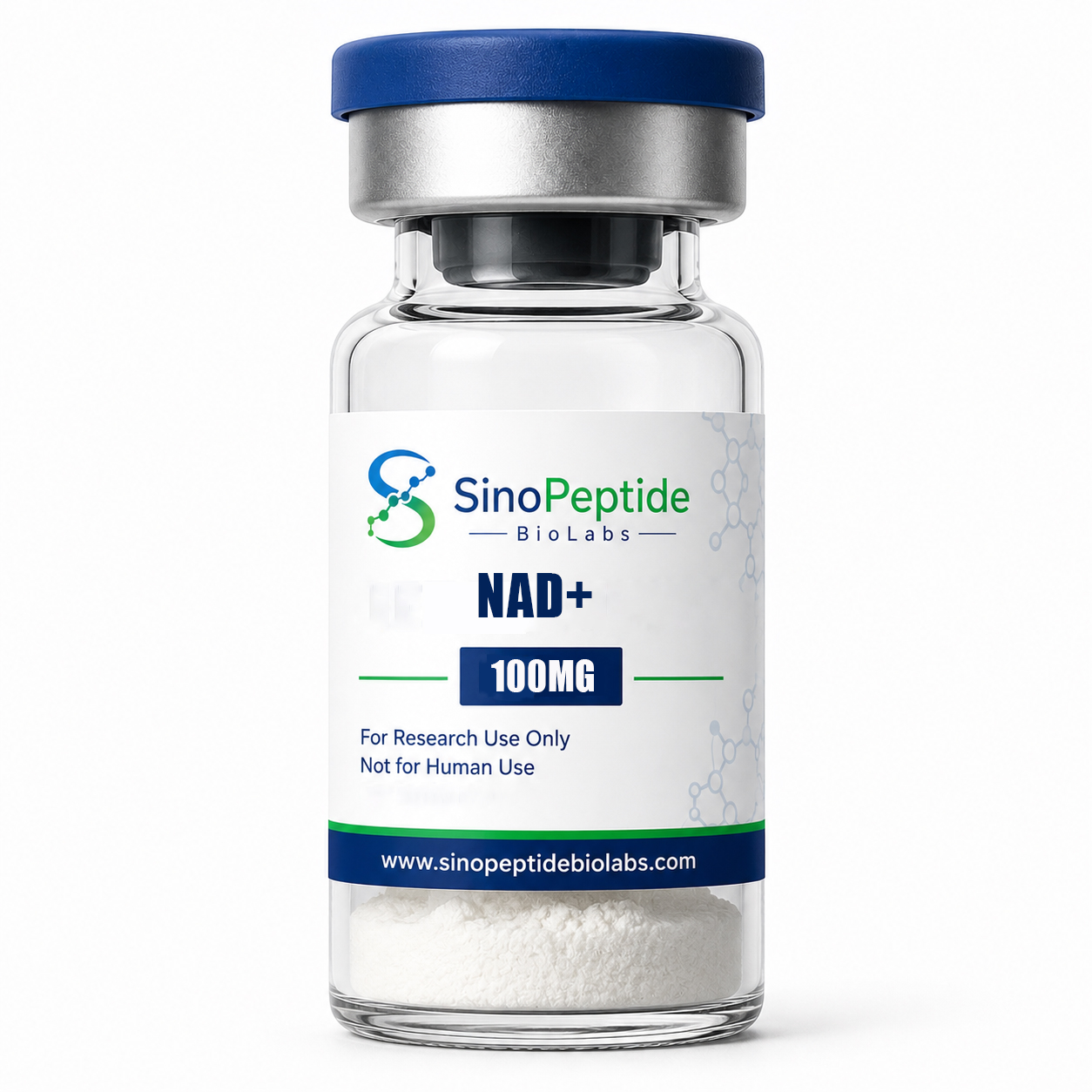
NAD+ 100mg
$39.00
10Vials/ Kits
NAD+ 100mg: Complete NAD+ Research Guide, Benefits, Uses, Safety & Quality
NAD+ 100mg refers to a product containing a stated 100 milligrams of nicotinamide adenine dinucleotide (NAD+), an essential cellular coenzyme involved in energy metabolism, redox reactions, DNA repair, cellular signaling, mitochondrial function, and other fundamental biological processes.
NAD+ has become an important subject in modern aging, metabolism, mitochondrial, neuroscience, and cellular biology research. Interest has increased because NAD+ availability can change with age, metabolic stress, cellular damage, and disease. Researchers are investigating whether restoring or increasing NAD+ availability can influence cellular function and health-related outcomes.
It is important, however, to distinguish NAD+ itself from compounds used to increase NAD+ levels. Research has extensively examined precursors such as nicotinamide riboside (NR) and nicotinamide mononucleotide (NMN). Evidence for these approaches should not automatically be transferred to a product containing NAD+ itself. A 2026 systematic review identified substantial biological activity from NAD+-related interventions but concluded that clinical effectiveness for anti-aging and wellness outcomes remains inconclusive. Notably, the review found no eligible outcomes trials evaluating intravenous or intramuscular NAD+ itself for anti-aging or wellness indications.
The 100mg designation describes the quantity stated for the product. It should not automatically be interpreted as a standardized clinical dose, administration recommendation, or proven therapeutic amount.
This guide explains NAD+ 100mg, NAD+ biology, cellular energy research, mitochondrial function, aging research, DNA repair, NAD+-dependent enzymes, NAD+ precursors, clinical evidence, quality testing, safety, regulatory considerations, and frequently asked questions.
What Is NAD+ 100mg?
NAD+ stands for nicotinamide adenine dinucleotide.
It is a naturally occurring molecule found throughout living cells and is essential for numerous biochemical processes.
A NAD+ 100mg product contains a stated quantity of NAD+, with the exact formulation depending on the manufacturer and intended research application.
NAD+ exists primarily in two related redox states:
- NAD+ — oxidized form
- NADH — reduced form
These molecules participate in reversible redox reactions that allow cells to transfer electrons during metabolic processes.
NAD+ also has functions beyond conventional energy metabolism. It serves as a substrate or cofactor for enzymes involved in:
- DNA repair
- Cellular signaling
- Protein modification
- Gene regulation
- Mitochondrial biology
- Calcium signaling
- Stress responses
- Cellular survival pathways
Because NAD+ participates in so many biological systems, changes in NAD+ availability can potentially affect multiple cellular pathways simultaneously.
NAD+ Chemical and Biological Identity
NAD+ is composed of two nucleotide-like components joined through phosphate groups.
Its structure contains:
- An adenine-containing nucleotide
- A nicotinamide-containing nucleotide
- Phosphate groups
The nicotinamide portion is particularly important because NAD+ participates in reactions where electrons are transferred between NAD+ and NADH.
This reversible chemistry is fundamental to metabolism.
The NAD+/NADH ratio also provides information about the redox state of cells and can change according to metabolic conditions.
For researchers, NAD+ is therefore both a biochemical molecule and a central component of cellular energy and redox biology.
What Does NAD+ Do in Cells?
NAD+ performs several major biological functions.
Energy Metabolism
NAD+ participates in pathways that extract energy from nutrients.
During glycolysis, the citric acid cycle, and other metabolic pathways, NAD+ accepts electrons and becomes NADH.
NADH can subsequently transfer electrons into mitochondrial energy-production pathways.
This relationship makes NAD+ essential to efficient cellular energy metabolism.
Redox Reactions
The NAD+/NADH pair functions as a major redox couple.
In simplified terms:
NAD+ + electrons → NADH
and the reverse reaction regenerates NAD+.
Maintaining appropriate NAD+ availability is therefore important for continued metabolic activity.
DNA Repair
NAD+ is also consumed by enzymes involved in cellular stress and DNA repair.
One important enzyme family is PARPs, or poly(ADP-ribose) polymerases.
PARP enzymes use NAD+ to add ADP-ribose units during cellular responses to DNA damage.
This connects NAD+ metabolism with genomic maintenance.
Protein Modification
Another major group of NAD+-dependent enzymes is the sirtuin family.
Sirtuins use NAD+ as part of their catalytic activity and participate in processes involving:
- Protein deacetylation
- Metabolic regulation
- Stress responses
- Mitochondrial function
- Gene regulation
These mechanisms have contributed significantly to interest in NAD+ and aging research.
NAD+ and Mitochondrial Function
Mitochondria are cellular structures responsible for much of the ATP production required by cells.
NAD+ is central to mitochondrial metabolism because NADH generated during nutrient metabolism transfers electrons into the mitochondrial respiratory chain.
This supports the production of ATP through oxidative phosphorylation.
NAD+ research therefore frequently examines:
- Mitochondrial respiration
- ATP production
- Oxidative metabolism
- Cellular energy availability
- Mitochondrial stress
- Metabolic flexibility
Preclinical studies have produced substantial interest in NAD+ restoration and mitochondrial function. However, translating these findings from animal models to humans remains a major research challenge. A 2023 review emphasized that NAD+ biology has broad relevance to metabolism and aging while also highlighting important gaps in clinical pharmacology and therapeutic evidence.
NAD+ and Aging Research
One of the most important areas of NAD+ research is aging.
Scientists have investigated whether NAD+ availability changes during aging and whether altered NAD+ metabolism contributes to age-associated cellular dysfunction.
Preclinical studies have reported NAD+-related changes involving:
- Mitochondrial function
- Metabolic health
- DNA repair
- Inflammation
- Cellular stress
- Neurodegeneration
- Muscle function
However, the human evidence is more complicated.
A 2025 review in Nature Metabolism noted that an age-related decline in NAD+ has been consistently observed in only a limited number of human studies and emphasized that human clinical trials of NAD+ precursors have generally shown more limited effects than preclinical research might suggest.
This distinction is essential when discussing NAD+ 100mg for SEO.
It is scientifically reasonable to discuss NAD+ as an important aging-research target. It is not scientifically justified to claim that NAD+ 100mg reverses aging or guarantees increased lifespan.
NAD+ and Cellular Senescence Research
Cellular senescence refers to a state in which cells permanently stop dividing while remaining metabolically active.
Senescent cells can alter their surrounding environment through signaling molecules and inflammatory factors.
Because NAD+ participates in cellular metabolism, DNA repair, mitochondrial activity, and stress responses, researchers have investigated relationships between NAD+ metabolism and cellular senescence.
This area remains active and involves multiple interconnected mechanisms.
NAD+ should therefore be viewed as one component of a much larger network of cellular pathways rather than as a single “anti-aging molecule.”
NAD+ and DNA Repair
DNA is continuously exposed to damage from:
- Oxidative stress
- Metabolic processes
- Environmental factors
- Replication errors
- Radiation
- Cellular inflammation
Cells use sophisticated DNA-repair systems to maintain genomic integrity.
NAD+ is relevant because certain DNA-repair enzymes consume NAD+ during their activity.
PARP enzymes are a major example.
When DNA damage activates PARP signaling, NAD+ can be consumed to produce ADP-ribose polymers involved in DNA-damage responses.
This relationship has made NAD+ metabolism an important area of research in:
- Genomic stability
- Cellular stress
- Aging biology
- Cancer biology
- DNA repair
- Metabolic disease
However, increasing NAD+ availability is not equivalent to directly repairing DNA. These are separate biological concepts.
NAD+ and Sirtuin Research
Sirtuins are NAD+-dependent enzymes involved in cellular regulation.
Seven mammalian sirtuins, SIRT1 through SIRT7, have been identified.
They participate in different cellular processes, including:
- Metabolism
- Chromatin regulation
- Mitochondrial function
- Stress responses
- Protein modification
- Cellular adaptation
Because sirtuins require NAD+, researchers have investigated whether changes in NAD+ availability influence sirtuin activity.
This relationship has become one of the major conceptual foundations of NAD+ aging research.
Nevertheless, increasing NAD+ does not guarantee activation of every sirtuin pathway in every tissue. Cellular NAD+ metabolism is tissue-specific and influenced by many factors.
NAD+ and Oxidative Stress
Oxidative stress occurs when production of reactive oxygen species exceeds the ability of biological systems to manage them.
NAD+ participates indirectly in several systems involved in cellular responses to oxidative stress.
NAD+-dependent pathways can interact with:
- Mitochondrial metabolism
- DNA repair
- Antioxidant systems
- Cellular signaling
- Stress-response pathways
Researchers are therefore investigating whether manipulating NAD+ metabolism can influence oxidative stress.
Much of the strongest mechanistic evidence comes from cellular and animal research, while human evidence remains an area of ongoing investigation.
NAD+ and Metabolic Research
NAD+ is deeply connected to metabolism.
NAD+/NADH reactions occur during the metabolism of:
- Carbohydrates
- Fatty acids
- Amino acids
This makes NAD+ relevant to research involving:
- Glucose metabolism
- Fat oxidation
- Mitochondrial respiration
- Insulin signaling
- Metabolic flexibility
- Obesity
- Diabetes
- Cardiometabolic health
Preclinical NAD+ research has produced promising results across several metabolic models.
However, clinical evidence is less consistent.
A 2026 systematic review found that NAD+-related interventions produced clear biochemical target engagement in humans, but effects on functional and metabolic outcomes were heterogeneous and often null or dependent on the endpoint studied.
NAD+ and Neurological Research
The brain has high energy requirements and depends heavily on mitochondrial metabolism.
NAD+ therefore has significant relevance to neuroscience.
Researchers have investigated NAD+-related pathways in:
- Neurodegeneration
- Mitochondrial dysfunction
- Brain aging
- Oxidative stress
- Neuroinflammation
- Neuronal survival
- Metabolic regulation
Preclinical research has generated interest in NAD+ pathways for neurological conditions, but evidence in humans remains insufficient to establish broad therapeutic effectiveness.
A 2025 review of NAD+ targeting in clinical research emphasized the need for larger trials examining efficacy, optimal routes, dosing strategies, and long-term safety.
NAD+ and Cardiometabolic Research
NAD+ metabolism has also been studied in relation to cardiovascular and metabolic biology.
Potential research areas include:
- Vascular function
- Endothelial biology
- Blood pressure
- Lipid metabolism
- Glucose regulation
- Mitochondrial health
Some human studies involving NAD+ precursors have reported changes in metabolic or vascular biomarkers.
However, these findings should not be generalized to NAD+ itself.
The distinction between:
NAD+
and
NAD+ precursors
is particularly important.
NAD+ vs NADH
NAD+ and NADH are closely related but chemically distinct forms of the same redox system.
| Feature | NAD+ | NADH |
|---|---|---|
| Redox state | Oxidized | Reduced |
| Primary role | Electron acceptor and enzyme substrate | Electron donor |
| Energy metabolism | Essential | Essential |
| DNA-repair involvement | Yes | Not equivalent |
| Sirtuin substrate | Yes | No |
| Research focus | Aging, metabolism, signaling | Redox and metabolic biology |
NAD+ and NADH should therefore not be described as interchangeable.
NAD+ vs NMN
Nicotinamide mononucleotide (NMN) is a precursor involved in NAD+ biosynthesis.
It is not the same molecule as NAD+.
NMN research has focused on whether supplying a precursor can increase cellular NAD+ availability.
Human trials have demonstrated biochemical changes in NAD+-related measures, but clinical outcomes have been more variable.
A review of NMN human trials concluded that much of the evidence remains preliminary and that additional research is needed to establish long-term safety and meaningful clinical effects.
NAD+ vs Nicotinamide Riboside
Nicotinamide riboside (NR) is another NAD+ precursor.
Like NMN, NR is used by the body in pathways that can contribute to NAD+ biosynthesis.
NR has been studied extensively in human trials.
Research has generally shown that NR can increase NAD+-related metabolites, but whether this biochemical effect consistently translates into meaningful health improvements remains uncertain.
This distinction is particularly important for product SEO.
A page targeting NAD+ 100mg should not use clinical findings from NR or NMN studies as if they were direct evidence for NAD+ 100mg.
What Does 100mg Mean for NAD+?
The 100mg label indicates the stated quantity of NAD+ in the product.
It does not automatically mean:
- A recommended human dose
- A standardized clinical dose
- An effective anti-aging dose
- A medically established amount
- An intravenous administration amount
The appropriate interpretation depends on the formulation and intended use.
Different NAD+ products may have different:
- Purity levels
- Chemical forms
- Excipients
- Delivery systems
- Stability characteristics
- Intended research applications
Researchers should therefore evaluate the complete product specification rather than relying only on the 100mg label.
NAD+ 100mg Quality and Purity
Quality control is particularly important for NAD+ because the molecule can be affected by environmental and formulation conditions.
Researchers evaluating NAD+ 100mg should consider:
- Chemical identity
- Purity
- Assay
- Degradation products
- Batch number
- Manufacturing source
- Storage conditions
- Certificate of Analysis
A high-quality product should ideally have documentation connecting analytical results to the specific production batch.
NAD+ HPLC Testing
High-performance liquid chromatography can be used to evaluate NAD+ preparations.
HPLC analysis may help assess:
- Main compound purity
- Related compounds
- Degradation products
- Batch consistency
The analytical method should be appropriate for NAD+ and validated or suitably qualified for the intended measurement.
A simple purity percentage without an identified analytical method provides less useful information.
NAD+ Mass Spectrometry
Mass spectrometry can provide additional information about molecular identity and molecular mass.
When appropriate, combining chromatographic analysis with mass spectrometry can provide stronger analytical characterization.
Researchers should consider both:
Identity
and
Purity
when evaluating NAD+.
These are related but different quality parameters.
NAD+ 100mg Certificate of Analysis
A useful COA may include:
| COA Parameter | Purpose |
|---|---|
| Product name | Identifies the tested material |
| Batch number | Connects analysis to a specific lot |
| Assay/purity | Quantifies the target compound |
| Analytical method | Shows how testing was performed |
| Identity testing | Helps confirm the compound |
| Testing date | Establishes when analysis occurred |
| Manufacturing information | Supports traceability |
| Storage conditions | Helps maintain product quality |
Batch-specific documentation is preferable to a generic certificate.
NAD+ Stability and Storage
NAD+ is a biologically active nucleotide and its stability can depend on environmental conditions.
Factors that may affect stability include:
- Temperature
- Moisture
- Light
- Oxygen
- pH
- Solvent
- Container integrity
- Freeze-thaw exposure
Researchers should follow the specific manufacturer’s stability and storage documentation.
A universal storage recommendation should not be applied to every NAD+ formulation.
NAD+ 100mg Safety Considerations
Safety depends strongly on the formulation and route of administration.
NAD+ is a naturally occurring cellular molecule, but this does not automatically mean that every concentrated NAD+ product or administration route is risk-free.
Human evidence for NAD+-related interventions remains incomplete.
A 2024 systematic review of NAD/NADH-related clinical studies included 10 studies involving 489 participants and reported generally limited serious safety concerns, but the interventions varied and the authors emphasized the need for additional research into specific conditions and dosing.
More recent evidence is particularly relevant to parenteral NAD+.
A 2026 retrospective real-world study comparing commercial intravenous NAD+ and intravenous NR reported moderate-to-severe gastrointestinal symptoms, increased heart rate, and chest pressure among participants receiving NAD+ IV; the authors emphasized that additional studies are needed to evaluate dosage and effectiveness beyond 30 days.
This does not establish that all NAD+ formulations have the same safety profile, but it demonstrates why route and formulation matter.
NAD+ and Intravenous Research
Intravenous NAD+ has received significant attention in wellness settings.
However, the evidence base remains considerably smaller than online marketing may imply.
The 2026 systematic review of NAD+-related interventions found no eligible outcomes trials evaluating intravenous or intramuscular NAD+ itself for anti-aging or wellness indications. It identified an intravenous NAD+ pharmacokinetic pilot but classified it as contextual evidence rather than an outcomes trial.
This is an important distinction.
Pharmacokinetic evidence can demonstrate that a substance enters or changes within the body. It does not establish that the intervention improves long-term health outcomes.
NAD+ and Anti-Aging Claims
“Anti-aging” is one of the most common search terms associated with NAD+.
There is a strong scientific rationale for studying NAD+ in aging biology because NAD+ participates in metabolism, DNA repair, mitochondrial function, and cellular signaling.
Preclinical research has produced compelling findings.
Human evidence is less definitive.
The latest systematic review found that NAD+-augmentation approaches clearly affect biological NAD-related measures but concluded that clinical effectiveness for anti-aging and wellness remains inconclusive.
Therefore, responsible SEO content should use terms such as:
- Aging research
- Healthy-aging research
- NAD+ metabolism
- Cellular aging research
- Mitochondrial aging research
rather than claiming that NAD+ 100mg reverses aging or extends human lifespan.
Common Misconceptions About NAD+ 100mg
Myth 1: NAD+ Is a Vitamin
No.
NAD+ is a cellular coenzyme/nucleotide involved in numerous biochemical processes. It is related to vitamin B3 metabolism but is not itself simply equivalent to niacin or another B3 vitamin.
Myth 2: NAD+ and NMN Are the Same
They are not.
NMN is a precursor involved in NAD+ biosynthesis.
Myth 3: NAD+ 100mg Is Automatically a Clinical Dose
No.
The 100mg label describes product quantity and does not establish a universal clinical regimen.
Myth 4: Raising NAD+ Automatically Reverses Aging
Human evidence does not establish this.
NAD+ biology is promising, but clinical outcomes remain an active research question.
Myth 5: Research on NR Proves NAD+ Works
No.
NR and NAD+ are chemically different interventions.
Myth 6: IV NAD+ Has Already Been Proven for Wellness
Current evidence does not support that conclusion. The 2026 systematic review found no eligible outcomes trials of IV or IM NAD+ itself for anti-aging or wellness indications.
How to Evaluate NAD+ 100mg for Research
Researchers can use several criteria when assessing a NAD+ 100mg product.
1. Verify Chemical Identity
Confirm that the material is actually NAD+ and identify the stated chemical form.
2. Review the COA
Look for batch-specific analytical documentation.
3. Examine Purity
Review the analytical method used to establish purity.
4. Check Molecular Identity
Appropriate identity testing can help confirm the expected compound.
5. Review Stability Information
NAD+ stability should be evaluated under the documented storage conditions.
6. Verify Batch Traceability
The lot number should correspond to the analytical documentation.
7. Determine Intended Use
A research material should not automatically be assumed suitable for human administration.
8. Distinguish NAD+ From Precursors
Make sure published evidence actually concerns NAD+ rather than NR, NMN, niacin, or another NAD+ precursor.
Frequently Asked Questions About NAD+ 100mg
What is NAD+ 100mg?
NAD+ 100mg is a product containing a stated 100mg quantity of nicotinamide adenine dinucleotide, depending on the manufacturer’s formulation and labeling.
What is NAD+?
NAD+ is an essential cellular coenzyme involved in energy metabolism, redox reactions, DNA repair, protein modification, and cellular signaling.
What does NAD+ stand for?
NAD+ stands for nicotinamide adenine dinucleotide.
What does the plus sign mean?
The “+” indicates the oxidized form of the NAD redox couple. NADH is the corresponding reduced form.
What does 100mg mean?
It refers to the stated amount of NAD+ in the product. It does not automatically represent a recommended human dose.
Is NAD+ the same as NMN?
No. NMN is a precursor involved in NAD+ biosynthesis, while NAD+ is the coenzyme itself.
Is NAD+ the same as NR?
No. Nicotinamide riboside is another NAD+ precursor.
What is NAD+ studied for?
NAD+ is studied in cellular metabolism, mitochondrial biology, DNA repair, aging, oxidative stress, neurobiology, metabolic research, and cellular signaling.
Does NAD+ increase energy?
NAD+ is essential to cellular energy metabolism, but this should not be translated into a guarantee that a NAD+ product produces a subjective energy boost in humans.
Is NAD+ studied for aging?
Yes. NAD+ is a major subject in aging and longevity research. However, current human evidence does not establish that NAD+ supplementation reverses aging or extends human lifespan.
Is NAD+ 100mg FDA approved?
A product labeled NAD+ 100mg should not be represented as an FDA-approved drug without product-specific evidence of approval.
How is NAD+ purity tested?
Potential analytical methods include HPLC and mass spectrometry, alongside other appropriate analytical techniques.
Why is a COA important?
A batch-specific Certificate of Analysis can provide information about identity, purity, assay, testing methods, and lot traceability.
The Future of NAD+ Research
NAD+ research continues to expand across several areas.
Future investigations are likely to focus on:
- Tissue-specific NAD+ metabolism
- Mitochondrial function
- Aging biology
- Neurodegenerative disease
- Metabolic disease
- DNA repair
- NAD+ precursor pharmacology
- Cellular senescence
- Precision NAD+ interventions
- Improved delivery technologies
- Long-term human safety
One important direction is understanding why different tissues respond differently to NAD+-related interventions.
Another is determining whether increasing NAD+ levels produces clinically meaningful benefits rather than simply changing biochemical biomarkers.
Researchers are also investigating improved ways to measure NAD+ in real time and to understand how NAD+ metabolism changes during disease and aging.
A 2025 clinical review emphasized the need for larger studies to determine optimal approaches, routes, dosing strategies, long-term safety, and individual differences in response.
Conclusion
NAD+ 100mg refers to a product containing a stated 100mg quantity of nicotinamide adenine dinucleotide, a fundamental cellular coenzyme involved in energy metabolism, redox reactions, DNA repair, mitochondrial function, and cellular signaling.
NAD+ has become a major research target because of its connection to metabolism, aging biology, mitochondrial function, genomic maintenance, and cellular stress.
Preclinical studies have produced extensive evidence supporting NAD+ as an important biological pathway. Human research, however, presents a more nuanced picture. Current reviews indicate that NAD+-related interventions can produce measurable biochemical changes, but meaningful clinical benefits for anti-aging and wellness remain uncertain.
It is also essential to distinguish NAD+ itself from NR, NMN, nicotinamide, and other NAD+ precursors. Evidence from one compound should not automatically be applied to another.
For researchers evaluating NAD+ 100mg, important quality considerations include chemical identity, purity, assay, HPLC or other analytical testing, molecular characterization, batch traceability, stability information, and a reliable Certificate of Analysis.
The 100mg quantity should not be interpreted as a universal clinical dose.
Finally, NAD+ should be discussed using evidence-based language. It is scientifically appropriate to describe NAD+ as an important target of cellular and aging research, but current evidence does not justify presenting NAD+ 100mg as a proven anti-aging treatment, lifespan-extending intervention, or guaranteed wellness product.
Research-use disclaimer: This article is provided for educational and scientific research purposes. It is not medical advice and does not provide instructions or recommendations for human administration. The safety and regulatory status of any specific NAD+ product depend on its formulation, route, manufacturing standards, intended use, and applicable jurisdiction.
Be the first to review “NAD+ 100mg”
Related products
Pure Peptides
Pure Peptides
Pure Peptides
Pure Peptides
Pure Peptides
Pure Peptides
Pure Peptides
Pure Peptides
Reviews
There are no reviews yet.