
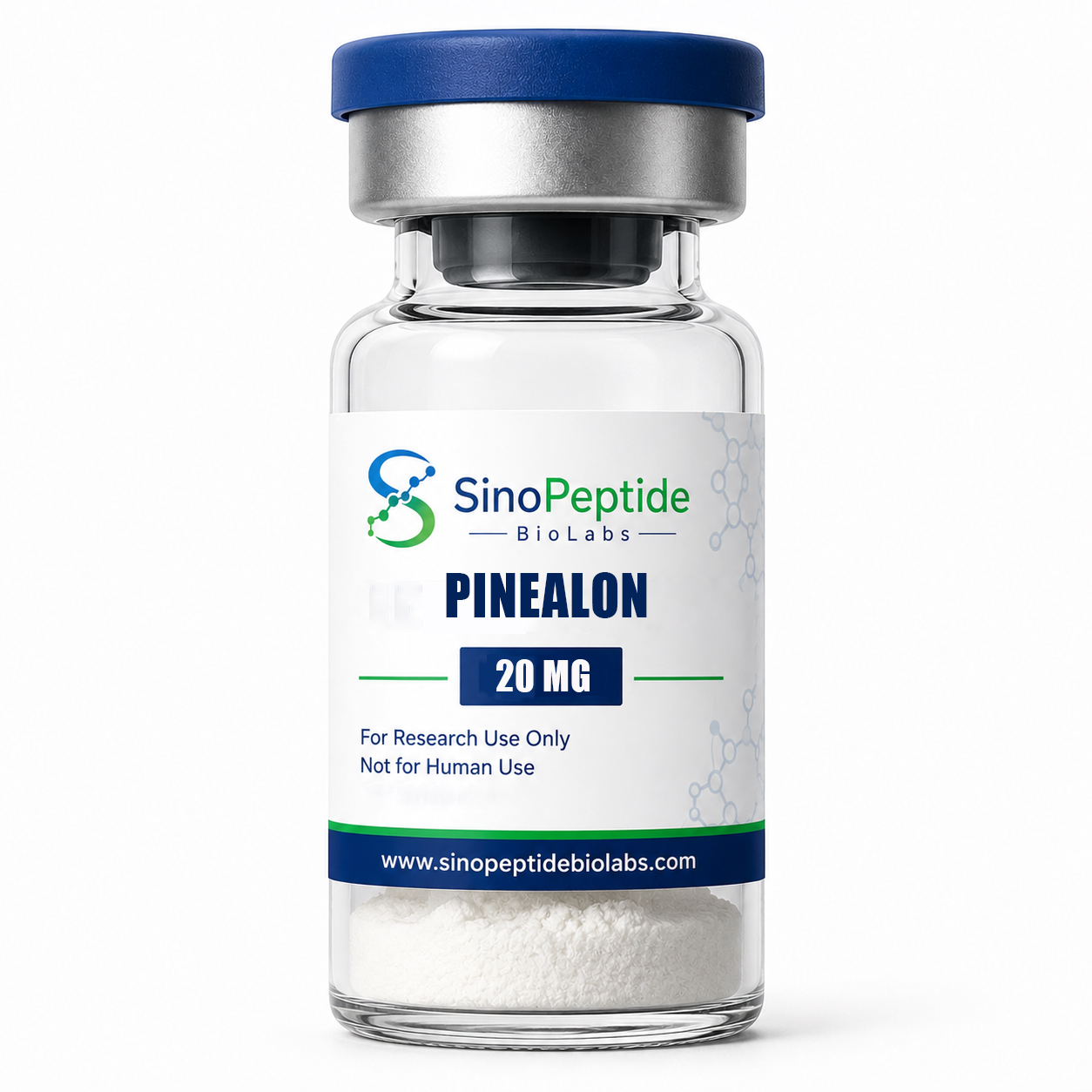
Pinealon 20mg
$110.00
Pinealon 20mg: Research, Mechanism, Benefits, Safety & Evidence
What Is Pinealon 20mg?
Pinealon 20mg refers to a 20-milligram quantity of Pinealon, a short synthetic peptide also known as EDR, consisting of the amino acids glutamic acid, aspartic acid and arginine (Glu-Asp-Arg).
Pinealon belongs to a group of short peptides associated with the research program of Vladimir Khavinson and colleagues. Scientific publications have investigated Pinealon and EDR in areas including neuronal function, oxidative stress, cellular signaling, aging-related biology and experimental neuroprotection.
One important distinction is necessary when creating accurate content about this compound:
Pinealon is not the same peptide as Epitalon.
Pinealon is generally described as the tripeptide Glu-Asp-Arg (EDR), whereas Epitalon is a different tetrapeptide, Ala-Glu-Asp-Gly (AEDG). A recent review of Epitalon confirms the AEDG sequence and its distinct research history.
The 20mg designation describes the amount of material in a product or research preparation. It should not automatically be interpreted as a clinically validated human dose.
Pinealon 20mg at a Glance
| Feature | Research information |
|---|---|
| Compound | Pinealon |
| Alternative name | EDR peptide |
| Amino-acid sequence | Glu-Asp-Arg |
| Compound type | Synthetic tripeptide |
| Main research areas | Neuroprotection, oxidative stress, aging biology |
| Research models | Cell and animal studies; limited human-related literature |
| 20mg designation | Quantity of material |
| Established human dose | Not clinically established |
| FDA-approved indication | No established approved medical indication |
| Research status | Experimental |
| Same as Epitalon? | No |
| Main scientific interest | Cellular and neuronal effects of EDR |
What Is the Pinealon Peptide?
Pinealon is a short synthetic peptide composed of three amino acids:
Glu-Asp-Arg
The abbreviation EDR comes directly from the amino-acid sequence.
Unlike larger therapeutic proteins, Pinealon contains only three amino-acid residues. Researchers have investigated whether short peptides such as EDR can interact with cellular structures and influence biochemical or gene-regulatory processes.
The scientific literature surrounding Pinealon includes experimental work examining oxidative stress, neuronal survival, neurochemical responses and possible interactions with DNA. For example, a 2019 biophysical study examined the interaction between EDR and DNA using spectroscopy, NMR, viscosimetry and molecular-dynamics methods. The authors reported that EDR could partly penetrate the major groove of DNA under the experimental conditions and that magnesium ions could promote the interaction.
Such findings are useful for understanding possible molecular mechanisms, but an in-vitro molecular interaction is not equivalent to demonstrated therapeutic activity in humans.
That distinction is important when evaluating Pinealon 20mg.
Pinealon 20mg and EDR
The terms Pinealon, EDR, and EDR peptide are frequently used to describe the same short peptide sequence.
The sequence is:
Glutamic acid – Aspartic acid – Arginine
or:
Glu-Asp-Arg (EDR)
A 2020 review specifically examined the EDR peptide and summarized research involving neuronal cultures, animal models and proposed molecular mechanisms. The review described experimental findings involving antioxidant enzyme expression, neuronal function, apoptosis-related pathways and behavioral observations in animals.
However, a review article summarizes available research; it does not independently establish that Pinealon is clinically effective.
For SEO and scientific accuracy, a product page should therefore use terms such as “Pinealon EDR peptide,” “Pinealon research,” and “EDR tripeptide” rather than making unsupported therapeutic claims.
How Does Pinealon Work?
The proposed mechanism of Pinealon remains an area of research rather than an established clinical pharmacological mechanism.
Researchers have proposed that EDR may influence cellular processes involving:
- Gene expression
- Protein synthesis
- Oxidative stress
- Antioxidant defenses
- MAPK/ERK signaling
- Apoptosis-related proteins
- Neuronal function
- Cellular responses to stress
The 2020 EDR review proposed that the peptide may enter cells and interact with histone proteins and/or RNA, potentially affecting expression of proteins involved in neuronal function and cellular protection. The review also discussed experimental effects involving pathways such as MAPK/ERK and proteins including SOD2 and GPX1.
These mechanisms should be described as proposed or experimentally investigated mechanisms, rather than established human mechanisms of action.
More research is required to determine how Pinealon behaves in living humans, including its absorption, distribution, metabolism, tissue exposure and biological target engagement.
Pinealon and Neuroprotection Research
One of the primary areas of interest surrounding Pinealon is neuroprotection.
Neuroprotection refers broadly to mechanisms that may help neurons withstand cellular stress, oxidative damage, inflammation or other harmful processes.
Pinealon has been investigated in experimental models involving neuronal stress and aging.
In a 2011 study, researchers examined the effects of Pinealon in several cell models exposed to oxidative stress. The authors reported that the synthetic tripeptide reduced accumulation of reactive oxygen species (ROS) and decreased necrotic cell death under the experimental conditions. They also observed changes in ERK1/2 activation and cell-cycle processes.
These findings provide a biological rationale for continued research into EDR.
They do not establish that Pinealon prevents neurodegenerative disease or protects the human brain in clinical practice.
Pinealon 20mg and Oxidative Stress Research
Oxidative stress occurs when reactive oxygen species and related reactive molecules exceed the capacity of biological systems to neutralize them.
Because oxidative stress can damage proteins, lipids, membranes and DNA, researchers frequently study antioxidant pathways when investigating aging and neurological disease.
Pinealon has been studied in cellular models of oxidative stress.
The 2011 study reported that Pinealon reduced ROS accumulation in cerebellar granule cells, neutrophils and PC12 cells under experimental oxidative-stress conditions. The study also associated the protective effect with reduced cell death.
This is potentially important from a research perspective because neuronal cells are particularly sensitive to oxidative damage.
However, laboratory antioxidant activity does not automatically mean that a compound functions as an antioxidant therapy in humans.
For that reason, a responsible Pinealon 20mg article should use language such as:
“Pinealon has demonstrated antioxidant-related effects in experimental cellular models.”
It should avoid statements such as:
“Pinealon eliminates oxidative stress in humans.”
The first statement reflects the evidence. The second goes beyond it.
Pinealon and Aging Research
Pinealon is often discussed online in the context of aging and longevity.
The scientific interest comes partly from the broader Khavinson peptide-bioregulator research program, which has investigated short peptides in relation to age-associated biological changes.
Some studies have examined Pinealon specifically in aged animal models.
For example, a 2015 study investigated Pinealon in 18-month-old rats exposed to acute hypobaric hypoxia and mild hypothermia. Researchers measured behavioral and neurochemical parameters and reported effects on brain mediators and stress-related biochemical processes.
Another study involving old rats examined Pinealon under acute hypoxic conditions and reported effects involving caspase-3 activity, inflammatory cytokines and neurogenesis-related observations.
These findings help explain why Pinealon is discussed in aging and neuroprotection research.
Nevertheless, animal aging research does not establish that Pinealon extends human lifespan.
Pinealon 20mg and Cognitive Research
Cognitive function is another area associated with Pinealon research.
The EDR peptide has been investigated in the context of neuronal function and age-related cognitive processes. A 2020 review specifically discussed EDR in relation to mechanisms relevant to Alzheimer’s disease research and summarized experimental findings involving neuronal cultures and animal models.
The review reported that EDR research has examined:
- Neuronal survival
- Dendritic spine preservation
- Antioxidant enzyme expression
- Apoptosis-related pathways
- Behavioral responses
- Memory-related observations
However, these findings should not be interpreted as evidence that Pinealon treats Alzheimer’s disease.
Alzheimer’s disease is a complex neurodegenerative condition requiring evidence from properly designed clinical studies.
Pinealon remains an experimental research compound, and its potential relevance to human cognitive disorders requires substantially more investigation.
Pinealon and Alzheimer’s Disease Research
The connection between Pinealon and Alzheimer’s disease is largely based on experimental and mechanistic research.
The EDR review published in Molecules discussed possible relationships between EDR and molecular processes implicated in Alzheimer’s disease. It described experimental findings involving neuronal cultures from disease models and proposed effects on gene expression and protein synthesis.
The authors proposed that EDR could affect proteins and signaling pathways involved in neuronal survival.
This makes EDR interesting as a research tool.
It does not mean that Pinealon is an established Alzheimer’s treatment.
When writing medical SEO content, this distinction is especially important because phrases such as “Pinealon for Alzheimer’s” can easily imply a level of clinical evidence that has not been established.
A more accurate SEO formulation is:
“Pinealon is being investigated in preclinical research related to neuronal protection and mechanisms relevant to neurodegenerative disease.”
Pinealon and DNA Interaction
One of the more interesting areas of Pinealon research concerns its potential interaction with DNA.
A 2019 study examined EDR-DNA interactions using multiple biophysical methods. Researchers reported evidence that EDR could interact with DNA and that divalent ions such as magnesium could influence the interaction.
This research is relevant because some hypotheses surrounding short peptide bioregulators involve the regulation of gene expression.
However, the existence of an interaction between a peptide and DNA in an experimental system does not prove that the same interaction occurs at therapeutically meaningful concentrations inside humans.
More pharmacological research would be needed to connect molecular findings with clinical effects.
Pinealon 20mg and Cell Viability
Cell viability is another area in which Pinealon has been studied.
The 2011 study reported that Pinealon restricted ROS accumulation and reduced necrotic cell death in several experimental cell systems exposed to oxidative stress. The authors also reported changes in cell-cycle-related processes.
Such studies are valuable for generating hypotheses.
For example, researchers may ask:
- Does EDR protect cells from oxidative injury?
- Does it modify intracellular signaling?
- Does it affect antioxidant enzyme expression?
- Does it alter pathways associated with cell survival?
- Could these effects be relevant to aging-related cellular dysfunction?
These questions remain part of the research process.
A cell-culture result should not be presented as proof of a clinical benefit.
Pinealon 20mg vs Epitalon
One of the most important SEO and scientific distinctions is between Pinealon and Epitalon.
Although both are short peptides associated with the same broad research tradition, they are chemically different.
| Feature | Pinealon | Epitalon |
|---|---|---|
| Common sequence | Glu-Asp-Arg | Ala-Glu-Asp-Gly |
| Abbreviation | EDR | AEDG |
| Peptide length | 3 amino acids | 4 amino acids |
| Research focus | Neuroprotection and cellular stress | Pineal biology, aging and related mechanisms |
| Same compound? | No | No |
The 2025 review of Epitalon identifies Epitalon as the tetrapeptide Ala-Glu-Asp-Gly (AEDG).
Pinealon, by contrast, is identified in the literature as Glu-Asp-Arg.
Therefore, content about Epitalon should not simply be copied and relabeled as Pinealon.
Doing so creates both a scientific accuracy problem and a potential SEO topical-quality problem.
What Does Pinealon 20mg Mean?
The term 20mg indicates the nominal quantity of Pinealon in a product.
It does not by itself establish:
- A recommended human dose
- A clinically tested dose
- A therapeutic dose
- A daily administration schedule
- A safe long-term exposure level
This distinction is particularly important because the experimental literature does not provide a standardized, clinically validated human dosing regimen for Pinealon.
A product containing 20mg should therefore be described according to its quantity, not as a 20mg therapeutic protocol.
Is Pinealon 20mg a Clinically Established Dose?
No established clinical dosing standard can be inferred simply from the phrase “Pinealon 20mg.”
Published studies use different experimental designs, biological models and exposure conditions.
Animal studies cannot be converted directly into human dosing instructions.
Similarly, concentrations used in cell culture cannot be translated directly into an appropriate amount for human administration.
For a research product page, the safest wording is:
“20mg refers to the stated quantity of research material and should not be interpreted as a clinically validated human dose.”
This phrasing is both scientifically responsible and useful for SEO.
What Does the Research Say About Pinealon?
The Pinealon evidence base includes several categories.
Cell research
Cellular studies have investigated oxidative stress, reactive oxygen species, cell viability and signaling pathways.
Biophysical research
Researchers have examined interactions between EDR and DNA using laboratory techniques.
Animal research
Rat studies have investigated Pinealon in models of aging, hypoxia, hypothermia and neurochemical stress.
Reviews
Reviews have summarized proposed neuroprotective and gene-regulatory mechanisms associated with EDR.
Human evidence
There are publications discussing human applications of peptide bioregulators and a review specifically describing Pinealon among peptide neuroprotective groups. However, the modern evidence base does not provide the type of large, independently replicated randomized clinical-trial evidence normally required to establish a therapeutic indication.
This distinction should remain clear when evaluating Pinealon.
Is Pinealon FDA Approved?
Pinealon should not be presented as an FDA-approved medication.
There is no established FDA-approved medical indication for Pinealon, and it should not be marketed as an approved treatment for Alzheimer’s disease, dementia, aging, oxidative stress or any other medical condition.
The absence of an approved indication is particularly important when publishing product content intended for consumers.
A research product page should clearly state that its information concerns experimental research rather than established medical treatment.
Is Pinealon Safe?
A comprehensive human safety profile for Pinealon has not been established.
Preclinical research can provide useful information about biological effects, but it cannot fully determine human safety.
Important unanswered questions include:
- Long-term safety
- Pharmacokinetics
- Tissue distribution
- Drug interactions
- Reproductive safety
- Effects in pregnancy
- Effects in people with chronic disease
- Potential immune reactions
- Appropriate clinical exposure levels
This evidence gap means that Pinealon should not be described as “completely safe,” “side-effect free,” or “proven safe for long-term use.”
For research applications, product quality and documented material characteristics are more appropriate subjects than unsupported safety promises.
Pinealon 20mg Research Product Quality
For laboratories evaluating a Pinealon 20mg research product, documentation is an important consideration.
A reputable research product page should ideally provide information such as:
Compound identity
The material should be clearly identified as Pinealon/EDR or Glu-Asp-Arg.
Quantity
The stated 20mg quantity should be clearly defined.
Batch or lot number
Batch identification allows researchers to connect analytical results to a specific product.
Certificate of Analysis
A current COA can provide information about identity, purity and analytical testing.
Analytical characterization
Depending on the laboratory and supplier, analytical methods may include chromatography and mass spectrometry.
Storage information
Storage instructions should come from the manufacturer’s product-specific documentation rather than generic assumptions.
Intended use
The product should be clearly identified as being intended for research purposes where applicable.
Why Research-Grade Documentation Matters
The quality of experimental material can influence reproducibility.
If researchers are investigating Pinealon, they need to know what material was actually used.
Useful documentation can include:
- Product name
- Chemical sequence
- Molecular information
- Batch number
- Purity
- Analytical method
- COA
- Manufacturing information
- Storage requirements
- Retest or expiration information
A product page should not claim a particular purity level unless the claim is supported by appropriate documentation.
This is especially important for SEO because high-quality medical content should demonstrate transparency rather than relying on exaggerated marketing language.
Pinealon Research Applications
Pinealon may be relevant to several experimental research areas.
1. Neuroprotection
Researchers can investigate how EDR affects neuronal survival under oxidative or metabolic stress.
2. Oxidative stress
Cell models can be used to evaluate changes in reactive oxygen species and antioxidant systems.
3. Aging biology
Animal models may help researchers investigate age-related changes in neurological and cellular function.
4. Cellular signaling
Studies can investigate pathways such as ERK/MAPK and apoptosis-related signaling.
5. Gene regulation
The interaction between EDR and nucleic acids has been investigated as part of proposed mechanisms for short peptide bioregulators.
6. Neurodegeneration research
EDR has been discussed in experimental research related to Alzheimer’s disease mechanisms, although this should not be interpreted as evidence of clinical efficacy.
Limitations of Pinealon Research
A balanced SEO article should explain not only what research suggests but also what remains unknown.
Limited independent replication
A substantial portion of the Pinealon literature comes from the same broader research tradition.
Limited modern clinical evidence
The evidence base does not resemble the large randomized clinical-trial programs supporting approved neurological medicines.
Uncertain pharmacokinetics
There is limited publicly established information about how Pinealon behaves in humans after administration.
Mechanistic uncertainty
Proposed cellular and gene-regulatory mechanisms require additional validation.
Animal-to-human translation
Positive findings in rats or cell cultures cannot automatically be applied to humans.
No established therapeutic indication
Pinealon has not been established as a standard treatment for a medical condition.
These limitations do not mean that the compound is scientifically uninteresting. They simply define the current evidence boundary.
Pinealon 20mg: Research vs Marketing Claims
When evaluating online information, readers should distinguish between scientific statements and promotional claims.
Research-supported wording
“Pinealon has been investigated in experimental models of oxidative stress and neuroprotection.”
Overstated wording
“Pinealon protects your brain from aging.”
The first statement accurately describes research.
The second turns experimental findings into a direct human health claim.
Other claims that should be treated cautiously include:
- “Pinealon reverses aging.”
- “Pinealon prevents Alzheimer’s disease.”
- “Pinealon permanently improves memory.”
- “Pinealon extends human lifespan.”
- “Pinealon is clinically proven.”
- “Pinealon has no side effects.”
Current evidence does not justify presenting these as established facts.
Frequently Asked Questions About Pinealon 20mg
What is Pinealon 20mg?
Pinealon 20mg refers to a product or research preparation containing a stated 20mg quantity of Pinealon, a synthetic EDR tripeptide composed of Glu-Asp-Arg.
What is Pinealon made of?
Pinealon is a short peptide composed of glutamic acid, aspartic acid and arginine, abbreviated Glu-Asp-Arg (EDR).
Is Pinealon a peptide?
Yes. Pinealon is a synthetic tripeptide.
What is EDR peptide?
EDR is the abbreviation for the Pinealon amino-acid sequence: Glu-Asp-Arg.
Is Pinealon the same as Epitalon?
No. Pinealon is EDR, while Epitalon is AEDG. They are different peptides.
What is Pinealon researched for?
Research has investigated Pinealon in neuroprotection, oxidative stress, neuronal function, aging-related biology and cellular signaling.
Does Pinealon increase memory?
Some published research and reviews discuss memory-related observations in experimental or older human-related peptide-bioregulator research, but this does not establish Pinealon as a clinically proven cognitive-enhancement treatment.
Does Pinealon treat Alzheimer’s disease?
No established clinical evidence supports describing Pinealon as an Alzheimer’s treatment. EDR has been investigated in experimental research related to Alzheimer’s mechanisms.
Does Pinealon have antioxidant properties?
Pinealon has demonstrated effects related to reactive oxygen species in experimental cellular models. A 2011 study reported reduced ROS accumulation under oxidative-stress conditions.
Is Pinealon 20mg a recommended human dose?
The 20mg label indicates the amount of material. It should not be presented as a clinically validated human dose.
Is Pinealon FDA approved?
Pinealon should not be presented as an FDA-approved medicine or as having an established FDA-approved medical indication.
Is Pinealon safe for long-term use?
A comprehensive long-term human safety profile has not been established. Claims that Pinealon is completely safe for chronic use are therefore not supported by adequate clinical evidence.
Can Pinealon be used instead of approved neurological medications?
It should not be presented as a substitute for prescribed neurological treatment.
Why is Pinealon studied in aging research?
Researchers are interested in short peptides such as EDR because experimental studies suggest possible effects on cellular stress responses, neuronal processes and age-associated biological pathways.
What should I look for in a Pinealon 20mg research product?
Look for clear compound identification, stated quantity, batch information, analytical documentation and a current Certificate of Analysis where applicable.
Pinealon 20mg: Final Scientific Perspective
Pinealon 20mg is a research-oriented product designation for a 20mg quantity of Pinealon, the short synthetic EDR tripeptide (Glu-Asp-Arg).
Research on Pinealon has explored several scientifically interesting areas, particularly neuroprotection, oxidative stress, cellular signaling, aging biology and neuronal function.
Experimental studies have reported reduced reactive oxygen species and reduced cell death under certain oxidative-stress conditions.
Animal research has also investigated Pinealon in models involving hypoxia, hypothermia, aging and neurochemical changes.
At the molecular level, researchers have investigated potential interactions between EDR and DNA, while reviews have proposed mechanisms involving gene expression, protein synthesis and neuronal survival pathways.
Nevertheless, these findings remain substantially different from the evidence required to establish an approved medical therapy.
The most important scientific points are therefore:
- Pinealon is the EDR tripeptide, Glu-Asp-Arg.
- Pinealon is not the same as Epitalon.
- 20mg describes the quantity of material, not a validated human dose.
- Much of the Pinealon-specific evidence is preclinical.
- Experimental findings should not be presented as proof of human anti-aging, cognitive or neuroprotective benefits.
- A comprehensive human safety profile has not been established.
- Pinealon should not be presented as an FDA-approved treatment.
For a high-quality website, this evidence-based positioning is preferable to exaggerated claims about longevity, memory enhancement or disease treatment. It provides useful information for readers while keeping the content scientifically responsible and appropriate for research-focused SEO.
Pinealon 20mg Pinealon 20mg Pinealon 20mg Pinealon 20mg Pinealon 20mgPinealon 20mg Pinealon 20mg Pinealon 20mg Pinealon 20mg Pinealon 20mg Pinealon 20mg Pinealon 20mg Pinealon 20mg Pinealon 20mg Pinealon 20mg Pinealon 20mg Pinealon 20mg Pinealon 20mg Pinealon 20mg Pinealon 20mg Pinealon 20mg
Be the first to review “Pinealon 20mg”
Related products
Pure Peptides
Pure Peptides
Pure Peptides
Pure Peptides
Pure Peptides
Pure Peptides
Pure Peptides
Pure Peptides
Reviews
There are no reviews yet.