

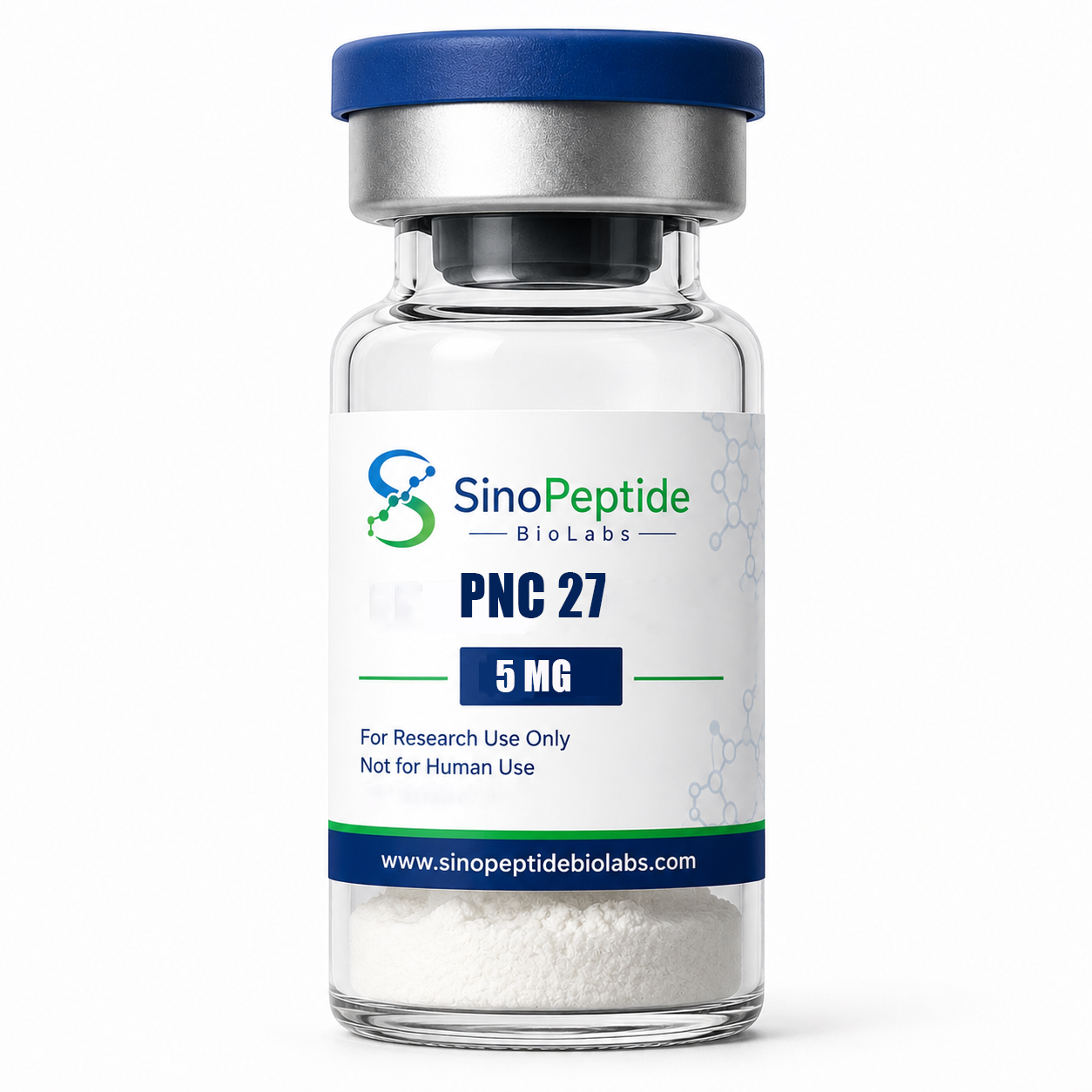
PNC 27 5mg
$105.00
10 Vials/Kits
PNC-27 5mg: Research, Mechanism, Evidence, Safety & Scientific Overview
What Is PNC-27 5mg?
PNC-27 5mg refers to a preparation containing a nominal 5 milligrams of the experimental peptide known as PNC-27.
PNC-27 is a synthetic chimeric peptide developed from a segment of the tumor-suppressor protein p53 together with a membrane-penetrating or membrane-residency sequence. Published research has investigated whether this design can interact with HDM-2, also known as human MDM2, associated with the plasma membrane of certain cancer cells.
The scientific interest in PNC-27 comes from its unusual proposed mechanism. Rather than functioning like a conventional small-molecule chemotherapy drug, PNC-27 has been investigated as a membrane-active peptide that may bind membrane-associated HDM-2 and promote formation of transmembrane pores, resulting in cancer-cell lysis or necrosis in experimental models.
Importantly, PNC-27 is an experimental research compound, not an established cancer treatment.
The distinction is essential when discussing PNC-27 online. Published laboratory studies can provide valuable information about molecular mechanisms and biological activity, but results observed in cancer cell lines or experimental models cannot automatically be translated into safety or effectiveness in humans.
The “5mg” designation describes the nominal quantity of peptide in a particular product. It does not establish a validated human dose, treatment schedule, route of administration or clinical indication.
PNC-27 5mg at a Glance
| Characteristic | Description |
|---|---|
| Compound | PNC-27 |
| Type | Synthetic chimeric peptide |
| Research classification | Experimental peptide |
| Key biological target studied | Membrane-associated HDM-2/MDM2 |
| p53 relationship | Contains a p53-derived binding region |
| Research mechanism | Membrane interaction and pore formation |
| Approximate peptide length | 32 amino acids |
| Example product quantity | 5mg |
| Main research area | Cancer biology |
| Evidence stage | Preclinical |
| Human clinical evidence | Not established |
| FDA-approved treatment | No approved indication identified |
| Human dosing | Not clinically established |
| Intended interpretation | Research, not established medical therapy |
The exact specifications of a commercial PNC-27 5mg product should always be checked against its manufacturer’s documentation, including identity, purity, batch information and certificate of analysis.
What Is PNC-27?
PNC-27 is a 32-residue peptide containing a region derived from the p53 protein and a membrane-associated peptide sequence.
The p53-derived portion corresponds to a region involved in binding HDM-2. Researchers designed PNC-27 to exploit interactions between this region and HDM-2 while incorporating a membrane-active sequence.
Early structural work investigated the molecular configuration of PNC-27 and reported amphipathic structures that could potentially support interaction with biological membranes.
Later research proposed that PNC-27 can bind membrane-associated HDM-2 and participate in formation of membrane pores.
A 2010 PNAS study reported that PNC-27 interacted with membrane-associated HDM-2 in cancer cells and that experimental manipulation causing HDM-2 expression at the membrane of an otherwise resistant cell line increased susceptibility to the peptide.
These findings helped establish the scientific rationale for continued investigation of PNC-27.
However, the mechanism remains a research hypothesis supported by preclinical experiments, rather than a clinically validated therapeutic mechanism.
How Does PNC-27 Work?
The proposed mechanism of PNC-27 is different from that of many conventional anticancer medicines.
Researchers have focused on the relationship between PNC-27 and HDM-2/MDM2.
MDM2 is well known for its interaction with p53 inside cells. In the PNC-27 research program, investigators have also examined HDM-2 associated with the plasma membrane of cancer cells.
The proposed sequence of events is broadly:
- PNC-27 encounters a membrane containing HDM-2.
- The p53-derived portion of the peptide interacts with the HDM-2 binding region.
- The membrane-associated peptide participates in formation of a pore-like structure.
- Membrane integrity is disrupted.
- Cellular contents can leak through the damaged membrane.
- The affected cancer cell undergoes necrotic or lytic cell death.
Experimental studies have reported this type of membrane disruption in several cancer-cell models.
The mechanism is scientifically interesting because it does not depend exclusively on the conventional intracellular p53 pathway.
For example, a study involving K562 leukemia cells reported PNC-27-associated membrane damage even though the cells lacked functional p53 expression, supporting the possibility that membrane-associated HDM-2 can serve as an important target in the experimental mechanism.
PNC-27 and HDM-2/MDM2 Research
HDM-2 and MDM2 are names commonly used for the human homolog of the mouse double minute 2 protein.
The protein has an important relationship with the tumor suppressor p53.
Under normal biological conditions, MDM2 contributes to regulation of p53. Cancer biology researchers have therefore investigated MDM2 extensively as a potential therapeutic target.
PNC-27 takes a somewhat different approach.
Instead of simply attempting to inhibit the intracellular interaction between MDM2 and p53, researchers have investigated whether PNC-27 can recognize HDM-2 associated with the cancer-cell membrane.
A 2010 study found membrane-associated HDM-2 in several cancer-cell models and reported that PNC-27 localized with this protein. The study also reported that untransformed cells engineered to express membrane-localized HDM-2 became susceptible to PNC-27.
These experiments provide mechanistic evidence for the proposed target.
They do not establish that all cancers express membrane HDM-2 or that a PNC-27 product would selectively destroy tumors in a human patient.
PNC-27 5mg and Cancer Research
PNC-27 is primarily discussed in scientific literature in connection with experimental cancer research.
Researchers have examined the peptide in several types of cancer-cell models, including studies involving:
- Breast cancer cells
- Pancreatic cancer cells
- Ovarian cancer cells
- Leukemia cells
- Other tumor-cell systems
A 2010 study examined PNC-27 in breast cancer cell models and reported membrane localization and tumor-cell lysis.
Research involving leukemia cells subsequently reported PNC-27-associated necrosis in a human K562 leukemia cell line, with the findings linked to membrane-associated HDM-2.
Another study investigated freshly isolated epithelial ovarian cancer cells and reported dose-dependent inhibition of cell growth and cytotoxicity in the experimental setting.
These studies are useful for understanding the scientific development of PNC-27.
They should not, however, be interpreted as clinical evidence that PNC-27 treats cancer in humans.
PNC-27 and Breast Cancer Research
One of the early experimental systems used to investigate PNC-27 involved breast cancer cells.
Researchers compared cancerous MCF-7 cells with an untransformed breast epithelial cell line.
The study reported that PNC-27 accumulated in the cancer-cell membrane and was associated with membrane lysis, while the untransformed cells remained viable under the experimental conditions.
Further structural and molecular research supported the hypothesis that PNC-27’s p53-derived region interacts with HDM-2 while the membrane-active portion contributes to pore formation.
This work illustrates why PNC-27 continues to attract interest in cancer biology.
At the same time, cell-culture selectivity does not guarantee selectivity within a human body. Human tissues contain many cell types, proteins and biological barriers that cannot be reproduced completely in a laboratory dish.
PNC-27 and Leukemia Research
PNC-27 has also been investigated in leukemia models.
A published study examined the K562 leukemia cell line, which is notable because it lacks functional p53 expression.
Researchers reported strong HDM-2 expression at the cell membrane and observed PNC-27 colocalization with membrane-associated HDM-2.
The study reported substantial experimental cell killing associated with membrane damage while the control normal leukocyte population was not affected under the tested conditions.
Additional research investigated acute myeloid leukemia and reported findings involving membrane HDM2 and PNC-27 in human and mouse experimental models. The study described activity against AML blasts and leukemia stem-cell-enriched populations in experimental settings.
These results are scientifically relevant but remain preclinical evidence.
They do not establish an effective or safe PNC-27 treatment protocol for people with leukemia.
PNC-27 and Ovarian Cancer Research
PNC-27 has also been studied using ovarian cancer models.
A 2015 study examined freshly isolated primary ovarian cancer cells as well as established ovarian cancer cell lines. The researchers reported PNC-27-associated cytotoxicity and inhibition of cell growth in their experimental systems.
Other research has investigated the relationship between HDM-2 expression in ovarian cancer cells and PNC-27-associated membrane disruption.
These findings contribute to the broader hypothesis that membrane-associated HDM-2 could potentially be exploited as a molecular target.
However, an ex vivo or cell-culture result is not equivalent to a clinical treatment outcome.
PNC-27 and Pancreatic Cancer Research
Pancreatic cancer has also appeared in PNC-27 research.
Laboratory experiments have investigated PNC-27 against pancreatic cancer cells and examined its interactions with HDM-2 and cellular membranes.
A 2024 publication reported that PNC-27 interacted with the p53-binding region of HDM-2 and described additional effects involving mitochondrial membranes in treated pancreatic cancer cells.
This research adds another dimension to the proposed mechanism.
The important limitation remains the same: these observations are experimental findings and should not be presented as evidence that PNC-27 is an established pancreatic cancer treatment.
PNC-27 5mg: What Does 5mg Mean?
The “5mg” in PNC-27 5mg generally indicates the nominal quantity of peptide supplied in the product.
It does not mean that 5mg is an established human treatment dose.
This distinction is especially important for experimental compounds.
A product label might describe a vial as containing 5mg of PNC-27, but that information alone does not establish:
- Human dosage
- Frequency of administration
- Route of administration
- Treatment duration
- Safety
- Pharmacokinetics
- Therapeutic effectiveness
There is currently no clinically validated human dosing regimen that can be inferred simply from a 5mg vial.
Therefore, responsible SEO content should avoid converting the vial quantity into a treatment recommendation.
PNC-27 5mg vs. PNC-28
PNC-27 and PNC-28 are related experimental peptides, but they should not be treated as identical.
Both belong to a research program involving p53-derived sequences and membrane-active mechanisms.
However, they contain different p53-derived regions and therefore have distinct molecular characteristics.
This distinction matters because research findings involving PNC-28 should not automatically be presented as evidence for PNC-27.
Some online sources combine results from the two compounds when describing experimental anticancer activity. A careful scientific article should identify which peptide was actually studied in each experiment.
This is particularly important for SEO pages because combining evidence from related but different peptides can create misleading claims.
PNC-27 Research Evidence: What Do Studies Actually Show?
The available evidence can broadly be divided into several categories.
Cell-Culture Research
A substantial portion of the PNC-27 literature involves cancer cell lines.
These experiments are useful for studying:
- Molecular binding
- Membrane localization
- Cytotoxicity
- Membrane permeability
- HDM-2 interactions
- Cellular morphology
- Mechanisms of cell death
Multiple published studies report PNC-27-associated cancer-cell damage under experimental conditions.
Ex Vivo Research
Researchers have also examined freshly isolated human tumor cells outside the body.
For example, ovarian cancer cells have been used to investigate PNC-27-associated cytotoxicity.
Ex vivo research is useful because it can involve primary human cells, but it still does not represent a clinical trial.
Animal Research
Some research programs involving PNC peptides have investigated tumor models in animals.
However, evidence should be attributed to the exact peptide used in the experiment. Findings involving PNC-28 or other related peptides should not automatically be attributed to PNC-27.
Human Clinical Research
This is the major evidence gap.
Current searches do not establish a validated body of human clinical-trial evidence for PNC-27. Consequently, there is no established human efficacy profile, pharmacokinetic profile or clinically validated dosing regimen for PNC-27.
That limitation should appear prominently on any responsible product or research page.
Is PNC-27 FDA Approved?
PNC-27 should not be presented as an FDA-approved cancer medicine.
Current research references characterize PNC-27 as an experimental research peptide rather than an approved cancer treatment.
The absence of an approved indication means that marketing a research-grade PNC-27 product as a proven cancer therapy would be scientifically and regulatory misleading.
This is particularly important because the phrase “anticancer peptide” appears in some scientific titles. The phrase describes the research hypothesis and experimental activity being investigated; it does not mean that a regulatory authority has approved PNC-27 to treat cancer.
Does PNC-27 Cure Cancer?
There is no clinical evidence establishing that PNC-27 cures cancer.
Published studies have reported cytotoxic effects against cancer cells under laboratory conditions and have explored mechanisms involving HDM-2 and membrane disruption.
However, demonstrating cancer-cell killing in vitro is an early stage of drug development.
Before an experimental peptide could be considered an established cancer treatment, researchers would need evidence addressing issues such as:
- Pharmacokinetics
- Biodistribution
- Appropriate dosing
- Toxicology
- Off-target effects
- Immunogenicity
- Manufacturing consistency
- Phase 1 safety
- Clinical efficacy
- Long-term safety
Therefore, claims that PNC-27 “cures cancer,” “eliminates tumors” or “replaces chemotherapy” should not be used as factual product claims.
Potential Advantages of the PNC-27 Research Concept
Although PNC-27 is not an established therapy, its mechanism presents several areas of scientific interest.
Membrane-Based Targeting
PNC-27 research focuses on HDM-2 associated with the cancer-cell membrane rather than solely on intracellular signaling.
p53-Derived Recognition
The peptide incorporates a region derived from p53 that is relevant to HDM-2 binding.
Membrane Disruption
Experimental studies suggest that PNC-27 can produce membrane pores under certain laboratory conditions.
Investigation Across Cancer Models
Researchers have examined PNC-27 in multiple cancer-cell systems, including breast, ovarian, pancreatic and leukemia models.
Novel Drug-Development Strategy
The research represents an approach based on targeted membrane disruption rather than conventional receptor inhibition or cytotoxic chemotherapy.
These are research characteristics, not established therapeutic benefits.
Limitations of PNC-27 Research
A high-quality article should also discuss the limitations.
Limited Clinical Evidence
The largest limitation is the absence of an established human clinical evidence base.
Laboratory Results May Not Translate to Humans
Cancer cells in culture are exposed directly to experimental concentrations of a compound. A human body presents considerably more complex pharmacological and biological barriers.
Pharmacokinetics Are Unclear
Without adequate human studies, important questions remain concerning absorption, distribution, metabolism and elimination.
Selectivity Requires Further Validation
A compound that appears selective in a controlled cell experiment may behave differently in complex human tissues.
Manufacturing Quality Matters
A research peptide’s purity, aggregation state, contaminants and formulation can influence experimental outcomes.
Related Peptides Should Not Be Confused
Evidence for PNC-28 or another p53-derived peptide should not automatically be assigned to PNC-27.
PNC-27 5mg Safety Considerations
Because PNC-27 lacks an established clinical safety profile, safety should be discussed conservatively.
There is no sufficiently developed human clinical dataset from which a comprehensive list of adverse effects, safe doses or long-term risks can be established.
Potential areas requiring investigation in formal drug development include:
- Off-target membrane effects
- Immunogenicity
- Tissue distribution
- Interaction with normal cells
- Organ toxicity
- Repeated-exposure effects
- Metabolic stability
- Drug interactions
- Effects on non-tumor tissues
The absence of established human adverse-event data should not be interpreted as evidence that the compound is safe.
For this reason, a research-use PNC-27 product should not be represented as suitable for self-treatment.
Why Product Quality Matters for PNC-27 5mg
If PNC-27 is being evaluated for laboratory research, product documentation is important.
A reputable research material should ideally provide information such as:
Identity
The documentation should identify the compound as PNC-27 and provide appropriate analytical confirmation.
Purity
Purity testing helps determine how much of the material corresponds to the stated compound.
Batch Information
A batch or lot number supports traceability.
Certificate of Analysis
A COA can provide analytical information for a particular production batch.
Molecular Information
Research organizations may require sequence, molecular-weight and analytical information for reproducibility.
Storage Requirements
Storage conditions should come from the product’s technical documentation rather than assumptions based on other peptides.
PNC-27 5mg for Laboratory Research
PNC-27 is best discussed as a research compound for experimental cancer biology.
Potential research questions include:
- How does PNC-27 interact with membrane-associated HDM-2?
- Which cancer cells express membrane-associated HDM-2?
- What structural features determine peptide binding?
- How do membrane pores form?
- What determines cellular susceptibility?
- Can delivery systems improve experimental targeting?
- How does PNC-27 behave in different biological environments?
- What safety barriers would need to be addressed before clinical development?
These questions demonstrate why PNC-27 remains scientifically interesting without turning experimental observations into medical promises.
PNC-27 and Drug-Delivery Research
Another area of interest involves using PNC-27 as a targeting component.
One study investigated PNC-27 as a targeting ligand attached to liposomal doxorubicin, examining whether PNC-27 could improve uptake and cytotoxicity in HDM-2-positive experimental tumor cells. The study reported increased experimental activity in an HDM-2-positive model compared with controls.
This illustrates an important point about peptide research.
A peptide does not necessarily need to function as a standalone drug. Researchers can also investigate peptides as:
- Targeting ligands
- Delivery components
- Molecular probes
- Diagnostic tools
- Components of nanoparticle systems
However, these applications remain experimental unless validated through appropriate clinical development.
How to Evaluate a PNC-27 5mg Product
Before purchasing or researching a PNC-27 5mg product, consider the following checklist.
1. Confirm the Exact Compound
Make sure the product is actually identified as PNC-27 rather than PNC-28 or another related peptide.
2. Check the Quantity
Confirm that the stated quantity is 5mg total and not 5mg/mL or another concentration.
3. Review the COA
Look for batch-specific analytical documentation.
4. Check Purity
Determine whether the manufacturer provides an analytical purity specification and method.
5. Verify the Sequence or Molecular Identity
For research applications, molecular identity is particularly important.
6. Check Intended Use
A product labeled research use only should not be represented as a medicine.
7. Avoid Unsupported Clinical Claims
Terms such as “cancer cure,” “guaranteed tumor killer” or “safe cancer treatment” are not supported by the current clinical evidence.
PNC-27 5mg Frequently Asked Questions
What is PNC-27 5mg?
PNC-27 5mg refers to a product containing a nominal 5mg quantity of the experimental PNC-27 peptide.
What is PNC-27?
PNC-27 is a synthetic 32-residue chimeric peptide containing a p53-derived HDM-2-binding region and a membrane-active sequence.
What is PNC-27 studied for?
PNC-27 has primarily been studied in experimental cancer biology, particularly its interaction with membrane-associated HDM-2 and its ability to disrupt cancer-cell membranes.
How does PNC-27 work?
Preclinical research proposes that PNC-27 binds membrane-associated HDM-2 and contributes to transmembrane pore formation, resulting in cancer-cell membrane disruption.
Is PNC-27 a cancer treatment?
PNC-27 is an experimental research peptide, not an established cancer treatment.
Is PNC-27 FDA approved?
PNC-27 should not be represented as an FDA-approved cancer treatment. No approved therapeutic indication for the exact compound has been established in the evidence reviewed for this article.
Does PNC-27 cure cancer?
There is no clinical evidence establishing that PNC-27 cures cancer.
Has PNC-27 been tested in cancer cells?
Yes. Published studies have investigated PNC-27 in multiple cancer-cell models, including breast cancer, leukemia, ovarian cancer and pancreatic cancer research.
What does the 5mg designation mean?
It generally refers to the nominal amount of PNC-27 in the product. It should not be interpreted as a validated human treatment dose.
Is there an established human dose for PNC-27?
No clinically validated human dosage regimen has been established. Preclinical research cannot be converted directly into a human dosing recommendation.
Is PNC-27 the same as PNC-28?
No. They are related experimental peptides but are chemically distinct and should not be treated as interchangeable.
What is HDM-2?
HDM-2, also known as human MDM2, is a protein involved in regulation of p53. PNC-27 research investigates a specific interaction between the peptide and membrane-associated HDM-2.
Is PNC-27 a peptide?
Yes. PNC-27 is a synthetic peptide.
Is PNC-27 the same as p53?
No. PNC-27 contains a p53-derived sequence but is a separately engineered synthetic peptide.
Is PNC-27 suitable for human self-administration?
A research-grade PNC-27 product should not be treated as an established human medicine. There is insufficient clinical evidence to establish safe self-administration.
Where is PNC-27 research conducted?
Published studies have investigated the peptide in laboratory cancer-cell models and other preclinical experimental systems.
Final Thoughts on PNC-27 5mg
PNC-27 5mg represents an experimental research peptide with a distinctive mechanism under investigation in cancer biology.
The peptide was designed around a p53-derived HDM-2-binding region combined with a membrane-active sequence. Research has reported interactions between PNC-27 and membrane-associated HDM-2 and has described membrane pore formation and cancer-cell lysis in experimental systems.
Additional studies have investigated PNC-27 in leukemia, ovarian, breast and pancreatic cancer models, providing a growing body of mechanistic and preclinical literature.
However, the most important limitation is the gap between preclinical research and clinical medicine.
Laboratory evidence does not establish that PNC-27 is safe or effective as a cancer treatment in humans. There is no clinically validated human dosing regimen, and PNC-27 should not be marketed as a cure for cancer or as a substitute for established oncology treatment.
For researchers evaluating PNC-27 5mg, product quality and documentation are equally important. Identity, purity, batch information, molecular characterization and a suitable certificate of analysis can help support reproducible laboratory work.
Ultimately, PNC-27 is best understood as an investigational peptide being studied for its interaction with HDM-2 and cancer-cell membranes, rather than as an approved therapeutic product.
Research-use disclaimer: This article is intended for scientific and educational information. A research-grade PNC-27 product should not be represented as an approved medicine or used as a substitute for professional cancer diagnosis or treatment. Product specifications, regulatory status and intended use should be independently verified from authoritative documentation.
PNC-27 5mg PNC-27 5mgPNC-27 5mg PNC-27 5mgPNC-27 5mg PNC-27 5mg PNC-27 5mg PNC-27 5mg PNC-27 5mg PNC-27 5mg PNC-27 5mg PNC-27 5mg PNC-27 5mg PNC-27 5mg PNC-27 5mg PNC-27 5mg PNC-27 5mg PNC-27 5mg PNC-27 5mg PNC-27 5mg PNC-27 5mg PNC-27 5mg PNC-27 5mg PNC-27 5mg PNC-27 5mg PNC-27 5mg PNC-27 5mg PNC-27 5mg PNC-27 5mg PNC-27 5mg PNC-27 5mg PNC-27 5mg PNC-27 5mg PNC-27 5mg PNC-27 5mg PNC-27 5mg PNC-27 5mg PNC-27 5mg PNC-27 5mg PNC-27 5mg PNC-27 5mg PNC-27 5mg v PNC-27 5mg PNC-27 5mg PNC-27 5mg
Be the first to review “PNC 27 5mg”
Related products

Pure Peptides
Pure Peptides
Pure Peptides
Pure Peptides
Pure Peptides
Pure Peptides
Pure Peptides
Pure Peptides
Reviews
There are no reviews yet.