

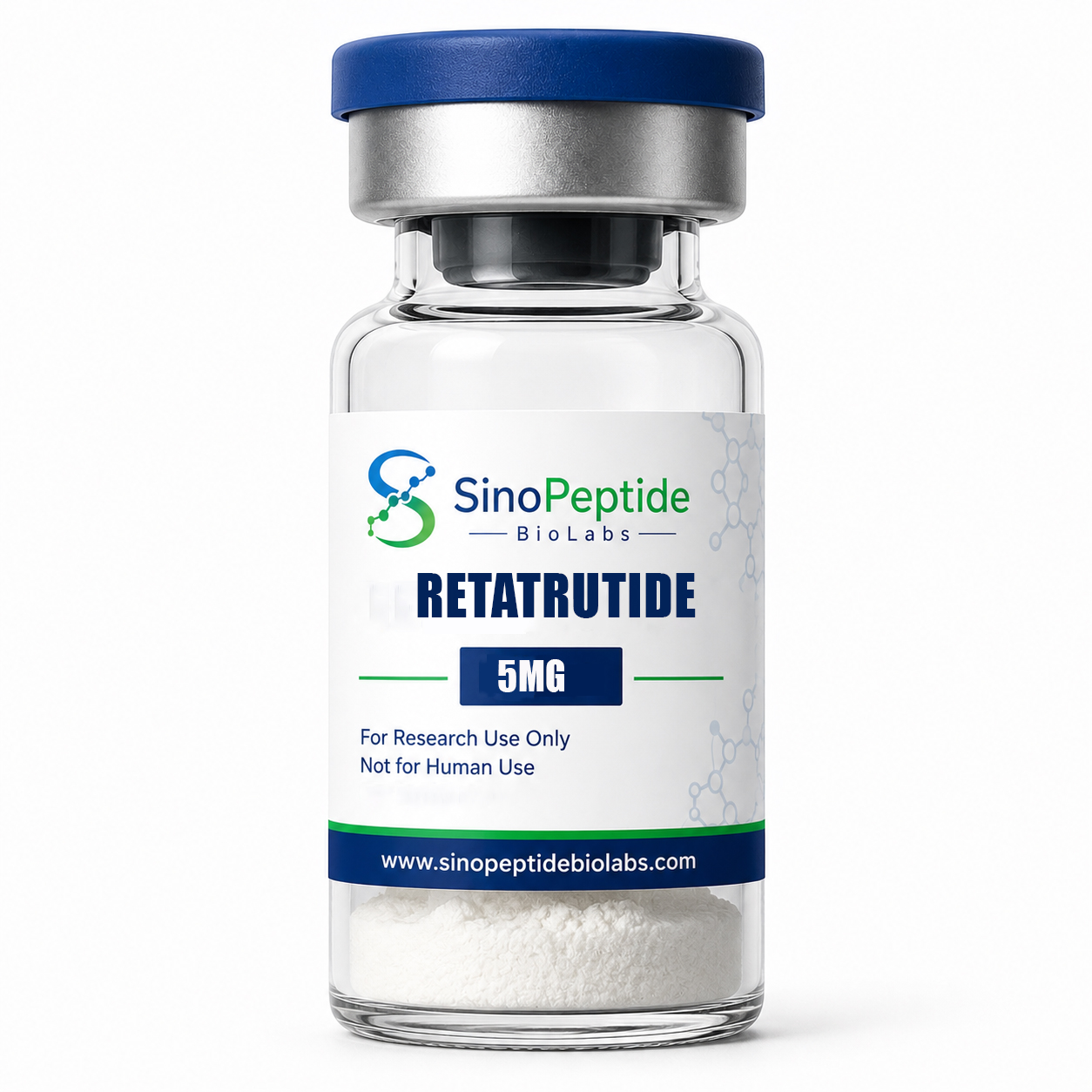
Retatrutide 5mg
$65.00
10Vials/ Kits
Retatrutide 5mg: Complete Guide to Research, Mechanism, Clinical Evidence and Safety
Retatrutide 5mg is a product designation associated with retatrutide, an investigational peptide being studied for its potential effects on metabolic health, body weight, glucose regulation, and related conditions. Retatrutide is also known by the development code LY3437943.
Unlike approved medicines such as semaglutide or tirzepatide, retatrutide remains an investigational compound. It has attracted substantial scientific interest because it activates three hormone receptors involved in metabolic regulation: the glucose-dependent insulinotropic polypeptide (GIP) receptor, glucagon-like peptide-1 (GLP-1) receptor, and glucagon receptor.
The term “Retatrutide 5mg” therefore needs to be handled carefully in SEO content. A 5mg product label should not be presented as evidence that 5mg is an FDA-approved dosage, nor should it be implied that a 5mg regimen has the same clinical evidence as the doses directly evaluated in published trials.
The landmark phase 2 obesity trial evaluated once-weekly retatrutide at 1mg, 4mg, 8mg, and 12mg, with different starting-dose strategies for some groups. A 5mg treatment arm was not included in that study.
This guide explains what Retatrutide 5mg means, how retatrutide works, what clinical research has shown so far, how 5mg differs from studied trial regimens, quality considerations, regulatory status, and important safety limitations.
Retatrutide 5mg at a Glance
| Feature | Information |
|---|---|
| Active compound | Retatrutide |
| Development code | LY3437943 |
| Drug type | Investigational peptide |
| Receptor activity | GIP, GLP-1 and glucagon receptors |
| Common research area | Obesity and metabolic disease |
| 5mg clinical-trial arm | Not used in the landmark phase 2 obesity trial |
| FDA-approved medicine | No |
| Established FDA-approved dose | None |
| Clinical development | Ongoing |
| Research status | Investigational |
| Key published obesity study | Phase 2, 48-week trial |
| Major research finding | Substantial weight reduction at studied doses |
| Important limitation | Results from studied doses should not be extrapolated directly to 5mg |
What Is Retatrutide?
Retatrutide is a synthetic peptide being investigated as a triple hormone-receptor agonist.
It is designed to activate three metabolic pathways:
- GIP
- GLP-1
- Glucagon
This three-receptor mechanism is what distinguishes retatrutide from several currently available incretin-based medicines.
Tirzepatide, for example, activates GIP and GLP-1 receptors, whereas retatrutide additionally activates the glucagon receptor. The scientific rationale for this combination is based on the complementary roles these pathways can play in energy intake, glucose regulation, and energy metabolism.
Retatrutide should not, however, be described as an approved weight-loss medication. As of the current FDA information, retatrutide is not an FDA-approved component of an approved drug and has not been established as safe and effective for a medical condition by the FDA.
What Does Retatrutide 5mg Mean?
The phrase Retatrutide 5mg generally describes a product containing or labeled as containing 5 milligrams of retatrutide.
However, the number “5mg” should not automatically be interpreted as an established clinical dose.
This distinction is particularly important because retatrutide is still under clinical development.
The major phase 2 obesity study published in the New England Journal of Medicine evaluated 1mg, 4mg, 8mg, and 12mg once-weekly treatment groups. It did not evaluate a 5mg treatment arm.
Therefore, an SEO page should avoid claims such as:
- “Retatrutide 5mg is the standard dose.”
- “Retatrutide 5mg is FDA approved.”
- “Retatrutide 5mg is clinically proven for weight loss.”
- “Retatrutide 5mg has the same results as the 12mg trial.”
- “Retatrutide 5mg is guaranteed to reduce body weight.”
A more accurate description is:
Retatrutide 5mg is a labeled quantity of an investigational compound, while the clinical evidence for retatrutide comes from specific research regimens that do not establish 5mg as an approved or validated human treatment dose.
How Does Retatrutide Work?
Retatrutide’s proposed mechanism is based on simultaneous activity at three receptors.
GIP Receptor Activity
GIP stands for glucose-dependent insulinotropic polypeptide.
GIP is an incretin hormone involved in nutrient-related metabolic signaling.
Activation of the GIP pathway can influence glucose-dependent insulin secretion and other metabolic processes.
Retatrutide’s GIP activity is one component of its broader triple-agonist mechanism.
GLP-1 Receptor Activity
GLP-1, or glucagon-like peptide-1, is another important incretin hormone.
GLP-1 signaling participates in:
- Glucose-dependent insulin secretion
- Glucagon regulation
- Gastrointestinal function
- Appetite-related signaling
- Energy intake regulation
GLP-1 receptor agonism is already an established pharmacological approach in several approved medicines.
Retatrutide incorporates this pathway into a broader three-receptor strategy.
Glucagon Receptor Activity
The third component is glucagon receptor activation.
Glucagon has important roles in energy metabolism and glucose homeostasis. The research rationale behind retatrutide involves combining glucagon receptor activity with GIP and GLP-1 receptor activation.
Researchers are investigating whether this combination can produce meaningful effects on body weight and metabolic parameters.
The phase 2 study described retatrutide as an agonist of GIP, GLP-1, and glucagon receptors and investigated its dose-response relationships in adults with obesity.
Why Is Retatrutide Receiving Scientific Attention?
The interest in retatrutide comes largely from its triple-receptor mechanism and the magnitude of weight reduction observed in early clinical research.
The phase 2 trial enrolled 338 adults with obesity or overweight plus a weight-related condition. Participants were randomly assigned to different retatrutide treatment groups or placebo and were followed for 48 weeks.
At 48 weeks, the study reported substantial reductions in body weight across the studied retatrutide groups.
For example, the least-squares mean changes in body weight were:
- −8.7% with 1mg
- −16.3% with 4mg using a 2mg initial dose
- −17.8% with 4mg using a 4mg initial dose
- −21.7% with 8mg using a 2mg initial dose
- −23.9% with 8mg using a 4mg initial dose
- −24.2% with 12mg using a 2mg initial dose
- −2.1% with placebo
These results were obtained under the trial’s specified methodology and should not be interpreted as predictions for people using an unstudied 5mg formulation.
Was Retatrutide 5mg Studied in Clinical Trials?
This is one of the most important questions for a Retatrutide 5mg SEO page.
The answer is: not in the landmark phase 2 obesity trial.
The major published phase 2 study evaluated:
- 1mg
- 4mg
- 8mg
- 12mg
Some of these groups used different initial doses before reaching their assigned treatment level.
There was no dedicated 5mg arm in that study.
Consequently, it would be inaccurate to take the results from the 4mg, 8mg, or 12mg groups and claim that those results prove what happens with a 5mg regimen.
This distinction makes the page more scientifically credible and prevents an important SEO problem: confusing a commercial product label with an established clinical dose.
Retatrutide 5mg and Weight-Loss Research
Retatrutide has generated considerable interest in obesity research because of the weight reductions observed in early trials.
However, the appropriate terminology is weight-loss research, not established weight-loss treatment.
The phase 2 trial found that retatrutide produced substantial body-weight reductions over 48 weeks, with larger average reductions at the higher studied doses.
For the 12mg group, the reported least-squares mean reduction at week 48 was 24.2%.
The study also reported that:
- 100% of participants in the 12mg group achieved at least 5% weight reduction.
- 93% achieved at least 10%.
- 83% achieved at least 15%.
Again, these figures describe participants receiving the studied 12mg regimen, not a hypothetical or commercial 5mg product.
This distinction should be preserved throughout any website content discussing Retatrutide 5mg.
Retatrutide 5mg vs. Studied Retatrutide Doses
| Retatrutide amount | Role in landmark phase 2 obesity trial |
|---|---|
| 1mg | Studied |
| 4mg | Studied |
| 5mg | Not studied in this trial |
| 8mg | Studied |
| 12mg | Studied |
This table provides an important SEO opportunity because users searching for “Retatrutide 5mg” may assume that every commercially listed strength corresponds directly to a clinical-trial dose.
It does not.
A product quantity and a clinical research regimen are two different concepts.
Retatrutide 5mg and FDA Status
Retatrutide is not an FDA-approved medication.
The FDA currently states that retatrutide is not a component of an FDA-approved drug and has not been found safe and effective for any condition. The agency has also stated that retatrutide cannot be used in compounding under federal law.
This makes regulatory wording particularly important for websites publishing Retatrutide 5mg content.
A page should not describe Retatrutide 5mg as:
- FDA approved
- FDA-approved weight-loss treatment
- FDA-approved peptide
- Approved obesity medication
- Approved diabetes medication
Instead, appropriate terminology includes:
- Investigational compound
- Retatrutide research
- Clinical-development candidate
- Investigational triple agonist
- Compound under clinical investigation
Retatrutide Research and Regulatory Considerations
The distinction between research and commercial medical use is important.
FDA enforcement actions in 2026 have specifically addressed websites marketing retatrutide and other unapproved products as drugs. In one August 2026 warning letter, the FDA identified a website marketing retatrutide as an unapproved new drug.
The FDA has also warned that retatrutide cannot be used in compounding under federal law.
Therefore, websites should avoid marketing language that turns an investigational compound into an established medical treatment.
For SEO purposes, accurate regulatory language is also more sustainable than exaggerated claims.
Retatrutide 5mg Safety Research
Because retatrutide remains investigational, its safety profile continues to be evaluated through clinical development.
The phase 2 obesity study reported gastrointestinal adverse events as the most common adverse events. These effects were dose-related and were generally mild to moderate. The study also found that using a lower initial dose partially reduced gastrointestinal adverse events.
The study reported dose-dependent increases in heart rate that peaked around week 24 and subsequently declined.
These findings are important because they demonstrate why investigational compounds should not be marketed as risk-free.
A responsible Retatrutide 5mg page should avoid statements such as:
- “No side effects”
- “Completely safe”
- “Zero health risks”
- “Safe for everyone”
- “Guaranteed tolerability”
The available evidence does not support such claims.
Common Adverse Events Reported in Retatrutide Research
The published phase 2 trial identified gastrointestinal reactions as the most common adverse events.
Reported reactions included issues such as:
- Nausea
- Diarrhea
- Vomiting
- Other gastrointestinal symptoms
The frequency and severity of these effects varied across treatment groups.
The researchers also observed changes in heart rate that were dose-dependent.
Because retatrutide remains investigational, its eventual safety profile cannot be assumed to be identical to that of currently approved GLP-1 or GIP/GLP-1 medicines.
Retatrutide 5mg Quality Considerations
If a website discusses a Retatrutide 5mg research product, quality information should be presented carefully.
Potentially useful analytical documentation may include:
Identity Testing
Identity testing is intended to establish whether the material corresponds to the stated compound.
Purity Testing
Purity analysis can help characterize the proportion of the desired peptide relative to detected impurities or related substances.
HPLC Analysis
High-performance liquid chromatography, commonly abbreviated as HPLC, is widely used for analytical characterization of peptides.
Mass Spectrometry
Mass spectrometry may be used to support molecular identity by examining molecular mass.
Certificate of Analysis
A Certificate of Analysis, or COA, can provide batch-specific analytical information when issued by an appropriately qualified laboratory.
A website should only make claims such as “99% pure,” “pharmaceutical grade,” or “independently tested” when appropriate documentation actually supports those statements.
Retatrutide 5mg: What a COA Should Tell You
A useful COA may include information such as:
- Product or compound name
- Batch or lot number
- Test method
- Identity result
- Purity or assay result
- Testing date
- Laboratory information
- Acceptance criteria
- Reported result
However, a COA should not automatically be interpreted as proof that a research product is FDA approved or suitable for human use.
Analytical quality and regulatory approval are different concepts.
Retatrutide 5mg Storage Considerations
Storage requirements depend on the exact research material, formulation, packaging, and manufacturer instructions.
For that reason, websites should avoid presenting a generic storage instruction as universally applicable to every Retatrutide 5mg product.
Research materials should be stored according to the supplier’s documented specifications.
Where stability information is unavailable, websites should not invent a shelf life or claim a specific storage condition without supporting documentation.
Retatrutide 5mg vs Tirzepatide
Retatrutide and tirzepatide are related in that both interact with GIP and GLP-1 pathways, but they are not the same molecule.
| Characteristic | Retatrutide | Tirzepatide |
|---|---|---|
| GIP receptor | Yes | Yes |
| GLP-1 receptor | Yes | Yes |
| Glucagon receptor | Yes | No |
| Regulatory status | Investigational | Approved in specific products/indications |
| Clinical development | Ongoing | Established clinical use |
| Triple agonist | Yes | No |
| Weight-management research | Extensive and ongoing | Extensive |
The additional glucagon-receptor activity is a central feature of retatrutide research.
However, comparing early-stage retatrutide research with an approved medicine should not be used to imply that retatrutide is already clinically equivalent to or superior to approved therapies.
Retatrutide 5mg vs Semaglutide
Semaglutide is primarily a GLP-1 receptor agonist, whereas retatrutide activates three receptors.
The different mechanisms are scientifically important.
Retatrutide’s triple-receptor activity is one reason researchers are investigating whether it can produce broader metabolic effects.
However, the clinical evidence for semaglutide and retatrutide comes from different development programs, populations, trial designs, and regulatory contexts.
Therefore, comparisons should focus on documented mechanisms and trial results rather than unsupported claims that one compound is universally “better.”
Why Retatrutide 5mg Is Popular in Search Queries
The phrase “Retatrutide 5mg” has strong search relevance because users often search pharmaceutical and peptide compounds by name plus quantity.
Related searches may include:
- Retatrutide 5mg
- Retatrutide 5 mg
- Retatrutide 5mg peptide
- Retatrutide 5mg research
- Retatrutide 5mg clinical trial
- Retatrutide 5mg weight loss
- Retatrutide 5mg safety
- Retatrutide 5mg dosage
- Retatrutide LY3437943
- Retatrutide triple agonist
A strong SEO page should answer these queries without turning unsupported search language into medical claims.
SEO Best Practices for a Retatrutide 5mg Product Page
A high-quality page should include:
1. A clear primary keyword
Use Retatrutide 5mg naturally in the title, H1, introduction, and selected subheadings.
2. Accurate scientific terminology
Explain that retatrutide is a GIP, GLP-1, and glucagon receptor agonist.
3. Regulatory transparency
Clearly state that retatrutide is investigational and not FDA approved.
4. Evidence-based clinical information
Reference the phase 2 clinical trial without presenting its results as proof of what a 5mg product will achieve.
5. Product-quality information
Discuss identity, purity, HPLC, mass spectrometry, and COA documentation where applicable.
6. Useful FAQs
Answer questions that searchers are likely to ask about mechanism, clinical research, safety, and regulatory status.
7. Avoid keyword stuffing
Repeating “Retatrutide 5mg” excessively can reduce readability. Semantic relevance is better achieved through related terms and genuinely useful information.
Frequently Asked Questions About Retatrutide 5mg
What is Retatrutide 5mg?
Retatrutide 5mg refers to a product or research material labeled as containing 5mg of retatrutide. Retatrutide is an investigational GIP, GLP-1, and glucagon receptor agonist.
Is Retatrutide 5mg FDA approved?
No. Retatrutide is not an FDA-approved drug. The FDA states that retatrutide is not a component of an FDA-approved drug and has not been found safe and effective for any condition.
Was 5mg retatrutide studied in clinical trials?
The major published phase 2 obesity trial did not include a 5mg treatment group. It evaluated 1mg, 4mg, 8mg, and 12mg regimens.
What is retatrutide also called?
Retatrutide is also known by its development code LY3437943.
How does retatrutide work?
Retatrutide activates GIP, GLP-1, and glucagon receptors, making it a triple hormone-receptor agonist.
Has retatrutide been studied for weight loss?
Yes. A phase 2 randomized clinical trial studied retatrutide in adults with obesity or overweight plus a weight-related condition and reported substantial reductions in body weight over 48 weeks.
Did the clinical trial study 5mg specifically?
No. The landmark phase 2 study used 1mg, 4mg, 8mg, and 12mg treatment groups.
What side effects have been reported in retatrutide research?
Gastrointestinal adverse events were the most common in the phase 2 trial. The study also reported dose-dependent increases in heart rate that later declined.
Is Retatrutide 5mg the same as an approved GLP-1 medicine?
No. Retatrutide is an investigational triple agonist and should not be represented as interchangeable with approved GLP-1 medicines.
Is Retatrutide 5mg a standard medical dose?
There is no FDA-established standard medical dose for retatrutide because it is not an FDA-approved medicine.
Can the results from 12mg retatrutide be applied to 5mg?
No. Results from a specific clinical-trial dose should not automatically be extrapolated to an unstudied 5mg regimen.
What should a Retatrutide 5mg COA contain?
A batch-specific COA may contain identity, purity or assay, testing method, batch information, testing date, and laboratory information. The exact documentation depends on the testing laboratory and product.
Final Takeaway
Retatrutide 5mg is best described as a research-oriented product designation for retatrutide, an investigational triple hormone-receptor agonist also known as LY3437943.
Retatrutide is scientifically significant because it simultaneously targets the GIP, GLP-1, and glucagon receptors. Early clinical research has demonstrated substantial effects on body weight, particularly at the higher doses evaluated in the phase 2 obesity trial.
However, accuracy is especially important when writing about Retatrutide 5mg.
The landmark phase 2 obesity study did not evaluate a 5mg treatment arm. It studied 1mg, 4mg, 8mg, and 12mg regimens. Consequently, the results from those groups should not be presented as direct evidence for a 5mg regimen.
Retatrutide also remains investigational and is not FDA approved. The FDA has specifically stated that retatrutide is not a component of an FDA-approved drug and has not been found safe and effective for any condition.
For an SEO-focused website, the strongest approach is therefore to combine the primary keyword Retatrutide 5mg with accurate scientific explanations, transparent regulatory language, clinical-trial context, quality considerations, and safety information.
This approach creates content that is more useful to readers while avoiding unsupported claims about dosage, efficacy, approval, or guaranteed results.
Research-use disclaimer: Retatrutide is an investigational compound. This article is provided for educational and research-information purposes and should not be interpreted as medical advice, a prescription, or evidence that Retatrutide 5mg is an approved human treatment.
Be the first to review “Retatrutide 5mg”
Related products
Pure Peptides
Pure Peptides
Pure Peptides
Pure Peptides
Pure Peptides
Pure Peptides
Pure Peptides
Pure Peptides
Reviews
There are no reviews yet.