

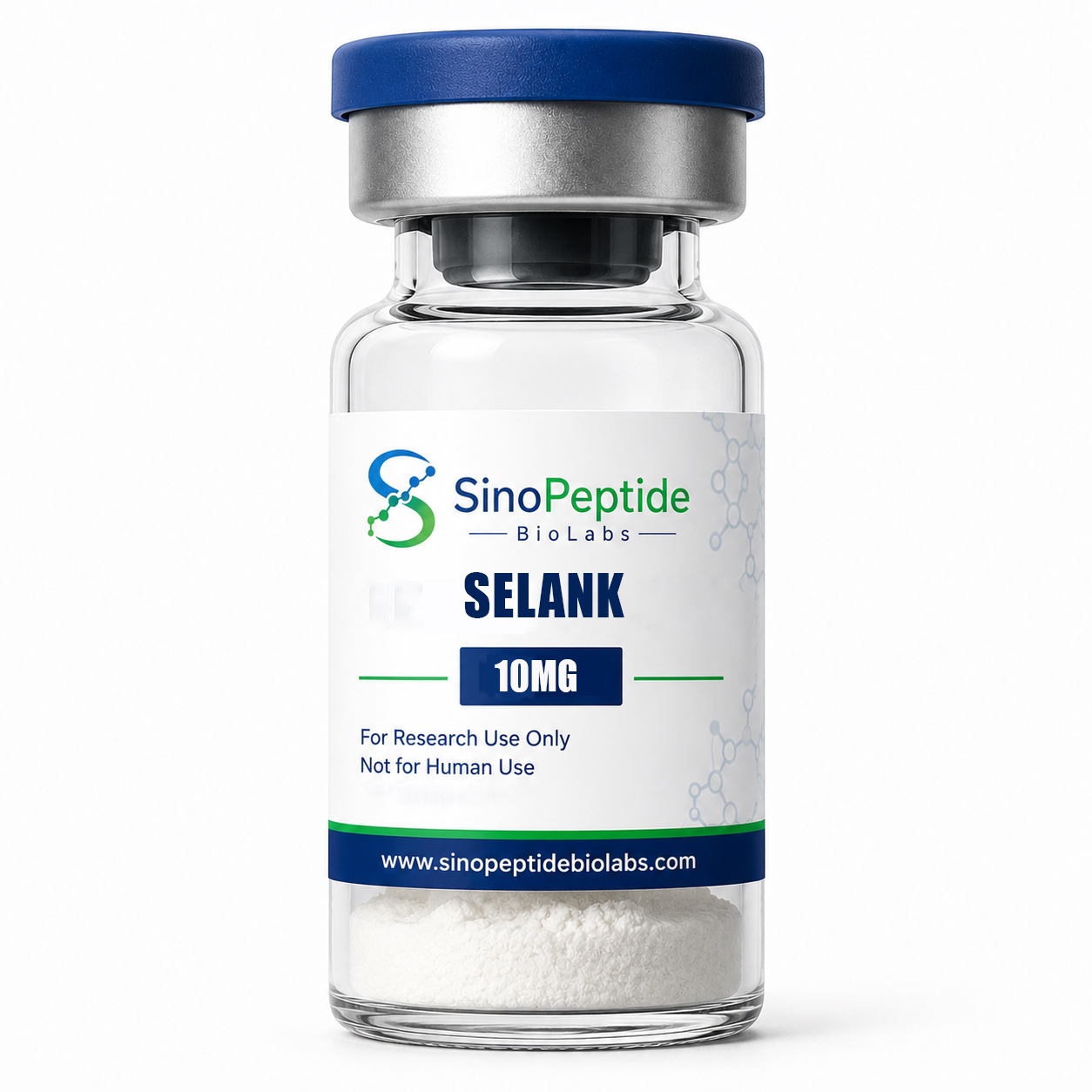
Selank 10mg
$60.00
10Vials/ Kits
Selank 10mg: Complete Research Peptide Guide
Introduction
Selank 10mg is a synthetic peptide product associated with research into neuropeptide signaling, anxiety-related pathways, cognitive processes, and immune-related mechanisms. Selank is also known as TP-7 and is structurally related to the naturally occurring immunomodulatory peptide tuftsin.
Interest in Selank has increased because published research has investigated its potential anxiolytic, neurochemical, cognitive, and immunomodulatory properties. Studies have examined Selank in anxiety-related disorders and laboratory models, while molecular research has explored possible interactions with GABAergic signaling and changes in neurochemical or immune-related pathways.
At the same time, Selank should not be confused with an FDA-approved treatment simply because it has appeared in scientific literature. Current FDA information identifies selank acetate (TP-7) among bulk substances for which compounded drugs may present significant safety risks, citing concerns including potential immunogenicity, aggregation, and peptide-related impurities. FDA also states that it lacks important information about safety in humans.
This makes accurate product information particularly important.
A high-quality Selank 10mg page should explain the peptide’s identity, research history, proposed mechanisms, analytical testing, quality considerations, regulatory status, storage, and evidence limitations without making unsupported therapeutic promises.
What Is Selank?
Selank is a synthetic heptapeptide commonly identified by the amino-acid sequence:
Thr-Lys-Pro-Arg-Pro-Gly-Pro
The peptide is structurally related to tuftsin, a naturally occurring tetrapeptide associated with immune-system signaling. Scientific literature has investigated tuftsin extensively, including its effects on phagocytic cells and immune-related processes.
Selank was developed as a synthetic analogue of tuftsin and has subsequently been investigated for additional biological effects.
Research has focused on areas including:
- Anxiety-related behavior
- GABAergic signaling
- Neurochemical pathways
- Cognitive and behavioral research
- Stress-related responses
- Immune signaling
- Cytokine and chemokine expression
- Peptide pharmacology
- Structure-activity relationships
It is important to distinguish research interest from established medical indications.
The fact that Selank has been studied in humans and experimental models does not by itself establish that every Selank 10mg product is clinically effective, safe, or approved for therapeutic use.
What Does Selank 10mg Mean?
The term Selank 10mg describes the stated quantity of Selank in a product.
The 10mg designation refers to mass, not necessarily concentration or dosage.
This distinction is important.
For example:
- 10mg = quantity by mass
- 10mL = volume
- 10mg/mL = concentration
- 10mg total = total stated amount of peptide
Therefore, a product labeled Selank 10mg should not automatically be described as a 10mg/mL solution.
The exact physical form should be verified from the manufacturer’s label and product documentation.
A research peptide may be supplied in different forms or formulations, and the quantity listed on the label does not by itself determine how the product should be administered.
Selank and Tuftsin
Understanding the relationship between Selank and tuftsin helps explain why Selank has attracted scientific interest.
Tuftsin is a naturally occurring tetrapeptide with the sequence Thr-Lys-Pro-Arg. It is derived from the Fc region of immunoglobulin G through enzymatic processing. Research has demonstrated biological activity involving phagocytic cells such as macrophages and neutrophils.
Selank incorporates the tuftsin-related sequence within a longer heptapeptide structure.
The relationship can be simplified as:
Tuftsin → natural tetrapeptide
Selank → synthetic heptapeptide analogue
Researchers have investigated whether modifications of the tuftsin structure can produce different biological properties.
This area of peptide science illustrates why small changes in amino-acid sequence can influence receptor interactions, stability, biological activity, and pharmacological behavior.
Selank Molecular Structure
Selank is a short synthetic peptide composed of seven amino acids.
Its commonly reported sequence is:
Thr-Lys-Pro-Arg-Pro-Gly-Pro
Because it is a peptide rather than a conventional small-molecule drug, its behavior is influenced by factors such as:
- Amino-acid sequence
- Peptide conformation
- Chemical purity
- Aggregation
- Degradation
- Formulation
- Route of exposure
- Biological environment
Analytical characterization is therefore important when evaluating research-grade Selank.
How Is Selank Studied?
Research into Selank has included both preclinical and human clinical research.
Studies have investigated its potential effects through several approaches.
Human research
Published clinical research has examined Selank in people with anxiety-related disorders.
One study published in 2008 investigated Selank in patients with generalized anxiety disorder and neurasthenia, comparing it with medazepam. The researchers reported anxiolytic effects and examined biochemical changes involving enkephalin-related activity.
Another published study compared Selank and phenazepam in patients with anxiety-related and somatoform disorders and reported anxiolytic effects in the study population.
A later study investigated Selank in combination with phenazepam in patients with anxiety disorders and evaluated efficacy and tolerability using clinical scales.
These studies provide historical clinical research data, but they should not be interpreted as evidence that an independently marketed Selank 10mg product is an approved treatment.
Selank and GABA-Related Research
One of the most frequently discussed areas of Selank research involves GABAergic signaling.
GABA, or gamma-aminobutyric acid, is one of the major inhibitory neurotransmitters in the central nervous system.
Research published in 2018 investigated molecular aspects of Selank activity and reported effects involving radioligand binding associated with GABA receptors. The authors described Selank as affecting GABA binding in a manner consistent with positive allosteric modulation.
This finding provides a possible mechanistic basis for some of the anxiolytic effects investigated in earlier studies.
However, laboratory evidence about receptor binding should not automatically be translated into claims about guaranteed clinical outcomes.
Mechanistic studies explain possible biological pathways; they do not independently establish clinical effectiveness.
Selank and Anxiety Research
Anxiety-related research is one of the most prominent areas associated with Selank.
Published research has investigated Selank in people diagnosed with anxiety-related disorders.
For example, a study involving 62 patients with generalized anxiety disorder and neurasthenia compared Selank with medazepam and evaluated anxiety using standardized clinical scales. The researchers reported anxiolytic effects in the study population.
Another clinical trial involving 60 patients compared Selank with phenazepam and assessed efficacy and tolerability.
These studies are relevant to Selank’s research history, but several limitations should be considered:
- They are relatively small studies.
- Much of the literature originates from Russian research institutions.
- The evidence base is substantially smaller than that for widely approved anxiety treatments.
- Historical clinical research does not establish current regulatory approval.
- Results from a particular formulation or route should not automatically be applied to every Selank product.
For SEO content, these distinctions are important because phrases such as “Selank cures anxiety” or “Selank is an approved anxiety treatment” would overstate the evidence.
Selank and Cognitive Research
Selank is also frequently discussed in connection with cognitive and nootropic research.
The scientific literature has investigated possible effects on:
- Learning
- Memory
- Attention
- Stress-related behavior
- Neurochemical signaling
- Cognitive performance
Some publications describe Selank as having anxiolytic and nootropic properties.
However, “nootropic” is a broad term and does not represent a specific regulatory indication.
A research article describing cognitive effects does not automatically establish that Selank improves cognition in healthy individuals or that a commercially available Selank 10mg product produces a particular result.
Selank and Neurochemical Research
The nervous system relies on complex interactions among neurotransmitters, peptides, receptors, enzymes, and signaling molecules.
Selank research has investigated several of these systems.
Areas of interest include:
- GABA-related signaling
- Enkephalin activity
- Cytokine expression
- Chemokine expression
- Stress-related pathways
- Neuropeptide signaling
A study examining gene-expression changes reported effects involving chemokines, cytokines, and their receptors in experimental models treated with Selank or Selank fragments.
These findings demonstrate why Selank has attracted interest in molecular pharmacology.
They do not, however, establish a single definitive mechanism for every biological effect attributed to the peptide.
Selank and Immune Research
Because Selank is related structurally to tuftsin, researchers have also investigated immune-related mechanisms.
Tuftsin itself has a long history of research involving macrophages, neutrophils, phagocytosis, and immune responses.
Selank research has investigated effects on gene expression involving immune-related mediators.
This creates an interesting research connection:
Tuftsin → immune-related peptide biology
Selank → synthetic tuftsin analogue with neurochemical and immunological research
However, it would be inaccurate to describe Selank simply as an “immune booster.”
The immune system is highly complex, and individual experimental findings do not establish a general clinical immune-enhancing effect.
Selank Research Applications
Selank 10mg may be of interest in research environments investigating several areas.
1. Peptide pharmacology
Researchers can investigate how synthetic peptides interact with biological systems.
2. GABAergic signaling
Selank has been studied in relation to GABA receptor binding and related mechanisms.
3. Anxiety research
Clinical and experimental studies have investigated Selank in anxiety-related conditions.
4. Neurochemical research
Studies have explored enkephalin-related and other neurochemical pathways.
5. Immune signaling
Researchers have investigated cytokine and chemokine expression associated with Selank.
6. Peptide structure-function research
Because Selank is structurally related to tuftsin, it can be considered within broader research into peptide analogues and structure-activity relationships.
Selank 10mg Quality Considerations
Quality is especially important when working with synthetic peptides.
A credible Selank 10mg product should have clear documentation identifying the material.
Useful quality information may include:
- Product name
- Chemical identity
- Peptide sequence
- Quantity
- Batch number
- Purity
- Analytical testing
- Manufacturing information
- Storage requirements
- Expiration or retest information
- Certificate of Analysis
The objective is to establish that the material being tested is actually the intended peptide and that its quality is consistent with the stated specification.
Selank HPLC Testing
High-performance liquid chromatography (HPLC) is commonly used in peptide analysis.
HPLC can help assess chromatographic purity and identify additional peaks that may represent impurities or related substances.
For a Selank 10mg research product, HPLC documentation can therefore provide useful information about:
- Relative purity
- Chromatographic profile
- Batch consistency
- Potential impurities
However, HPLC purity should not be confused with clinical safety or effectiveness.
A product with high analytical purity is not automatically an approved medicine.
Selank Mass Spectrometry
Mass spectrometry (MS) can complement HPLC by helping verify molecular mass.
For peptide research, identity confirmation is important because peptides with similar names or sequences can be confused.
A robust analytical package may therefore combine:
HPLC + mass spectrometry + batch documentation
This provides stronger evidence about identity and purity than a product page containing only an unsupported purity percentage.
Certificate of Analysis for Selank 10mg
A Certificate of Analysis (COA) should ideally correspond to the exact batch being supplied.
A useful COA may include:
- Product name
- Batch number
- Test date
- Purity
- Identity testing
- Analytical method
- Molecular mass
- Appearance
- Testing specifications
Researchers should distinguish between a genuine batch-specific COA and a generic document that is reused across multiple batches.
Batch traceability is an important part of responsible research material sourcing.
Selank 10mg Storage and Stability
Peptide stability can be influenced by:
- Temperature
- Moisture
- Light
- Oxygen
- pH
- Solvent
- Container type
- Freeze-thaw exposure
- Formulation
There is no universal storage condition that should automatically be applied to every Selank 10mg product.
Storage instructions should therefore come from the product’s manufacturer or validated stability documentation.
A dry peptide and a prepared formulation can have significantly different stability characteristics.
Selank Safety Considerations
Safety is an especially important topic for Selank because the available evidence does not establish the same safety framework associated with widely approved medicines.
Current FDA information lists selank acetate (TP-7) among bulk drug substances for which compounded drugs may present significant safety risks. FDA specifically notes potential risks related to immunogenicity, aggregation, and peptide-related impurities and states that important information about safety in humans is lacking.
This is highly relevant when discussing Selank 10mg online.
A research peptide should not automatically be described as:
- Completely safe
- Risk-free
- Clinically proven
- FDA approved
- Suitable for everyone
Safety depends on the exact substance, formulation, purity, route of exposure, manufacturing process, and individual circumstances.
Selank and Immunogenicity
Immunogenicity refers to the ability of a substance to trigger an immune response.
Peptides can potentially produce immune responses depending on their molecular characteristics, formulation, impurities, aggregation, and route of administration.
FDA’s current discussion of selank acetate specifically identifies potential immunogenicity concerns for compounded products.
This does not mean every Selank product will produce an immune reaction.
Rather, it means that immunogenicity is an important quality and safety consideration that should not be ignored.
Selank and Peptide Aggregation
Peptide aggregation occurs when individual peptide molecules associate into larger molecular assemblies.
Aggregation can affect:
- Product stability
- Biological behavior
- Analytical measurements
- Immunogenicity
- Formulation quality
FDA specifically identifies aggregation as one of the concerns relevant to compounded selank acetate.
This reinforces why peptide quality involves more than simply reporting a purity percentage.
Is Selank FDA Approved?
A website should be particularly careful with this question.
Selank should not be presented as an FDA-approved drug for anxiety, cognition, stress, or another medical condition.
Current FDA information specifically lists selank acetate (TP-7) among bulk substances that may pose significant safety risks when used in compounded drugs and notes that FDA lacks important safety information about selank acetate administered to humans.
Therefore, published research should not be confused with FDA approval.
The regulatory status of Selank may differ between jurisdictions, so country-specific claims should be checked against the applicable regulatory authority.
Selank vs Conventional Anxiety Medications
Selank is sometimes compared online with conventional anxiolytic medications.
This comparison should be approached carefully.
Traditional anxiety medications have established regulatory frameworks, clinical guidelines, dosing information, contraindications, pharmacovigilance systems, and manufacturing requirements.
Selank has a considerably different regulatory and evidence profile.
Published research has compared Selank with medications such as phenazepam and medazepam in particular studies, but those studies do not establish that Selank is interchangeable with approved anxiety medicines.
For this reason, product pages should avoid presenting Selank as a direct replacement for prescription treatment.
Selank vs Semax
Selank and Semax are often discussed together because both are synthetic neuropeptides associated with Russian peptide research.
However, they are different compounds.
| Feature | Selank | Semax |
|---|---|---|
| Type | Synthetic heptapeptide | Synthetic peptide |
| Research focus | Anxiety, GABA-related signaling, neurochemical and immune research | Cognitive, neuroprotective and other neurological research |
| Relationship to tuftsin | Yes | No |
| Identical compounds | No | No |
The FDA also separately identifies Semax as a substance for which compounded drugs may present potential safety concerns, including issues involving immunogenicity and peptide-related impurities.
Common Selank Misconceptions
Misconception 1: Selank is FDA approved
Current FDA information does not support presenting Selank as an FDA-approved treatment.
Misconception 2: Selank is simply a natural peptide
Selank is a synthetic peptide analogue related to tuftsin.
Misconception 3: Selank and tuftsin are identical
They are structurally related but different peptides.
Misconception 4: Published research proves every Selank 10mg product works
Research findings depend on the specific material, formulation, study design, population, and route.
Misconception 5: High purity means the product is clinically safe
Analytical purity and clinical safety are separate concepts.
Misconception 6: Selank is a replacement for anxiety medication
Published research does not establish that commercially available Selank products can replace approved anxiety treatments.
Misconception 7: 10mg means 10mg/mL
It does not. Mass and concentration are different measurements.
Frequently Asked Questions About Selank 10mg
What is Selank 10mg?
Selank 10mg refers to a product containing a stated 10mg quantity of Selank peptide. Selank is a synthetic heptapeptide related to tuftsin and has been investigated in neurochemical, anxiety-related, cognitive, and immune research.
What is Selank peptide?
Selank is a synthetic heptapeptide commonly reported as Thr-Lys-Pro-Arg-Pro-Gly-Pro. It is structurally related to the naturally occurring peptide tuftsin.
What is Selank used for in research?
Research has investigated Selank in areas including anxiety-related pathways, GABAergic signaling, cognitive processes, neurochemical activity, and immune-related gene expression.
Is Selank FDA approved?
Selank should not be described as an FDA-approved drug. FDA currently identifies selank acetate (TP-7) as a substance that may present significant safety risks in compounded drugs and notes limited human safety information.
Is Selank the same as tuftsin?
No. Selank is a synthetic analogue related to tuftsin. Tuftsin is a naturally occurring tetrapeptide, while Selank is a longer synthetic heptapeptide.
What does 10mg mean?
It refers to the stated mass of peptide in the product. It does not automatically describe concentration or administration amount.
What is Selank’s relationship with GABA?
Research has investigated Selank’s effects on GABA-related receptor binding and proposed positive allosteric modulation.
Has Selank been studied in humans?
Yes. Published studies have investigated Selank in patients with anxiety-related disorders, including studies comparing it with conventional anxiolytic medications.
Is Selank a nootropic?
Selank has been described as having nootropic properties in scientific literature, but “nootropic” is a broad research term and should not be interpreted as a regulatory indication or guarantee of improved cognitive performance.
How can Selank quality be evaluated?
Relevant documentation may include a batch-specific Certificate of Analysis, HPLC purity testing, mass spectrometry, identity confirmation, batch number, and manufacturing information.
How should Selank be stored?
Storage requirements depend on the exact formulation and manufacturer’s specifications. Product-specific storage instructions should be followed.
How to Evaluate a Selank 10mg Product
A quality-focused product page should provide transparent information rather than relying on aggressive therapeutic claims.
Important considerations include:
Product identity
The product should clearly identify Selank or Selank acetate and provide appropriate specifications.
Quantity
The label should clearly state whether the product quantity is expressed in mg, mL, or another unit.
Analytical testing
HPLC and mass spectrometry can provide useful information about purity and identity.
Batch traceability
The batch number should correspond to the supplied analytical documentation.
Manufacturer information
A reputable supplier should provide clear information about the origin and specifications of the material.
Regulatory information
The product page should distinguish research material from approved pharmaceutical products.
Selank and Responsible SEO
A strong SEO page should target the user’s search intent without making exaggerated medical claims.
The primary keyword Selank 10mg can naturally appear in:
- H1
- Introduction
- One or two H2 headings
- Product description
- FAQ section
- Meta title
- Meta description
- URL slug
- Image alt text
Supporting keywords can cover:
- Selank peptide
- Selank research
- Selank acetate
- Selank 10mg peptide
- Selank research peptide
- Selank GABA
- Selank anxiety research
- Selank mechanism
- Selank safety
- Selank COA
- Selank HPLC
- Selank purity
- Selank regulatory status
- Selank vs Semax
Keyword repetition should remain natural.
Search engines do not require a page to repeat “Selank 10mg” in every paragraph. Comprehensive topical coverage is more useful.
Research Limitations
Although Selank has been investigated in multiple scientific studies, the overall evidence base has important limitations.
Much of the published literature comes from a relatively small number of research groups and institutions.
Some studies are relatively small, while others are preclinical.
Research involving Selank also varies considerably in:
- Experimental design
- Population
- Formulation
- Route
- Study duration
- Outcome measures
- Comparator
- Publication date
Consequently, a balanced website should avoid turning individual study results into universal claims.
The best description is that Selank remains a subject of scientific and pharmacological research, with published studies investigating several possible biological effects.
Research-Use Disclaimer
Selank 10mg should be described according to its actual product specification and intended research context.
Research-grade Selank should not automatically be considered an approved medicine or a clinically validated treatment.
This page is intended for educational and research-information purposes and should not be interpreted as medical advice, diagnosis, or a recommendation to administer experimental peptide products.
Current regulatory requirements and safety information should be checked with the appropriate national authority and qualified healthcare professionals where applicable.
Conclusion
Selank 10mg is a synthetic peptide product associated with research into anxiety-related pathways, GABAergic signaling, neurochemical mechanisms, cognitive processes, and immune-related biology.
Selank is structurally related to tuftsin, a naturally occurring tetrapeptide with a long history of research involving immune and phagocytic functions. Selank itself is a synthetic heptapeptide commonly reported as Thr-Lys-Pro-Arg-Pro-Gly-Pro.
Published human studies have investigated Selank in anxiety-related disorders, while molecular research has explored possible relationships with GABA receptor signaling and other neurochemical pathways.
However, scientific research should not be confused with regulatory approval. Current FDA information lists selank acetate (TP-7) among substances that may pose significant safety risks in compounded drugs, specifically identifying potential concerns related to immunogenicity, aggregation, and peptide-related impurities. FDA also states that important safety information about selank acetate in humans is lacking.
For anyone researching or evaluating Selank 10mg, the most important considerations include product identity, quantity, purity, analytical testing, batch traceability, storage requirements, scientific evidence, and regulatory status.
A well-optimized Selank 10mg website should therefore combine relevant search terms with accurate scientific language. Rather than promising guaranteed anxiety relief, cognitive enhancement, or other medical outcomes, the strongest approach is to explain what Selank is, what researchers have investigated, what remains uncertain, and how product quality can be evaluated.
This evidence-focused approach provides useful information to readers while creating a stronger and more trustworthy SEO foundation for the keyword Selank 10mg.
Selank 10mg Selank 10mg Selank 10mg Selank 10mg Selank 10mg Selank 10mg Selank 10mg Selank 10mg Selank 10mg
Be the first to review “Selank 10mg”
Related products
Pure Peptides
Pure Peptides
Pure Peptides
Pure Peptides
Pure Peptides
Pure Peptides
Pure Peptides
Pure Peptides
Reviews
There are no reviews yet.