
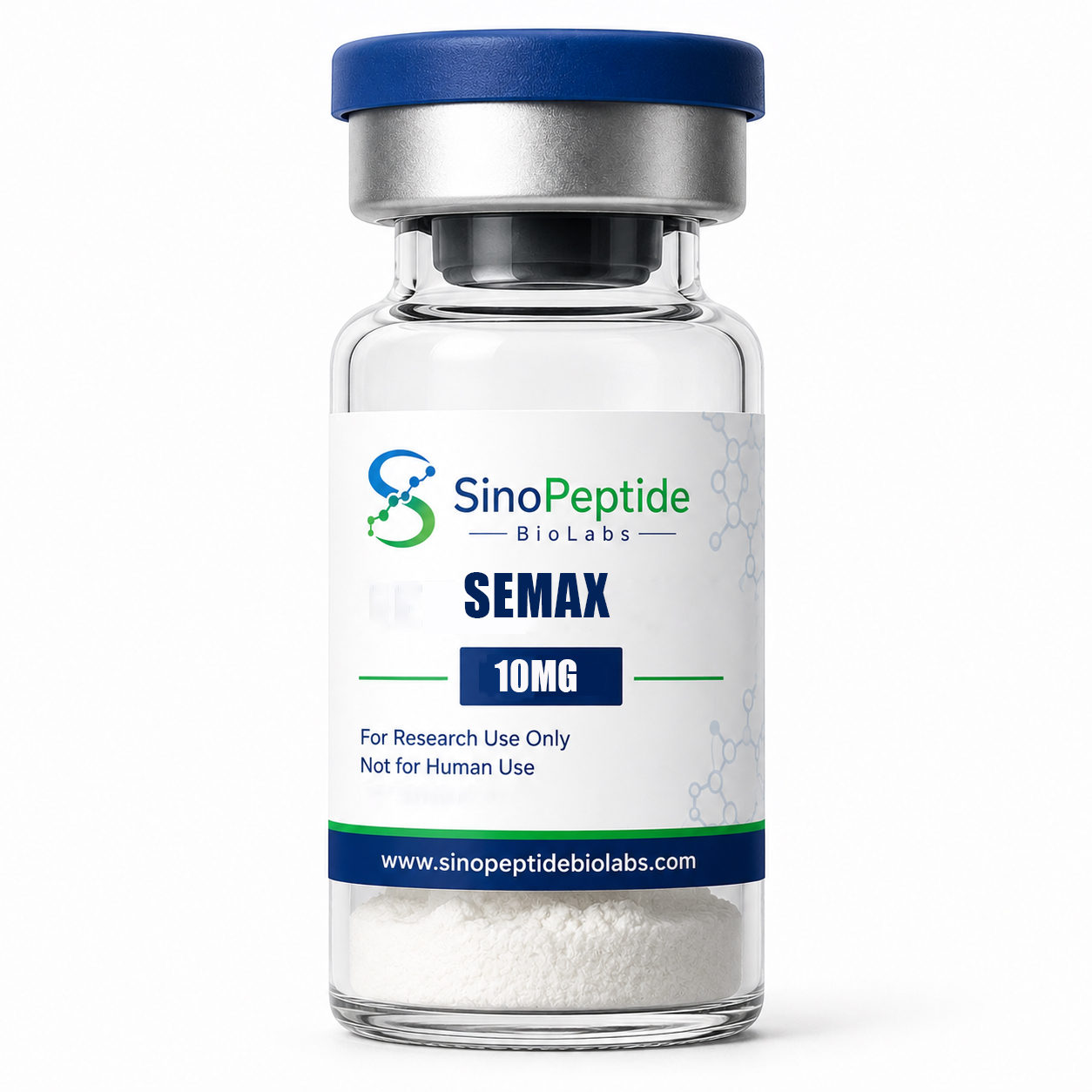
Semax 10mg
$50.00
10Vials/ Kits
Semax 10mg: Complete Research Peptide Guide, Mechanism, Uses, Safety and Quality
Semax 10mg is a synthetic peptide associated with neuroscience, neurotrophic signaling, cognitive research, and experimental neuroprotection. Semax has been investigated for its potential influence on brain-derived neurotrophic factor (BDNF), nerve growth factor (NGF), neuronal signaling, learning and memory, cerebral ischemia, and neurological recovery.
The peptide is particularly interesting because research has explored biological pathways that extend beyond traditional stimulant or nootropic mechanisms. Experimental studies have reported effects involving BDNF and TrkB signaling, while other research has examined Semax in models of cerebral ischemia and neurological injury. Human studies have also investigated Semax in neurological and brain-imaging contexts.
However, scientific interest should not be confused with universal medical approval. The regulatory status of Semax differs between jurisdictions, formulations, and products. In the United States, current FDA materials distinguish Semax free base and Semax acetate as separate substances and have evaluated them in the context of potential compounding rather than treating the evaluation as approval of a Semax drug. FDA has also identified concerns related to peptide aggregation, peptide-related impurities, and potential immunogenicity for compounded Semax.
This guide provides an evidence-conscious overview of Semax 10mg, including its identity, proposed mechanisms, research applications, quality considerations, regulatory status, and frequently asked questions.
What Is Semax 10mg?
Semax is a synthetic heptapeptide commonly described as an analogue of an ACTH-derived peptide sequence. Its amino-acid sequence is:
Met-Glu-His-Phe-Pro-Gly-Pro
Scientific literature has extensively investigated Semax in relation to neurological and neurotrophic activity. Research has focused particularly on the peptide’s relationship with BDNF, NGF, TrkB signaling, neuronal plasticity, and responses to cerebral ischemia.
The 10mg designation describes the nominal quantity of Semax in a product. It does not, by itself, establish a clinical dose, concentration, route of administration, treatment duration, or regulatory approval.
This distinction is essential when creating a product page for Semax 10mg.
For example:
- 10mg describes mass.
- 10mg/mL describes concentration.
- A clinical dose is a separate concept.
- A product quantity is not automatically an approved pharmaceutical strength.
- Different formulations may have different chemical and stability characteristics.
Therefore, a product marketed as Semax 10mg should be evaluated according to its actual analytical documentation rather than its product name alone.
Semax Peptide Structure and Identity
Semax belongs to a group of synthetic peptides investigated for effects on the central nervous system.
The peptide is structurally related to the N-terminal portion of adrenocorticotropic hormone (ACTH), but Semax itself is a distinct synthetic compound.
FDA’s 2026 briefing materials provide separate identities for Semax free base and Semax acetate. The free-base form is listed with the sequence:
H-Met-Glu-His-Phe-Pro-Gly-Pro-OH
The FDA document lists a molecular weight of approximately 813.93 g/mol for Semax free base and approximately 874.0 g/mol for Semax acetate.
This distinction is important for researchers and buyers because the words “Semax,” “Semax acetate,” and “Semax free base” should not automatically be treated as identical product specifications.
A properly documented research product should identify its chemical form clearly.
How Does Semax Work?
The exact biological mechanism of Semax remains an area of scientific investigation. Instead of describing one definitive mechanism, researchers have proposed several interconnected pathways.
One of the most frequently investigated is the BDNF/TrkB pathway.
Semax and BDNF
Brain-derived neurotrophic factor, or BDNF, is a neurotrophin involved in neuronal survival, synaptic plasticity, learning, and memory.
Experimental studies have reported that Semax can influence BDNF expression.
In one rat study, intranasal Semax increased BDNF protein levels in the basal forebrain. Researchers also identified specific Semax binding characteristics in brain tissue.
Another study found that Semax increased BDNF protein levels and TrkB phosphorylation in the rat hippocampus. The researchers suggested that modulation of the BDNF/TrkB system could contribute to the peptide’s effects on cognitive-related processes.
These findings provide a biological rationale for further investigation.
They do not, however, establish that a Semax 10mg product produces the same effects in healthy humans.
Semax and TrkB Signaling
TrkB is a receptor associated with BDNF signaling.
When BDNF interacts with TrkB, downstream signaling pathways can influence neuronal survival, synaptic function, and plasticity.
Experimental research has investigated whether Semax can affect this system.
The 2006 rat study reported increases in both BDNF protein and TrkB phosphorylation following Semax exposure.
This is one reason Semax continues to attract interest in neuroscience research.
Researchers can investigate whether manipulating neurotrophic pathways may help explain observed changes in learning, memory, neuronal resilience, or recovery following neurological injury.
Semax and NGF Research
Semax research has also examined nerve growth factor (NGF).
NGF is another neurotrophin involved in neuronal development, maintenance, and signaling.
Animal research reported changes in BDNF and NGF gene expression following Semax exposure in the hippocampus and frontal cortex.
This suggests that Semax may influence multiple neurotrophic pathways rather than acting through a single molecular target.
However, gene-expression changes in laboratory animals are mechanistic findings. They should not be interpreted as direct evidence of a clinical benefit in humans.
Semax 10mg and Cognitive Research
Semax is frequently associated with the terms memory, focus, attention, and cognition.
Scientific literature has investigated these areas, but the strength of evidence varies.
Early research reported effects on learning and memory in experimental animals. Studies have also explored neurotrophic mechanisms that could potentially influence cognitive processes.
The scientific rationale is therefore based partly on the relationship between Semax and neurotrophic signaling.
However, responsible SEO content should avoid statements such as:
- “Semax makes you smarter.”
- “Semax permanently improves memory.”
- “Semax guarantees better concentration.”
- “Semax is a proven cognitive enhancer.”
Those statements go beyond what the available evidence establishes.
A more scientifically appropriate description is that Semax has been investigated in cognitive and neurotrophic research.
Semax and Neuroprotection Research
Neuroprotection is another major research area associated with Semax.
Neurons can be damaged by conditions involving oxygen deprivation, metabolic stress, excitotoxicity, inflammation, and impaired blood supply.
Researchers have investigated whether Semax can influence some of these processes.
Experimental studies have reported neuroprotective effects in models involving cerebral ischemia and neuronal stress.
One laboratory study found that Semax delayed calcium dysregulation and mitochondrial potential loss in cultured neurons exposed to glutamate toxicity. The researchers reported improved neuronal survival under those experimental conditions.
These results are useful for understanding possible mechanisms, but cell-culture experiments cannot establish human therapeutic efficacy.
Semax 10mg and Cerebral Ischemia Research
Cerebral ischemia occurs when blood flow to part of the brain is reduced or interrupted.
Because ischemic injury can trigger multiple damaging processes, researchers investigate compounds that may affect:
- Neurotrophic signaling
- Inflammatory pathways
- Oxidative stress
- Neuronal survival
- Mitochondrial function
- Functional recovery
Semax has been investigated in experimental models of cerebral ischemia.
Animal research has reported changes in neurotrophin expression following ischemic injury and Semax exposure.
Published human research has also examined Semax in people recovering from ischemic stroke.
One study involving 110 patients evaluated Semax alongside rehabilitation and reported changes in plasma BDNF levels and functional outcomes.
Such studies are part of the scientific history of Semax, but they should not be interpreted as evidence that every Semax 10mg product is an approved stroke medicine.
Stroke is a medical emergency requiring established clinical evaluation and treatment.
Semax and Neurotrophic Signaling
The relationship between Semax and neurotrophins is one of the most interesting areas of research.
Studies have investigated:
BDNF
Associated with:
- Synaptic plasticity
- Learning
- Memory
- Neuronal survival
NGF
Associated with:
- Neuronal maintenance
- Differentiation
- Neural signaling
Trk Receptors
These receptors participate in neurotrophin signaling and cellular responses.
Experimental Semax research has reported changes in BDNF, NGF, and related receptor signaling.
This gives researchers a framework for investigating how synthetic peptides may influence neuronal function.
Semax 10mg Research Applications
Semax has been investigated in several areas of neuroscience.
1. Cognitive Neuroscience
Researchers have explored Semax in relation to:
- Learning
- Memory
- Attention
- Behavioral responses
- Neurotrophic signaling
2. Neuroprotection
Experimental models have examined Semax under conditions involving:
- Hypoxia
- Ischemia
- Excitotoxicity
- Neuronal stress
3. Cerebral Ischemia
Research has evaluated Semax in experimental stroke models and in some human clinical research.
4. Neurotrophin Research
Semax is particularly interesting for studies involving:
- BDNF
- NGF
- TrkB
- TrkA
- Neuroplasticity
5. Brain Research
The peptide has been studied as a tool for investigating how synthetic regulatory peptides interact with neurological pathways.
What Does 10mg Mean?
The term Semax 10mg can create confusion because users may interpret 10mg as a recommended administration amount.
It is important to separate three concepts:
Product Quantity
10mg = the stated mass of Semax.
Concentration
For example, a hypothetical concentration might be expressed as X mg/mL.
Clinical Dose
A clinical dose is determined by a specific medical study, formulation, patient population, route, and medical context.
These are not interchangeable.
Therefore, the phrase “Semax 10mg” should generally be treated as a product specification, not as an instruction for human administration.
Semax 10mg vs Semax 5mg
Semax 10mg and Semax 5mg primarily differ in the stated quantity of peptide.
| Feature | Semax 5mg | Semax 10mg |
|---|---|---|
| Peptide | Semax | Semax |
| Stated quantity | 5mg | 10mg |
| Research identity | Same peptide | Same peptide |
| Product mass | Lower | Higher |
| Clinical meaning | Not automatically a dose | Not automatically a dose |
| Quality requirements | Identity and purity testing | Identity and purity testing |
A larger quantity does not necessarily mean greater purity or higher quality.
For research purposes, analytical documentation is more meaningful than the numerical quantity alone.
Semax Free Base vs Semax Acetate
Semax may be described in different chemical forms.
Current FDA documentation explicitly separates Semax free base and Semax acetate. FDA’s briefing materials state that the active moiety is Semax free base in both forms, while the acetate form includes an acetate component.
Researchers should therefore verify which form is actually present.
Important product documentation can include:
- Chemical form
- Molecular formula
- Molecular weight
- CAS number
- Peptide sequence
- Purity
- Analytical method
- Batch number
This information is particularly useful when comparing suppliers or laboratory materials.
Semax 10mg Quality and Purity
Quality control is essential for research peptides.
A product label alone cannot demonstrate peptide identity or purity.
HPLC Testing
High-performance liquid chromatography (HPLC) is commonly used to characterize peptide purity.
A useful analytical report should identify:
- Sample
- Batch
- Testing method
- Retention profile
- Reported purity
The HPLC report should ideally correspond to the actual production batch.
Mass Spectrometry
Mass spectrometry can help verify molecular mass and support chemical identity.
Combining mass spectrometry with chromatographic analysis can provide stronger evidence than a product label alone.
Certificate of Analysis
A Certificate of Analysis (COA) can provide information about:
- Product identity
- Batch number
- Purity
- Testing laboratory
- Analytical method
- Test date
A batch-specific COA is more useful than a generic certificate that cannot be linked to the supplied product.
Why Peptide Aggregation Matters
Peptide aggregation is an important consideration in peptide research.
Individual peptide molecules can potentially associate into larger structures under certain conditions.
This matters because aggregation can influence:
- Product stability
- Analytical results
- Biological behavior
- Immunogenicity
FDA has specifically identified potential risks involving aggregation and peptide-related impurities for compounded Semax.
This makes proper formulation, characterization, manufacturing controls, and storage information important considerations when evaluating Semax 10mg.
Semax 10mg Safety Considerations
Safety should be discussed separately from efficacy.
A compound can have interesting biological effects while still having unresolved safety questions.
FDA’s current materials identify potential concerns for compounded Semax involving immunogenicity, aggregation, and peptide-related impurities for certain routes of administration.
This is especially relevant because peptide products can vary significantly in:
- Purity
- Formulation
- Manufacturing quality
- Chemical identity
- Stability
- Container system
- Storage conditions
Research findings involving one formulation should not automatically be transferred to every Semax 10mg product.
Semax 10mg Storage and Stability
Peptide stability depends on the specific formulation.
Factors that can affect peptide integrity include:
- Temperature
- Moisture
- Light
- Repeated temperature changes
- Container integrity
- Solution formulation
- Freeze-thaw exposure
- Storage duration
There is no single storage rule that applies to every Semax 10mg product.
The appropriate approach is to follow the validated storage information supplied for the specific formulation and batch.
Researchers should avoid assuming that storage conditions for one Semax product are automatically appropriate for another.
FDA Regulatory Status of Semax
Regulatory status is an important part of any Semax 10mg product page.
In the United States, FDA has evaluated Semax-related bulk drug substances, including Semax free base and Semax acetate, in the context of potential inclusion on the 503A Bulks List. The FDA’s July 2026 advisory committee materials identify cerebral ischemia, migraine, and trigeminal neuralgia as the uses evaluated in connection with these substances.
The FDA briefing document also explains that Semax acetate and Semax free base are different active pharmaceutical ingredients and therefore different bulk drug substances.
Importantly, an FDA advisory committee review or evaluation of a substance should not be represented as FDA approval of a Semax 10mg product.
FDA has also identified safety concerns surrounding compounded Semax, particularly potential immunogenicity associated with aggregation and peptide-related impurities.
Therefore, an SEO product page should use careful wording such as:
“Semax is an investigational peptide that has been studied in neurological and neurotrophic research.”
It should avoid unsupported wording such as:
“FDA-approved Semax 10mg treatment.”
Semax 10mg vs Traditional Nootropics
Semax differs from conventional nootropics in several important ways.
Many traditional nootropics are small-molecule compounds that interact with established neurotransmitter systems.
Semax is a peptide.
Its research profile centers more heavily on:
- Neurotrophic signaling
- BDNF
- NGF
- Neuronal plasticity
- Neuroprotection
- Cerebral ischemia research
This makes Semax an interesting subject for peptide neuroscience research rather than simply another stimulant-like compound.
Semax vs Selank
Semax and Selank are sometimes discussed together because both have been investigated as synthetic neuroactive peptides.
However, they have different research profiles.
Semax is strongly associated with:
- BDNF research
- Neuroprotection
- Cerebral ischemia
- Cognitive research
- Neurotrophic signaling
Selank is more commonly investigated in connection with:
- Stress-related pathways
- Anxiety-related research
- Neuroimmune signaling
They should not be treated as interchangeable substances.
Semax vs BPC-157
Semax and BPC-157 represent different areas of peptide research.
Semax is predominantly associated with neuroscience and neurotrophic research.
BPC-157 has been studied primarily in experimental models involving tissue injury, gastrointestinal biology, vascular mechanisms, and related pathways.
Consequently, comparing them simply by “which peptide is stronger” is scientifically inappropriate because they are investigated for different biological questions.
Common Misconceptions About Semax 10mg
Myth 1: Semax 10mg means a 10mg clinical dose
Not necessarily.
The number generally describes the product’s stated quantity.
Myth 2: Semax is proven to make healthy people smarter
Research involving learning, memory, and neurotrophic pathways does not establish that Semax increases intelligence.
Myth 3: Semax and Semax acetate are automatically identical
FDA materials distinguish the free-base and acetate forms.
Myth 4: A COA proves clinical safety
A COA provides analytical information. It does not establish clinical efficacy, safety, or regulatory approval.
Myth 5: Animal BDNF research proves human benefits
Animal studies are useful for mechanism research but cannot independently establish equivalent human outcomes.
Myth 6: Every Semax 10mg product has the same quality
Different products can have different manufacturing processes, purity, formulation, and analytical documentation.
Frequently Asked Questions About Semax 10mg
What is Semax 10mg?
Semax 10mg is a product designation referring to a stated 10mg quantity of Semax, a synthetic heptapeptide investigated primarily in neurological and neurotrophic research.
What is Semax used for in research?
Semax has been investigated in cognitive neuroscience, BDNF signaling, neuroprotection, cerebral ischemia, neurological recovery, and brain-related research.
Is Semax a peptide?
Yes. Semax is a synthetic heptapeptide with the sequence Met-Glu-His-Phe-Pro-Gly-Pro.
What does 10mg mean?
It refers to the stated mass of peptide in the product. It does not automatically establish a clinical dose or concentration.
Does Semax affect BDNF?
Experimental research has reported changes in BDNF levels and related BDNF/TrkB signaling following Semax exposure, particularly in animal studies.
Has Semax been studied in humans?
Yes. Human studies have investigated Semax in areas including neurological recovery and other brain-related research.
What is Semax acetate?
Semax acetate is a chemical form of Semax in which the peptide is associated with acetate. FDA distinguishes Semax acetate from Semax free base as separate bulk drug substances.
Is Semax FDA approved?
Current FDA materials do not establish Semax free base or Semax acetate as components of an FDA-approved drug. FDA has evaluated these substances in a compounding context.
What is the difference between Semax 5mg and Semax 10mg?
The primary stated difference is the amount of peptide: 5mg versus 10mg. The quantity alone does not determine purity, quality, or clinical suitability.
What should I look for in Semax 10mg research material?
Important documentation includes chemical identity, chemical form, purity testing, HPLC, mass spectrometry, batch-specific COA, manufacturing information, and storage specifications.
How to Evaluate Semax 10mg for Research
Before purchasing or evaluating a Semax 10mg research product, consider the following checklist.
1. Verify the peptide identity
Confirm that the material is actually identified as Semax.
2. Confirm the chemical form
Determine whether the product is Semax free base, Semax acetate, or another specified form.
3. Request analytical documentation
Look for appropriate purity and identity testing.
4. Verify batch traceability
The product batch should correspond with its COA and analytical documentation.
5. Review purity methodology
A purity percentage without a stated analytical method provides limited information.
6. Examine storage specifications
Use product-specific stability information.
7. Separate research status from medical approval
A research peptide should not be marketed as an approved treatment unless a specific regulatory authorization exists.
8. Avoid unsupported health claims
Scientific content should distinguish laboratory findings from established clinical outcomes.
Why Semax 10mg Is Relevant to Peptide Research
Semax occupies an interesting position within peptide neuroscience because research has examined both molecular mechanisms and potential neurological applications.
The peptide has been associated with:
- BDNF signaling
- NGF signaling
- Trk receptor activity
- Neuronal plasticity
- Neuroprotection
- Cerebral ischemia
- Learning and memory research
- Brain-network research
Animal experiments provide substantial mechanistic information. Human research adds another level of evidence, but differences in study design, formulation, population, and regulatory environment must be considered.
This makes Semax an appropriate subject for continued scientific investigation rather than a compound that should be described through exaggerated marketing claims.
Conclusion
Semax 10mg is a synthetic neuroactive peptide that has been investigated extensively in neuroscience and neurotrophic research. Scientific studies have examined its potential relationship with BDNF, NGF, TrkB signaling, neuronal survival, learning and memory, cerebral ischemia, and neurological recovery.
One of the most interesting research pathways is the BDNF/TrkB system. Experimental studies have reported changes in BDNF protein levels, TrkB signaling, and neurotrophin gene expression following Semax exposure.
Research has also examined Semax in cerebral ischemia and stroke-related settings, including animal models and human studies.
At the same time, Semax should be discussed carefully. The term 10mg identifies a product quantity and does not automatically represent a clinical dose. Semax free base and Semax acetate are distinct chemical forms, and product quality can vary depending on manufacturing, purification, formulation, and analytical controls.
Current FDA materials also highlight unresolved considerations surrounding Semax-related bulk substances, including peptide aggregation, peptide-related impurities, and potential immunogenicity for certain compounded formulations.
For researchers and scientifically minded readers, the most useful approach is therefore to evaluate Semax 10mg through chemical identity, analytical purity, batch documentation, formulation, stability, scientific evidence, and regulatory context.
Semax remains an important subject of peptide and neuroscience research, but responsible scientific communication should always distinguish between experimental findings, human clinical evidence, and regulatory approval.
Research-use disclaimer: This article is intended for educational and research-information purposes. It does not constitute medical advice, diagnosis, or a recommendation for human use. Experimental peptide products should not be represented as approved medicines unless a specific product has received appropriate regulatory authorization.
Be the first to review “Semax 10mg”
Related products
Pure Peptides
Pure Peptides
Pure Peptides
Pure Peptides
Pure Peptides
Pure Peptides
Pure Peptides
Pure Peptides
Reviews
There are no reviews yet.