
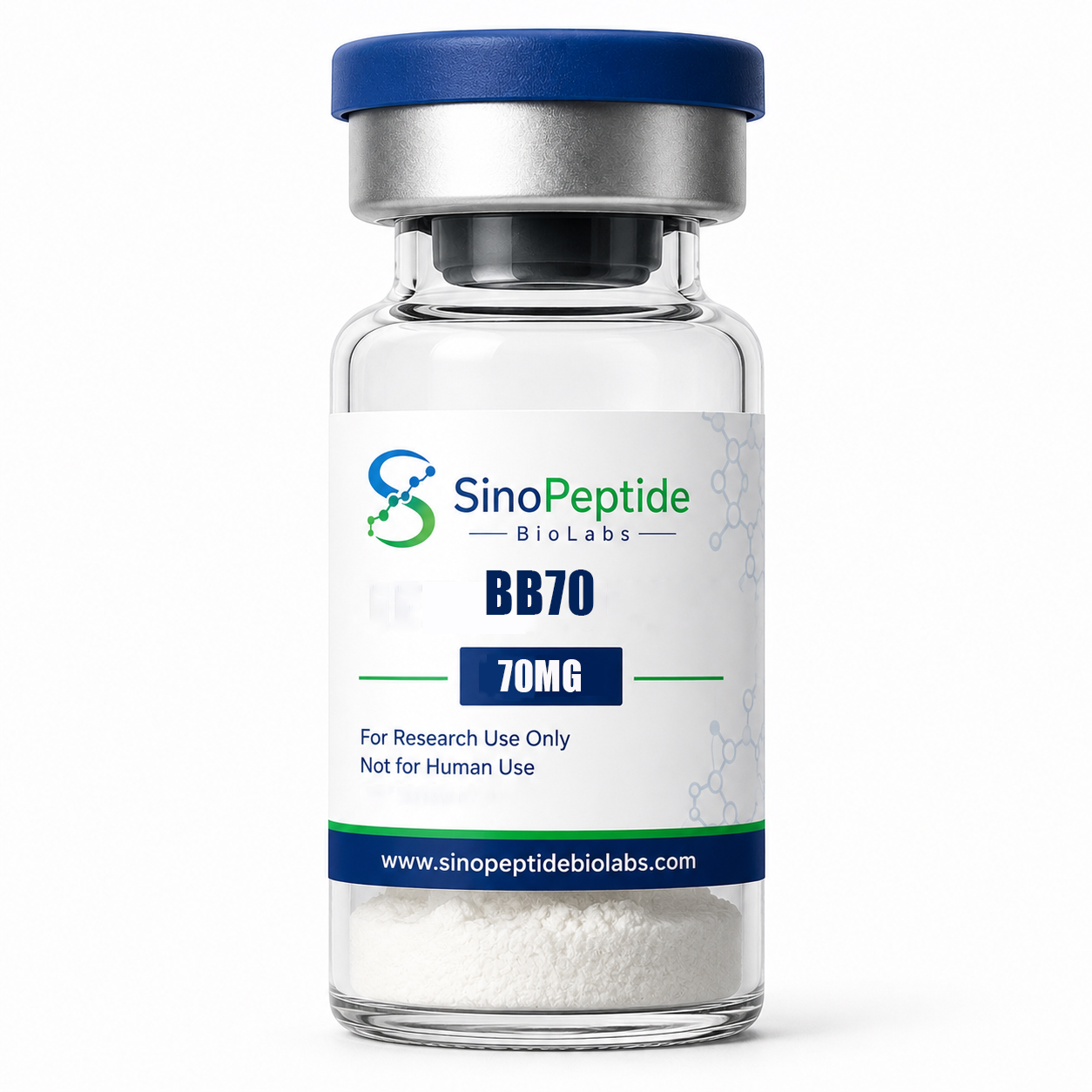
BBG70 70mg
$195.00
Glow BPC-157 10mg + GHk-Cu 50mg + TB500 10mg
10 Vials/ Kits
BBG70 70mg: Complete Research Peptide Blend Guide
BBG70 70mg is a multi-peptide research blend commonly associated with three peptide ingredients: BPC-157, GHK-Cu, and TB-500 or thymosin beta-4-related material. In many current product specifications, the 70 mg formulation is described as approximately 10 mg BPC-157, 50 mg GHK-Cu, and 10 mg TB-500, although the precise composition should always be verified against the supplier’s current product specification and lot-specific Certificate of Analysis (COA).
Unlike a single peptide, BBG70 is a combination research material. Its components have been investigated independently in areas such as cellular signaling, tissue remodeling, wound biology, extracellular matrix research, angiogenesis, inflammation, and skin biology. However, research findings involving an individual ingredient should not automatically be interpreted as evidence that the complete BBG70 combination produces the same effects.
This distinction is especially important for accurate scientific communication. A product page can describe the biological rationale behind BPC-157, GHK-Cu, and thymosin-related research without making unsupported claims that BBG70 treats injuries, accelerates healing, reverses aging, or produces specific outcomes in humans.
This guide explains what BBG70 70mg is, what its individual components are, how researchers may investigate the blend, what 70mg means, how to evaluate product quality, and what buyers should look for in laboratory documentation.
What Is BBG70 70mg?
BBG70 70mg is a catalog designation used for a 70 mg multi-peptide blend rather than a single molecular compound.
Current research-product listings commonly describe BBG70 as a blend containing:
| Component | Common reference amount |
|---|---|
| BPC-157 | 10 mg |
| GHK-Cu | 50 mg |
| TB-500 / thymosin-related material | 10 mg |
| Total | 70 mg |
The formulation is not necessarily identical across every supplier. For this reason, a product should not be identified solely by the BBG70 name. Researchers should verify the actual composition, batch number, analytical documentation, and specification supplied with the material.
Some current catalog references identify BBG70 as GLOW 70, Glow Blend, or a similar name. The naming convention is commercial rather than a standardized pharmaceutical designation.
BBG70 Is a Blend, Not a Single Peptide
One of the most important SEO and scientific distinctions is that BBG70 does not represent one molecule with one molecular weight or one amino-acid sequence.
Instead, it combines separate peptide materials.
That means:
- BPC-157 has its own sequence and molecular characteristics.
- GHK-Cu is a copper-associated tripeptide complex.
- TB-500 terminology can refer to different materials depending on the supplier, so the exact identity should be confirmed.
- The 70 mg label refers to the total labeled amount of the blend, not necessarily 70 mg of one peptide.
This distinction helps prevent one of the most common misunderstandings surrounding BBG70 products.
BBG70 70mg Composition
The most frequently published BBG70 specification is a 10 mg BPC-157 + 50 mg GHK-Cu + 10 mg TB-500/thymosin-related blend.
The 50 mg GHK-Cu component represents the largest proportion of the commonly marketed formulation, while BPC-157 and the thymosin-related component each account for 10 mg.
However, analytical reports from different suppliers can show measured component amounts that differ from the nominal formulation. This may reflect manufacturing specifications, assay methodology, sampling, or differences between lots.
For example, current public product documentation shows different analytical results for BBG70-associated lots, reinforcing the importance of checking the specific lot COA rather than relying only on a generic product description.
What Does 70mg Mean?
The term 70mg describes the nominal total peptide content of the BBG70 formulation.
It does not mean:
- 70 mg of BPC-157
- 70 mg of GHK-Cu
- 70 mg of TB-500
- a recommended human dose
- a clinical dose
- a standardized pharmaceutical strength
For research procurement, the number is primarily a way of identifying the quantity of material contained in the vial according to the manufacturer’s specification.
A laboratory should therefore record both the total labeled quantity and the individual component composition.
BPC-157 in BBG70
BPC-157 is a synthetic pentadecapeptide that has attracted substantial interest in preclinical research.
Studies have investigated BPC-157 in models involving gastrointestinal biology, tissue injury, inflammation, vascular signaling, and musculoskeletal research. More recent reviews continue to emphasize that much of the evidence remains preclinical and that important translational and pharmaceutical-development questions remain unresolved.
BPC-157 Research Areas
BPC-157 has been investigated in areas including:
- cellular signaling
- gastrointestinal research
- tissue-injury models
- vascular responses
- inflammatory pathways
- musculoskeletal research
- tendon and ligament models
- oxidative-stress research
- experimental wound biology
A 2025 systematic review of BPC-157 in orthopaedic and sports-medicine research described promising findings in animal models involving muscle, tendon, ligament, bone, and related tissues, while also highlighting the lack of adequate human safety data.
That evidence distinction is important when writing BBG70 content. Research involving BPC-157 alone should not be presented as proof that BBG70 has equivalent effects.
GHK-Cu in BBG70
GHK-Cu, or glycyl-L-histidyl-L-lysine copper, is a copper-associated peptide complex studied extensively in skin biology, extracellular matrix regulation, tissue remodeling, and cellular signaling.
GHK is naturally occurring and has a strong affinity for copper, forming the GHK-Cu complex. Scientific literature has investigated GHK-Cu in connection with tissue remodeling, inflammation, oxidative stress, and skin-related processes.
More recent reviews continue to examine GHK-Cu in aesthetic and regenerative research while noting limitations in standardized clinical evidence.
GHK-Cu Research Applications
Research involving GHK-Cu may examine:
- collagen-related pathways
- extracellular matrix biology
- fibroblast activity
- skin-cell signaling
- oxidative stress
- inflammatory pathways
- tissue remodeling
- wound biology
- copper-dependent cellular processes
Because GHK-Cu is the largest component in many BBG70 formulations, it represents an important part of the blend’s overall research rationale.
TB-500 and Thymosin Beta-4 Research
The terminology surrounding TB-500 requires particular attention.
Commercial research products do not always use the name TB-500 consistently. Some sources use TB-500 to describe a thymosin beta-4-related fragment, while other product documentation describes material corresponding to full-length thymosin beta-4.
Therefore, researchers should verify the exact chemical identity on the COA instead of assuming that every product labeled TB-500 contains the same molecule.
Thymosin Beta-4 Research
Thymosin beta-4 is a naturally occurring peptide involved in actin binding and cellular processes associated with migration and tissue repair.
Scientific literature has investigated thymosin beta-4 in wound healing, angiogenesis, inflammation, cell migration, and tissue repair. Preclinical studies and some clinical research have explored these mechanisms in specific settings.
Research has examined thymosin beta-4 in areas including:
- wound-healing biology
- cell migration
- angiogenesis
- epithelial repair
- inflammation
- extracellular matrix remodeling
- tissue regeneration
- corneal research
Importantly, these findings concern thymosin beta-4 or specific experimental formulations and should not automatically be interpreted as evidence for a commercial BBG70 blend.
How Does BBG70 Work?
Because BBG70 is a combination of separate peptides, it does not have one universally established mechanism of action.
Instead, researchers may investigate the individual biological pathways associated with each component.
BPC-157
BPC-157 research has examined multiple signaling pathways associated with tissue responses, vascular biology, inflammation, and cellular protection.
GHK-Cu
GHK-Cu is associated with copper-dependent peptide signaling and has been investigated in relation to extracellular matrix regulation, fibroblast biology, collagen-associated processes, and inflammatory signaling.
Thymosin-Related Component
Thymosin beta-4 research has focused heavily on actin-associated cellular processes, cell migration, angiogenesis, and repair-related signaling.
Why Researchers May Study a Blend
A blend such as BBG70 may be of interest when researchers want to examine multiple biological pathways within one experimental material.
However, the concept of combining mechanisms is a research hypothesis, not proof of clinical synergy.
There is currently no adequate basis for stating that BBG70 is clinically proven to produce additive or synergistic benefits simply because its components have been studied separately.
BBG70 70mg Research Applications
BBG70 may be relevant to laboratory research involving several interconnected areas of peptide biology.
1. Tissue Remodeling Research
GHK-Cu and thymosin-related research has generated interest in extracellular matrix biology, fibroblast behavior, cell migration, and tissue remodeling.
A BBG70 blend can therefore serve as a research material for experiments investigating multiple signaling pathways involved in tissue-response models.
2. Cellular Migration Studies
Cell migration is an important component of wound and tissue biology.
Thymosin beta-4 research has particularly examined cellular migration and actin-associated processes.
Researchers can investigate cellular migration using appropriate in-vitro experimental systems without assuming that laboratory findings translate directly to human treatment.
3. Skin Biology Research
GHK-Cu has been studied extensively in skin-related research.
Potential laboratory areas include:
- fibroblast activity
- collagen-associated signaling
- extracellular matrix research
- oxidative stress
- inflammatory signaling
- cellular regeneration models
4. Wound Biology
Individual BBG70 components have been investigated in wound-related models.
Thymosin beta-4, in particular, has a substantial preclinical research history involving dermal repair and cell migration.
BPC-157 has also been studied experimentally in various injury models.
Nevertheless, BBG70 itself should be treated as an experimental blend rather than a clinically validated wound-healing treatment.
5. Comparative Peptide Research
Because BBG70 contains multiple components, researchers may use it in comparative laboratory studies examining:
- single peptide versus blend systems
- cellular responses
- pathway interactions
- concentration-response relationships
- molecular signaling
- peptide stability
- formulation characteristics
These experiments can help determine whether combining separate peptides produces measurable differences compared with individual components.
BBG70 vs Individual Peptides
Understanding the difference between BBG70 and its components is essential.
| Material | Description | Research focus |
|---|---|---|
| BPC-157 | Synthetic pentadecapeptide | Tissue, vascular, gastrointestinal and musculoskeletal research |
| GHK-Cu | Copper-associated tripeptide | Skin, extracellular matrix and cellular research |
| TB-500 | Commercially variable thymosin-related designation | Repair and cellular migration research |
| Thymosin beta-4 | Naturally occurring peptide | Actin, migration, angiogenesis and tissue-repair research |
| BBG70 | Multi-component blend | Combination and comparative research |
A study involving one of these compounds should not automatically be described as a study of BBG70.
BBG70 70mg Quality and Purity
Quality control is one of the most important considerations when evaluating research peptides.
A product description stating “99% purity” is not sufficient by itself.
Researchers should ideally review a lot-specific Certificate of Analysis.
Important documentation may include:
HPLC Testing
High-performance liquid chromatography can be used to evaluate peptide-related purity and chromatographic profiles.
The report should identify:
- tested material
- lot number
- testing date
- analytical method
- reported purity
- laboratory information
Mass Spectrometry
Mass spectrometry can help confirm molecular identity by evaluating expected molecular mass.
This is especially important for a blend because the identity of each component should be established rather than relying exclusively on the product name.
Content or Assay Testing
Purity and content are different measurements.
For example, a report may confirm the presence and purity profile of a peptide while separately reporting measured content.
Researchers should avoid treating “99% purity” as automatically meaning that exactly 70 mg of peptide is present.
Endotoxin and Microbial Testing
Depending on the intended laboratory application, additional testing may include:
- bacterial endotoxin
- microbial contamination
- sterility
- heavy metals
- residual solvents
- water content
Not every research application requires the same analytical panel, so the testing requirements should be matched to the experimental purpose.
Why a Lot-Specific COA Matters
A common SEO mistake in research-peptide product pages is to display one laboratory report as if it proves the quality of every future batch.
It does not.
A COA generally applies to the tested sample or lot identified in the report.
Current BBG70-associated public reports illustrate why this distinction matters: different suppliers and lots report different measured component quantities and analytical values.
A high-quality product page should therefore make it easy for researchers to identify:
- Product name
- Catalog number
- Lot number
- Manufacturing date
- Testing date
- Analytical laboratory
- HPLC results
- Mass-spectrometry identity
- Component content
- Applicable contaminant testing
BBG70 Storage and Stability
BBG70 is commonly supplied as a lyophilized research material.
Current supplier specifications commonly recommend cold, dry storage and protection from light and moisture, with some listings specifying approximately −20°C for sealed material.
However, storage requirements are formulation-specific.
Researchers should always follow the manufacturer’s current documentation rather than assuming that every BBG70 formulation has identical stability characteristics.
Factors that can affect peptide stability include:
- temperature
- moisture
- light exposure
- oxygen exposure
- container closure
- formulation buffer
- repeated temperature cycling
- time in solution
A laboratory should document storage conditions as part of its research-quality procedures.
Is BBG70 Approved for Human Use?
BBG70 should not be presented as an approved human pharmaceutical.
The individual components also have very different evidence histories.
BPC-157, for example, remains an investigational research peptide with significant translational limitations and no approved formulation for routine human medical treatment. A 2026 review specifically highlighted the absence of a validated dosing regimen and completed Phase II clinical trial for BPC-157.
Thymosin beta-4 has a more extensive clinical research history than BPC-157, including investigation in tissue-repair settings, but that does not mean a commercial BBG70 blend is an approved therapeutic product.
The regulatory status of a particular product should always be checked with the relevant national medicines regulator.
BBG70 Safety Considerations
Safety should be addressed conservatively because BBG70 is a combination research material.
Potential concerns include:
- uncertain pharmacokinetics
- limited human data for the combination
- uncertain interactions between components
- formulation variability
- contamination risk
- inaccurate labeling
- differences between suppliers
- insufficient long-term safety information
The presence of published research on an individual peptide does not establish the safety of combining it with other peptides.
For this reason, research products should not be represented as established medical treatments.
BBG70 Is Not a Substitute for Medical Treatment
Claims such as “BBG70 heals injuries,” “BBG70 repairs tissue,” “BBG70 reverses aging,” or “BBG70 guarantees faster recovery” are inappropriate unless supported by high-quality evidence directly studying that specific product and outcome.
A scientifically stronger formulation is:
“BBG70 is an experimental multi-peptide blend investigated as a laboratory research material, with individual components studied in areas including tissue biology, cellular migration, extracellular matrix signaling, and wound-related research.”
This wording is both more accurate and more useful for research-oriented readers.
BBG70 70mg vs GHK-Cu
GHK-Cu is a single peptide-copper complex, whereas BBG70 contains multiple research components.
Researchers studying a specific GHK-Cu mechanism may prefer a defined single-component material because it reduces experimental variables.
BBG70 may be more relevant when the research question concerns interactions or combined pathways.
The correct choice therefore depends on the research objective rather than on claims that one material is universally superior.
BBG70 vs BPC-157
BPC-157 is a single synthetic peptide with a substantial preclinical literature.
BBG70 incorporates BPC-157 alongside GHK-Cu and a thymosin-related component.
This means that a study using BBG70 cannot necessarily attribute an observed result specifically to BPC-157.
For mechanistic experiments, researchers may therefore compare:
- BPC-157 alone
- GHK-Cu alone
- thymosin-related material alone
- BBG70 blend
Such experimental design can help separate individual effects from combination effects.
BBG70 vs TB-500
The comparison between BBG70 and TB-500 is also important because BBG70 may contain a thymosin-related component as one part of a broader blend.
TB-500 terminology is not consistently standardized across commercial research products.
Consequently, researchers should examine the actual analytical identity and sequence information rather than assuming that every product labeled “TB-500” is chemically identical.
Common Misconceptions About BBG70
Myth 1: BBG70 Is One Peptide
Reality: BBG70 is generally marketed as a multi-peptide blend.
Myth 2: 70mg Means 70mg of Each Ingredient
Reality: 70mg generally refers to the total nominal amount of the blend.
Myth 3: Every BBG70 Product Has the Same Formula
Reality: Commercial specifications can differ, so the lot-specific documentation should be checked.
Myth 4: Research on BPC-157 Proves BBG70 Works
Reality: Research on one component does not establish the efficacy of the entire combination.
Myth 5: A 99% Purity Claim Proves Product Quality
Reality: Researchers should review the analytical method, laboratory, lot number, identity confirmation, and measured content.
Myth 6: BBG70 Is an Approved Treatment
Reality: BBG70 is marketed as a research blend and should not be represented as an approved therapeutic product.
How to Choose a BBG70 70mg Research Product
When comparing BBG70 suppliers, focus on documentation rather than marketing language.
1. Confirm the Composition
Check whether the product contains:
- BPC-157
- GHK-Cu
- TB-500 or thymosin beta-4-related material
Verify the stated quantity of each component.
2. Request a Current COA
The COA should correspond to the actual lot being supplied.
3. Check Analytical Methods
Look for HPLC and mass spectrometry where appropriate.
4. Confirm Lot Traceability
A product should have a traceable lot or batch number.
5. Examine Storage Information
Storage specifications should be clearly stated.
6. Avoid Unsupported Medical Claims
Research-grade products should be described according to their scientific status rather than advertised as guaranteed treatments.
SEO-Friendly Product Description for BBG70 70mg
BBG70 70mg is a multi-peptide research blend commonly formulated with BPC-157, GHK-Cu, and a TB-500/thymosin-related component. The blend is primarily discussed in laboratory research involving cellular signaling, tissue biology, extracellular matrix processes, skin research, and repair-related pathways. Product composition can vary between suppliers, so researchers should verify the exact formulation and lot-specific Certificate of Analysis before use in laboratory work.
Frequently Asked Questions About BBG70 70mg
What is BBG70 70mg?
BBG70 70mg is a multi-component research peptide blend. Current commercial specifications commonly describe a formulation containing BPC-157, GHK-Cu, and TB-500 or thymosin-related material.
What does BBG70 contain?
A commonly published formulation contains approximately 10 mg BPC-157, 50 mg GHK-Cu, and 10 mg TB-500/thymosin-related material, totaling 70 mg. Always verify the current supplier specification.
Is BBG70 a single peptide?
No. BBG70 is a blend of multiple peptide materials.
What is BBG70 used for?
BBG70 is marketed as a laboratory research material. Its individual components have been investigated in areas including cellular migration, tissue biology, skin research, extracellular matrix signaling, inflammation, and wound-related research.
Is BBG70 FDA approved?
BBG70 should not be described as an FDA-approved pharmaceutical treatment.
Does BBG70 contain BPC-157?
Many current BBG70 formulations list BPC-157 as one component, commonly at a nominal 10 mg per 70 mg blend. Product documentation should be checked for the exact lot.
Does BBG70 contain GHK-Cu?
Yes, many BBG70/GLOW formulations list GHK-Cu as the largest component, commonly around 50 mg per 70 mg blend.
Is TB-500 the same in every BBG70 product?
Not necessarily. Commercial use of the TB-500 name can vary. Researchers should confirm the chemical identity using the product’s COA and specification.
What does the 70mg label mean?
It generally indicates the total nominal quantity of peptide material in the blend, not a human dose.
How should BBG70 be stored?
Many current research-product specifications describe lyophilized BBG70 as requiring cold, dry storage, often around −20°C. The manufacturer’s current storage specification should always take precedence.
Should BBG70 be used by people?
BBG70 should be treated as a research material rather than a self-treatment product. It should not be marketed as a substitute for approved medical care.
Conclusion
BBG70 70mg is a multi-peptide research blend commonly associated with BPC-157, GHK-Cu, and TB-500/thymosin-related material. A frequently published formulation is 10 mg BPC-157, 50 mg GHK-Cu, and 10 mg of the thymosin-related component, although researchers should verify the exact composition of each lot.
The scientific rationale behind BBG70 comes from the separate research histories of its components. BPC-157 has been investigated extensively in preclinical models, GHK-Cu has attracted research interest in skin and extracellular-matrix biology, and thymosin beta-4 has been studied in cellular migration, angiogenesis, and tissue-repair research.
The key limitation is that research on individual components does not establish the clinical effectiveness or safety of the complete BBG70 blend.
For laboratory procurement, the most important considerations are exact composition, lot-specific identity, HPLC results, mass-spectrometry confirmation, measured content, storage requirements, and transparent COA documentation.
Used in this research-focused context, BBG70 70mg can be described accurately without overstating the available evidence or confusing a research blend with an approved pharmaceutical product.
Research-use disclaimer: BBG70 and its individual components discussed in this article are presented for scientific and laboratory research information. This article does not provide human dosing or administration instructions and should not be interpreted as medical advice, a treatment recommendation, or evidence that BBG70 is approved to diagnose, treat, cure, or prevent any disease.
BBG70 70mg BBG70 70mg BBG70 70mg vBBG70 70mg BBG70 70mg BBG70 70mg BBG70 70mg BBG70 70mg BBG70 70mg BBG70 70mg BBG70 70mg BBG70 70mg BBG70 70mg BBG70 70mg BBG70 70mg BBG70 70mg BBG70 70mg BBG70 70mg BBG70 70mg BBG70 70mg BBG70 70mg BBG70 70mg BBG70 70mg
Be the first to review “BBG70 70mg”
Related products
Pure Peptides
Pure Peptides
Pure Peptides
Pure Peptides
Pure Peptides
Pure Peptides
Pure Peptides
Pure Peptides
Reviews
There are no reviews yet.