

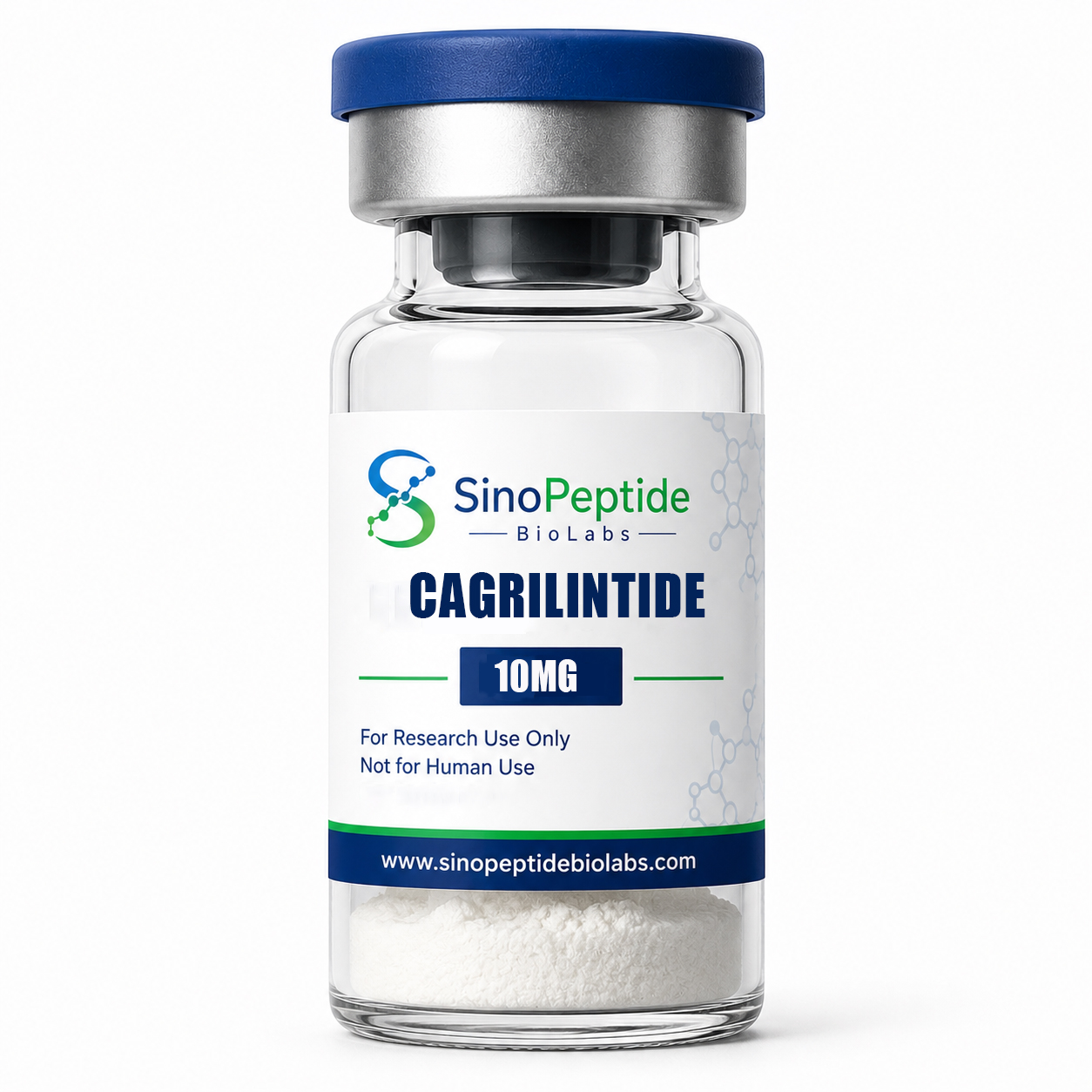
Cagrilintide 10mg
$195.00
10Vials/ Kits
Cagrilintide 10mg: Complete Research Peptide Guide, Mechanism, Uses, Safety & Quality
Cagrilintide 10mg is a research product containing a stated 10 milligrams of cagrilintide, a long-acting synthetic analogue of the pancreatic hormone amylin. Cagrilintide has become an important subject of metabolic and obesity research because of its effects on appetite regulation, satiety, food intake, and body-weight control.
Unlike glucagon-like peptide-1 (GLP-1) receptor agonists such as semaglutide, cagrilintide belongs to the amylin-based class of investigational metabolic therapies. Research indicates that cagrilintide activates amylin-related receptor pathways and can also interact with calcitonin-receptor signaling. This provides a distinct mechanism from conventional GLP-1 receptor agonists.
Cagrilintide has been investigated both as a standalone compound and in combination with semaglutide. The combination, known as CagriSema, has produced substantial weight reduction in phase 3 studies, although CagriSema is a separate fixed-dose combination and should not be confused with a standalone Cagrilintide 10mg product.
The 10mg designation refers to the quantity of material in the product. It should not be interpreted as a recommended human dose, clinical protocol, or evidence-based administration amount.
This guide explains what Cagrilintide 10mg is, how cagrilintide works, its amylin receptor biology, obesity and metabolic research, clinical evidence, CagriSema research, quality testing, safety considerations, regulatory status, and frequently asked questions.
What Is Cagrilintide 10mg?
Cagrilintide is a long-acting analogue of amylin, a hormone naturally produced by pancreatic beta cells and released alongside insulin in response to food intake.
Amylin participates in the regulation of:
- Satiety
- Food intake
- Gastric emptying
- Glucagon secretion
- Post-meal glucose regulation
- Energy balance
Cagrilintide was developed to provide longer-lasting amylin-receptor activity than native amylin.
A product labeled Cagrilintide 10mg therefore indicates a stated quantity of 10mg of cagrilintide, depending on the manufacturer’s formulation and labeling.
It is important to distinguish the product amount from doses studied in clinical trials.
In a phase 2 trial of cagrilintide monotherapy, researchers studied weekly doses ranging from 0.3mg to 4.5mg. The 10mg product quantity is therefore not equivalent to a 10mg clinical dose used in that study.
What Is Cagrilintide?
Cagrilintide is a synthetic, long-acting peptide analogue designed to activate pathways associated with amylin.
Amylin is an endogenous pancreatic hormone that contributes to the physiological regulation of appetite and energy balance.
The biological effects of amylin involve receptors expressed in several regions of the nervous system, including areas involved in appetite regulation.
Cagrilintide has been described as a dual amylin and calcitonin receptor agonist (DACRA). Structural and functional research has demonstrated activation of signaling through amylin receptor 1 and calcitonin receptor pathways.
This receptor activity is central to understanding why cagrilintide is being investigated for weight-management applications.
How Does Cagrilintide Work?
Cagrilintide’s mechanism is primarily connected with amylin receptor signaling.
Amylin helps regulate food intake and satiety after meals. Activation of amylin-related pathways can influence the brain circuits involved in hunger and meal termination.
Research suggests that cagrilintide can affect:
- Appetite
- Satiety
- Food intake
- Gastric motility
- Energy balance
- Body-weight regulation
Amylin signaling involves receptor complexes containing the calcitonin receptor and receptor activity-modifying proteins (RAMPs).
Recent structural research has provided additional insight into how cagrilintide interacts with amylin and calcitonin receptor systems.
This makes cagrilintide mechanistically different from a pure GLP-1 receptor agonist.
Cagrilintide and Amylin
Amylin is a peptide hormone secreted from pancreatic beta cells together with insulin.
Its physiological functions include helping regulate:
- Meal-related satiety
- Gastric emptying
- Glucagon secretion
- Food intake
- Postprandial metabolism
Because native amylin has a relatively short biological lifetime, researchers have explored longer-acting analogues.
Cagrilintide is one such analogue.
The development of long-acting amylin analogues has become an important area of metabolic research because amylin signaling provides a pathway that is complementary to GLP-1 signaling.
Cagrilintide and Appetite Research
Appetite regulation is one of the central areas of cagrilintide research.
The central nervous system integrates signals from:
- The gastrointestinal tract
- Pancreas
- Adipose tissue
- Circulating hormones
- Nutrient availability
Amylin is one of the signals involved in this system.
Research suggests that amylin activates neural circuits associated with satiation and reduced food intake. A recent review describes amylin signaling across multiple brain regions, including the hindbrain, hypothalamus, and other neural pathways involved in appetite regulation.
Cagrilintide is designed to exploit this biology through sustained receptor activity.
Cagrilintide and Satiety Research
Satiety refers to the feeling of fullness that contributes to termination of a meal.
Amylin is an important physiological satiety signal.
Cagrilintide research has therefore focused on whether prolonged amylin-receptor activation can reduce food intake and contribute to body-weight reduction.
This is distinct from simply suppressing appetite through a single mechanism.
Amylin pathways interact with several central and peripheral systems involved in:
- Meal size
- Food intake
- Gastric motility
- Energy homeostasis
- Reward-related feeding
These mechanisms are part of the scientific rationale for investigating cagrilintide in obesity.
Cagrilintide and Gastric Emptying
Amylin signaling can influence gastric emptying and the movement of food through the gastrointestinal tract.
Slower gastric emptying can contribute to prolonged satiety after eating.
This mechanism is also relevant to several other metabolic peptide therapies, although the specific receptor pathways differ.
Researchers investigating cagrilintide therefore consider gastrointestinal effects alongside central appetite signaling.
Gastrointestinal effects are also among the most frequently reported adverse events in clinical cagrilintide research, including nausea, constipation, and diarrhea.
Cagrilintide and Body-Weight Research
Cagrilintide has been evaluated in randomized clinical research involving adults with overweight or obesity.
The phase 2 dose-finding study published in The Lancet included 706 participants assigned to cagrilintide doses ranging from 0.3mg to 4.5mg, liraglutide, or placebo.
After 26 weeks, mean weight reductions under the trial-product estimand ranged from approximately 6.0% to 10.8% across the cagrilintide groups, compared with approximately 3.0% with placebo. The 4.5mg cagrilintide group showed approximately 10.8% mean weight reduction under that analysis.
These findings supported continued development of cagrilintide as a potential weight-management therapy.
However, the results should not be interpreted as evidence that every Cagrilintide 10mg product produces the same outcomes.
Cagrilintide 10mg vs Clinical Trial Doses
This distinction is particularly important for accurate product content.
A product may contain 10mg total cagrilintide, while clinical research may investigate smaller amounts under controlled protocols.
For example:
| Context | Cagrilintide amount |
|---|---|
| Product designation | 10mg |
| Phase 2 monotherapy range | 0.3–4.5mg |
| CagriSema cagrilintide component in major phase 3 program | 2.4mg |
| Meaning of 10mg | Product quantity, not automatically a clinical dose |
The 10mg product label should therefore not be presented as if it were a dose validated by clinical trials.
Cagrilintide and CagriSema
Cagrilintide is also a component of CagriSema, an investigational combination of cagrilintide and semaglutide.
CagriSema combines:
- Cagrilintide — amylin analogue
- Semaglutide — GLP-1 receptor agonist
The rationale is that the two compounds affect complementary pathways involved in appetite, food intake, metabolism, and body weight.
The major phase 3 program has primarily evaluated a fixed combination containing 2.4mg cagrilintide + 2.4mg semaglutide.
This is not the same as a standalone Cagrilintide 10mg product.
CagriSema Clinical Research
The REDEFINE 1 phase 3 trial included 3,417 adults with overweight or obesity without type 2 diabetes.
At week 68, the estimated mean body-weight change was:
- −20.4% with cagrilintide-semaglutide
- −3.0% with placebo
The estimated difference was −17.3 percentage points.
Gastrointestinal adverse events occurred in 79.6% of the combination group and 39.9% of the placebo group, with nausea, vomiting, diarrhea, constipation, and abdominal pain among the reported events. Most were described as mild to moderate and transient.
These findings relate specifically to the investigational combination, not standalone Cagrilintide 10mg.
Cagrilintide in Type 2 Diabetes Research
CagriSema has also been evaluated in adults with overweight or obesity and type 2 diabetes.
In REDEFINE 2, the estimated mean body-weight change at week 68 was:
- −13.7% with cagrilintide-semaglutide
- −3.4% with placebo
The estimated treatment difference was −10.4 percentage points.
The study also reported that 73.5% of participants receiving the combination had an HbA1c of 6.5% or less compared with 15.9% receiving placebo. Gastrointestinal adverse events were reported in 72.5% and 34.4%, respectively.
Again, these findings concern the cagrilintide-semaglutide combination and should not be attributed directly to a standalone Cagrilintide 10mg product.
Cagrilintide and GLP-1 Research
One of the most important research questions is whether amylin and GLP-1 pathways can provide complementary effects.
GLP-1 receptor agonists can influence:
- Appetite
- Food intake
- Gastric emptying
- Glucose regulation
Amylin pathways influence overlapping but distinct aspects of appetite and energy regulation.
This provides a biological rationale for combining cagrilintide with semaglutide.
The strong results observed in CagriSema trials support continued investigation of combination approaches, while the individual contribution of each component must be evaluated separately.
Cagrilintide and Metabolic Research
Cagrilintide research extends beyond body weight.
Researchers are also examining its potential relevance to:
- Glycemic control
- Insulin sensitivity
- Appetite regulation
- Energy balance
- Cardiometabolic risk
- Body composition
- Type 2 diabetes
However, cagrilintide should primarily be understood as an investigational metabolic peptide rather than an established treatment for every metabolic condition.
The current evidence is strongest around its development for weight management and combination metabolic therapy.
Cagrilintide and Body Composition
Weight loss is not simply a matter of total body mass.
Researchers also examine:
- Fat mass
- Lean mass
- Visceral adipose tissue
- Muscle preservation
- Changes in energy expenditure
Clinical development programs are therefore increasingly studying body composition alongside total body weight.
This is important because a reduction in body weight can involve multiple tissue compartments.
Ongoing phase 3 research is evaluating the broader effects of CagriSema and cagrilintide-based approaches, including longer-term outcomes and body-composition measures.
Cagrilintide 10mg Quality and Purity
Quality is essential when evaluating an investigational peptide.
A product labeled Cagrilintide 10mg should ideally have documentation supporting:
- Chemical identity
- Peptide purity
- Molecular characterization
- Batch consistency
- Manufacturing traceability
- Storage conditions
A batch-specific Certificate of Analysis (COA) is particularly useful.
Researchers should avoid relying solely on marketing claims such as “99% pure” without analytical documentation.
HPLC Testing for Cagrilintide
High-performance liquid chromatography, or HPLC, is commonly used for peptide analysis.
HPLC can help evaluate:
- Chromatographic purity
- Related impurities
- Degradation products
- Batch consistency
A credible analytical report should identify the testing method and connect the results to the specific batch.
Purity alone, however, does not establish sterility, clinical effectiveness, or regulatory approval.
Mass Spectrometry and Cagrilintide Identity
Mass spectrometry can provide additional information about the molecular identity and mass of a peptide.
When combined with HPLC or another chromatographic technique, mass spectrometry can help distinguish:
- Correct peptide
- Related impurities
- Degradation products
- Incorrect or unexpected molecular species
For research applications, identity confirmation is as important as purity.
Cagrilintide 10mg Certificate of Analysis
A useful COA may include:
| COA Feature | Importance |
|---|---|
| Product name | Identifies the material |
| Batch number | Connects testing to a specific lot |
| Purity/assay | Quantifies the target material |
| Analytical method | Shows how testing was conducted |
| Molecular identity | Supports compound confirmation |
| Testing date | Provides analytical timing |
| Manufacturer information | Supports traceability |
| Storage conditions | Helps maintain product integrity |
A generic COA without a matching lot number provides less confidence in the specific material being evaluated.
Cagrilintide 10mg Storage and Stability
Peptide stability depends on the specific formulation.
Environmental factors that can affect peptide integrity include:
- Temperature
- Moisture
- Light
- Oxygen
- pH
- Solvent
- Container integrity
- Repeated environmental exposure
Researchers should follow the manufacturer’s documented storage requirements for the specific Cagrilintide 10mg product.
A universal storage protocol should not be assumed for every formulation.
Cagrilintide 10mg Safety Considerations
Cagrilintide remains an investigational compound in the United States.
Clinical research has identified gastrointestinal adverse events as among the most common effects associated with cagrilintide.
In the phase 2 monotherapy trial, gastrointestinal adverse events occurred in approximately 41%–63% of cagrilintide-treated participants compared with 32% in the placebo group. Nausea, constipation, and diarrhea were among the reported events. Administration-site reactions were also reported.
CagriSema trials have similarly reported gastrointestinal adverse events.
This information is important when evaluating the biological and safety profile of cagrilintide.
It is not appropriate to assume that a research-grade Cagrilintide 10mg product has the same safety characteristics as material manufactured for a controlled clinical trial.
Cagrilintide and Regulatory Status
As of September 2026, cagrilintide is not an FDA-approved drug.
The FDA states that cagrilintide cannot be used in compounding under federal law and that it is not a component of an FDA-approved drug. The agency also states that cagrilintide has not been found safe and effective for any condition.
This is a critical distinction between:
- Investigational research
- Clinical-trial material
- Compounded products
- FDA-approved drugs
FDA enforcement activity has also included warning letters concerning the marketing of cagrilintide as an unapproved drug. In a March 2026 warning letter, FDA described cagrilintide products marketed by Prime Sciences as unapproved new drugs.
Therefore, websites should avoid presenting Cagrilintide 10mg as an FDA-approved weight-loss medication.
Cagrilintide and CagriSema Regulatory Development
Although standalone cagrilintide is not FDA approved, its development as part of CagriSema has advanced through phase 3 clinical trials.
Novo Nordisk submitted a New Drug Application for CagriSema in December 2025, describing it as an investigational fixed-dose combination of cagrilintide 2.4mg and semaglutide 2.4mg.
By 2026, additional CagriSema phase 3 studies were continuing, including trials examining type 2 diabetes, cardiovascular outcomes, lower-dose combinations, and longer-term weight management.
This ongoing development does not mean that a standalone Cagrilintide 10mg product has received FDA approval.
Cagrilintide vs Semaglutide
Cagrilintide and semaglutide are different peptide-based compounds with different primary receptor targets.
| Feature | Cagrilintide | Semaglutide |
|---|---|---|
| Primary class | Amylin analogue | GLP-1 receptor agonist |
| Main target | Amylin/calcitonin receptor pathways | GLP-1 receptor |
| Research focus | Appetite, satiety, weight regulation | Glycemic control, appetite, weight regulation |
| Development status | Investigational | Approved in several formulations/indications |
| CagriSema role | Amylin component | GLP-1 component |
The two compounds are being studied together because their mechanisms may be complementary.
Cagrilintide vs CagriSema
These terms should not be used interchangeably.
Cagrilintide is one investigational active compound.
CagriSema is the combination of cagrilintide and semaglutide.
The major phase 3 formulation uses 2.4mg cagrilintide + 2.4mg semaglutide, not 10mg cagrilintide alone.
Therefore, clinical results for CagriSema should not be presented as clinical results for Cagrilintide 10mg.
Common Misconceptions About Cagrilintide 10mg
Misconception 1: Cagrilintide 10mg Is a 10mg Clinical Dose
Not necessarily.
The 10mg designation describes the product quantity. It is not automatically a validated human dose.
Misconception 2: Cagrilintide Is the Same as Semaglutide
No.
Cagrilintide is an amylin analogue, while semaglutide is a GLP-1 receptor agonist.
Misconception 3: Cagrilintide and CagriSema Are the Same Product
No.
CagriSema contains both cagrilintide and semaglutide.
Misconception 4: CagriSema Trial Results Prove Cagrilintide Alone Produces the Same Results
No.
Combination-trial results cannot simply be attributed to one component.
Misconception 5: Cagrilintide Is FDA Approved
As of September 2026, FDA states that cagrilintide is not a component of an FDA-approved drug and has not been found safe and effective for any condition.
Misconception 6: Research Peptide Quality Is Guaranteed by a Product Listing
No.
Researchers should verify identity, purity, analytical testing, batch traceability, and appropriate documentation.
How to Evaluate Cagrilintide 10mg for Research
When evaluating a Cagrilintide 10mg research product, consider the following:
1. Verify the Compound Identity
Confirm that the product is specifically identified as cagrilintide.
2. Review the COA
Look for batch-specific analytical documentation.
3. Check HPLC Data
Review chromatographic purity and related impurities.
4. Check Molecular Identity
Mass spectrometry or another appropriate analytical technique can provide additional confirmation.
5. Verify Batch Traceability
The lot number should correspond to the analytical report.
6. Review Formulation
Determine whether the product is a dry research material, solution, or another formulation.
7. Check Storage Information
Follow the manufacturer’s documented stability requirements.
8. Separate Research From Clinical Use
Do not assume that research material is approved for human administration.
9. Avoid Unsupported Claims
Clinical results should only be attributed to the formulation, dose, population, and study actually investigated.
Frequently Asked Questions About Cagrilintide 10mg
What is Cagrilintide 10mg?
Cagrilintide 10mg is a product labeled as containing 10mg of cagrilintide. Cagrilintide is a long-acting amylin analogue under investigation for metabolic and weight-management applications.
What is cagrilintide?
Cagrilintide is a long-acting synthetic analogue of amylin that has been investigated for effects on appetite, satiety, food intake, and body weight.
What does 10mg mean?
It refers to the stated quantity of cagrilintide in the product. It does not automatically represent a clinical dose.
Is cagrilintide an amylin analogue?
Yes. Cagrilintide was developed as a long-acting amylin analogue.
How does cagrilintide work?
Research indicates that cagrilintide activates amylin-related receptor pathways and can also activate calcitonin receptor signaling. These pathways are involved in appetite and energy regulation.
Is cagrilintide the same as semaglutide?
No. Cagrilintide is an amylin analogue, while semaglutide is a GLP-1 receptor agonist.
What is CagriSema?
CagriSema is an investigational combination of cagrilintide and semaglutide. The major phase 3 program has used 2.4mg of each component.
Is cagrilintide FDA approved?
No. As of September 2026, FDA states that cagrilintide is not a component of an FDA-approved drug and has not been found safe and effective for any condition.
What research has been conducted on cagrilintide?
Research includes phase 2 and phase 3 studies involving obesity, overweight, body-weight reduction, appetite regulation, and type 2 diabetes, as well as mechanistic studies of amylin receptor signaling.
What were the doses studied in early cagrilintide research?
A phase 2 monotherapy study evaluated 0.3mg, 0.6mg, 1.2mg, 2.4mg, and 4.5mg once-weekly doses.
Is Cagrilintide 10mg the same as the cagrilintide used in CagriSema?
The name refers to the same investigational active compound, but the product quantity and formulation are not necessarily the same as clinical-trial material. CagriSema’s major phase 3 formulation contains 2.4mg cagrilintide with 2.4mg semaglutide.
How is cagrilintide purity tested?
Potential analytical approaches include HPLC and mass spectrometry, along with other appropriate identity and purity testing.
Why is a Cagrilintide COA important?
A batch-specific COA can provide information about identity, purity, assay, analytical methods, and lot traceability.
The Future of Cagrilintide Research
Cagrilintide remains an active area of metabolic research.
Future studies are investigating questions including:
- Long-term weight management
- Body-composition changes
- Type 2 diabetes
- Cardiovascular outcomes
- Different cagrilintide/semaglutide combinations
- Lower-dose combinations
- Higher-dose combination strategies
- Treatment durability
- Gastrointestinal tolerability
- Individual response differences
The ongoing development program illustrates how researchers are exploring amylin biology both independently and in combination with GLP-1 receptor signaling.
Novo Nordisk has reported additional phase 3 work involving CagriSema, including cardiovascular outcomes and longer-term weight-management studies.
This continued research may help clarify the long-term role of amylin-based therapies in metabolic medicine.
Conclusion
Cagrilintide 10mg is a research product containing a stated 10mg quantity of cagrilintide, a long-acting synthetic analogue of the pancreatic hormone amylin.
Cagrilintide is being investigated because amylin signaling plays an important role in satiety, food intake, gastric motility, and energy balance. Research has demonstrated activity at amylin and calcitonin receptor pathways, providing a distinct mechanism from GLP-1 receptor agonists.
Clinical research has produced significant findings. In a phase 2 monotherapy study, cagrilintide doses ranging from 0.3mg to 4.5mg were associated with greater weight reduction than placebo after 26 weeks.
Cagrilintide has also been studied in combination with semaglutide as CagriSema. In REDEFINE 1, the combination produced an estimated mean body-weight reduction of 20.4% at week 68 compared with 3.0% with placebo. REDEFINE 2 also demonstrated significant weight reduction in adults with overweight or obesity and type 2 diabetes.
However, these clinical results should not be transferred directly to a standalone Cagrilintide 10mg product.
The 10mg designation identifies product quantity, not a standardized clinical dose. Published cagrilintide monotherapy research has used different amounts, while the principal CagriSema formulation uses 2.4mg cagrilintide combined with 2.4mg semaglutide.
As of September 2026, cagrilintide remains not FDA approved. FDA states that cagrilintide cannot be used in compounding under federal law and has not been found safe and effective for any condition.
For legitimate research, product quality should therefore be assessed through chemical identity, HPLC purity, molecular characterization, batch-specific COA documentation, manufacturing traceability, and appropriate storage information.
Cagrilintide is an important investigational compound in modern metabolic research, but responsible scientific communication should clearly separate research findings, clinical-trial evidence, product specifications, and regulatory status.
Research-use disclaimer: This article is provided for educational and scientific research purposes. It is not medical advice and does not provide instructions or recommendations for human administration. Cagrilintide products should not be represented as FDA-approved medicines, and product specifications should be evaluated according to the manufacturer’s documentation and applicable regulations.
Cagrilintide 10mg Cagrilintide 10mg Cagrilintide 10mg Cagrilintide 10mg Cagrilintide 10mg Cagrilintide 10mg Cagrilintide 10mg Cagrilintide 10mg Cagrilintide 10mg Cagrilintide 10mg Cagrilintide 10mg Cagrilintide 10mg Cagrilintide 10mg Cagrilintide 10mg
Be the first to review “Cagrilintide 10mg”
Related products
Pure Peptides
Pure Peptides
Pure Peptides
Pure Peptides
Pure Peptides
Pure Peptides
Pure Peptides
Pure Peptides
Reviews
There are no reviews yet.