

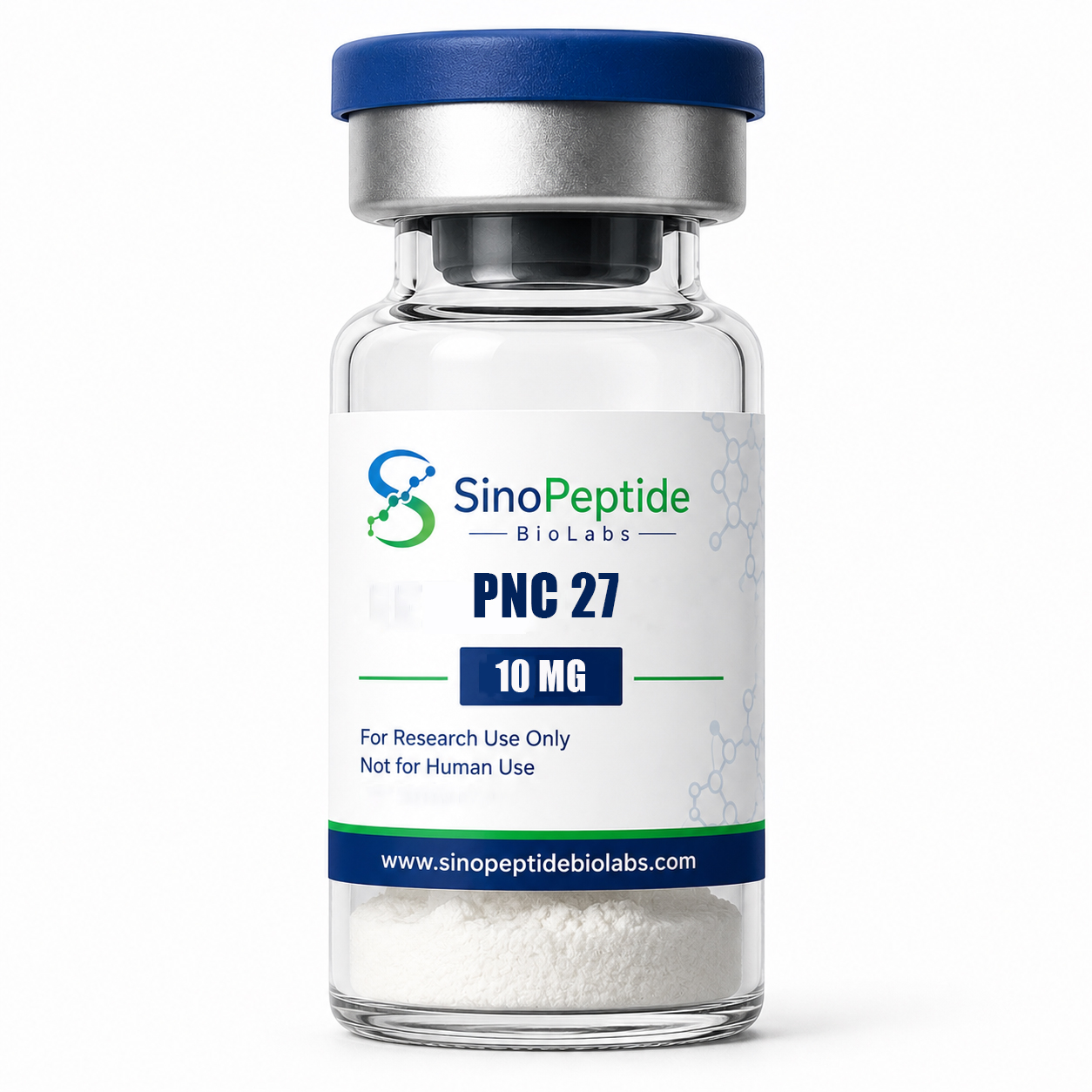
PNC 27 10mg
$170.00
10 Vials/Kits
PNC-27 10mg: Research, Mechanism, Potential Uses, Safety and Evidence
What Is PNC-27 10mg?
PNC-27 10mg refers to a research-peptide preparation containing a stated 10-milligram amount of PNC-27. The name PNC-27 identifies a synthetic peptide studied primarily in experimental cancer biology, while 10mg describes the quantity associated with a particular product.
It is important not to interpret the 10mg amount as an established human treatment dose.
PNC-27 is a synthetic chimeric peptide designed from a region of the tumor-suppressor protein p53 and a membrane-penetrating peptide sequence. Published research describes PNC-27 as a 32-residue peptide containing an HDM-2-binding region corresponding to p53 residues 12–26 together with a membrane-associated or cell-penetrating leader sequence.
The scientific interest in PNC-27 comes from its proposed ability to interact with HDM-2, also known as MDM2, on the membranes of certain cancer cells. Laboratory studies have reported membrane disruption and cancer-cell death following exposure to PNC-27.
However, these findings should be interpreted within the appropriate evidence level. PNC-27 remains an experimental research compound, and laboratory findings should not be presented as proof that the peptide treats cancer in humans. Current evidence does not establish a safe or effective human treatment regimen.
PNC-27 Peptide Overview
PNC-27 belongs to a broader area of research involving peptides designed to interact selectively with cancer-associated molecular targets.
Unlike conventional medicines that are developed through extensive clinical testing, PNC-27 remains at the research stage.
The peptide was developed around an interaction involving p53 and HDM-2.
p53 is one of the best-studied tumor-suppressor proteins in human biology. Under normal conditions, p53 contributes to cellular responses to DNA damage, cellular stress and abnormal growth.
MDM2/HDM-2 is an important regulator of p53. In simplified terms, MDM2 can bind to p53 and promote its degradation, thereby limiting p53 activity.
Researchers investigating PNC-27 proposed a different approach: rather than simply attempting to restore intracellular p53 activity, the peptide could exploit HDM-2 located at the surface of certain cancer cells.
Published research has reported that PNC-27 can bind membrane-associated HDM-2 and produce membrane-disrupting effects in experimental cancer models.
This mechanism is one of the main reasons PNC-27 continues to attract interest in oncology research.
What Is the Structure of PNC-27?
PNC-27 is described in peer-reviewed literature as a 32-amino-acid peptide.
Its structure can broadly be divided into two functional regions:
- A p53-derived HDM-2-binding domain
- A membrane-penetrating or membrane-residency domain
The p53-derived portion corresponds to residues 12–26 of p53, which are involved in the interaction between p53 and HDM-2.
The second region is designed to help the peptide interact with cellular membranes.
A 2022 study described PNC-27 as a 32-residue peptide containing an HDM-2-binding domain and a cell-penetrating peptide leader sequence. The researchers used structural and imaging approaches to investigate how PNC-27 interacts with HDM-2 and the cancer-cell membrane.
This structure is important because PNC-27 is not simply a fragment of naturally occurring p53. It is a synthetic engineered peptide containing functional components intended to produce a particular biological effect.
How Does PNC-27 Work?
The proposed mechanism of PNC-27 involves membrane-associated HDM-2.
Researchers have reported that some cancer cells display HDM-2 at the plasma membrane. PNC-27 was designed to recognize this target through its p53-derived domain.
After binding, the membrane-active portion of PNC-27 may contribute to the formation of transmembrane pores.
These pores can compromise the integrity of the cancer-cell membrane, resulting in leakage of cellular contents and ultimately cell death.
A PNAS study reported that PNC-27 interacted with HDM-2 located at cancer-cell membranes and that membrane-associated HDM-2 was associated with susceptibility to the peptide.
A later study published in Biomedicines investigated the structural relationship between PNC-27 and HDM-2 and reported evidence consistent with pore formation involving PNC-27 at the cell membrane.
The proposed mechanism can therefore be summarized as:
PNC-27 → HDM-2 recognition → membrane interaction → pore formation → membrane disruption → experimental cancer-cell death
This is a research mechanism, not a clinically established treatment pathway.
PNC-27 and HDM-2 / MDM2
Understanding HDM-2 is central to understanding PNC-27 research.
HDM-2 and MDM2 refer to the same protein, with HDM-2 commonly used in some of the PNC-27 literature.
MDM2 is an E3 ubiquitin ligase that regulates p53. In normal cellular biology, MDM2 helps control p53 levels and activity.
Researchers have also investigated abnormal localization of MDM2 at the cell membrane in certain cancers.
The PNC-27 research hypothesis is that membrane-associated HDM-2 may provide a target that can distinguish certain malignant cells from normal cells.
A 2010 PNAS study reported membrane-associated HDM-2 in several cancer-cell models and found that PNC-27 colocalized with this membrane-associated protein. The researchers also reported that introducing membrane-localized HDM-2 into an otherwise resistant untransformed cell model increased susceptibility to PNC-27.
These findings helped establish the mechanistic basis for subsequent PNC-27 research.
PNC-27 10mg and Cancer Research
One of the most common reasons for searching for PNC-27 10mg is the peptide’s connection to experimental cancer research.
PNC-27 has been investigated against different cancer-cell models.
Published studies have examined its activity in models involving different malignancies, including pancreatic cancer and leukemia.
For example, researchers studying leukemia reported that PNC-27 interacted with membrane-associated HDM-2 and induced cancer-cell death in experimental models. The study also examined the peptide in human and mouse AML models.
Other research has investigated PNC-27 in cancer-cell cultures and explored how the peptide interacts with HDM-2 and cellular membranes.
These findings are scientifically interesting because they suggest a possible approach to selectively targeting cells with particular membrane-associated molecular characteristics.
However, preclinical activity does not establish clinical efficacy.
A peptide can produce a strong effect against cancer cells in a laboratory environment and still fail during clinical development because of problems involving pharmacokinetics, distribution, toxicity, immune responses, stability, tumor penetration or lack of selectivity in humans.
That distinction is essential when writing about PNC-27.
PNC-27 Research Evidence
The current evidence surrounding PNC-27 should be separated into several categories.
In-Vitro Research
A substantial portion of PNC-27 research involves cultured cancer cells.
These studies allow researchers to investigate:
- Cell viability
- Membrane integrity
- HDM-2 expression
- Peptide binding
- Membrane pore formation
- Necrotic cell death
- Differences between transformed and untransformed cells
Several publications have reported selective cytotoxic effects in particular experimental cancer-cell models.
However, cell-culture experiments cannot reproduce the full complexity of a human body.
Mechanistic Research
Researchers have also investigated how PNC-27 interacts with HDM-2.
Structural studies have examined the peptide’s conformation and its interaction with the HDM-2 binding site.
A 2004 study used NMR spectroscopy to investigate the solution structure of PNC-27 and reported structural features that may help explain its membrane-interacting properties.
Later work examined the peptide’s interaction with HDM-2 and its proposed role in membrane-pore formation.
Mechanistic studies are important because they help researchers determine whether a proposed therapeutic target is biologically plausible.
Animal Research
Animal research must also be distinguished from human clinical evidence.
Some publications involving the broader PNC peptide research program have investigated animal cancer models. The literature should be examined carefully because PNC-27 and related peptides such as PNC-28 are not interchangeable.
For example, research involving PNC-28 should not automatically be described as evidence for PNC-27.
This distinction is particularly important for SEO content because online product pages sometimes combine information from several related peptides.
A scientifically accurate article should identify the exact peptide studied in each experiment.
Has PNC-27 Been Tested in Humans?
There is currently no established human clinical evidence demonstrating that PNC-27 is a safe and effective cancer treatment.
Current research summaries report no registered human clinical trial for PNC-27, and available evidence remains predominantly preclinical.
This means there is no established clinical evidence defining:
- A therapeutic human dose
- A standard treatment schedule
- Long-term safety
- Human pharmacokinetics
- Human pharmacodynamics
- Appropriate cancer indications
- Overall response rates
- Survival benefits
- Combination-treatment protocols
Therefore, websites should avoid claims such as:
“PNC-27 cures cancer.”
“PNC-27 is a proven cancer treatment.”
“PNC-27 eliminates tumors in humans.”
Those statements go beyond the available evidence.
A more accurate statement is:
PNC-27 is an experimental peptide being investigated in preclinical cancer research, particularly for its interaction with membrane-associated HDM-2 and its ability to disrupt cancer-cell membranes in laboratory models.
What Does PNC-27 10mg Mean?
The 10mg designation generally describes the amount of peptide contained in a particular research preparation.
It should not be confused with a clinically validated dosage.
This distinction is especially important because online peptide products can use terms such as:
- 5mg
- 10mg
- 20mg
- 30mg
These numbers describe product quantities and do not establish how a compound should be administered to a person.
For an experimental peptide such as PNC-27, there is no established human dosing schedule that can be presented as a standard medical recommendation.
Therefore, an SEO article should use phrases such as “PNC-27 10mg research preparation” or “10mg quantity” rather than presenting 10mg as a therapeutic dose.
PNC-27 10mg: Potential Research Applications
Although PNC-27 is not an established cancer treatment, its properties make it relevant to several areas of laboratory investigation.
1. HDM-2 Research
PNC-27 can be used as an experimental tool for investigating HDM-2-related biology.
Researchers can study how membrane-associated HDM-2 behaves and how interaction with a p53-derived peptide affects cellular membranes.
2. Cancer-Cell Membrane Research
PNC-27 is particularly interesting because of its reported membrane-disrupting activity.
Researchers can investigate:
- Membrane permeability
- Transmembrane pore formation
- Lipid-membrane interactions
- Cell-membrane stability
- Cancer-cell membrane differences
3. p53/MDM2 Biology
Because PNC-27 incorporates a p53-derived sequence, it can also serve as a research tool for studying the relationship between p53 and MDM2.
4. Peptide-Based Oncology Research
PNC-27 is part of a broader research field investigating whether synthetic peptides can selectively interact with cancer cells.
This includes research into targeted peptides, membrane-active peptides and peptide-based therapeutic strategies.
PNC-27 vs. PNC-28
PNC-27 and PNC-28 are related research peptides, but they should not be treated as identical.
Both are associated with the same general research program involving p53-derived sequences and membrane-active mechanisms.
However, their sequences and experimental applications differ.
Published research describes PNC-27 as containing the p53 residues 12–26 region combined with a membrane-penetrating sequence.
PNC-28 uses a different p53-derived region while sharing aspects of the membrane-active peptide design.
This distinction matters because results obtained with PNC-28 should not automatically be attributed to PNC-27.
For SEO content, maintaining this separation improves scientific accuracy and prevents misleading claims.
PNC-27 vs. Traditional Cancer Medicines
PNC-27 is fundamentally different from an approved cancer medicine.
Approved oncology medicines have generally undergone a development pathway involving:
- Laboratory research
- Preclinical testing
- Toxicology studies
- Clinical trials
- Regulatory review
- Manufacturing controls
- Post-marketing monitoring where applicable
PNC-27 has not established this type of clinical evidence base.
Consequently, it should not be presented alongside approved chemotherapy, targeted therapy, immunotherapy or hormone therapy as though it were an equivalent treatment option.
The appropriate context is experimental oncology research.
PNC-27 10mg Safety Considerations
Safety is one of the largest unanswered questions surrounding PNC-27.
The absence of established human clinical trials means there is insufficient evidence to define the peptide’s complete human safety profile.
Important unknowns include:
- Human toxicity
- Immunogenicity
- Pharmacokinetics
- Tissue distribution
- Metabolism
- Clearance
- Potential organ toxicity
- Long-term effects
- Effects on healthy tissues
- Interactions with other medicines
- Appropriate therapeutic exposure
Laboratory selectivity does not automatically translate into clinical selectivity.
For example, the fact that a peptide affects particular cancer cells in a controlled experiment does not prove that the same degree of selectivity will occur after exposure in a human body.
This is one of the major reasons preclinical research must be followed by carefully designed clinical studies before a compound can become a medical treatment.
Why PNC-27 Should Not Be Described as a Proven Cancer Cure
The strongest SEO content is not necessarily the content that makes the largest medical claims.
For a research peptide such as PNC-27, credibility comes from accurately describing the evidence.
Published studies have reported promising experimental findings, including cancer-cell membrane disruption and HDM-2-dependent effects in laboratory models.
But several important questions remain unanswered.
Researchers still need to establish whether PNC-27 can:
- Reach tumors effectively in humans
- Remain stable in circulation
- Produce sufficient tumor exposure
- Avoid unacceptable toxicity
- Maintain selectivity for malignant cells
- Produce clinically meaningful responses
- Improve patient outcomes
Until those questions are answered through appropriate clinical research, PNC-27 should remain described as an experimental research peptide rather than a cancer treatment.
PNC-27 10mg Research Quality and Product Verification
For laboratories purchasing a PNC-27 10mg research preparation, product documentation is important.
Researchers should evaluate documentation such as:
Certificate of Analysis
A current COA can provide batch-specific information about identity and purity.
Analytical Testing
Depending on the supplier and product, analytical testing may include techniques such as HPLC and mass spectrometry.
Peptide Identity
The product identity should correspond to the intended PNC-27 sequence.
Batch Information
The batch or lot number should be traceable to the associated analytical documentation.
Storage Information
Storage conditions should follow the supplier’s validated specifications for the particular preparation.
Importantly, a high-purity research product is not automatically an approved medicine.
Analytical purity and regulatory approval are separate concepts.
PNC-27 10mg Storage and Handling
Storage requirements can vary according to the specific research preparation, formulation and supplier.
A website should therefore avoid publishing a universal storage protocol unless it has been verified against the manufacturer’s documentation for that exact product.
Researchers should follow:
- Product-specific storage instructions
- Laboratory SOPs
- Applicable institutional requirements
- Chemical and biological safety procedures
- Batch documentation
- Manufacturer handling instructions
Research-use materials should be handled by appropriately trained personnel in accordance with applicable laboratory standards.
PNC-27 and the Future of Peptide Cancer Research
PNC-27 represents one example of a broader effort to develop peptides capable of targeting cancer-associated molecular features.
Traditional cancer treatments often target processes such as DNA synthesis, cell division, hormone signaling, angiogenesis or immune regulation.
Membrane-active peptides offer another conceptual approach.
Rather than relying entirely on intracellular signaling, a membrane-targeting peptide could potentially exploit differences between malignant and normal cells.
PNC-27 research is particularly interesting because it combines:
- A tumor-suppressor-derived targeting sequence
- HDM-2 recognition
- A membrane-active peptide region
- Structural peptide biology
- Cancer-cell membrane research
The long-term therapeutic potential of this approach remains an open research question.
Future work would need to address delivery, selectivity, pharmacology, toxicity and clinical efficacy.
Frequently Asked Questions About PNC-27 10mg
What is PNC-27 10mg?
PNC-27 10mg refers to a research preparation containing a stated 10mg quantity of PNC-27. PNC-27 is a synthetic 32-residue peptide studied for its interaction with HDM-2 and cancer-cell membranes.
What is PNC-27 used for?
PNC-27 is primarily discussed in the context of laboratory and preclinical cancer research. Studies have investigated its interaction with membrane-associated HDM-2 and its ability to cause membrane disruption in cancer-cell models.
Is PNC-27 FDA approved?
PNC-27 should not be represented as an FDA-approved cancer treatment. Current evidence does not establish it as an approved human medicine.
Is PNC-27 a cancer treatment?
No established clinical evidence demonstrates that PNC-27 is a safe and effective cancer treatment in humans. Its published research is predominantly preclinical.
Does PNC-27 kill cancer cells?
Published laboratory studies have reported that PNC-27 can kill certain cancer cells in experimental models through membrane-disrupting mechanisms. This does not establish that it kills cancer cells in human patients.
How does PNC-27 work?
The proposed mechanism involves binding to HDM-2 associated with the cancer-cell membrane, followed by membrane pore formation and cellular membrane disruption.
Is PNC-27 the same as PNC-28?
No. PNC-27 and PNC-28 are related experimental peptides, but they have different peptide sequences and should not be treated as interchangeable.
Is 10mg the recommended dose of PNC-27?
There is no established human therapeutic dose for PNC-27. The 10mg designation should be interpreted as a product quantity rather than a validated human treatment dose.
Has PNC-27 been tested in clinical trials?
Current research references do not establish a registered human clinical trial program for PNC-27. Available evidence remains predominantly preclinical.
What is the relationship between PNC-27 and p53?
PNC-27 contains a p53-derived sequence corresponding to the p53 HDM-2-binding region. The peptide was designed to exploit the interaction between this region and HDM-2.
What is HDM-2?
HDM-2, commonly referred to as MDM2, is a protein that regulates the tumor-suppressor protein p53. PNC-27 research focuses partly on membrane-associated HDM-2.
Is PNC-27 safe?
Its complete human safety profile has not been established. Because clinical safety data are lacking, PNC-27 should not be assumed to be safe for human use.
Where can researchers learn more about PNC-27?
Researchers should prioritize peer-reviewed publications, PubMed-indexed literature, institutional research documentation and validated analytical documentation rather than relying exclusively on commercial peptide descriptions.
Conclusion: Understanding PNC-27 10mg
PNC-27 10mg is best understood as a research-oriented peptide preparation rather than a conventional pharmaceutical treatment.
PNC-27 is a synthetic 32-residue peptide containing a p53-derived HDM-2-binding domain and a membrane-active sequence. Researchers have investigated its ability to interact with membrane-associated HDM-2 and disrupt the membranes of certain cancer-cell models.
The research is scientifically significant because it explores a different approach to cancer-cell targeting. Instead of relying exclusively on conventional intracellular pathways, PNC-27 research investigates whether molecular differences at the cancer-cell membrane can be exploited.
At the same time, the evidence must be kept in perspective.
Laboratory findings are not equivalent to human clinical outcomes. PNC-27 does not currently have an established human therapeutic dosing schedule, and its long-term human safety, pharmacokinetics and clinical efficacy remain unresolved.
For this reason, a medically accurate website should describe PNC-27 10mg using terms such as:
- Research peptide
- Experimental peptide
- Preclinical cancer research
- p53-derived peptide
- HDM-2/MDM2 research
- Cancer-cell membrane research
- Laboratory research
It should avoid unsupported claims that PNC-27 cures cancer, replaces conventional oncology treatment, or has proven benefits in human patients.
For researchers evaluating a PNC-27 10mg preparation, product identity, analytical documentation, batch information and appropriate laboratory handling are important considerations. A stated 10mg quantity is a product specification and should not be confused with a clinically validated dose.
Medical and research disclaimer: PNC-27 is an experimental research peptide. The information in this article is provided for educational and scientific purposes and does not constitute medical advice, cancer treatment guidance, diagnosis or a recommendation for human use. Preclinical findings should not be interpreted as evidence of proven safety or efficacy in humans. Individuals with cancer should consult a qualified oncology professional and should not replace established cancer treatment with an unapproved experimental compound.
PNC-27 10mg PNC-27 10mg PNC-27 10mg PNC-27 10mg PNC-27 10mg PNC-27 10mg PNC-27 10mg PNC-27 10mg PNC-27 10mg PNC-27 10mg PNC-27 10mg PNC-27 10mg PNC-27 10mg PNC-27 10mg PNC-27 10mg PNC-27 10mg PNC-27 10mg PNC-27 10mg PNC-27 10mg PNC-27 10mg PNC-27 10mg
Be the first to review “PNC 27 10mg”
Related products
Pure Peptides
Pure Peptides
Pure Peptides
Pure Peptides
Pure Peptides
Pure Peptides
Pure Peptides
Pure Peptides
Reviews
There are no reviews yet.