
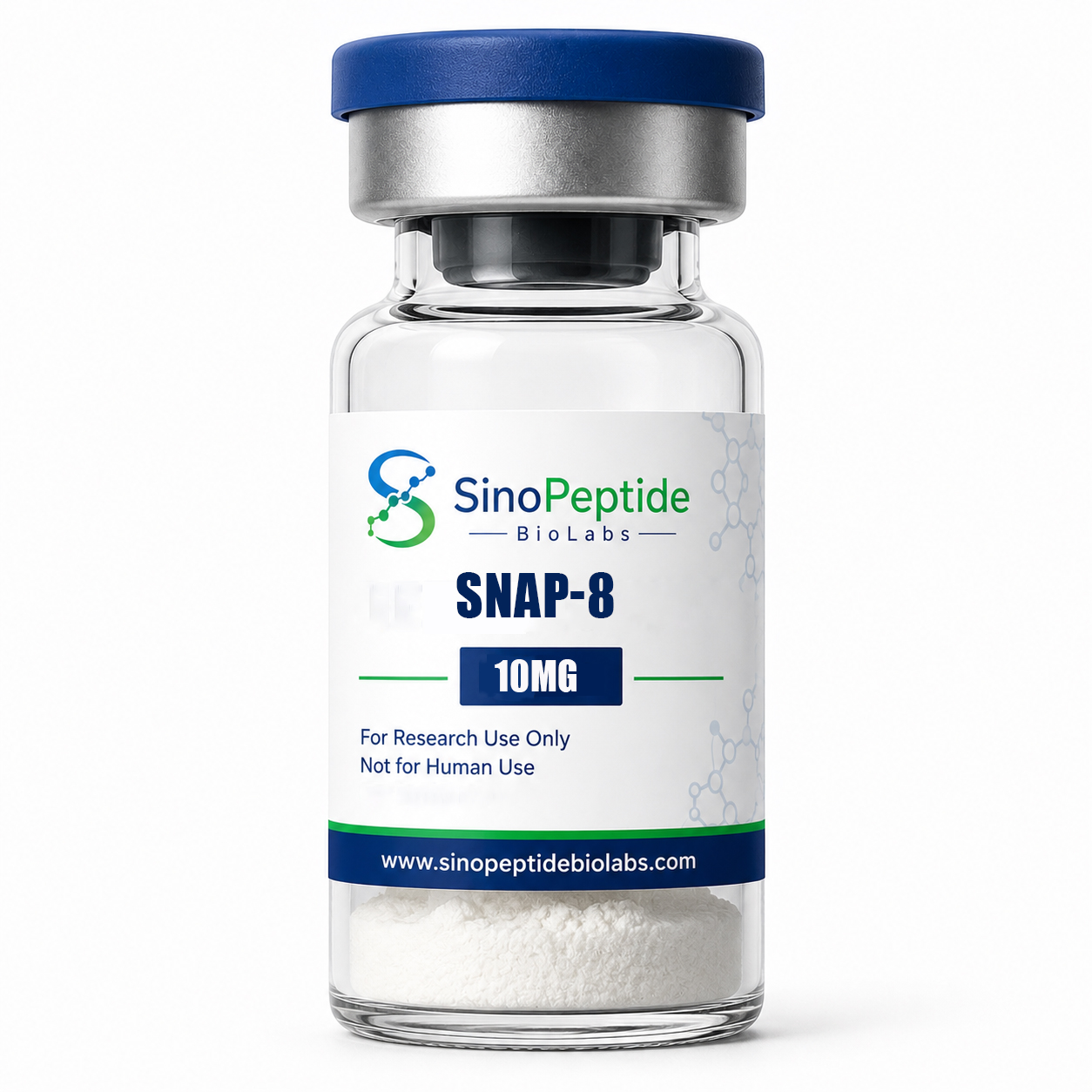
Snap -8 10mg
$50.00
10Vials/ Kits
SNAP-8 10mg: Complete Research Peptide and Skincare Guide
SNAP-8 10mg is a peptide product specification associated with SNAP-8, also known as Acetyl Octapeptide-3. SNAP-8 is a synthetic peptide that has attracted interest in cosmetic and skin-aging research because of its proposed relationship with molecular pathways involved in facial expression lines and wrinkle formation.
One of the most important points when researching SNAP-8 is avoiding confusion with Acetyl Hexapeptide-8, commonly known as Argireline. Although the names are similar and both are associated with peptide-based cosmetic research, they are different peptide ingredients.
SNAP-8 is generally discussed in the context of topical cosmetic formulations and experimental skin-care research rather than as an approved pharmaceutical treatment.
The term 10mg describes the stated quantity of material in a particular product presentation. It does not by itself establish a cosmetic concentration, recommended application amount, medical dose, or suitability for injection.
This guide explains what SNAP-8 10mg is, how SNAP-8 is studied, its relationship with expression lines, how it differs from other cosmetic peptides, product-quality considerations, formulation issues, research evidence, safety considerations, and frequently asked questions.
What Is SNAP-8?
SNAP-8 is the common name used for Acetyl Octapeptide-3, a synthetic peptide associated with cosmetic anti-wrinkle research.
The ingredient belongs to a broader category of cosmetic peptides designed to interact with biological pathways associated with the appearance and structure of aging skin.
SNAP-8 is particularly associated with research into expression-related facial lines.
These lines can become visible in areas such as:
- Forehead
- Between the eyebrows
- Around the eyes
- Upper face
- Other areas affected by repeated facial expression
Unlike injectable neuromodulators, topical cosmetic peptides are generally intended to work at the skin surface or within cosmetic formulations. Therefore, it is important not to describe SNAP-8 as equivalent to botulinum toxin or another prescription injectable treatment.
The scientific rationale for SNAP-8 has contributed to its popularity in cosmetic peptide formulations, particularly products marketed around the appearance of fine lines and wrinkles.
What Does SNAP-8 10mg Mean?
The phrase SNAP-8 10mg contains two important components.
SNAP-8
This identifies the peptide ingredient, commonly referred to as Acetyl Octapeptide-3.
10mg
This identifies the stated quantity of the material.
The 10mg specification should not automatically be interpreted as a concentration or recommended cosmetic application amount.
For example, 10mg of a peptide powder is different from:
- 10mg per milliliter
- 10mg per gram of finished cream
- 10mg per serving
- 10mg in a serum bottle
- 10mg in a laboratory sample
A product page should therefore clearly distinguish total quantity from concentration.
This is particularly important for SEO because searches for “SNAP-8 10mg” may include researchers, cosmetic formulators, ingredient buyers, and consumers looking for finished skin-care products.
SNAP-8 and Acetyl Octapeptide-3
SNAP-8 is associated with the ingredient name Acetyl Octapeptide-3.
The “octapeptide” terminology indicates that the peptide contains eight amino-acid residues in its peptide chain.
The “acetyl” designation describes an acetyl modification associated with the peptide structure.
Understanding the chemical name is useful because cosmetic peptide names can sometimes be confused with similar-sounding ingredients.
For example:
SNAP-8 = Acetyl Octapeptide-3
while:
Argireline = Acetyl Hexapeptide-8
These are not the same peptide.
A well-optimized product page should use the correct terminology throughout the article to prevent inaccurate indexing and misleading product descriptions.
SNAP-8 vs Acetyl Hexapeptide-8
This is one of the most important distinctions for SNAP-8 SEO content.
| Feature | SNAP-8 | Acetyl Hexapeptide-8 |
|---|---|---|
| Common chemical name | Acetyl Octapeptide-3 | Acetyl Hexapeptide-8 |
| Peptide class | Synthetic cosmetic peptide | Synthetic cosmetic peptide |
| Common association | Expression-line research | Expression-line research |
| Frequently associated trade name | SNAP-8 | Argireline |
| Same compound? | No | No |
| Primary cosmetic interest | Appearance of expression-related lines | Appearance of expression-related lines |
| Pharmaceutical drug? | No | No |
Both ingredients belong to the wider category of cosmetic peptides, but they have different sequences and chemical identities.
This means that a website should not describe SNAP-8 as simply “another name for Argireline.”
Using accurate ingredient terminology also helps prevent duplicate or misleading product content.
How Does SNAP-8 Work?
SNAP-8 has been developed around a molecular concept involving the SNARE complex, a group of proteins involved in vesicle fusion and neurotransmitter release.
Facial expression involves coordinated activity of muscles and neuronal signaling.
The cosmetic research rationale behind SNAP-8 involves the possibility that peptide-based modulation of pathways associated with neurotransmitter release may influence the appearance of expression-related wrinkles.
This is why SNAP-8 is often described in cosmetic literature as a peptide designed to target the appearance of dynamic facial lines.
However, the mechanism should not be interpreted as meaning that topical SNAP-8 produces the same pharmacological effect as botulinum toxin.
Botulinum toxin is a regulated biological drug with a distinct mechanism, route of administration, clinical evidence base, manufacturing requirements, and medical use.
SNAP-8 is a cosmetic peptide ingredient and should be described according to the evidence applicable to its particular formulation.
What Are Dynamic Wrinkles?
Understanding dynamic wrinkles helps explain the interest in SNAP-8.
Dynamic wrinkles are facial lines that become more visible during repeated expressions.
Common examples include:
- Forehead lines
- Crow’s feet
- Frown lines
- Expression lines around the eyes
- Certain perioral expression lines
Repeated facial movement contributes to the development and visibility of these lines over time.
Static wrinkles are different because they can remain visible even when the face is relaxed.
Cosmetic research involving expression-related peptides therefore often focuses on whether a formulation can improve the appearance of lines rather than eliminate the underlying biological process completely.
SNAP-8 and Cosmetic Skin Research
SNAP-8 is primarily associated with cosmetic and dermatological research.
Researchers and cosmetic formulators may be interested in questions such as:
- Can a peptide-containing formulation improve the appearance of fine lines?
- How stable is the peptide in a finished formulation?
- What delivery system is appropriate?
- How does concentration affect formulation performance?
- How does skin penetration influence activity?
- What combination of cosmetic ingredients provides acceptable stability?
- How well is the finished formulation tolerated?
These are formulation and cosmetic-science questions rather than evidence that SNAP-8 is a medical treatment.
Research on Peptide-Based Wrinkle Formulations
Clinical research into peptide-containing topical and transdermal formulations has produced evidence that some peptide combinations can improve measurable aspects of wrinkle appearance.
For example, clinical research has evaluated formulations containing Acetyl Octapeptide-3 together with other cosmetic ingredients. Studies involving microneedle systems have reported improvements in wrinkle-related measurements, hydration, elasticity, and other skin parameters.
However, studies involving combinations of ingredients should not automatically be interpreted as proof that SNAP-8 alone caused every observed effect.
This distinction is important when interpreting cosmetic research.
A formulation can contain multiple active ingredients, delivery technologies, and supporting compounds. Therefore, results from the complete formulation may not represent the isolated effect of SNAP-8.
SNAP-8 and Anti-Wrinkle Research
The primary cosmetic interest in SNAP-8 is its potential role in improving the appearance of expression-related facial lines.
Research involving peptide-based skin-care systems commonly evaluates parameters such as:
- Fine-line appearance
- Wrinkle depth
- Skin texture
- Skin smoothness
- Elasticity
- Firmness
- Hydration
- Overall appearance
The quality of evidence depends heavily on study design.
A randomized controlled study with an appropriate control group provides stronger evidence than an uncontrolled consumer survey.
Likewise, a study involving SNAP-8 as one component of a multi-ingredient formulation does not establish that SNAP-8 alone produced the observed outcome.
SNAP-8 10mg Research Applications
SNAP-8 may be encountered in several research and formulation contexts.
1. Cosmetic Peptide Research
Researchers may investigate how synthetic peptides can be incorporated into topical formulations designed for aging skin.
2. Expression-Line Research
SNAP-8 is particularly relevant to research concerning the appearance of facial expression lines.
3. Skin-Aging Research
Researchers may evaluate peptide formulations alongside other ingredients targeting visible signs of skin aging.
4. Formulation Science
SNAP-8 can be studied in relation to:
- pH
- Solubility
- Stability
- Compatibility
- Preservative systems
- Delivery systems
- Packaging
5. Cosmetic Ingredient Development
Formulators may investigate whether SNAP-8 can be incorporated into:
- Serums
- Creams
- Gels
- Masks
- Specialized cosmetic formulations
- Advanced delivery systems
SNAP-8 and Skin Penetration
One challenge associated with topical peptide research is skin penetration.
The skin’s outermost barrier, particularly the stratum corneum, limits the penetration of many molecules.
Peptide size, charge, formulation, stability, and vehicle composition can all influence topical delivery.
Consequently, the presence of SNAP-8 in a cosmetic formula does not automatically mean that the peptide reaches a particular biological target at a concentration sufficient to produce a measurable effect.
Researchers therefore investigate delivery systems designed to improve peptide exposure.
These may include:
- Conventional topical formulations
- Lipid-based systems
- Encapsulation
- Microneedle systems
- Other controlled-delivery technologies
Research involving microneedle patches containing Acetyl Octapeptide-3 has demonstrated why delivery technology is an important consideration when interpreting cosmetic peptide studies.
SNAP-8 in Microneedle Research
Microneedle technology has become an interesting area of cosmetic research.
Microneedles are designed to create microscopic pathways through the outer skin barrier, potentially improving delivery of selected ingredients.
Clinical studies have investigated microneedle systems containing Acetyl Octapeptide-3.
These studies have reported improvements in wrinkle-related measurements and other skin parameters under specific experimental conditions.
However, a microneedle formulation should not automatically be considered equivalent to a conventional topical serum containing SNAP-8.
The delivery method can significantly influence exposure and therefore the observed outcome.
SNAP-8 10mg and Product Quality
Quality control is important when purchasing or researching any synthetic peptide.
A product labeled SNAP-8 10mg should ideally have documentation supporting its identity and stated quantity.
Important quality characteristics include:
Peptide Identity
The documentation should clearly identify the material as SNAP-8 or Acetyl Octapeptide-3.
Purity
Analytical testing can help identify the relative proportion of the desired peptide compared with related impurities.
Molecular Characterization
Mass spectrometry or another appropriate analytical method can help verify molecular identity.
HPLC Testing
High-performance liquid chromatography may be used to assess chromatographic purity and related substances.
Certificate of Analysis
A batch-specific COA may include:
- Product name
- Batch number
- Test date
- Purity
- Identity
- Analytical method
- Specification
- Results
- Laboratory information
Batch Traceability
A traceable lot or batch number makes it easier to associate analytical results with the specific material tested.
Why a Certificate of Analysis Matters
A Certificate of Analysis should not be viewed simply as a marketing document.
For research materials, a useful COA provides evidence about a particular batch.
Ideally, the document should be consistent with the product label and identify the analytical methods used.
A generic certificate without a batch number is less useful for verifying the specific product being purchased.
For professional cosmetic formulation or laboratory research, batch-level documentation can help improve reproducibility.
SNAP-8 10mg Purity and HPLC
HPLC is one of the analytical methods commonly used to characterize synthetic peptides.
It can help researchers assess:
- Main peptide peak
- Related peaks
- Relative chromatographic purity
- Batch consistency
However, HPLC purity should not be confused with complete product safety.
A high analytical purity result does not automatically establish:
- Sterility
- Endotoxin status
- Stability
- Suitability for injection
- Clinical efficacy
- Regulatory approval
Each quality characteristic requires appropriate evidence.
SNAP-8 Storage and Stability
Peptide stability depends on the specific formulation and product specifications.
Factors that may affect peptide stability include:
- Temperature
- Moisture
- Light
- Oxygen
- pH
- Solvent
- Container closure
- Freeze-thaw exposure
- Finished formulation
For this reason, a product page should avoid claiming a universal storage temperature or shelf life unless the manufacturer has validated those conditions.
The manufacturer’s technical documentation should be followed for the specific product.
This is particularly important when distinguishing a raw peptide research material from a finished cosmetic product.
SNAP-8 10mg and Cosmetic Formulation
The performance of a cosmetic peptide depends on more than the peptide itself.
A finished product may also contain:
- Humectants
- Emollients
- Preservatives
- Solvents
- Stabilizers
- Penetration-enhancing ingredients
- Other peptides
- Botanical ingredients
- Antioxidants
- Skin-conditioning agents
These components can influence peptide stability and overall product performance.
Therefore, research on a finished SNAP-8 serum cannot automatically be generalized to every SNAP-8-containing product.
SNAP-8 vs Botox
The comparison between SNAP-8 and Botox is common in online searches, but the two should not be treated as equivalent products.
Botulinum toxin is a regulated biological drug used by qualified medical professionals for specific medical and aesthetic indications.
SNAP-8 is a synthetic cosmetic peptide primarily associated with topical skincare research.
Key differences include:
| Feature | SNAP-8 | Botulinum toxin |
|---|---|---|
| Category | Cosmetic peptide | Biological drug |
| Typical research/application | Topical skincare | Medical/aesthetic treatment |
| Route commonly associated | Topical | Injection |
| Regulatory status | Ingredient-specific and jurisdiction-dependent | Regulated medicine |
| Mechanism | Studied in relation to SNARE-related pathways | Blocks acetylcholine release at neuromuscular junctions |
| Product form | Cosmetic formulations/research material | Pharmaceutical preparation |
The phrase “Botox in a bottle” is therefore a marketing comparison rather than a scientifically equivalent description.
SNAP-8 vs Argireline
Another important comparison is SNAP-8 vs Argireline.
Argireline is commonly associated with Acetyl Hexapeptide-8.
SNAP-8 is associated with Acetyl Octapeptide-3.
They are chemically different peptides.
Both have been incorporated into cosmetic research and formulations focused on the appearance of facial lines, but evidence for one should not automatically be transferred to the other.
SNAP-8 vs Other Cosmetic Peptides
Modern cosmetic formulations may contain several different peptide classes.
Examples include peptides associated with:
- Expression-line appearance
- Collagen-related signaling
- Skin barrier support
- Firmness
- Hydration
- Antioxidant pathways
A formulation containing several peptides may therefore target multiple aspects of visible skin aging.
However, combining ingredients does not guarantee additive or synergistic effects.
Each formulation should be evaluated based on its own evidence.
Is SNAP-8 an Injectable Peptide?
SNAP-8 should not automatically be described as an injectable product.
The commercial and research literature around SNAP-8 primarily concerns cosmetic formulations and topical delivery.
A product labeled “SNAP-8 10mg” may refer to a research peptide quantity rather than a pharmaceutical injectable.
A website should therefore avoid adding injection instructions, reconstitution instructions, or human administration claims unless a specific legally authorized pharmaceutical product and its official labeling support those statements.
SNAP-8 Safety Considerations
Safety depends on the specific formulation, concentration, route, manufacturing process, and individual factors.
For topical cosmetic products, relevant considerations may include:
- Skin sensitivity
- Irritation
- Allergic reactions
- Ingredient interactions
- Preservative sensitivity
- Product contamination
- Formulation pH
Research material intended for laboratory use should not automatically be applied to human skin.
Likewise, a raw peptide powder should not automatically be considered a finished cosmetic ingredient suitable for direct consumer application.
The product’s intended use and technical documentation should always be considered.
Common Misconceptions About SNAP-8 10mg
Myth 1: SNAP-8 and Argireline are the same peptide
They are not.
SNAP-8 is associated with Acetyl Octapeptide-3, while Argireline is associated with Acetyl Hexapeptide-8.
Myth 2: 10mg is a recommended facial application dose
No.
10mg describes the stated quantity of a product or material. It does not establish a universal topical dose.
Myth 3: SNAP-8 is Botox
No.
SNAP-8 is a cosmetic peptide, while botulinum toxin is a regulated biological drug.
Myth 4: SNAP-8 permanently removes wrinkles
There is no basis for describing SNAP-8 as a permanent wrinkle-removal treatment.
Cosmetic studies generally evaluate changes in the appearance of lines and wrinkles under specific formulation and usage conditions.
Myth 5: Higher peptide quantity automatically means better results
Not necessarily.
The performance of a peptide depends on formulation, stability, delivery, concentration, exposure, and the biological context.
Myth 6: Research-grade SNAP-8 is automatically suitable for cosmetic use
No.
A laboratory research material and a finished cosmetic ingredient are different product categories with different quality requirements.
Frequently Asked Questions About SNAP-8 10mg
What is SNAP-8 10mg?
SNAP-8 10mg refers to a stated 10mg quantity of SNAP-8, commonly identified as Acetyl Octapeptide-3. It is primarily associated with cosmetic and peptide research.
What is SNAP-8 used for?
SNAP-8 is primarily studied in cosmetic formulations targeting the appearance of facial expression lines and wrinkles.
Is SNAP-8 the same as Argireline?
No. Argireline is associated with Acetyl Hexapeptide-8, whereas SNAP-8 is associated with Acetyl Octapeptide-3.
Is SNAP-8 Botox?
No. SNAP-8 is a synthetic cosmetic peptide and should not be represented as equivalent to botulinum toxin.
What does 10mg mean?
It indicates the stated quantity of SNAP-8 in the product presentation. It does not by itself establish a recommended cosmetic concentration or dosage.
Does SNAP-8 remove wrinkles?
Research has investigated peptide-containing formulations for improvements in the appearance of wrinkles. It is more accurate to describe SNAP-8 as a cosmetic ingredient studied for visible wrinkle appearance rather than claiming that it permanently removes wrinkles.
Is SNAP-8 an injectable?
SNAP-8 is primarily associated with topical cosmetic and formulation research. A product labeled SNAP-8 10mg should not automatically be assumed to be an injectable pharmaceutical.
How can SNAP-8 quality be evaluated?
Relevant documentation can include identity testing, HPLC purity analysis, mass spectrometry, batch traceability, and a batch-specific Certificate of Analysis.
How should SNAP-8 be stored?
Storage requirements depend on the specific product formulation. Manufacturer-provided technical specifications should be followed rather than relying on generic storage recommendations.
Can SNAP-8 be used directly from a research vial?
A research-grade peptide should not automatically be considered a finished cosmetic product. Its intended use, formulation, purity, documentation, and applicable regulations should be evaluated before any cosmetic application.
Is SNAP-8 FDA approved?
SNAP-8 should not be marketed as an FDA-approved drug. Its use as a cosmetic ingredient and the regulatory requirements applicable to a particular finished product depend on the jurisdiction and product claims.
Research-Use and Cosmetic Disclaimer
This article is provided for educational, cosmetic-science, and research-information purposes.
SNAP-8 is discussed as a synthetic peptide associated with cosmetic and formulation research. This article does not establish that any particular SNAP-8 10mg product is safe, effective, sterile, or appropriate for human administration.
A research-grade peptide should not automatically be treated as a finished cosmetic product or pharmaceutical ingredient.
Claims about wrinkle reduction, skin rejuvenation, anti-aging, or other cosmetic outcomes should be based on evidence applicable to the specific formulation being marketed.
Products intended for human use should comply with applicable cosmetic, pharmaceutical, labeling, manufacturing, and advertising requirements in the relevant jurisdiction.
Conclusion
SNAP-8 10mg is a product specification associated with SNAP-8, also known as Acetyl Octapeptide-3, a synthetic peptide investigated primarily in cosmetic and skin-care research.
The peptide has attracted interest because of its proposed relationship with pathways involved in facial expression and the appearance of dynamic wrinkles.
One of the most important points for anyone researching SNAP-8 is the distinction between SNAP-8 and Acetyl Hexapeptide-8. Although both are cosmetic peptides associated with anti-wrinkle products, they are chemically different ingredients. Acetyl Hexapeptide-8 is commonly associated with Argireline, while SNAP-8 refers to Acetyl Octapeptide-3.
Clinical and experimental research involving Acetyl Octapeptide-3-containing formulations has investigated changes in wrinkle appearance and other skin parameters. Some studies have also examined advanced delivery systems such as microneedle patches. However, results from multi-ingredient formulations or specialized delivery systems should not automatically be interpreted as evidence for isolated SNAP-8 powder.
The 10mg designation is also important to interpret correctly. It identifies a stated quantity of material, not a universal topical concentration, medical dose, or recommendation for human administration.
For a high-quality SNAP-8 product page, transparency is more valuable than exaggerated claims. Clearly identifying the peptide, explaining its relationship with cosmetic research, distinguishing it from Argireline, providing appropriate quality documentation, and describing the limitations of current evidence can create a more authoritative and trustworthy resource.
A strong SEO strategy should therefore focus on scientifically accurate terms such as SNAP-8 10mg, Acetyl Octapeptide-3, SNAP-8 peptide, SNAP-8 research, cosmetic peptide, anti-wrinkle peptide, and SNAP-8 skincare research while avoiding unsupported claims of permanent wrinkle removal or equivalence to injectable botulinum toxin.
SNAP-8 10mg SNAP-8 10mg SNAP-8 10mg SNAP-8 10mg SNAP-8 10mg SNAP-8 10mg SNAP-8 10mg SNAP-8 10mg SNAP-8 10mg SNAP-8 10mg SNAP-8 10mg SNAP-8 10mg SNAP-8 10mg SNAP-8 10mg SNAP-8 10mg SNAP-8 10mg SNAP-8 10mg SNAP-8 10mg SNAP-8 10mg SNAP-8 10mg SNAP-8 10mg SNAP-8 10mg SNAP-8 10mg
Be the first to review “Snap -8 10mg”
Related products
Pure Peptides
Pure Peptides
Pure Peptides
Pure Peptides
Pure Peptides
Pure Peptides
Pure Peptides
Pure Peptides
Reviews
There are no reviews yet.