

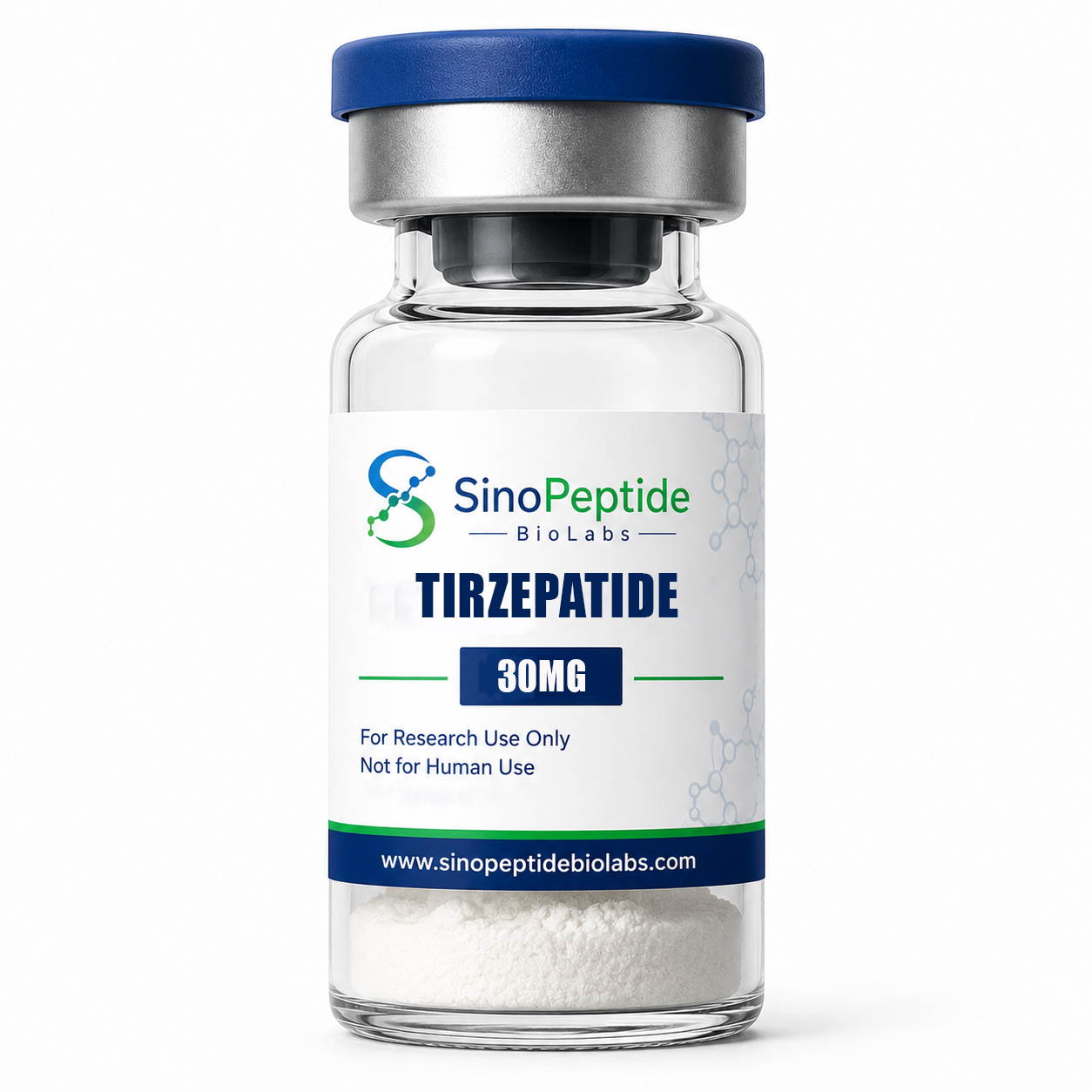
Tirzepatide 30mg
$120.00
10 Vials/ Kits
Tirzepatide 30mg: Complete Guide to Research, Uses, Safety, Quality & FDA Status
Tirzepatide 30mg is a product-specific search term associated with tirzepatide research, peptide products, laboratory materials, and higher-quantity formulations. Because tirzepatide has become widely studied for metabolic health, obesity, type 2 diabetes, and related conditions, searches for different product quantities and strengths have increased substantially.
However, an important distinction must be made between the amount of tirzepatide contained in a product and an approved clinical dosage.
Tirzepatide is a dual GIP and GLP-1 receptor agonist. In the United States, it is the active ingredient in FDA-approved prescription products including Mounjaro and Zepbound. Zepbound is approved for certain chronic weight-management and obstructive sleep apnea indications, while Mounjaro is approved for improving blood glucose control in adults with type 2 diabetes.
Current FDA labeling for Zepbound lists 2.5mg, 5mg, 7.5mg, 10mg, 12.5mg, and 15mg injection strengths, with 15mg once weekly as the maximum recommended dosage. A 30mg weekly dose is therefore not an FDA-approved Zepbound dosage under current U.S. labeling.
This makes accurate terminology particularly important for websites publishing content about Tirzepatide 30mg.
A product labeled “Tirzepatide 30mg” may refer to the total quantity of active ingredient in a particular product or research presentation. It should not automatically be interpreted as a recommendation for administering 30mg to a person.
This comprehensive guide covers what Tirzepatide 30mg means, how tirzepatide works, the clinical evidence behind tirzepatide, the difference between 30mg product quantity and approved dosage, research applications, quality testing, safety considerations, regulatory status, and frequently asked questions.
What Is Tirzepatide?
Tirzepatide is a synthetic peptide-based active pharmaceutical ingredient that acts on two incretin hormone receptors:
- Glucose-dependent insulinotropic polypeptide, or GIP, receptors
- Glucagon-like peptide-1, or GLP-1, receptors
Because it activates both pathways, tirzepatide is commonly described as a dual GIP/GLP-1 receptor agonist.
GIP and GLP-1 are naturally occurring hormones involved in metabolic signaling. Their pathways influence processes including glucose-dependent insulin secretion, glucagon regulation, appetite, food intake, and energy metabolism.
Tirzepatide was first approved in the United States as Mounjaro for improving blood glucose control in adults with type 2 diabetes, alongside diet and exercise. The FDA subsequently approved Zepbound for chronic weight management in qualifying adults with obesity or overweight and for moderate-to-severe obstructive sleep apnea in adults with obesity.
These products contain the same active ingredient but have different approved indications and labeling.
What Does Tirzepatide 30mg Mean?
The phrase Tirzepatide 30mg requires context.
The “30mg” designation may describe the total amount of tirzepatide contained in a particular product rather than an approved amount intended for administration at one time.
For example, 30mg could potentially describe:
- Total peptide quantity in a research product
- Total active ingredient in a multi-dose presentation
- A laboratory research material
- A product specification used outside the U.S. prescription-drug framework
- A product marketed online with a quantity-based name
Consequently, the phrase Tirzepatide 30mg should not automatically be rewritten as “30mg tirzepatide weekly dose.”
That distinction is particularly important because current FDA-approved Zepbound labeling establishes 15mg once weekly as the maximum recommended dosage.
Product Quantity vs Clinical Dose
These two concepts are different.
Product quantity refers to how much active ingredient is contained in a particular product.
Clinical dose refers to the amount administered according to an approved prescribing regimen.
A 30mg product therefore does not establish a 30mg clinical dosing regimen.
For SEO content, this distinction helps avoid misleading readers while still allowing the page to rank naturally for searches such as:
- Tirzepatide 30mg
- Tirzepatide 30mg peptide
- Tirzepatide 30mg research
- Tirzepatide 30mg product
- Tirzepatide 30mg COA
- Tirzepatide 30mg purity
Is Tirzepatide 30mg FDA Approved?
A 30mg weekly dose is not listed as an FDA-approved Zepbound dosage.
The current FDA prescribing information lists the following Zepbound injection strengths:
| Strength | Current U.S. Zepbound labeling |
|---|---|
| 2.5mg | Approved strength |
| 5mg | Approved strength |
| 7.5mg | Approved strength |
| 10mg | Approved strength |
| 12.5mg | Approved strength |
| 15mg | Approved strength and maximum recommended dosage |
| 30mg | Not listed as an approved weekly dosage |
For weight reduction and long-term weight maintenance, the FDA label lists 5mg, 10mg, or 15mg as maintenance dosages. For obstructive sleep apnea, 10mg or 15mg are listed as maintenance dosages. The maximum recommended dosage for Zepbound is 15mg once weekly.
This does not necessarily mean that no product can contain a total of 30mg tirzepatide.
It means that a website should not describe a 30mg product as an FDA-approved 30mg weekly treatment.
How Does Tirzepatide Work?
Tirzepatide’s pharmacological activity is based on dual GIP and GLP-1 receptor activation.
GIP Receptor Activity
GIP stands for glucose-dependent insulinotropic polypeptide.
GIP is an incretin hormone involved in metabolic signaling following nutrient intake. Tirzepatide activates GIP receptors and contributes to glucose-dependent insulinotropic activity.
GLP-1 Receptor Activity
GLP-1 stands for glucagon-like peptide-1.
GLP-1 signaling is involved in:
- Glucose-dependent insulin secretion
- Regulation of glucagon secretion
- Gastrointestinal activity
- Appetite signaling
- Food intake
The combination of GIP and GLP-1 receptor activity distinguishes tirzepatide from selective GLP-1 receptor agonists.
The FDA describes Zepbound as a GIP and GLP-1 receptor agonist that reduces appetite and food intake.
Why Dual Receptor Activity Matters
Tirzepatide’s dual-receptor mechanism is a major focus of metabolic research.
Researchers have investigated its effects on:
- Body weight
- Glycemic control
- Appetite
- Food intake
- Insulin signaling
- Metabolic risk factors
- Obesity-related conditions
The clinical evidence, however, comes from specific studied doses and populations. It should not be assumed that increasing the amount beyond studied or approved regimens automatically produces a corresponding clinical effect.
Tirzepatide 30mg and Clinical Research
One of the most important points for an SEO article about Tirzepatide 30mg is to distinguish research involving tirzepatide from research specifically involving a 30mg clinical dose.
Major tirzepatide clinical trials have evaluated doses such as 5mg, 10mg, and 15mg.
For example, SURMOUNT-1 was a large phase 3 randomized controlled trial involving 2,539 adults with obesity or overweight and a weight-related complication who did not have diabetes.
Participants received 5mg, 10mg, or 15mg tirzepatide or placebo once weekly for 72 weeks.
The trial did not evaluate a 30mg weekly tirzepatide group.
Therefore, the findings from SURMOUNT-1 can support an explanation of tirzepatide’s clinical evidence, but they should not be presented as evidence that a 30mg weekly dose has been established.
Tirzepatide 15mg: The Highest Studied Approved Strength
The 15mg strength is especially relevant when explaining Tirzepatide 30mg.
In SURMOUNT-1, the 15mg group experienced a mean body-weight reduction of approximately 20.9% at week 72 under the treatment-regimen estimand, compared with 19.5% with 10mg and 15.0% with 5mg.
The trial also found that gastrointestinal adverse events were the most common adverse events and were generally mild to moderate, occurring primarily during dose escalation.
These results demonstrate the clinical evidence available for tirzepatide at the 15mg level.
They do not establish the safety, effectiveness, or appropriate use of a 30mg weekly dose.
Tirzepatide 30mg and Long-Term Research
Long-term research has provided additional evidence concerning tirzepatide.
A three-year analysis of SURMOUNT-1 included participants with obesity and prediabetes who received 5mg, 10mg, or 15mg tirzepatide.
At week 176, mean body-weight changes were approximately:
- 12.3% with 5mg
- 18.7% with 10mg
- 19.7% with 15mg
- 1.3% with placebo
The study also reported substantially fewer new cases of type 2 diabetes among tirzepatide-treated participants during the treatment period.
Again, this study provides evidence for tirzepatide generally and for the studied strengths, but it does not establish a 30mg weekly treatment regimen.
Tirzepatide 30mg and Weight-Management Research
Tirzepatide has become a major subject of obesity research.
The SURMOUNT program has investigated tirzepatide in people with overweight and obesity, including populations with and without type 2 diabetes.
The original SURMOUNT-1 trial found substantial weight reductions at 5mg, 10mg, and 15mg.
The FDA subsequently approved Zepbound for chronic weight management in qualifying adults with obesity or overweight and at least one weight-related condition. The treatment is intended to be used alongside a reduced-calorie diet and increased physical activity.
For SEO purposes, this makes related search terms such as Tirzepatide 30mg weight loss research relevant, but the page should clarify that clinical evidence does not establish 30mg as an approved weekly dose.
Tirzepatide 30mg and Type 2 Diabetes Research
Tirzepatide was originally developed as a treatment for type 2 diabetes.
Mounjaro is an FDA-approved tirzepatide product used to improve blood glucose control in adults with type 2 diabetes as an adjunct to diet and exercise.
The SURPASS clinical program evaluated tirzepatide at 5mg, 10mg, and 15mg in adults with type 2 diabetes.
One major study, SURPASS-2, directly compared tirzepatide at 5mg, 10mg, and 15mg with semaglutide 1mg in adults with type 2 diabetes.
This research established a substantial evidence base for tirzepatide’s role in glucose-management research.
It does not establish 30mg as a standard clinical dose.
Tirzepatide and Obstructive Sleep Apnea Research
Tirzepatide has also expanded into obstructive sleep apnea research.
Zepbound is now FDA-approved for the treatment of moderate-to-severe obstructive sleep apnea in adults with obesity. Current labeling lists 10mg and 15mg as maintenance dosages for this indication.
This is another reason a Tirzepatide 30mg page should clearly separate the active ingredient from an approved branded product.
A website should not claim that a 30mg product is an FDA-approved OSA treatment simply because tirzepatide itself has an approved OSA indication.
The approved product, indication, strength, and labeling must be considered together.
Tirzepatide 30mg vs Tirzepatide 15mg
A comparison between Tirzepatide 30mg and Tirzepatide 15mg should begin with regulatory status.
Tirzepatide 15mg
15mg is an FDA-approved Zepbound strength and the current maximum recommended Zepbound dosage. It has been directly evaluated in large phase 3 trials.
Tirzepatide 30mg
30mg is not listed as an approved weekly Zepbound dosage.
A 30mg product may instead represent a total quantity or another formulation specification.
The two should therefore not be described simply as “15mg versus double-strength 30mg” without explaining what the product quantity represents.
Tirzepatide 30mg vs Tirzepatide 10mg
Tirzepatide 10mg is an approved strength of Zepbound and has been directly studied in clinical trials.
Tirzepatide 30mg, by contrast, is not an FDA-listed weekly maintenance dosage.
This means that a comparison page should focus on:
- Regulatory status
- Product quantity
- Intended use
- Clinical evidence
- Quality documentation
- Formulation
- Manufacturer information
Rather than implying that a larger numerical amount automatically represents a clinically appropriate treatment.
Tirzepatide 30mg vs Semaglutide
Tirzepatide and semaglutide are both incretin-based medicines, but their mechanisms differ.
Tirzepatide activates both GIP and GLP-1 receptors.
Semaglutide primarily activates the GLP-1 receptor.
Clinical research has directly compared tirzepatide and semaglutide in obesity. SURMOUNT-5 randomized adults with obesity but without type 2 diabetes to maximum tolerated doses of tirzepatide, 10mg or 15mg, or semaglutide, 1.7mg or 2.4mg, for 72 weeks.
This trial provides a direct clinical comparison between the two active ingredients, but it does not establish 30mg tirzepatide as a studied clinical dose.
Potential Research Areas for Tirzepatide
Tirzepatide research covers multiple areas.
Body-Weight Research
Clinical trials have evaluated changes in body weight and body composition in people with obesity and overweight.
Glucose Regulation
Tirzepatide has been studied extensively in adults with type 2 diabetes.
Appetite and Food Intake
The GIP and GLP-1 pathways influence appetite and food intake.
Metabolic Research
Researchers have evaluated changes in cardiometabolic measures alongside weight reduction and glucose control.
Obstructive Sleep Apnea
Tirzepatide is now also relevant to obesity-associated OSA research and treatment.
The existence of evidence in these areas should not be interpreted as evidence for every concentration or product labeled Tirzepatide 30mg.
Tirzepatide 30mg Safety Considerations
Safety information should be based on the actual approved product and studied formulations.
Common adverse reactions associated with Zepbound include:
- Nausea
- Diarrhea
- Vomiting
- Constipation
- Abdominal discomfort
- Abdominal pain
- Injection-site reactions
- Fatigue
- Hypersensitivity reactions
- Burping
- Hair loss
- Gastroesophageal reflux disease
The FDA label also contains warnings and precautions concerning severe gastrointestinal adverse reactions, acute kidney injury, acute gallbladder disease, pancreatitis, hypoglycemia in certain combinations, diabetic retinopathy complications, hypersensitivity, and pulmonary aspiration during anesthesia or deep sedation.
Thyroid C-Cell Tumor Warning
The current Zepbound label carries a boxed warning concerning thyroid C-cell tumors observed in rats.
The human relevance of this finding has not been established.
Zepbound is contraindicated in people with a personal or family history of medullary thyroid carcinoma or in people with Multiple Endocrine Neoplasia syndrome type 2.
Why 30mg Requires Particular Caution in SEO Copy
Because 30mg is not an FDA-approved weekly Zepbound dosage, a website should avoid suggesting that the safety profile of an unapproved 30mg regimen is established simply because 15mg has been studied.
Clinical evidence at one dosage cannot automatically be extrapolated to another.
Tirzepatide 30mg Quality and Purity
Quality documentation becomes particularly important when a website discusses a product that is not an FDA-approved prescription presentation.
For research materials, relevant quality information may include:
- Certificate of Analysis (COA)
- HPLC purity analysis
- Mass spectrometry
- Identity testing
- Lot or batch number
- Manufacturing information
- Storage requirements
- Retest or expiration information
HPLC Testing
High-performance liquid chromatography can be used to characterize peptide purity and related analytical properties.
However, an HPLC percentage should not automatically be described as proof of:
- FDA approval
- Sterility
- Clinical safety
- Therapeutic effectiveness
- Pharmaceutical equivalence
- Suitability for human administration
Mass Spectrometry
Mass spectrometry can help confirm molecular identity and molecular mass.
Used together with appropriate analytical methods, it can provide useful information about the identity and quality of a research material.
However, laboratory testing does not transform a research product into an FDA-approved medicine.
Certificate of Analysis
A COA can document analytical results for a particular batch.
For a high-quality research product page, the COA should ideally be traceable to the relevant lot or batch and identify the tested material and analytical methods.
A COA should never be presented as equivalent to FDA approval.
Research Tirzepatide vs Prescription Tirzepatide
The distinction between research material and prescription medication is fundamental.
FDA-Approved Prescription Products
Mounjaro and Zepbound are FDA-approved tirzepatide products with defined indications, formulations, labeling, manufacturing requirements, and approved strengths.
Research Products
Research products may be intended for laboratory, analytical, or scientific applications.
They should not automatically be described as:
- Zepbound
- Mounjaro
- FDA-approved medication
- Clinically validated treatment
- Therapeutically equivalent to an approved prescription product
For a website offering a product described as Tirzepatide 30mg, the product page should clearly state the actual regulatory status and intended use.
Tirzepatide 30mg Storage and Stability
Storage requirements depend on the exact formulation and manufacturer.
FDA-approved Zepbound products have specific storage instructions contained in the prescribing information. Current labeling provides refrigerated storage requirements and specific conditions for certain presentations.
A research product may have completely different stability requirements.
Therefore, website owners should avoid copying Zepbound storage instructions onto an unrelated Tirzepatide 30mg research product.
The manufacturer’s documentation should determine the storage information for that particular material.
Why People Search for Tirzepatide 30mg
The keyword Tirzepatide 30mg can represent several different search intents.
Informational Search Intent
People may want to understand:
- What Tirzepatide 30mg means
- Whether 30mg is approved
- How tirzepatide works
- What clinical research exists
- How 30mg compares with 15mg
Commercial Search Intent
Some users may search for:
- Tirzepatide 30mg product
- Tirzepatide 30mg peptide
- Tirzepatide 30mg research
- Tirzepatide 30mg COA
- Tirzepatide 30mg purity
Research Search Intent
Researchers may be looking for information about:
- Tirzepatide analytical standards
- Peptide purity
- HPLC testing
- Mass spectrometry
- Batch documentation
- Research-grade materials
A well-optimized page can address all these search intents while maintaining accurate regulatory language.
Common Misconceptions About Tirzepatide 30mg
Is Tirzepatide 30mg the highest approved tirzepatide dose?
No. Current FDA Zepbound labeling identifies 15mg once weekly as the maximum recommended dosage.
Is 30mg an FDA-approved weekly Zepbound dose?
No. The current approved Zepbound dosage schedule does not list 30mg once weekly.
Does a 30mg product necessarily mean 30mg should be administered at once?
No. Product quantity and clinical dosage are different concepts.
Is every Tirzepatide 30mg product Zepbound?
No. Zepbound is a specific FDA-approved prescription product.
Does a COA prove FDA approval?
No. A COA provides batch-specific analytical information and does not itself establish regulatory approval.
Does more tirzepatide automatically mean greater clinical benefit?
Clinical effects cannot be assumed to increase proportionally with an amount that has not been established in an approved regimen.
Has 30mg tirzepatide been evaluated in the major SURMOUNT-1 obesity trial?
No. SURMOUNT-1 evaluated 5mg, 10mg, and 15mg once-weekly tirzepatide.
Frequently Asked Questions About Tirzepatide 30mg
What is Tirzepatide 30mg?
Tirzepatide 30mg generally describes a product containing a total quantity of 30mg of tirzepatide. The exact meaning depends on the formulation and product presentation.
Is Tirzepatide 30mg FDA approved?
A 30mg weekly dosage is not listed as an FDA-approved Zepbound dosage. Current FDA labeling identifies 15mg once weekly as the maximum recommended Zepbound dosage.
What is tirzepatide used for?
FDA-approved tirzepatide products have indications involving type 2 diabetes, chronic weight management in qualifying adults, and moderate-to-severe obstructive sleep apnea in adults with obesity, depending on the specific product.
What is the maximum approved Zepbound dosage?
The current maximum recommended Zepbound dosage is 15mg once weekly.
How does tirzepatide work?
Tirzepatide activates GIP and GLP-1 receptors, influencing metabolic pathways involved in glucose regulation, appetite, and food intake.
Has 30mg tirzepatide been studied in SURMOUNT-1?
No. SURMOUNT-1 evaluated 5mg, 10mg, and 15mg tirzepatide.
What are the common side effects of tirzepatide?
Common adverse effects include gastrointestinal symptoms such as nausea, diarrhea, vomiting, constipation, abdominal discomfort, and abdominal pain.
Is Tirzepatide 30mg the same as Zepbound?
Not automatically. Zepbound is a specific FDA-approved branded product. A product labeled Tirzepatide 30mg should not automatically be identified as Zepbound.
Is Tirzepatide 30mg the same as Mounjaro?
Not necessarily. Mounjaro is a specific FDA-approved tirzepatide product with its own approved labeling and strengths.
What should a Tirzepatide 30mg research product page include?
A strong product page should clearly identify the product, quantity, intended use, manufacturer or supplier information, analytical documentation, purity information where available, storage requirements, and regulatory status.
Final Thoughts on Tirzepatide 30mg
Tirzepatide 30mg is a valuable SEO topic because it intersects with searches for tirzepatide products, peptide research, clinical evidence, quality testing, and higher-quantity formulations.
The most important factual distinction is that 30mg should not be presented as an FDA-approved weekly Zepbound dose. Current FDA labeling identifies 15mg once weekly as the maximum recommended Zepbound dosage and lists approved injection strengths from 2.5mg through 15mg.
At the same time, tirzepatide itself has a substantial clinical evidence base. Major trials such as SURMOUNT-1 evaluated 5mg, 10mg, and 15mg and demonstrated significant average weight reduction compared with placebo.
Long-term research has also examined 5mg, 10mg, and 15mg over three years in people with obesity and prediabetes.
For website owners, the strongest content strategy is therefore not to make unsupported claims about a 30mg clinical dose. Instead, build topical relevance around Tirzepatide 30mg research, product quantity, FDA status, quality, purity, COA documentation, mechanism of action, clinical evidence, safety, and comparisons with approved strengths.
This approach allows the page to target the exact keyword while providing readers with the information needed to understand what “30mg” actually represents.
Educational disclaimer: This article is for informational and SEO purposes and does not constitute medical advice. Prescription tirzepatide should be used according to applicable prescribing information and under appropriate healthcare supervision. The quantity stated on a product label, a certificate of analysis, or an online product description does not by itself establish FDA approval, sterility, clinical suitability, or therapeutic effectiveness.
Be the first to review “Tirzepatide 30mg”
Related products
Pure Peptides
Pure Peptides
Pure Peptides
Pure Peptides
Pure Peptides
Pure Peptides
Pure Peptides
Pure Peptides
Reviews
There are no reviews yet.