
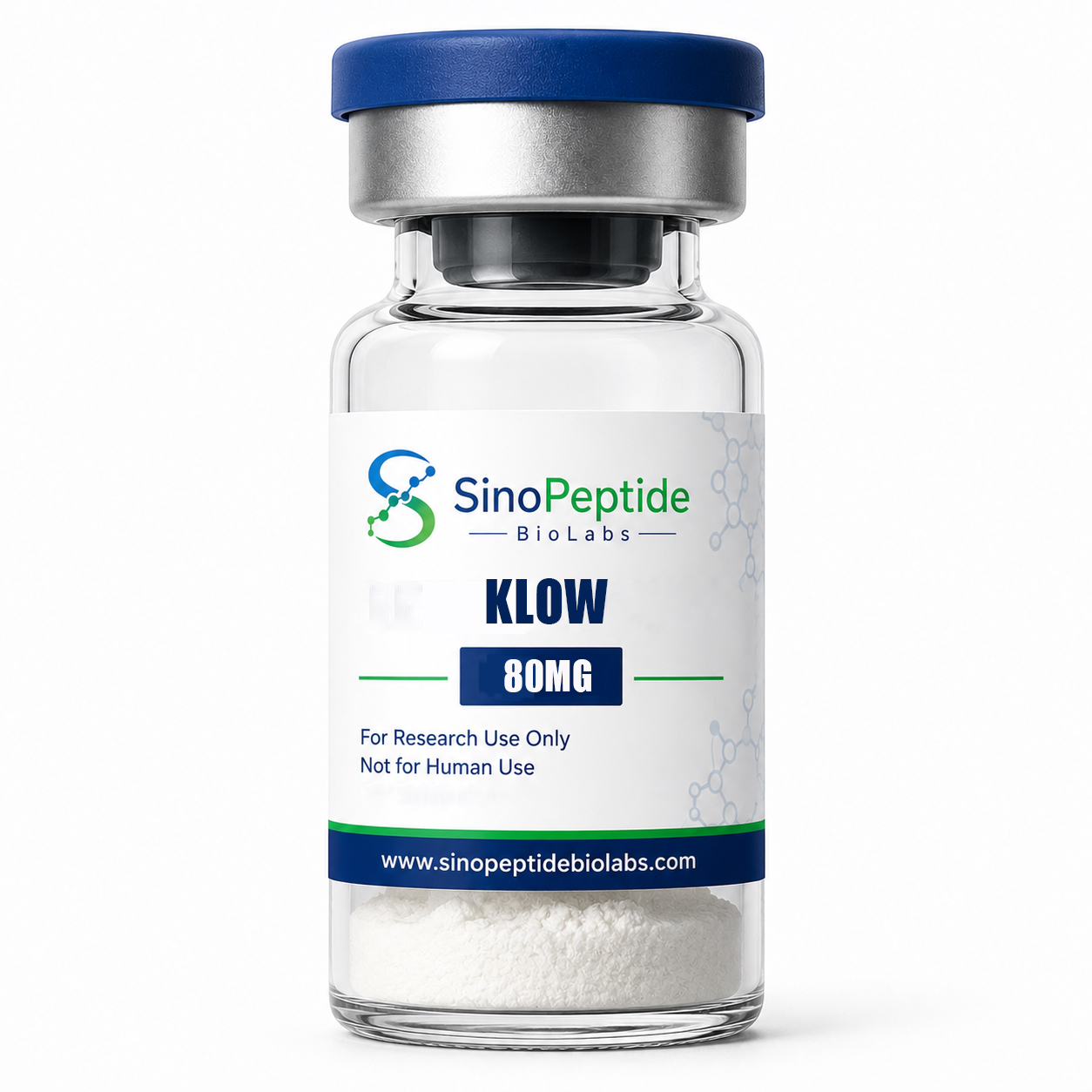
KLOW (CU50 + TB10+BC10+KPV10) 80mg
$255.00
10 Vials/Kits
KLOW (CU50 + TB10 + BC10 + KPV10) 80mg: Research, Ingredients, Benefits, Safety and Evidence
What Is KLOW (CU50 + TB10 + BC10 + KPV10) 80mg?
KLOW (CU50 + TB10 + BC10 + KPV10) 80mg is a multi-peptide research formulation combining four compounds commonly discussed in tissue-repair, inflammation, and regenerative-medicine research.
Based on the product designation supplied, the formulation contains:
- CU50: 50 mg of copper peptide, generally referring to GHK-Cu
- TB10: 10 mg of TB-500/thymosin-related peptide
- BC10: 10 mg of BPC-157
- KPV10: 10 mg of KPV
- Total: 80 mg
The individual quantities add up to 80 mg.
However, abbreviations used on commercial peptide products are not universally standardized. For that reason, the exact identity, sequence, purity, salt form, and formulation should always be confirmed from the manufacturer’s label, certificate of analysis (COA), and other product documentation.
KLOW is best understood as a research peptide blend, rather than a single pharmaceutical ingredient. Each component has a different biological origin and research profile.
This distinction is particularly important for SEO and medical accuracy. Research findings involving GHK-Cu, BPC-157, thymosin beta-4 or KPV individually should not automatically be interpreted as evidence that the complete KLOW 80mg combination works in humans.
Current evidence reviews specifically note that published research on the exact four-peptide KLOW combination is lacking, meaning there is no established clinical evidence demonstrating that the ingredients work better together than individually.
KLOW 80mg Ingredients at a Glance
The KLOW formula described by the product name contains four components.
| Ingredient | Listed amount | General research area |
|---|---|---|
| CU / GHK-Cu | 50 mg | Skin biology, collagen, tissue repair |
| TB / TB-500 | 10 mg | Tissue repair and wound-healing research |
| BPC-157 | 10 mg | Gastrointestinal and tissue-repair research |
| KPV | 10 mg | Inflammation and intestinal research |
| Total | 80 mg | Multi-peptide research formulation |
The four ingredients have different mechanisms and evidence levels.
GHK-Cu has been investigated particularly in dermatology and tissue-repair research. Thymosin beta-4 has been studied in wound healing, including human clinical research involving topical formulations. BPC-157 has a much more limited human evidence base, while KPV remains predominantly a preclinical research compound.
Why Is KLOW a Multi-Peptide Blend?
The rationale behind a formulation such as KLOW is based on the idea that different peptides may influence different biological pathways.
For example:
- GHK-Cu is associated with extracellular-matrix and skin biology.
- Thymosin beta-4 has been investigated for cell migration, angiogenesis and wound repair.
- BPC-157 has been studied in models of tissue injury and gastrointestinal function.
- KPV has been investigated for anti-inflammatory signaling.
This creates a theoretical basis for studying the compounds together.
However, a plausible mechanism is not the same as demonstrated clinical efficacy.
Researchers must determine whether compounds remain stable together, whether they alter one another’s pharmacokinetics, whether their effects are additive or redundant, and whether the combination introduces new safety issues.
These questions have not been adequately answered for KLOW as a complete four-peptide formulation. A current evidence review reports no published study directly evaluating the four-component KLOW blend as a combination.
GHK-Cu in KLOW: What Is CU50?
The CU50 component is generally understood to refer to approximately 50 mg of GHK-Cu, also known as copper tripeptide-1.
GHK-Cu consists of the peptide glycyl-L-histidyl-L-lysine complexed with copper.
It has attracted scientific interest because copper and peptide signaling are involved in several processes related to extracellular-matrix biology and tissue repair.
Research has investigated GHK-Cu in areas including:
- Collagen production
- Fibroblast activity
- Skin remodeling
- Wound healing
- Angiogenesis
- Inflammatory signaling
- Skin appearance
However, evidence varies considerably depending on the formulation and route of administration.
For example, a randomized clinical study investigated a topical copper tripeptide complex following CO₂ laser resurfacing. Although participants reported greater satisfaction with the GHK-Cu regimen, objective measures did not show significant improvements in erythema, wrinkles, or overall skin quality compared with the control regimen.
This illustrates why GHK-Cu research should be interpreted carefully.
A laboratory mechanism does not necessarily translate into a clinically meaningful outcome.
GHK-Cu and Tissue Repair
GHK-Cu is one of the better-known components in regenerative peptide research.
Laboratory and preclinical studies have investigated whether GHK-Cu can influence fibroblast activity, extracellular-matrix production, angiogenesis and inflammatory responses.
Recent reviews continue to describe GHK-Cu as a compound of interest for tissue repair, while emphasizing that the clinical evidence is limited and formulation-dependent.
This is especially relevant to KLOW because the CU50 component represents the largest individual quantity in the 80 mg formulation.
Nevertheless, the amount of GHK-Cu in a product should not be interpreted as proof of a therapeutic dose.
There is no established human dosing protocol for the KLOW combination itself.
TB10 in KLOW: TB-500 and Thymosin Beta-4
The TB10 component is commonly used in commercial peptide terminology to refer to TB-500, a synthetic peptide associated with thymosin beta-4 research.
This distinction matters.
TB-500 and full-length thymosin beta-4 should not automatically be treated as identical compounds.
Thymosin beta-4 is a naturally occurring 43-amino-acid peptide that has been investigated extensively in laboratory and clinical wound-healing research.
Research has reported roles involving:
- Cell migration
- Angiogenesis
- Wound repair
- Inflammation
- Tissue remodeling
Preclinical studies have demonstrated effects on wound repair, while some human studies have investigated full-length thymosin beta-4 in topical wound applications.
Thymosin Beta-4 Research in Wound Healing
One of the more important distinctions in peptide research is the difference between full-length thymosin beta-4 and products marketed as TB-500.
A phase 2 study investigated topical thymosin beta-4 in patients with venous stasis ulcers. The study included 73 randomized participants and reported an acceptable safety profile, with findings suggesting potential improvement in wound healing.
Another review describes phase 2 studies involving pressure ulcers, stasis ulcers, and epidermolysis bullosa wounds, while also emphasizing the broader preclinical research supporting thymosin beta-4 biology.
These findings are interesting, but they should not be used to claim that TB-500 in a KLOW 80mg vial has been proven to treat wounds in humans.
The specific peptide identity, formulation, route, and clinical protocol matter.
BPC-157 in KLOW: What Is BC10?
The BC10 component generally refers to BPC-157, a synthetic pentadecapeptide that has received considerable attention in experimental regenerative medicine.
BPC-157 has been investigated in models involving:
- Tendon injury
- Ligament injury
- Muscle injury
- Bone injury
- Gastrointestinal injury
- Inflammation
- Tissue repair
Much of the published evidence remains preclinical.
A 2025 systematic review of BPC-157 in orthopaedic sports medicine identified 36 relevant studies, of which 35 were preclinical and only one was clinical. The authors concluded that human clinical safety data remain limited.
A 2026 review similarly described BPC-157 as an investigational peptide with no approved formulation and no validated dosing regimen, highlighting significant pharmaceutical and translational gaps.
BPC-157 and Tissue Repair Research
BPC-157 has become particularly popular because of animal studies involving musculoskeletal injuries.
Experimental research has explored whether BPC-157 may influence:
- Nitric oxide signaling
- Blood-vessel development
- Inflammatory pathways
- Fibroblast activity
- Tissue remodeling
- Tendon and ligament repair
These mechanisms provide a scientific basis for continued research.
But animal findings cannot be directly converted into human treatment recommendations.
A review published in Pharmaceuticals notes that BPC-157 has demonstrated biological activity across numerous preclinical models but has not progressed to an approved clinical formulation or validated therapeutic regimen.
Therefore, the BPC-157 portion of KLOW should be described as experimental research, not as an established treatment for injuries.
KPV10 in KLOW: What Is KPV?
KPV is a three-amino-acid peptide consisting of:
Lysine – Proline – Valine
It is derived from the C-terminal portion of alpha-melanocyte-stimulating hormone (α-MSH).
KPV has attracted research interest because of its potential effects on inflammatory signaling.
Research has examined KPV in:
- Intestinal inflammation
- Colitis models
- Skin inflammation
- Immune signaling
- Epithelial biology
- Antimicrobial research
One notable study investigated KPV uptake through the PepT1 transporter and reported reduced inflammatory signaling in human intestinal cell models and reduced inflammation in mouse models of colitis.
These findings help explain why KPV is included in some experimental peptide formulations.
However, they do not establish KPV as a clinically proven treatment for inflammatory bowel disease or other inflammatory conditions.
KPV and Anti-Inflammatory Research
KPV is particularly interesting because it is a very small peptide.
Experimental studies suggest that KPV can influence inflammatory pathways including NF-κB and MAP kinase signaling.
In the 2008 study of intestinal inflammation, KPV reduced inflammatory signaling and cytokine production in cell models and improved markers of colitis in mice.
The limitation is important: these were laboratory and animal findings.
Current evidence reviews continue to describe KPV as a preclinical compound without established controlled human clinical evidence.
Consequently, claims that KPV10 in KLOW will reduce inflammation in a person should not be presented as established medical facts.
How Might the KLOW Ingredients Work Together?
The proposed rationale for KLOW is based on complementary biological pathways.
Conceptually:
GHK-Cu → extracellular matrix and skin/tissue biology
TB-related peptide → cell migration and repair pathways
BPC-157 → experimental tissue-protection and repair pathways
KPV → experimental anti-inflammatory signaling
This creates an appealing research hypothesis.
But there is a major distinction between a multi-target hypothesis and a demonstrated therapeutic effect.
The exact KLOW combination has not been adequately studied in controlled clinical trials. Current evidence reviews report no published study directly evaluating all four ingredients together as the KLOW formulation.
Therefore, it would be scientifically inaccurate to claim that KLOW is proven to produce a synergistic effect.
KLOW 80mg: Is There Clinical Evidence?
The evidence needs to be divided into two categories.
Evidence for individual ingredients
Some individual ingredients have been studied extensively in laboratory or animal models, while thymosin beta-4 has also been investigated in human wound-related trials.
Evidence for the complete KLOW blend
This is substantially different.
There is currently no established body of controlled human clinical evidence demonstrating that CU50 + TB10 + BC10 + KPV10 as an 80 mg combination is safe or effective for treating a medical condition.
A review specifically examining the KLOW blend reports that no published study has evaluated the complete four-peptide combination and that there is no established combination pharmacokinetic, dosing, or safety dataset.
This distinction should be prominently communicated on any website selling or describing the product.
Potential Research Areas for KLOW
Based on the biological properties of its individual components, KLOW may be of interest to researchers studying several areas.
Tissue Repair
GHK-Cu, thymosin beta-4 and BPC-157 have all been investigated in different experimental models of tissue repair.
Skin Biology
GHK-Cu has been studied in dermatological and cosmetic research, including skin remodeling and wound-related applications.
Inflammation
KPV has been studied particularly for inflammatory signaling in intestinal and epithelial models.
Musculoskeletal Research
BPC-157 has been studied extensively in animal models of tendon, ligament, muscle and bone injury.
Wound-Healing Research
Thymosin beta-4 has been investigated in both animal models and human wound studies, although this evidence should not be automatically applied to TB-500 or the KLOW combination.
KLOW 80mg and Wound Healing
Wound healing is one of the major reasons peptide combinations such as KLOW attract attention.
The theoretical rationale involves several biological processes:
- Inflammation begins after tissue injury.
- Immune cells respond to the damaged area.
- New blood vessels can form.
- Fibroblasts migrate into the wound.
- Extracellular matrix is produced.
- New tissue is remodeled.
Different peptides have been investigated at different points in this process.
GHK-Cu has been studied in relation to extracellular-matrix biology, while thymosin beta-4 has been associated with cell migration and angiogenesis. BPC-157 has produced tissue-repair findings in animal models. KPV has primarily been investigated for inflammation-related pathways.
But the evidence does not establish that combining all four produces superior wound healing in humans.
KLOW 80mg for Skin and Cosmetic Research
GHK-Cu makes KLOW particularly relevant to skin research.
Copper peptides are commonly investigated for:
- Collagen-related pathways
- Skin elasticity
- Extracellular matrix
- Skin barrier biology
- Wound repair
- Inflammation
There is some human research involving topical GHK-Cu formulations, but results are not uniformly positive.
For example, one randomized study after CO₂ laser resurfacing did not demonstrate significant objective improvements in erythema or wrinkles, despite differences in patient satisfaction.
Therefore, KLOW should not be marketed with guaranteed claims such as “removes wrinkles,” “rebuilds collagen,” or “reverses aging.”
Such claims go beyond the available evidence.
KLOW 80mg and Recovery Research
The combination is also commonly associated with the broader concept of recovery.
This interest comes primarily from preclinical research involving individual peptides.
BPC-157 has been investigated in animal models of musculoskeletal injury, while thymosin beta-4 has been studied in wound repair. GHK-Cu has been investigated in tissue and skin biology. KPV has been examined in inflammation models.
However, “recovery” is a broad term.
Recovery from a muscle strain is different from recovery from surgery, a tendon tear, a gastrointestinal condition, or a chronic wound.
Consequently, a website should avoid presenting KLOW as a universal recovery treatment.
KLOW 80mg Safety Considerations
Safety is one of the most important issues when evaluating an experimental multi-peptide blend.
The safety profile of the individual ingredients cannot simply be added together to determine the safety of the combination.
Potential concerns include:
- Unknown interactions between peptides
- Product contamination
- Incorrect peptide identity
- Incorrect concentration
- Immunogenicity
- Sterility problems in injectable products
- Unknown long-term effects
- Lack of standardized manufacturing
- Limited human pharmacokinetic data
The evidence gap is particularly significant for BPC-157 and KPV, where human clinical evidence remains limited or absent.
A compounded or research-labeled product should therefore not be assumed to have the same safety profile as a prescription medicine that has undergone formal clinical development.
Is KLOW 80mg FDA Approved?
KLOW should not be presented as an FDA-approved therapeutic product unless the exact product has an applicable regulatory authorization that can be independently verified.
The individual peptides also have different regulatory and research histories.
For example, recent medical literature describes BPC-157 as lacking an approved formulation and validated therapeutic regimen.
Likewise, research evidence for KPV remains predominantly preclinical.
Regulatory status can change and depends on the jurisdiction, product, formulation and intended use. Website owners should therefore avoid broad claims such as “FDA approved peptide blend” without documentation.
What Does 80mg Mean in KLOW?
The 80mg designation refers to the total nominal quantity of the four listed components.
Based on the formulation in the product name:
- CU50 = 50 mg
- TB10 = 10 mg
- BC10 = 10 mg
- KPV10 = 10 mg
Therefore:
50 mg + 10 mg + 10 mg + 10 mg = 80 mg
The 80 mg figure should not be confused with an established human dose.
A product’s total mass tells you how much peptide is represented in the formulation; it does not establish how much should be administered to a person.
There is no validated clinical dosing schedule for the complete KLOW combination.
Why Product Verification Matters
Because peptide blends can contain multiple active compounds, product verification is particularly important.
Before evaluating a KLOW product, check whether documentation clearly identifies:
- Exact peptide names
- Peptide sequences where applicable
- Quantity of each component
- Purity
- Lot number
- Manufacturing information
- Testing laboratory
- Certificate of analysis
- Intended use
- Storage requirements
- Expiration or retest information
A COA can help verify identity and purity, but consumers should also understand that a laboratory report does not by itself establish clinical efficacy or safety.
KLOW vs Individual Peptides
One common misconception is that a combination product is automatically more effective than its individual components.
That is not established for KLOW.
KLOW
Contains four peptides in one formulation and is designed around a multi-pathway research concept.
GHK-Cu
Primarily associated with copper-peptide research involving skin, extracellular matrix and tissue biology.
BPC-157
Primarily studied in preclinical tissue-repair and gastrointestinal models.
TB-500
Associated with thymosin-related tissue-repair research, although TB-500 should not automatically be equated with full-length thymosin beta-4.
KPV
A small alpha-MSH-derived peptide investigated particularly for inflammatory pathways.
The scientific question is not simply whether each peptide has interesting research.
The more important question is whether the exact combination produces a reproducible benefit that is greater than its individual components without creating unacceptable safety concerns.
That question remains insufficiently answered.
Who Should Be Cautious About Experimental Peptide Products?
Extra caution is appropriate for people who:
- Are pregnant or breastfeeding
- Are under 18
- Have significant chronic illnesses
- Have a history of severe allergic reactions
- Take multiple prescription medicines
- Have immune-system disorders
- Are preparing for surgery
- Have unexplained symptoms
- Are receiving cancer treatment
- Have an active serious infection
People with a medical condition should not substitute an experimental peptide blend for evidence-based medical treatment.
KLOW 80mg: Frequently Asked Questions
What is KLOW 80mg?
KLOW 80mg is a multi-peptide formulation identified in the supplied product name as containing CU50, TB10, BC10 and KPV10, with a total listed quantity of 80 mg.
What does KLOW stand for?
KLOW is a product or blend designation rather than a universally standardized pharmaceutical name. The exact meaning should be confirmed from the manufacturer’s documentation.
What is CU50?
CU50 generally refers to 50 mg of a copper peptide, commonly GHK-Cu. Confirm the exact identity from the product label or COA.
What is TB10?
TB10 is commonly used in peptide-product terminology to indicate 10 mg of a thymosin-related peptide, often TB-500. The exact compound should be verified because TB-500 and full-length thymosin beta-4 are not necessarily identical.
What is BC10?
BC10 generally refers to 10 mg of BPC-157.
BPC-157 has been extensively studied in preclinical research but remains investigational, with limited human clinical evidence.
What is KPV10?
KPV10 generally refers to 10 mg of KPV, the Lys-Pro-Val tripeptide derived from α-MSH.
KPV has been investigated mainly in laboratory and animal models of inflammation.
Is KLOW clinically proven?
No. The individual ingredients have different levels of research evidence, but there is not established clinical evidence demonstrating the efficacy and safety of the complete KLOW 80mg combination.
Does KLOW contain BPC-157?
Based on the supplied product designation, BC10 refers to 10 mg of BPC-157. The exact formulation should be confirmed using the manufacturer’s documentation.
Does KLOW contain GHK-Cu?
Based on the supplied designation, CU50 generally refers to 50 mg of GHK-Cu. Verification from the product label or COA is recommended.
Is KLOW the same as the Wolverine peptide stack?
KLOW and so-called Wolverine-style peptide combinations are not necessarily the same formulation. Product names and ingredient combinations vary between suppliers. KLOW as specified here contains four components: CU50, TB10, BC10 and KPV10.
Is KLOW suitable for medical treatment?
KLOW should not be presented as an established medical treatment without appropriate regulatory authorization and clinical evidence. The complete combination lacks sufficient clinical evidence to establish therapeutic effectiveness.
Does 80mg mean 80mg per dose?
No. The 80 mg designation refers to the total listed peptide quantity in the formulation. It should not automatically be interpreted as a validated human dose.
Can KLOW be used for wound healing?
Wound healing is an area of research interest for several individual components, particularly GHK-Cu and thymosin beta-4. However, these findings do not establish that the KLOW combination is an effective wound-healing treatment in humans.
Does KLOW have human clinical trials?
The evidence reviewed does not establish a controlled human clinical trial of the complete KLOW four-peptide combination. Individual components have substantially different evidence bases.
Is BPC-157 in KLOW safe?
Available evidence does not establish the long-term safety of BPC-157 in humans. Recent reviews emphasize the lack of an approved formulation, validated dosing regimen and comprehensive clinical development.
Is KPV clinically proven for inflammation?
No. KPV has demonstrated anti-inflammatory activity in cell and animal research, including intestinal inflammation models, but controlled human evidence is not established.
Final Thoughts on KLOW (CU50 + TB10 + BC10 + KPV10) 80mg
KLOW (CU50 + TB10 + BC10 + KPV10) 80mg represents a multi-peptide research concept combining four compounds that have attracted interest in tissue repair, inflammation, skin biology and regenerative research.
The formulation described by the product name contains:
50 mg CU + 10 mg TB + 10 mg BPC-157 + 10 mg KPV = 80 mg total.
The scientific interest is understandable because each component has a different research profile.
GHK-Cu has been investigated in skin and tissue biology. Thymosin beta-4 has produced interesting wound-healing findings in preclinical research and has also been studied in human wound trials. BPC-157 has generated extensive preclinical research but remains underdeveloped from a clinical and pharmaceutical perspective. KPV has demonstrated anti-inflammatory effects in laboratory and animal models.
The most important limitation is that research on individual ingredients is not equivalent to research on KLOW itself.
There is currently no strong clinical evidence establishing that the four ingredients work synergistically when combined in the specific CU50 + TB10 + BC10 + KPV10 80mg formulation.
For this reason, KLOW is best discussed as an experimental peptide blend for research interest, rather than as a proven treatment for injuries, inflammation, wound healing, aging, or any other medical condition.
For website owners, accurate wording is also important for long-term SEO. Content that distinguishes laboratory evidence, animal studies, human trials and established medical use is more informative and avoids making unsupported therapeutic promises.
KLOW 80mg Research Summary
Product: KLOW
Listed formulation: CU50 + TB10 + BC10 + KPV10
Total listed quantity: 80 mg
Primary research areas: tissue repair, skin biology, inflammation and regenerative biology
Evidence for individual ingredients: varies substantially
Evidence for complete KLOW combination: limited/not established
Human clinical evidence for the complete blend: not established
Validated human dosing: not established
Key consideration: verify exact peptide identity and product documentation before interpreting the formulation
The most responsible way to understand KLOW 80mg is therefore to examine each peptide individually while recognizing that the complete combination remains an area requiring substantially more research.
KLOW (CU50 + TB10 + BC10 + KPV10) 80mg KLOW (CU50 + TB10 + BC10 + KPV10) 80mg KLOW (CU50 + TB10 + BC10 + KPV10) 80mg KLOW (CU50 + TB10 + BC10 + KPV10) 80mg KLOW (CU50 + TB10 + BC10 + KPV10) 80mg KLOW (CU50 + TB10 + BC10 + KPV10) 80mg KLOW (CU50 + TB10 + BC10 + KPV10) 80mg KLOW (CU50 + TB10 + BC10 + KPV10) 80mg KLOW (CU50 + TB10 + BC10 + KPV10) 80mg KLOW (CU50 + TB10 + BC10 + KPV10) 80mg KLOW (CU50 + TB10 + BC10 + KPV10) 80mg KLOW (CU50 + TB10 + BC10 + KPV10) 80mg KLOW (CU50 + TB10 + BC10 + KPV10) 80mg KLOW (CU50 + TB10 + BC10 + KPV10) 80mg KLOW (CU50 + TB10 + BC10 + KPV10) 80mg KLOW (CU50 + TB10 + BC10 + KPV10) 80mg KLOW (CU50 + TB10 + BC10 + KPV10) 80mg KLOW (CU50 + TB10 + BC10 + KPV10) 80mg KLOW (CU50 + TB10 + BC10 + KPV10) 80mg KLOW (CU50 + TB10 + BC10 + KPV10) 80mg KLOW (CU50 + TB10 + BC10 + KPV10) 80mg KLOW (CU50 + TB10 + BC10 + KPV10) 80mg KLOW (CU50 + TB10 + BC10 + KPV10) 80mg KLOW (CU50 + TB10 + BC10 + KPV10) 80mg KLOW (CU50 + TB10 + BC10 + KPV10) 80mg KLOW (CU50 + TB10 + BC10 + KPV10) 80mg KLOW (CU50 + TB10 + BC10 + KPV10) 80mg KLOW (CU50 + TB10 + BC10 + KPV10) 80mg KLOW (CU50 + TB10 + BC10 + KPV10) 80mg KLOW (CU50 + TB10 + BC10 + KPV10) 80mg KLOW (CU50 + TB10 + BC10 + KPV10) 80mg KLOW (CU50 + TB10 + BC10 + KPV10) 80mg KLOW (CU50 + TB10 + BC10 + KPV10) 80mg KLOW (CU50 + TB10 + BC10 + KPV10) 80mg
Be the first to review “KLOW (CU50 + TB10+BC10+KPV10) 80mg”
Related products
Pure Peptides
Pure Peptides
Pure Peptides
Pure Peptides
Pure Peptides
Pure Peptides
Pure Peptides
Pure Peptides
Reviews
There are no reviews yet.