
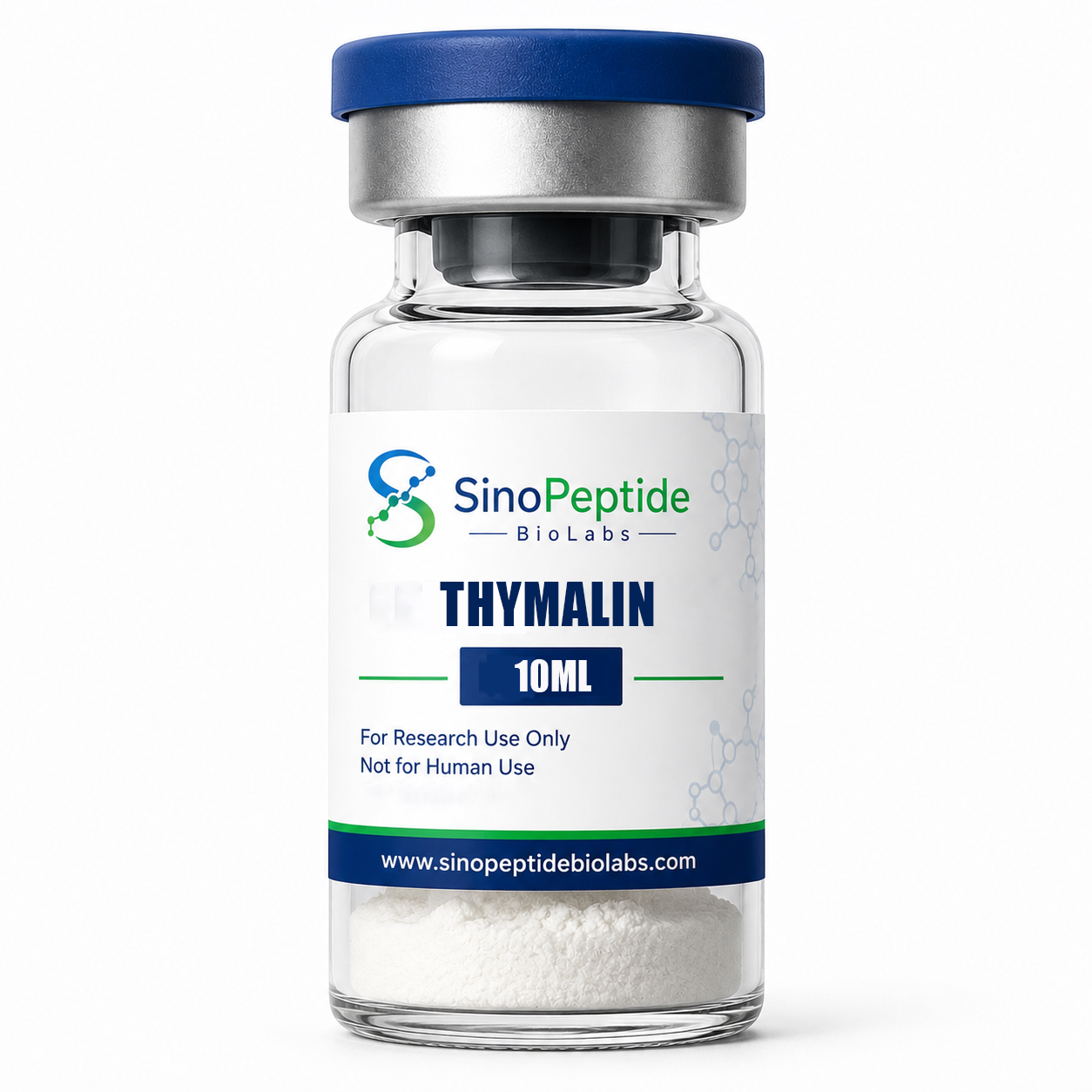
Thymalin 10ml
$70.00
10 Vials/ Kits
Thymalin 10ml: Complete Research and Product Guide
Thymalin 10ml is a product name associated with Thymalin, a peptide-based bioregulatory preparation historically studied in relation to the thymus, immune-system signaling, and age-related biological processes. Interest in Thymalin has grown within peptide research because of its proposed relationship with thymic biology and cellular regulation.
However, it is important to distinguish research interest from established clinical evidence. Thymalin should not be presented as a proven anti-aging treatment, immune-system cure, or universally approved medicine. The exact composition, concentration, formulation, regulatory status, and intended use of a product labeled “Thymalin 10ml” can vary between manufacturers.
The 10ml designation generally refers to the volume of the product container or solution. It does not by itself indicate the amount of peptide, biological activity, or an appropriate human dose.
This guide provides an in-depth overview of Thymalin 10ml, including its background, thymic research, proposed biological mechanisms, laboratory applications, product quality, storage considerations, safety questions, regulatory considerations, and frequently asked questions.
What Is Thymalin 10ml?
Thymalin is associated with research into thymic peptides and their potential biological effects.
The thymus is an important organ of the immune system. It is particularly active during childhood and adolescence and plays a central role in the development and maturation of T lymphocytes.
Thymalin emerged from research into biologically active substances associated with the thymus. It is commonly discussed as a polypeptide or peptide-based bioregulatory preparation rather than as a conventional pharmaceutical drug with the same evidence base as widely established medicines.
When a product is described as Thymalin 10ml, the “10ml” generally indicates the volume of the formulation.
For example:
- Thymalin = product or peptide preparation name
- 10ml = labeled liquid volume
- Concentration = must be confirmed from the product label
- Purity = depends on manufacturer and testing
- Intended use = determined by the product’s labeling and regulatory status
This distinction is important because two products can both be called “Thymalin 10ml” while having different formulations.
Understanding the Thymus
To understand why Thymalin attracts scientific interest, it is useful to understand the thymus.
The thymus is a specialized lymphoid organ located in the upper chest behind the sternum.
Its most recognized biological role is the development and maturation of T cells, a group of lymphocytes involved in adaptive immune responses.
During T-cell development, immature cells undergo processes that help establish appropriate immune recognition and tolerance.
The thymus is especially active earlier in life. With increasing age, the organ undergoes a process known as thymic involution.
Thymic involution involves structural and functional changes in thymic tissue.
Researchers have therefore investigated thymic peptides and other thymus-associated molecules to better understand:
- T-cell development
- Immune regulation
- Cellular signaling
- Age-associated immune changes
- Thymic biology
- Peptide-mediated biological regulation
This scientific background helps explain the interest in Thymalin without assuming that experimental observations automatically translate into proven clinical benefits.
What Is Thymalin Made From?
The terminology surrounding Thymalin can be confusing because different sources may use “Thymalin” to describe preparations derived from or associated with thymic peptides.
Historically, thymic peptide preparations have been investigated as mixtures or preparations containing biologically active peptide components.
The exact composition of a modern commercial product labeled Thymalin 10ml should therefore be verified directly from its manufacturer’s documentation.
Important product information may include:
- Peptide identity
- Peptide concentration
- Total volume
- Purity
- Excipients
- Solvent or carrier
- Manufacturing method
- Batch number
- Storage conditions
- Intended use
A product page should avoid assuming a particular molecular composition unless it is supported by the manufacturer’s technical documentation.
Thymalin 10ml and Peptide Research
Thymalin is part of a broader area of research involving thymic peptides and bioregulatory peptides.
Peptide research examines how relatively small chains of amino acids can influence biological systems.
Depending on their structure, peptides may interact with:
- Receptors
- Enzymes
- Cell membranes
- Transcription pathways
- Signaling proteins
- Immune cells
Thymalin research is particularly interesting because the thymus is closely connected with immune-system development.
Researchers have explored whether thymus-derived peptide preparations may influence aspects of cellular and immune regulation.
However, the available evidence should be interpreted carefully. Research findings do not automatically establish that Thymalin can prevent disease, reverse aging, improve immunity in healthy people, or treat a medical condition.
How Does Thymalin Work?
The proposed mechanism of action of Thymalin remains an area of scientific investigation.
Because Thymalin has been described in the context of thymic peptide regulation, research discussions commonly focus on interactions with biological processes associated with immune function and cellular regulation.
Potential areas of investigation include:
Immune signaling
Researchers have examined thymic peptides in relation to signaling pathways involved in immune-cell activity.
T-cell biology
Because the thymus is central to T-cell maturation, thymic peptide research frequently considers possible effects on T-cell development and function.
Cellular regulation
Peptides can potentially influence cellular communication and regulatory processes.
Age-associated changes
The relationship between thymic involution and aging has contributed to scientific interest in thymic peptide preparations.
These mechanisms should be described as research areas rather than established therapeutic effects.
Thymalin and Immune System Research
One of the primary reasons Thymalin is discussed in scientific literature is its relationship to the immune system.
The thymus plays an important role in T-cell maturation, and thymic peptides have therefore been studied as possible biological regulators.
Research involving thymic peptide preparations has investigated areas such as:
- Immune-cell regulation
- T-cell function
- Cytokine signaling
- Immune response
- Age-related immune changes
- Thymic function
It is important to distinguish between studying an immune pathway and demonstrating a clinically meaningful improvement in human immunity.
A laboratory finding may identify a biological mechanism without establishing that a particular peptide preparation is effective or safe as a treatment.
Thymalin and T-Cell Research
T cells are central components of adaptive immunity.
They perform different functions, including:
- Recognizing specific antigens
- Helping coordinate immune responses
- Destroying certain abnormal or infected cells
- Establishing immunological memory
The thymus provides an environment in which immature T cells undergo selection and maturation.
This makes thymic biology a significant area of immunology research.
Thymalin-related studies have consequently attracted attention from researchers investigating whether thymic peptide preparations interact with pathways involved in T-cell regulation.
Nevertheless, the existence of a biological relationship between thymic peptides and T-cell processes does not establish that a commercially marketed Thymalin product can reliably enhance immune function in humans.
Thymalin and Aging Research
Another major reason for interest in Thymalin is the relationship between the thymus and aging.
The thymus undergoes substantial changes with age. This process is commonly called thymic involution.
Researchers have investigated whether age-related thymic changes are associated with alterations in immune function.
This has led to scientific interest in:
- Thymic regeneration
- T-cell production
- Immune aging
- Cellular senescence
- Immune-system regulation
- Peptide bioregulation
Thymalin is sometimes marketed online using terms such as “anti-aging” or “longevity peptide.”
Such terminology should be approached carefully.
Research into aging biology is not equivalent to proof that a particular peptide extends human lifespan or reverses biological aging.
Is Thymalin an Anti-Aging Treatment?
Thymalin is sometimes described online as an anti-aging peptide.
A more scientifically responsible description is that Thymalin has been investigated in connection with biological processes associated with thymic function, immune regulation, and aging.
Claims that it definitively:
- Reverses aging
- Extends lifespan
- Restores the thymus
- Prevents age-related disease
- Dramatically improves immunity
would require strong clinical evidence and appropriate regulatory authorization.
The strength of evidence should therefore be evaluated before making therapeutic claims.
For SEO purposes, it is better to use phrases such as:
“Thymalin and aging research”
or
“Thymalin peptide research”
rather than making unsupported claims about guaranteed anti-aging effects.
Potential Research Areas for Thymalin
Thymalin may be relevant to several areas of laboratory and biomedical research.
1. Thymic Biology
Researchers can investigate the biological processes associated with the thymus and thymic peptides.
2. Immunology
Thymalin-related research can be incorporated into studies involving immune-cell signaling and regulation.
3. T-Cell Research
Because the thymus is responsible for T-cell maturation, thymic peptides are relevant to experimental T-cell biology.
4. Aging Biology
Thymic involution makes thymic peptides relevant to studies of immune aging.
5. Cellular Signaling
Peptides can be investigated for their effects on cellular signaling pathways.
6. Peptide Bioregulation
Thymalin is associated with the broader concept of peptide-mediated biological regulation.
Thymalin 10ml Product Specifications
A product page for Thymalin 10ml should provide transparent information.
A useful specification table may include:
| Specification | Information to verify |
|---|---|
| Product name | Thymalin |
| Volume | 10ml |
| Peptide concentration | Manufacturer-specific |
| Formulation | Manufacturer-specific |
| Purity | Batch-specific |
| Intended use | Product label |
| Storage | Manufacturer instructions |
| Batch number | Should be traceable |
| Expiration/retest date | Manufacturer-specific |
| Certificate of Analysis | Where applicable |
The exact concentration should never be guessed from the product’s name.
Why Product Purity Matters
Peptide research is sensitive to product quality.
Impurities can interfere with experiments and make it difficult to determine whether an observed effect is associated with the target peptide or another component.
Important quality parameters may include:
Peptide identity
Analytical testing should confirm that the expected peptide or peptide preparation is present.
Purity
Purity testing helps identify unwanted chemical components.
Concentration
The labeled concentration should be supported by appropriate analytical documentation.
Batch consistency
Researchers benefit from consistent manufacturing and traceable batches.
Sterility
For products intended for applications requiring sterility, appropriate sterility testing and documentation are essential.
Certificate of Analysis for Thymalin
A Certificate of Analysis (COA) can be an important quality document.
Depending on the manufacturer and product type, a COA may contain:
- Product name
- Batch number
- Manufacturing date
- Expiration or retest date
- Purity
- Identification testing
- Concentration or assay
- Analytical methods
- Quality-control results
Potential analytical techniques may include chromatography, mass spectrometry, or other validated laboratory methods.
A COA should correspond to the specific batch being supplied rather than being a generic document unrelated to the product.
Thymalin 10ml Storage
Storage requirements depend on the formulation.
Peptide products can be sensitive to:
- Temperature
- Light
- Moisture
- Repeated temperature changes
- Oxidation
- Contamination
The correct storage conditions should therefore come directly from the manufacturer’s documentation.
A responsible product page should specify:
- Recommended temperature
- Light protection requirements
- Whether refrigeration is necessary
- Whether freezing is permitted
- Stability information
- Storage after opening, if applicable
Avoid applying generic storage instructions to an unidentified Thymalin formulation.
Thymalin 10ml and Research-Grade Products
Some Thymalin products available through online peptide suppliers may be described as research grade.
Research-grade labeling generally means that the product is supplied for laboratory investigation rather than approved as a medicine for human treatment.
This distinction is particularly important for websites selling peptide products.
A research-use product should not be marketed with unsupported claims that it:
- Treats disease
- Cures illness
- Reverses aging
- Guarantees immune enhancement
- Replaces prescription medication
Instead, the product description should accurately identify its intended research application and provide relevant quality information.
Thymalin 10ml vs. Other Thymic Peptides
Thymalin is sometimes discussed alongside other thymic peptide preparations.
These products may include different peptide sequences, extracts, formulations, or research compounds.
They should not automatically be treated as equivalent.
A useful comparison should consider:
| Characteristic | Thymalin | Other thymic peptide |
|---|---|---|
| Origin | Thymic peptide research | Depends on compound |
| Composition | Product-specific | Product-specific |
| Biological target | Research-dependent | Research-dependent |
| Clinical status | Depends on jurisdiction/product | Varies |
| Evidence | Depends on study | Depends on compound |
| Formulation | Manufacturer-specific | Manufacturer-specific |
The names of peptide products alone are insufficient to establish equivalent biological activity.
Thymalin Safety Considerations
The safety profile of Thymalin depends on the specific formulation, route, purity, dose, and individual exposure.
Where robust modern clinical safety data are limited, it is inappropriate to describe an experimental peptide as completely safe.
Potential concerns in evaluating peptide products include:
- Allergic reactions
- Unexpected biological activity
- Product contamination
- Incorrect concentration
- Unknown impurities
- Drug interactions
- Immunological effects
- Long-term safety uncertainty
Anyone considering a peptide for personal medical use should discuss it with a qualified healthcare professional rather than relying on online product descriptions.
Thymalin and Regulatory Status
Regulatory status can differ substantially between countries.
A peptide may be:
- Investigational
- Available under a particular national regulatory framework
- Used in limited medical settings
- Sold as a research product
- Unapproved for human therapeutic use
Therefore, statements such as “approved worldwide” or “clinically proven” should not be used without strong regulatory evidence.
For a commercial website, the safest approach is to state the product’s specific regulatory status in the relevant market and avoid generalizing from another country.
How to Choose a Thymalin 10ml Research Product
For laboratory researchers evaluating a Thymalin product, several factors can help establish product quality.
Transparent labeling
The product should clearly state what it contains.
Batch traceability
A batch or lot number allows the product to be linked to quality documentation.
Analytical testing
Independent or manufacturer testing can provide evidence about identity and purity.
Appropriate packaging
Packaging should protect the peptide from environmental conditions that could affect stability.
Clear intended-use statement
Research-only products should clearly state that they are intended for laboratory research where applicable.
Manufacturer transparency
A credible supplier should provide sufficient technical and quality information to allow researchers to evaluate the material.
Common Misconceptions About Thymalin
Myth 1: Thymalin is simply a vitamin for the immune system
No.
Thymalin is a peptide-related biological preparation and should not be categorized as an ordinary vitamin or dietary supplement.
Myth 2: Thymalin automatically restores the thymus
There is not sufficient basis to treat this as an established universal clinical effect.
Thymic biology and regeneration remain complex areas of research.
Myth 3: Thymalin is proven to extend lifespan
Research into aging and thymic function does not establish that Thymalin extends human lifespan.
Myth 4: Every Thymalin 10ml product is identical
No.
Concentration, formulation, purity, manufacturing process, and intended use can vary between suppliers.
Myth 5: Research-grade Thymalin is automatically approved for humans
No.
Research-grade labeling does not establish regulatory approval for human therapeutic use.
Frequently Asked Questions About Thymalin 10ml
What is Thymalin 10ml?
Thymalin 10ml refers to a Thymalin product supplied in a 10 mL presentation. The exact concentration and formulation depend on the manufacturer.
What is Thymalin used for?
Thymalin is primarily discussed in research concerning thymic biology, immune regulation, T-cell biology, cellular signaling, and age-associated biological processes. Its research status should not be confused with established clinical efficacy.
Is Thymalin an anti-aging peptide?
Thymalin is often marketed in connection with aging research, but claims that it definitively reverses aging or extends human lifespan should not be presented as established medical facts.
Does Thymalin affect the immune system?
Thymalin has been studied in the context of thymic and immune biology. However, the extent to which specific commercial formulations produce clinically meaningful immune effects requires appropriate scientific and clinical evidence.
Is Thymalin a hormone?
Thymalin is generally discussed as a thymic peptide or peptide preparation rather than as a conventional endocrine hormone.
Is Thymalin approved for human use?
Regulatory status depends on the specific product and jurisdiction. A research product should not be assumed to have approval for human therapeutic use.
What does 10ml mean in Thymalin 10ml?
The 10ml designation generally refers to the volume of the product container or formulation. It does not specify the peptide concentration.
How should Thymalin 10ml be stored?
Storage depends on the formulation and manufacturer. Always follow the specific product’s storage documentation.
Does Thymalin require refrigeration?
Some peptide formulations may require controlled-temperature storage, but refrigeration requirements cannot be assumed without checking the manufacturer’s instructions.
What should a Thymalin COA contain?
Depending on the product, a Certificate of Analysis may identify the batch, purity, identity, assay or concentration, analytical methods, and relevant quality-control results.
Is Thymalin the same as other thymic peptides?
Not necessarily. Different thymic peptide products can have different compositions, structures, manufacturing processes, and evidence bases.
Thymalin 10ml for Laboratory Research
For researchers, Thymalin 10ml may be of interest as a material for investigating thymic peptide biology and cellular regulation.
Potential experimental areas include:
- Immune-cell research
- T-cell biology
- Thymic signaling
- Cellular communication
- Aging-related immune research
- Peptide interaction studies
- Bioregulatory mechanisms
Researchers should select materials according to the requirements of their experimental design and should document the exact product identity, batch, concentration, and analytical characteristics.
This is particularly important when comparing results between laboratories.
Why Scientific Documentation Matters
Peptide research can be difficult to reproduce when product identity and quality are poorly documented.
For this reason, researchers should record:
- Product name
- Manufacturer
- Batch number
- Purity
- Concentration
- Storage conditions
- Preparation date
- Experimental conditions
Such documentation can improve reproducibility and help identify potential sources of experimental variation.
Building an E-E-A-T-Friendly Thymalin Product Page
For websites targeting the keyword Thymalin 10ml, strong SEO should not rely on keyword repetition alone.
A high-quality page should demonstrate:
Experience
Explain the product clearly and provide relevant technical information.
Expertise
Use accurate terminology relating to thymic peptides, immunology, and peptide research.
Authoritativeness
Reference credible scientific and regulatory sources where appropriate.
Trustworthiness
Clearly identify:
- Product specifications
- Intended use
- Manufacturer
- Batch information
- Quality documentation
- Limitations of available evidence
Avoid exaggerated medical promises.
A transparent product page is more useful to researchers and healthcare readers than a page built around unsupported claims.
Conclusion
Thymalin 10ml is a product associated with research into thymic peptides, immune regulation, T-cell biology, cellular signaling, and age-related changes in thymic function.
The thymus has an important role in immune-system development, particularly through T-cell maturation. This biological role has contributed to scientific interest in thymic peptide preparations such as Thymalin.
At the same time, it is important to maintain a clear distinction between experimental research and established medical treatment. Claims about anti-aging, immune enhancement, thymus regeneration, disease prevention, or lifespan extension should not be presented as guaranteed or universally established effects.
For researchers and buyers, the most important product considerations include exact composition, concentration, purity, batch traceability, storage requirements, manufacturer documentation, intended use, and applicable regulatory status.
The term “10ml” describes the product volume; it does not establish the concentration or biological activity of the peptide.
A responsible Thymalin 10ml product page should therefore combine accurate scientific information with transparent specifications and clear research-use or regulatory statements. This approach provides useful information to readers while avoiding unsupported therapeutic claims.
Research and medical disclaimer: This article is for educational and informational purposes. It does not establish that Thymalin is effective or safe for treating, preventing, or reversing any disease or condition, and it does not provide human dosing, administration, or treatment instructions. Products labeled for research use should not be represented as approved medicines for human use.
Thymalin 10ml Thymalin 10ml Thymalin 10ml Thymalin 10ml Thymalin 10ml Thymalin 10ml Thymalin 10ml Thymalin 10ml Thymalin 10ml Thymalin 10ml Thymalin 10ml Thymalin 10ml Thymalin 10ml Thymalin 10ml Thymalin 10ml Thymalin 10ml Thymalin 10ml Thymalin 10ml Thymalin 10ml Thymalin 10ml Thymalin 10ml Thymalin 10ml Thymalin 10ml Thymalin 10ml Thymalin 10ml Thymalin 10ml Thymalin 10ml Thymalin 10ml Thymalin 10ml Thymalin 10ml
Be the first to review “Thymalin 10ml”
Related products
Pure Peptides
Pure Peptides
Pure Peptides
Pure Peptides
Pure Peptides
Pure Peptides
Pure Peptides
Pure Peptides
Reviews
There are no reviews yet.